Retrotechtacular: Mr. Wizard Jams With IBM

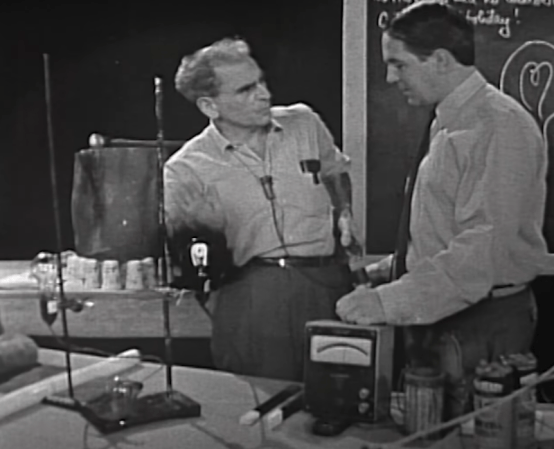
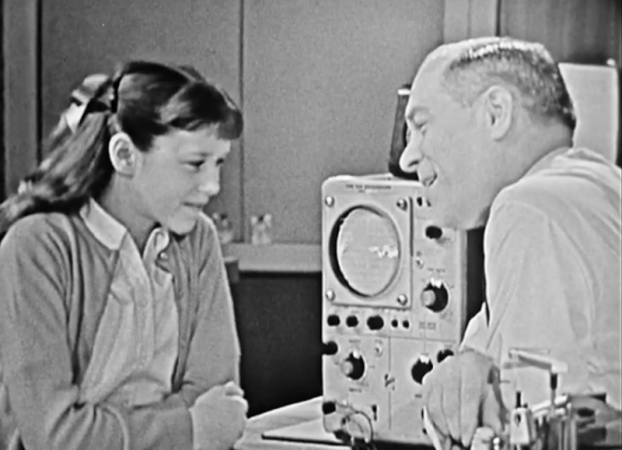
You may not remember [Mr. Wizard], but he was a staple of nerd kids over a few decades, teaching science to kids via the magic of television. The Computer History Archives Project has a partially restored film of [Mr. Wizard] showing off sounds and noise on a state-of-the-art (for 1963) Tektronix 504 oscilloscope. He talks about noise and also shows the famous IBM mainframe rendition of the song “Daisy Bell.” You can see the video along with some extras below.

You might recall that the movie “2001: A Space Odyssey” paid homage to the IBM computer’s singing debut by having HAL 9000 sing the same song as it is being deactivated. The idea that HAL was IBM “minus one” has been repeatedly denied, but we still remain convinced.

Continue reading “Retrotechtacular: Mr. Wizard Jams With IBM”

Retrotechtacular: RCA Loses Fight To IBM

If you follow electronics history, few names were as ubiquitous as RCA, the Radio Corporation of America. Yet in modern times, the company is virtually forgotten for making large computers. [Computer History Archive Project] has a rare film from the 1970s (embedded below) explaining how RCA planned to become the number two supplier of business computers, presumably behind behemoth IBM. They had produced other large computers in the 1950s and 1960s, like the BIZMAC, the RCA 510, and the Spectra. But these new machines were their bid to eat away at IBM’s dominance in the field.

RCA had innovative ideas and arguably one of the first demand paging, virtual memory operating systems for mainframes. You can hope they were better at designing computers than they were at making commercials.

Continue reading “Retrotechtacular: RCA Loses Fight To IBM”

Retrotechtacular: Learning The Slide Rule The New Old Fashioned Way

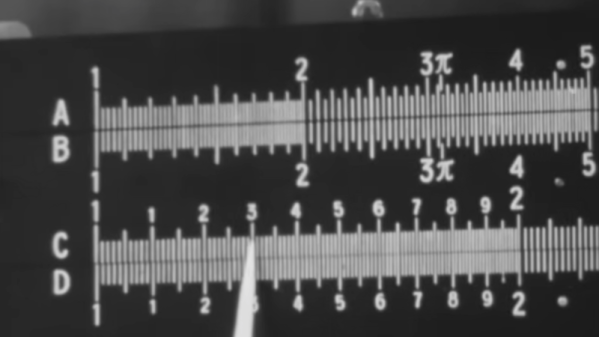
Learning something on YouTube seems kind of modern. But if you are watching a 1957 instructional film about slide rules, it also seems old-fashioned. But Encyclopædia Britannica has a complete 30-minute training film, which, what it lacks in glitz, it makes up for in mathematical rigor.

We appreciated that it started out talking about numbers and significant figures instead of jumping right into the slide rule. One thing about the slide rule is that you have to sort of understand roughly what the answer is. So, on a rule, 2×3, 20×30, 20×3, and 0.2×300 are all the same operation.

You don’t actually get to the slide rule part for about seven minutes, but it is a good idea to watch the introductory part. The lecturer, [Dr. Havery E. White] shows a fifty-cent plastic rule and some larger ones, including a classroom demonstration model. We were a bit surprised that the prestigious Britannica wouldn’t have a bit better production values, but it is clear. Perhaps we are just spoiled by modern productions.

We love our slide rules. Maybe we are ready for the collapse of civilization and the need for advanced math with no computers. If you prefer reading something more modern, try this post. Our favorites, though, are the cylindrical ones that work the same, but have more digits.

Continue reading “Retrotechtacular: Learning The Slide Rule The New Old Fashioned Way”

How Cross-Channel Plumbing Fuelled The Allied March On Berlin

During World War II, as the Allies planned the invasion of Normandy, there was one major hurdle to overcome—logistics. In particular, planners needed to guarantee a solid supply of fuel to keep the mechanized army functional. Tanks, trucks, jeeps, and aircraft all drink petroleum at a prodigious rate. The challenge, then, was to figure out how to get fuel over to France in as great a quantity as possible.

War planners took a diverse approach. A bulk supply of fuel in jerry cans was produced to supply the initial invasion effort, while plans were made to capture port facilities that could handle deliveries from ocean-going tankers. Both had their limitations, so a third method was sought to back them up. Thus was born Operation Pluto—an innovative plan to simply lay fuel pipelines right across the English channel.

Continue reading “How Cross-Channel Plumbing Fuelled The Allied March On Berlin”

Jerry Seinfeld dressed up as a honey bee promoting his film Bee Movie.

Retrotechtacular: The $550K Video Conferencing System Used To Make Bee Movie

The modern office environment has shifted in recent years. Employees are routinely asked to collaborate with co-workers half way around the globe and be camera ready, or whatever passes for webcam ready, in order to telecommute when they are out of office. Every office laptop, tablet, or cell phone these days comes equipped with some sort of camera sensor capable of recording at HD resolution. Twenty years ago, that was not the case. Though tech conglomerates like HP had a different idea of teleconferencing to sell back in 2005 dubbed the Halo Collaboration Studio.

The Halo Studio was a collaboration between HP and Dreamworks that was used during the production of Bee Movie. Studio heads at Dreamworks thought it necessary to install the HP teleconferencing solution inside the New York office of Jerry Seinfeld, the writer of the film, as to allow him to avoid long trips to Dreamworks production offices in Los Angeles. According to the HP Halo Collaboration Studio brochure, “Halo actually pays for itself, not only by reducing travel costs, but also by encouraging higher productivity and stronger employee loyalty.” Certainly Dreamworks believed in that sales pitch for Bee Movie, because the upfront asking price left a bit of a sting.

Less of a singular machine, more of an entire dedicated room, the Halo Studio had a $550,000 asking price. It utilized three 1280×960 resolution plasma screens each fitted with a 720p broadcast camera and even included an “executive” table for six. The room lighting solution was also part of the package as the intent was to have all participants appear true to life size on the monitors. The system ran on a dedicated T3 fiber optic connection rated at 45 Mbps that connected to the proprietary Halo Video Exchange Network that gave customers access to 24×7 tech support for the small sum of $30,000 a month.

For more Retrotechtacular stories, check out Dan’s post on the Surveyor 1 documentary. It’s out of this world.

Continue reading “Retrotechtacular: The $550K Video Conferencing System Used To Make Bee Movie

Retrotechtacular: Computers In Schools? 1979 Says Yes

The BBC wanted to show everyone how a computer might be used in schools. A program aired in 1979 asks, “Will Computers Revolutionise Education?” There’s vintage hardware and an appearance of PILOT, made for computer instructions.

Using PILOT looks suspiciously like working with a modern chatbot without as much AI noise. The French teacher in the video likes that schoolboys were practicing their French verb conjugation on the computer instead of playing football.

If you want a better look at hardware, around the five-minute mark, you see schoolkids making printed circuit boards, and some truly vintage oscilloscope close-ups. There are plenty of tiny monitors and large, noisy printing terminals.

You have to wonder where the eight-year-olds who learned about computers in the video are today, and what kind of computer they have. They learned binary and the Towers of Hanoi. Their teacher said the kids now knew more about computers than their parents did.

As a future prediction, [James Bellini] did pretty well. Like many forecasters, he almost didn’t go far enough, as we look back almost 50 years. Sure, Prestel didn’t work out as well as they thought, dying in 1994. But he shouldn’t feel bad. Predicting the future is tough. Unless, of course,  you are [Arthur C. Clarke].

Continue reading “Retrotechtacular: Computers In Schools? 1979 Says Yes”

Retrotechtacular: The Noisy Home Computer From 1967

[Rex Malik] didn’t need an alarm clock. That’s because he had one of two “home computer terminals” next to his bed and, as you can see in the video below, it made quite a racket. The terminal looks like an ASR33 with some modifications. In 1967, it was quite a novelty and, of course, it didn’t have any real processing power. It connected to an “invisible brain” ten miles away.

What do you do with a computer in 1967? Well, it looks like you could trade stocks. It also apparently managed his shopping list and calendar. His young son also learned some letters and numbers. We’d love to hear from the young [Mr. Malik] today to find out what kind of computer he’s using now.

Continue reading “Retrotechtacular: The Noisy Home Computer From 1967”