
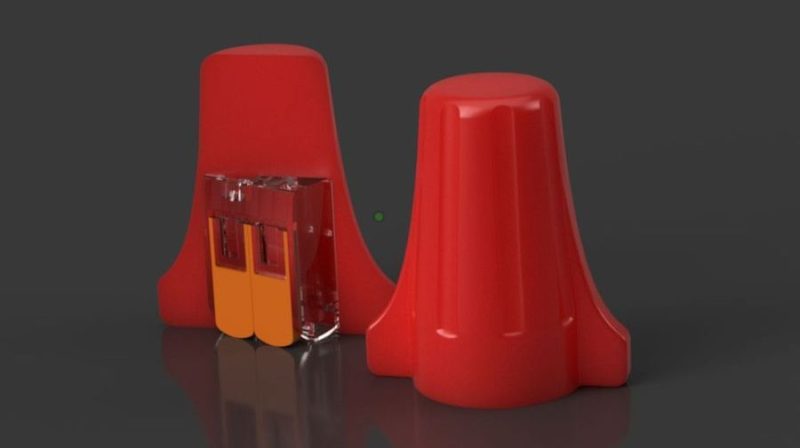
Wago connectors are somewhat controversial in the electrical world—beloved by some, decried by others. The company knows it has a dedicated user base, though, and has established the Wago Creators site for that very community.
The idea behind the site is simple—it’s a place to discover and share unique little tools and accessories for use with Wago’s line of electrical connectors. Most are 3D printed accessories that make working with Wago connectors easier. There are some fun and innovative ideas up there, like an ESP8266 development kit that has a Wago connector for all the important pins, as well as a tool for easily opening the lever locks. Perhaps most amusing, though, is the project entitled “Hide Your Wago From Americans”—which consists of a 3D-printed wire nut lookalike designed to slide over the connectors to keep them out of view. There’s also a cheerful attempt at Wago art, that doesn’t really look like anything recognizable at all. Oh well, they can’t all be winners.
It’s great to see Wago so openly encouraging creativity among those that use its products. The sharing of ideas has been a big part of the 3D printing movement, and Wago isn’t the first company to jump on the bandwagon in this regard. If you’ve got some neat Wago hacks of your own, you can always let us know on the tipsline!
[Thanks to Niklas for the tip!]












How about a Wago with a built in LED?
How about Wago-Lego?
With spring-loaded pins to be assembled into the shape of a pufferfish, so it can be Fugu-Pogo-Wago-Lego?
Seriously though, I did get a chuckle out of the “Hide your Wago from Americans” project linked above.
When I was a small child and not trusted with a soldering iron, I’d join wires together for my 12V model railroad stuff by simply twisting them – I didn’t even know about the Western Union Splice. It blew my mind when I moved to the States and discovered that domestic 120V wiring uses exactly the same mechanism. Praise be to Wagos – I’m in the “fan” camp.
Just another commercial on HaD
What happens when some yank yanks those when giving a check on tightness? They look fake to me.
I think it’s mostly a joke.
What happens? The nut comes off and the yank is still safe, but curses the damn commies for tricking him into false, but actually true, sense of safety. That’s what happens.
they hold the wire in.
These are honestly great and lightyears ahead of the annoying wirenuts that make your wires annoying pigtails.
cant wait till someone does a wago connector you can screw onto a couple leads. it will happen, mark my words.
Love the Wagonut!
I recently rewired my house with the assistance of a friend (a registered electrician) after I discovered it had suffered an attack of the cowboys and I think the only thing which could have triggered him more than some of the jaw dropping bodges we discovered would have been a Wagonut.
I might print some as a Christmas present for him.
You evil EVIL man, you! ;-)
Thanks for the chuckle.
I’m not a licensed electrician but I have seen my fare share of horrible bodges (have you ever pressed two “push” button switches on the same pulse triggered light circuit, only for them to fuse together (they were on different phases)).
A friend of mine bought a house in the UK in the late 90s. He moved in late one winter’s day, when it was already dark. He walked into the house and flicked the nearest lightswitch… and there was a bang, a flash, and a fuse popped.
The previous owners had taken the ceiling light pendant fixture with them; not wanting to leave “unsafe” bare wires dangling from the ceiling they had…. twisted them together 😂
As fun as it is, the plastics used in/with electric connectors must in my opionion (and probably according to code, idk) be self extinguishing which i doubt all 3d printed plastic is. You can buy UL listed filament afaik, but the dangers of stuffing wagos into flamable meltable pieces of plastic should not be ignored.
Am I the only one who thinks this is a bad idea?
Sure it’s fun, but that doesn’t make it a good idea. Using these yourself on your own installation looks like an innocent little joke. But eventually somebody else needs to work on that same installation and discovers this and then start to wonder what kind of joker installed all this, causing the new person to distrust everything else in the installation, after all… if these parts are fake, what silly and possibly dangerous tricks did this previous “electrician” pull. Can you even trust the colors of the wires? To be honest, I do not like working on an installations that generate doubt. Don’t mess around, period.
“Can you even trust the colors of the wires?” No. You never can. Has nothing to do with who did the installation.
Putting anything 3D printed, especially PLA, into a junction box would be bad from fire safety perspective too.
Wagos are absolutely not controversial for anyone who should be doing electrical work, and 3D printed ‘may-or-may-not’ burn plastics should be nowhere near electrical installations
“Controversial” seems to be due to confusion between some old, basically backstab-style connectors Wago made (and which some consider unreliable/dangerous/out of date/easily misapplied), and modern 221 series connectors everyone who knows them likes.
It’s the exact same principle, the difference is in how easy it is to disconnect/re-use. And price, consequently. Just don’t try pushing flexi into 2773.
Absolutely nothing wrong with Push-Wire where Push-Wire is called for. User’s mental capacity is not the product’s fault.
+1 …. Tried many connector types and now religiously use WAGO whenever possible. The quality and user friendliness is unbeatable. Want to use screwed connectors? Fine, but just remember vibration will quite happily undo them over time.
Yeah, another +1, Wagos are great (the genuine ones at least).
I believe there’s a bunch of other ‘fast’ connector types now which have gained the required safety approvals in the UK and EU but I think I’ll be sticking with Wago for the foreseeable future.
Once you go Wago you never go back-o.
I’ll show myself out. :)
I was a electrical inspector years ago when I saw my 1st install with Wago’s.
Was not sure they were even “legal”?!?! But— Yep, they are, and FAR BETTER
than wire nuts.
I only use Wagos’ now.
Only thing is price, but it’s worth it. Just make sure to get the genuine stuff.
Too late. Home Despot, US retailer of domestic bodges and bodge accessories, carries them in store now.
In my opinion Wago Connector vs. Wire Nut is the voltage difference Europe vs USA. Actually not the voltage, but current. 110V requires more current vs 220V and Wire Nut is more reliable for high current.
I used both Wago in Europe and Wire Nuts in USA. Wago can be used in tight space and European buildings have have much less space for wire connectors. Also the building codes visually not existing in most European countries vs to USA.
Wago is high-end for quick wiring.
That sounds like BS. Wago 221 are rated for 32A (https://www.wago.com/global/installation-terminal-blocks-and-connectors/splicing-connector-with-levers/p/221-413#details)
BS. There are some pretty fat WAGOs around that very well handle high currents.
Quick wiring is also cheaper wiring: the electrician hours often cost more than the material itself.
English is my 2nd language and I do not understand “visually not existing” in this context. Help please.
“Virtually not existing”? Like pretty much not existing? If so I beg to differ.
Pretty sure most countries in the EU have pretty strict building codes (especially regarding electric circuits, wiring, protection and so on).
“Virtually” Sorry typo.
Chris Boden changed my opinion on wago, my latest home electrical work has been using it exclusively, I’m never going back to wire nuts.
Wanna see something cool?!?!
Love me some Chris.
He’s actually based in my home town. One of these days when I go home to visit I’d love to see if I can touch base with him.
This is my design for a wire twister tool: https://wago-creators.com/design/185
I use it whenever I am building machines like 3D printers and sand tables.
I’ve always been very confused about wire nuts. They aren’t common in my country (NL) and considered dangerous by many. When I bought my current house, I saw my first wire nuts in real life. That was 8 years ago. The electrics in my house were done by someone who possible vaguely understood what electricity was and that person loved wire nuts. I really hope that this was the persons first electrical job. I’m still confused why the house never burned down and why no one has died, as far as I know. I ended up replacing all the wiring, the distribution board etc, but started with those dangerous wire nuts.
Also nothing wrong with wire nuts if used correctly. They used to be up to code in most of Europe up to the 80s-90s or thereabouts.
The problem is you mostly don’t know if they have been used correctly – unlike Wagos (or anything of the sort – did you know Ideal also makes some?), which if you do what the manual says is nigh impossible to use improperly, also some of them are transparent for your visual inspection pleasure.
I like video on FB where the contractor sees a furnace with mess of wires and wire nuts and yells at the older lady home owner in the background…..
Contractor “who did your wiring ?”
Older Lady “my nephew”
Contractor “when his house burn down ?”
Older Lady “last month…..Hey ! How did you know ?”
🤣
Wago push-in terminals, at first I was sceptical because North American electrical religion is using screw-in terminal blocks, wire nuts etc.
Developing a commercial product to 40A using Wago’s, thermal imaging camera showed they are excellent! I thought they would heat up due to poor resistance but no, they connect very well.
They are also excellent connectors in high vibration such as for trains, because the spring gives constant tension instead of a screw loosening up which does happen.
The Baltimore bridge disaster caused by not enough insertion depth on the Wago DIN rail terminal blocks due to improper wire labels. Not the Wago fault. The panel assembler bungled it.
“North American electrical religion”
This is about the most beautiful way of describing the situation.
That spring bending tool is quite clever too. Atleast first time for me to see one.
How about Apple Doing the same and have fans make novel things like an iphone attached to every pin of an ESP32..
I mean if the purpose is to make things extra expensive while making specific companies wealthier.
I’m American and prefer wagos. I know several others too. It isnt quite as ubiquitous as many think, just lots of dinosaur electricians here because all the young people are trying to be influencers or streamers instead of tradesmen/women.