
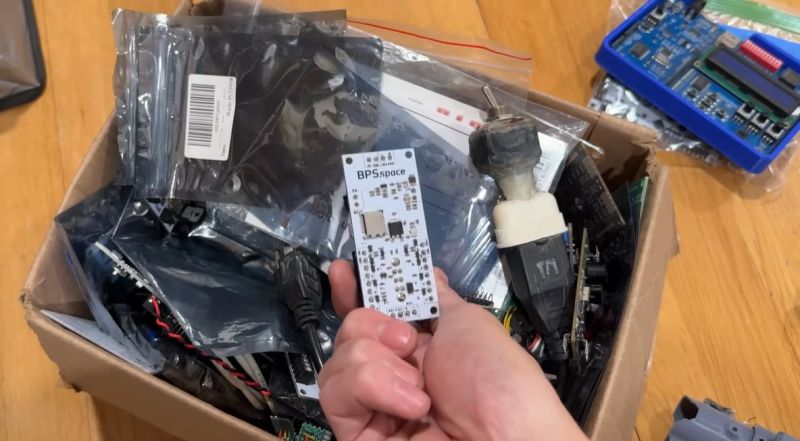
We have probably all been there: digging through boxes full of old boards for projects and related parts. Often it’s not because we’re interested in the contents of said box, but because we found ourselves wondering why in the name of project management we have so many boxes of various descriptions kicking about. This is the topic of [Joe Barnard]’s recent video on his BPS.shorts YouTube channel, as he goes through box after box of stuff.
For some of the ‘trash’ the answer is pretty simple; such as the old rocket that’s not too complex and can have its electronics removed and the basic tube tossed, which at least will reduce the volume of ‘stuff’. Then there are the boxes with old projects, each of which are tangible reminders of milestones, setbacks, friendships, and so on. Sentimental stuff, basically.
Some rules exist for safety that make at least one part obvious, and that is that every single Li-ion battery gets removed when it’s not in use, with said battery stored in its own fire-resistant box. That then still leaves box after box full of parts and components that were ordered for projects once, but not fully used up. Do you keep all of it, just in case it will be needed again Some Day™? The same issue with boxes full of expensive cut-off cable, rare and less rare connectors, etc.
One escape clause is of course that you can always sell things rather than just tossing it, assuming it’s valuable enough. In the case of [Joe] many have watched his videos and would love to own a piece of said history, but this is not an option open to most. Leaving the question of whether gritting one’s teeth and simply tossing the ‘value-less’ sentimental stuff and cheap components is the way to go.
Although there is always the option of renting storage somewhere, this feels like a cheat, and will likely only result in the volume of ‘stuff’ expanding to fill the void. Ultimately [Joe] is basically begging his viewers to help him to solve this conundrum, even as many of them and our own captive audience are likely struggling with a similar problem. Where is the path to enlightenment here?












What about taking all your boxes to a local Makerspace and donating them? Surely at least SOME of the stuff would be useful and needed as a free part to other enterprising Hackaday-type DIY’ers.
Depends on the makerspace. Definitely ask before dropping trash, er, gifts, off there.
Previously I ran a makerspace. We were very short on space and had to deal with boxes of “gifts” generously donated… We ended up fire-saling everything (come and get it for free) and trashing the stuff that didn’t get picked up in the fire sale.
There are people who treat hackerspaces as a dumping grounds for e-waste.
And then there are hacker space members/admins who hoard boxes full of old ribbon cables, obsolete development/training boards demanding software that doesn’t run on anything modern and isn’t available anyhow, and broken equipment or tools like a crusted and knackered old toaster oven that nobody uses for anything – just because.
Meanwhile, the actually useful and expensive to replace tools, like the big old metal lathe that takes up floor space, is carted off to the dump first because it’s in the middle of the room and none of the software/electrical nerds who represent the majority of the group know how to use it. Those tools are replaced with 3D printers and cheap laser cutters instead.
Dude, I’ve had somebody bring their chemical waste from home and filled up the makespace’s hazardous waste bin (“because it was there”). Our hazardous waste bin is for solder relate debris, costs a fortunate to empty, and usually only needs emptying once in a while (once a year maybe?). On top of that some of the chemicals where not approved for our hazardous waste plan, but because they are mixed with other hazardous waste they cannot be separated (without breaking regulations). Mean while other folks want training or equipment fixed, but I am busy cleaning up other peoples dump ideas and trying to keep EHS people happy so we can stay open….
The biggest danger to a makerspace is that core group of users (and admins…) that think they own it and the makerspace is there to serve them as their resource… A true makerspace space should serve its community. without gate keeping that community, or only serving people that think they are ‘experts’…
I don’t know what makerspace you hang out at, but the one I get to occasionally is about the inverse.
When “donations” come in, they get parsed pretty quickly. Items useful to the space get a quick exam or test, then get stored in their reasonably organized storage. Anything left over is open-season: anyone can grab it, but they are responsible for storage.
Anything unuseable e-waste gets cannibalized if possible, and decomposed into metal, hardware, pc boards etc. and recycled or disposed of responsibly.
The space has a massive working CNC machine, one smaller one that I helped work on and it’s up and running, a few lathes. A few members have small CNC personal projects they bring in.
The space has a pretty big laser-cutter that they fixed and it gets used. They recently had an even bigger one donated, but after a couple of weeks they determined that it was unfixable. it’s now being scrapped and broken-up for recycling.
And yes there’s a bench of working 3-D printers, craft desks, electronics bench…
A thing may be worth money, but still be difficult to sell, so is it valuable or not?
Reminds me of stashing massive copper CPU coolers thinking they’ll at least be worth something because they cost something and new ones cost the same, only to realize that they won’t fit any newer sockets and the price of scrap copper is 10% of what I paid for the thing.
It’s never worth the sell if finding a buyer, wrapping it up and bringing it to USPS takes your precious unpaid lifetime. If I have the choice to clean my house in that time, tend my garden, or be there for my family, I’d rather dump it at the local recycling yard.
Also I’m a fair bit salty about external people being often so very ungrateful about (valuable) gifts.
Pearls before the swine, so they say.
And I write this mini-rant after having recently dumped (at a specialised yard) about 400 spare components and various PCB modules. I’d rather think not about the money, but our local city funded electronics and computer science lab is a scam that just siphons public funds. The guy in there is a complete twat and when the parents are not around he lets the kids sit in front of Minecraft there.
They have fun, it’s good for them. But not a single soul in there will learn anything about tech.
And for the non-UK anglos here, in our parts the word I used is for:
“referring to an obnoxious or stupid person regardless of gender”
Saw the perfboard in the screengrab with all the wires on it…said to myself “Hey…how did they get my… Wait, That’s not mine…”
It is either reason or sentimental value. Reason not always wins.
Toss em all out. Your learning was valuable ten times over the material cost of anything you could had done. You should only keep something if you can immediately see use for it or it has components or materials that you can use in a future project. No tolerance for clutter is the only defence you have against hoarding tendencies (electronics hobbyists are notoriously prone to hoarding)
Life is too short to getting sentimental over material objects. Especially if you made it, it just means you could make it again.
I learned embedded programming on a DIP-28 MCU. I socketed-unsocketed it so many times over the years, the many pins were broken off and the metal was getting awfully thin on the pins that remained. Even after it was unusable, I swore I would keep it safe forever as a memento.
Now? I have no idea where it is. Probably threw it away in the trash years ago. But in the same time, I have learned and made many things that I can be more proud of. I have designed consumer devices that are working in tens of thousands of people’s houses right now…and I don’t own one unit myself.
It’s your immaterial code you can put in a Github/Gitlab, the journey and friends you made along.
Good luck and god speed!
I recently had this problem solved for me when my garage flooded. 3/4 of those old projects, leftover parts and bits that were too expensive to bin got taken to the dump in a soggy corroded mess. I haven’t missed any of it.
1 minute ago I WAS going through numerous boxes of components and past (mostly unfinished) projects.
Having ADHD and Asperger’s means I get distracted extremely easily, kind of like a golden retriever spotting a squirrel, except EVERYTHING is a “squirrel”.
I pulled my phone out of my pocket to use it as a flashlight, saw some random notification, randomly decided to check hackaday like I would usually do a couple of times each day and THIS POST was at the top.
I’ve wasted enough time writing this comment, I’ll get back to looking through my boxes and crates now..
i only save old projects for salvage purposes. i dont have a sentimental bone in my body. but if i need a protoboard or a pro micro, i can usually find one in the junk box. with projects, the chase is better than the catch. noting sends a project to the junk box faster than making the mistake of finishing it.
One thing I do know is if you are contemplating renting storage… you do have to much stuff. Time to downsize. My wife and I agree on that. No renting. Make do in the space we have. That usually means deep six or donate. Let ’em go. Easier as you get older… I think…
My problem seems to be I never have the ‘right’ part on hand for new projects. For example, recently I needed a right angle usb plug. oh, I had 180s, straight, left, … but no right in the flavor I wanted… errr, needed. So buy a few … one for this job, and ‘possibly’ for next project… :rolleyes: . Or, just the other day I noticed I had no stainless 2.5mm screws. Plenty of black ones… Needed four stainless bolts for a project. So today, I ordered up a whole ‘set’ of stainless 2.5mm bolts (different lengths), nuts, washers….
One caveat to the storage point is safety (and maintaining domestic bliss.) We had to move and the only place we could get was small, but there was a discount on the storage unit right alongside the parking lot. I do my own auto maintenance and I use the small storage unit for the bulky tools and greasy/stinky stuff which I use on the regular. There is a purpose, sometimes, and only so much you can downsize before you are throwing out items that provide a higher return than their outsourced alternative (tool or service rental, or tool Library/sharing.)
I DO have some tools passed down from my late father for which I have a sentimental attachment (including a good old stick welder, which I hope to use again once we can get a larger place again with a 240V outlet proper.) A large rolling chest of Snap On tools is always nearest the door of the unit, so it is like having a tiny garage for now.
I’m sure had already did articles on this matter, and their main takeaway that isn’t mentioned, is that if you can’t remember to use it when you need it, then it should have been thrown away: This guy needs to list what box contains what because that’s the only way he’ll reuse them again (and then its easier to store without taking much space)
I would add that because its about optimizing space usage, that they should account not for the value of an item, but for their value (actual and sentimental) relative to their cargo/envelope volume. (and also how easy it would be to recreate)
Of course i go through this fairly often. I’m a big fan of stripping things down to take less space, but keeping any parts i might imagine using later. I definitely keep unused supplies. I even keep remainders from cutting down lumber. And i have a big box of roughly one representative of each kind of plastic container that fills my weekly recycle bin. It’s amazing how many projects i can do without going out to the store for anything, and a lot of things really do wind up getting used (though few things are “used up”). At least once a month i dig through the scrap wood pile and the plastic container pile. But i do try to be merciless about throwing away things that are “maybe broken.”
Since i’ve had enough money to buy whatever tech i desire (mostly), i’ve really tried to tackle this on ingress instead of egress though. I try to avoid buying things if i don’t have a specific project in mind. And if i failed to use the version 1.0 that i bought, i try not to buy the version 2.0 even if it does have twice the features and half the price. And if i don’t want to use the project, then i don’t build it. That’s actually a big part of why i hate the youtube clickbait and portable raspi projects that are always on display here…i’m very sensitive to people making things they don’t actually want to use, because that’s a fate i work to avoid.
And the other part of ingress filtering is if i need an inexpensive component, of course i buy two of them in case i burn out the first one in prototyping. But i try to buy maybe twice what i need, not 10x what i need, even if it’s cheap. For example, i still have single digit numbers of PIC12 and PIC16 sitting around — which is awesome — but i’m glad i don’t have dozens of them!
The biggest low-value pile in my basement is devices i bought and used and used up, like laptops and cellphones, and sometimes the spare parts / worn parts from them. A lot of times they still “work”, but aren’t really useful for anything anymore. Oh, and i have a pretty nice pile of roughly y2k-era PC hardware that i don’t really use but can’t imagine not having. And i accidentally bought a really nice PC power supply when i erroneously thought mine had died, but in fact it has lasted like 8 years since that crisis. I have a hard time throwing that sort of stuff out. And i’m kind of bummed about my soldering iron situation, because i kind of want one of the newer irons with a super light tip that heats up in seconds, but i barely use the iron i have and in fact i’ve never had trouble with it even though its tip is corroded af.
I think the answer has to be an amnesty rule. If you haven’t done it in 5 years, you’re not going to and/or it’s no longer worth doing.
Ah, who was that, one of those TV cleaning shows, “three boxes, 1 week, 1 month, 1 year”. First box has what you will be using this week, second box – this month, third box – this year. The rest gets donated or thrown away depending on the condition.
Realistically (IMHE=Experience) it is 3 x 3 x 3, 3 weeks, 3 months, 3 years. I am lazy like that.
I’m not alone LOL. Now, without exception, the day after I throw out something I’ve had sitting around for years for some eventual project…… I realize I need it!!
I have been doing a lot of this myself lately; close friend and fellow Ham Pat WA6MHZ passed on a month ago and I am going the dozens of projects Pat built. This includes his famous (over on QRZ.com) Cat Ranch and Rat Ranch Electronics brand of projects…
By the way for a few of these projects Pat wrote manuals.
Those of us who have friends to share our hobby with in our aria will sooner or later will be doing what I am doing now….
Going thourgh the boxes of parts projects and radio gear thinking of all the memories Pat and I had together…
73 OM…..
Anything that needs de-soldering or similar worthless tedious tasks is not worth keeping around. Only keep raw materials in a state you can use immediately instead of buying them again.
The rest goes directly to the recycling center.
In the world of RF there are many things worth unsoldering………
Sometimes that PIN diode you need is coming off a board that came out of an old UHF radio from the 90’s…
And if you have a thing for HP gear out of the eighties and nineties you need a stock of boards on hand to rob parts from…..
and a bag of tantalum capacitors.
Otherwise I tend to agree….
Oh, if you re-animate old stuff, sure, you need to keep those specialties around.
I was sticking with the theme of personal projects, stuff that one creates.
I love my old analogue….
I come from the Bob Widlar school of taught and design.
Something as sensitive as diodes I would especially not subject to countless solder and desolder cycles. Foolish I bought NOS Germanium diodes a couple of years ago for a project. I vastly overestimated their need, especially with modern diodes performing better and new circuits doing the exact same thing as old crystal receivers.
It was definitely purely nostalgia and sentimental values hijacking my decision making.
Generally speaking you are right, modern diodes are nearly ideal.
Just wondering out loud…..
I always leave those fragile parts in circuit until needed.
Very small collection of boards that would fit in 10 x 10 x 10x cm box.
Everything else is up for grabs….
Oh….
On the subject of diodes…
I have three that are older than I..
All three are antique cat-wisker type galena diodes.
What if you have way too many liion batteries? Putting them all in one fireproof box isn’t particularly safe, and you can’t afford the space for lots of fireproof boxes, right?
Drive nails through them in ‘controlled conditions’.
Fire is cool.