
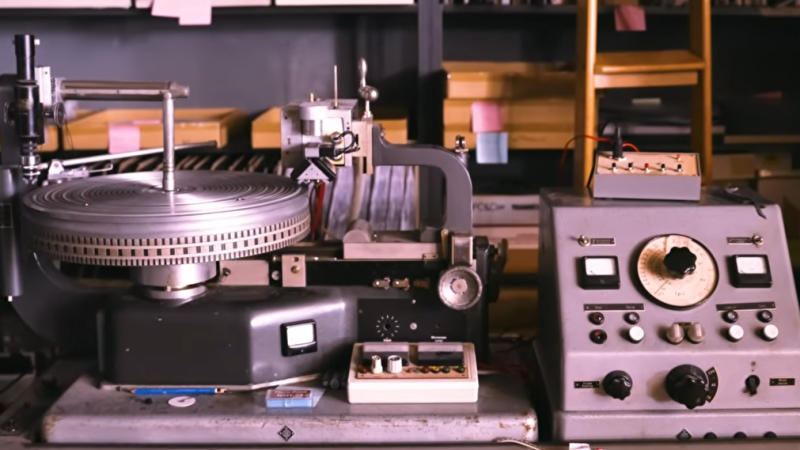
Most of us are familiar with vinyl LPs, and even with the way in which they are made by stamping a hot puck of polyvinyl chloride (PVC) into a record. But [Technostalgism] takes us all the way back to the beginning, giving us a first-hand look at how a lacquer master is cut by a specialized recording lathe.
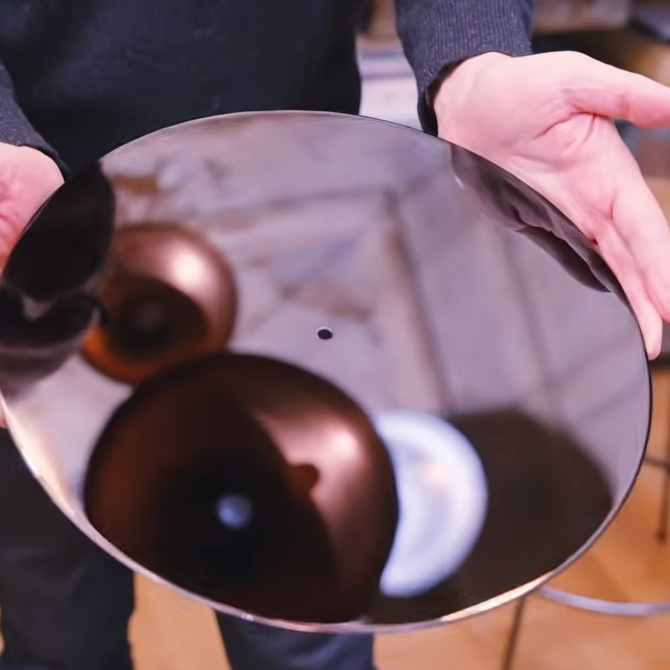
Cutting a lacquer master is the intricate process by which lacquer disks, used as the masters for vinyl records, are created. These glossy black masters — still made by a company in Japan — are precision aluminum discs coated with a special lacquer to create a surface that resembles not-quite-cured nail polish and, reportedly, smells like fresh paint.
The cutting process itself remains largely unchanged over the decades, although the whole supporting setup is a bit more modernized than it would have been some seventy years ago. In the video (embedded below), we get a whole tour of the setup and watch a Neumann AM32B Master Stereo Disk Recording Lathe from 1958 cut the single unbroken groove that makes up the side of a record.
The actual cutting tool is a stylus whose movement combines the left and right channels and is heated to achieve the smoothest cuts possible. The result is something that impresses the heck out of [Technostalgism] with its cleanliness, clarity, and quality. Less obvious is the work that goes into arranging the whole thing. Every detail, every band between tracks, is the result of careful planning.
It’s very clear that not only is special equipment needed to cut a disk, but doing so effectively is a display of serious craftsmanship, experience, and skill. If you’re inclined to agree and are hungry for more details, then be sure to check out this DIY record-cutting lathe.








Ran one of these at CBS London in the early 70’s
The futility of trying to demonstrate audio quality through a youtube video.
And cutting music from YT library…. to lacquer
‘Zero noise’
So much BS makes it onto BSaDay.
Who is picking these?
Yesterday, over 100% efficiency electric motors, today zero noise, tomorrow??
Ok. Let me guess.
Free energy, Quantum teleportation, FTL travel?
Easily hackable Apple products.
Then let us listen to the master tape now ;-)
The How It’s Made on vinyl records is a 2-parter and super rad and worth the watch! Such a wild process and way more complex than I’d imagined.
Just last night I found a document detailing how RCA was able to record video onto a copper master with a 0.3 micron wide, 13 mile long groove (!), use it to make nickel stampers, and finally press CEDs in vinyl. And all of this in the early 1980s.
Hehe…my grandparents had a Recordio system from who knows when. It was housed in a “portable” cabinet. Am and shortwave radio receiver if I remember right, and a record player. It had two tonearms…one of which was extremely heavy for it’s size…as the cutter…and a lighter one for playback. My dad inherited it when my Grandfather passed away. It came with 2 or three different sizes of blanks and a gnarly crystal mike and stand.
It smelled of tubes and phenolics and the past. I wonder whatever happened to it….
Toronto, too, still has LP recording studios. What I am unsure about, though, if they actually cut their own, or send the tracks to Japan to cut it there, that much I never bothered to learn. Maybe both depending on the budget of the project.
Toronto used to be a backroom recording for the NY/LA studios of the past. A lot of US stuff was actually produced in Toronto, remixed, etc, and shipped back to the US for selling. It also had gazillion small-ish (and very good) independent studios with gig musicians that were cheaper than those in the US, so one could always go low budget. Entire industry collapsed because of MP3, though, didn’t completely dry up.
On a separate note, vinyl had its major drawbacks – for example, low frequencies, if I remember right, under ~200Hz, were mono – limitation of the 45 degree placement of the stereo needles, if I remember correctly, the needles following a low base sound simply couldn’t react to the mid- and high-frequencies properly without loosing the traction. Also, hissing was inevitable, and with every spec of dust eagerly waiting for its only chance to cling to the inside of the track and make its existence heard … you get the point.
But I digress. I still own entire box of LPs, and an old Marantz LP player (budget variety, nothing fancy), but somehow I don’t miss the sound. Sorry. Must be something else that wasn’t agreeing with my ears, I never found LPs worthy keeping around (I’ve inherited the box from a relative of mine who passed away, and Marantz was bought as part of the entire early 1980s enchilada, double-cassette deck, etc).
BTW, I always wanted to chase down one of the Diatones (Mitsubishi) Z-30s. Very nice totally 1980s design, upright LP player stereo cassette boombox. Sound quality is probably about as good as any 1980s boombox, but sure looks impressive to have around. One of those days …
There is a machine much like this in the recent Bruce Springsteen biopic where Bruce is unhappy with the way that recording of his album is going and tells the producer “I want you to find a way to get the audio off this cassette tape onto a vinyl record without changing it at all”
‘The Boss’ is a PHB.