
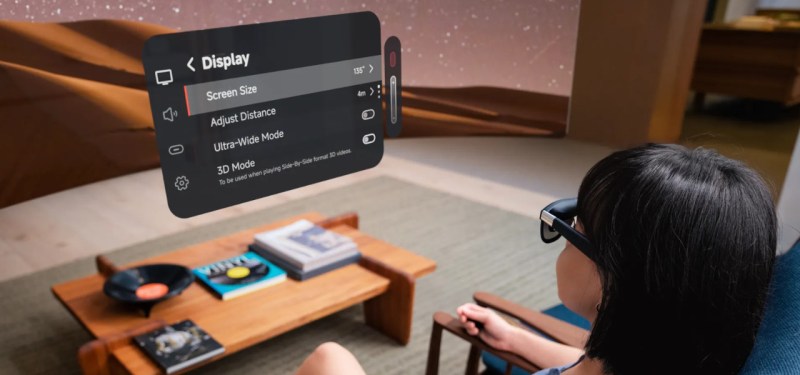
In a recent article from IEEE Spectrum, [Alfred Poor] asks the question what do consumers really want in smart glasses? And are you finally ready to hang a computer screen on your face?
[Alfred] says that since Google Glass was introduced in 2012, smart glasses haven’t yet found their compelling use-case. Apparently it looks like while virtual reality (VR) might be out, augmented reality (AR) might be in. And of course now we have higher levels of “AI” in the mix, whatever that means.
According to the article in the present day there are two competing visions of what smart glasses might be: we have One Pro from Xreal in Beijing, and AI Glasses from Halliday in Singapore, each representing different design concepts evolving in today’s market. The article goes into further detail. The video below the break is promotional material from Halliday showing people’s reactions to their AI Glasses product.
[Alfred] talks with Louis Rosenberg, CEO and chief scientist of Unanimous AI, who says he believes “that within five years, immersive AI-powered glasses will replace the smartphone as the primary mobile device in our digital lives.” Predicting the future is hard, but what do you think? Sound off in the comments!
All in all smart glasses remain a hot topic. If you’d like to read more check out our recent articles Making Glasses That Detect Smartglasses and Mentra Brings Open Smart Glasses OS With Cross-Compat.












Dog help us!
Indeed, help us get through to the marketers making these mock-ups that AR glasses cannot project images darker than the environment…
I for one has been lucky. I haven’t needed to wear glasses for my first 45 years in life. I have been aware and thankful for that freedom every day. Glasses are such a hassle.
Also, I do NOT need to see ads wherever I look, or feeding data to whoever really owns the glasses. This is what these dumb glasses will be used for. I really hope this never catches on.
Happen to own a smart phone?
The tech looks OK and may even be useful, but the cost in loss of privacy, curated information and visual distractions (adds goota be noticed) is far too great. Now where is that big red button.
Hold advertisers responsible.
Car crash in line of sight of a billboard? The responsible party owns the billboard (aside from obvious mitigating factors like DUI).
Someone should be fined the “don’t mess with Texas” $1500 for each and every ad mailer thrown on a front lawn – you bet those things would cease to exist real quick.
There are compelling usecases for augmented reality stuff – as long as it is a projection onto the real world or simple HUD rather than a camera pass through system at least – don’t want to deal with the hassle of fixed focus or focus seeking cameras and latency that image processing stream creates when dealing with the real world. So something that could give me the multimeter/Oscope output in my eyeline enough while I’m poking with the probes etc I’d like to try, but an ‘AI’ filled tool always on your head by design…
But I really can’t see it being a day to day need I’d want to walk around with, but then I didn’t expect everyone to get a GPS navigation device and suddenly become unable to read road signs and maps or remember those navigation waypoint detail you’d glean from studying the route before you set off…
So it seems rather depressingly plausible such a thing will take off and replacing smartphones doesn’t seem unreasonable – so many folks never seem to look up from their devices these days, now they won’t have to ever put them down to get their hand back…
I used to think the “cyber-psychosis” premise of Cyberpunk was a little bit silly – like how would a prosthesis cause that kind of problem.
Then, I became a professional AI wrangler (my title is just software engineer).
Too much integration with a modern AI will absolutely cause severe psychiatric problems.
The tools are great! Extension of the human mind! That’s what makes them so damn dangerous – you integrate too closely to that and it will break your brain.
Brain firewalls.
Indeed, but these ‘AI’ and AR don’t have to have any overlap at all, though these days as a tech product I’m pretty sure it must be a capitol offence to not be ‘AI’ in some way…
So. No.
Another principle: any headline that doesn’t reveal the article’s main thesis or claim is clickbait, because it tries to make you to open the article to find out what they’re really talking about.
The original article’s headline is “Two Visions for the Future of AR Smart Glasses”, which reveals the main theme of the discussion. If you’re interested, you can click to read what the two visions are.^ A headline in the style of “Are we ready for X yet?” is vague enough that the reader has to click in to see what they’re even talking about, and then decide whether they’re interested enough to keep reading. That is the point of clickbait: arouse interest by omitting information or adding ambiguity that seems to demand an explaination.
This HaD article doesn’t really add any point of view or claim over the original article, and instead asks for comments from us, so a more appropriate headline here would be “Industry Experts Predict Revival of AR Smart Glasses; We Have No Comments.”.
^(In good quotation and referencing practices you would write out the article’s headline instead of hiding it behind a hyperlink, again forcing the readers to click on it to find out what it is and thus making clickbait for someone else.)
+1
Thanks!
+42
In the worst cases, writers do a double clickbait: neither the headline nor the lead paragraph reveal what the article is really about, so the reader is doubly frustrated.
Thanks for some clarity around “clickbait”. I didn’t intentionally write a clickbait title. I have added an item to my article checklist to make sure I don’t do that again. I will endeavor to give you a title which summarizes the article rather than ask a question.
On the plus side:
24 hour GPS location tracking
Face recognition of friends with a list of impeding birthday’s/anniversaries for them and their family and friends. Windows displaying common interests and communal appointments.
Near realtime audio subtitles and/or translations.
Recording all accidents/incidents and being used in court against/for anyone in the field of view.
On the minus side:
All of the above plus ads
All of the above with location specific ads
All of the above with selling the raw or processed metadata to third parties
Context ads based on data mining location, view, speech and the transactions of strangers with similar metadata.
Tracking where all money transactions take place.
Accidentally recording pin codes
Accidentally recording passwords
Accidentally recording results of medical (including STD and pregnancy) tests. Forwarding to third party’s and insurance providers.
In my mind the positives are not worth the total loss of all privacy.
24 hour GPS location tracking…like everyone over 8 years old isnt already carrying a smartphone?
Tracking where all money transactions take place. Like the majority of transactions arent already debit/credit/app/loyalty card tracked.
“In my mind the positives are not worth the total loss of all privacy.”
Privacy is a delusion already. that boat sailed and sunk well before smartglasses could arrive.
I leave my GPS off to save battery and use cash at the liquor store. You need cash at the strip club anyways. The security cameras are still an issue, but you can’t exactly show up in a rubber Nixon mask and expect good service.
Privacy may not exist in the strict sense, and never has, but that’s not a big issue as long as the information is dispersed and hard to get at. When one big corporation like Google has access to everything at once without limits and costs, that is when it becomes dangerous.
Location services on smartphones don’t need GPS. There are billions of unintended radio beacons out there, anything that is stationary and has a unique ID or signature will do, like WiFi, BT and cell towers. Our corporate friends have collected vast amounts of coordinate data by abusing mobile devices of unsuspecting users. Officially it’s there to augment GPS and provide indoor navigation…
The WiFi and bluetooth tracking is why you have to enable location on Android to scan for WiFi networks and bluetooth devices.
your phones location services being turned off only prevents YOU and apps on YOUR phone from accessing your location. Unless youve turned your phone off and removed the battery your phone itself is creating a digital record of your location through the network. Additionally, there are devices being used all around you to track visitors that use your phones signal to identify you as a unique individual. These devices may not know your name but they know how, when and long your are at a particular location.
Data is not dispersed and hard to get at. Its aggregated and sold to anyone interested by dozens of companies. Not just google.
Privacy very much DID exist. Electronic payments are fairly recent, and credit cards didnt even exist before 1950. Only a short time ago no one had tracking devices in their pocket. Only a short time ago no one had cameras glued to their hands 24/7. Public video cameras used to record to a tape that was constantly being overwritten every few days if nothing of consequence happened. Now its all being stored somewhere digitally in near perpetutity. Now its not just the banks and jewelry stores recording, its every shop everywhere. Its upwards to 1/3 of the nations front doors and to half of homes in general. The walls have eyes and ears now.
That certainly wasnt the case when I was a kid.
And only a short time ago your neighbor used to peek behind the curtains and then gossip with the other neighbors about you coming and going, because they had nothing better to do with their lives in the absence of social media and mobile games.
Everybody in town knew who was where and when, with whom, and did what. In some countries, much of that was being literally recorded by secret police who even sampled your mail in order to identify the letter faces of your typewriter, so they could later identify it should you happen to write something politically dangerous – or at least put you to jail and beat you up until you told them who used the typewriter.
Oh, did you honestly trust that the post office didn’t open your mail?
“had nothing better to do with their lives in the absence of social media and mobile games.”
Yeah because no one had hobbies, social clubs, dinner parties, malls to crawl, or any of the other myriad of activities people now neglect to stare into their screens.
“Everybody in town knew who was where and when, with whom, and did what”
Only if you lived in a small town.
“Oh, did you honestly trust that the post office didn’t open your mail?”
My mother received a box of tea from a friend in california every month during the early 80s, with just enough tea in it to cover the smell of the weed. In the 90s I used to get sheets of LSD sent in first class envelopes regularly.
Unless you lived under an oppressive regime, or were under government scrutiny due to blatantly public activities, the odds of having your mail monitored was pretty small.
“Privacy is a delusion already.”
This is exactly what the world’s mega wealthy want you to think, so they can continue to collect and consolidate data. If we all adopt your attitude the future will be way darker that we currently imagine. Yes, things are bleak, but the battle for personal privacy is far from over. We will likely be flight our whole lives to maintain the current leave and slowly claw back control and agency over our own data.
But on behalf of Mark Zuckerberg, Eric Schmidt (famed for saying the same thing you did), Bill Gates, Larry Ellison, Elon Musk, and a bunch of others, thank you for helping erode the idea we can have personal privacy. They really appreciate folks like you.
Its not a matter of the mega wealthy tricking us into believing privacy is dead. The reality is MOST people hlissfully sacrifice their privacy for their shiny gadgets and their desire to appear to be glamorous online. Big brother didnt need to chip us, we chipped ourselves. You can totally have personal privacy, just opt out of all the modern conveniences, perks, and playthings. Go live in the hills, grow your own food, live off the radar, Youll get at least 90% of your privacy back.
But if you want to live like the 80% of the US population, In urban areas, you can pretty much forget privacy. Its gone and no matter how much the fringe whines and whinges the majority isnt going to stop waving their cameras around.
“hlissfully sacrifice their privacy”
Yes, educating people on their rights and what they are giving up is an important part of the battle for personal privacy. Tell people ‘privacy is dead’, ‘privacy is a delusion’, etc., is not going to help educate people on the risks they face, it has the opposite affect of making people ignore risks they should be considering.
“Tell people ‘privacy is dead’, ‘privacy is a delusion’, etc., is not going to help educate people on the risks they face,”
Its slapping you in the face with the reality that exists. That raises awareness, sparks outrage, and DOES in fact cause people to self educate about the realities they face.
I don’t think your actions are having the effect you are hoping for.
Privacy is most certainly not a delusion, you just have to believe in it.
A delusion is a fixed, false belief held with incorrigible certainty despite evidence to the contrary. If you have to believe in privacy for it to exist, it doesnt exist. Its just a delusion.
Consider that the combination of live facial recognition, digital id and digital currency are already on the verge of totally removing privacy and individual freedom. Mobile phones are bad enough, but this would essentially be the equivalent to everyone livestreaming all day long, with an AI overseeing the entire country, constantly making inferences and nudges, not to mention looking over your shoulder to snitch on your every infraction. People will be stressed all the time, constantly walking on eggshells. I wonder what would be made of people designating their property technology free zones or just trying to flee the country entirely.
“Recording all accidents/incidents and being used in court against/for anyone in the field of view.”
Definitly a negative as the vast majority of the cases will be legal system facitated harrassment/theft and will make ALL of our insurance premiums go up. Will be a good windfall for the lawers though.
Funny that nobody has stumbled on the most obvious Killer Ap for glasses: Naming the People in Front of You.
As I’ve gotten older, my problem remembering names has only gotten worse. I can tell you about our previous conversation, your children, your job, etc, BUT I CAN’T REMEMBER YOUR NAME.
I would pay thousands for a pair of glasses that identified the people in front of me.
Wake up Google! This is the Application we need.
It would show you the person’s name when you’re talking to them, but then as you come to rely on the system, it becomes even harder to remember their name when they’re not in the room. What was the name of the person I was supposed to email after the meeting?
Case in point: I have a list of important account numbers I’ve written down so I can’t forget them, but then since I have them written down, it’s easier and faster to look at my note than try to recall the numbers. My note-taking has actually ensured that I don’t and won’t remember those particular account numbers, because I don’t have to.
It’s one of those things that seems helpful at first, but turns into a disadvantage later.
Studies have shown that the prevelant practice of recording and photographing everything is disrupting long term memory formation. We are documenting more and more and remembering less and less. AR might be necessary in old age to fill in the gaps as our past becomes less and less memorable thanks to our smartphones.
https://pmc.ncbi.nlm.nih.gov/articles/PMC12466594/
What do you think AI is all about? We humans don’t have to remember anything … let the AI ‘remember’ it. Don’t know how to do something? Let the AI figure it out. Don’t have to think…. Ah, yes, we are well on the way to Idiocracy. No doubt about it.
Remember the days when we had to remember poems to help train our memories? My kids didn’t have to do that anymore. My memory may be going, but I try to keep the brain stimulated with new things to figure out how to do. And sometimes it is ‘hard’…. but good for the brain.
In five years? My answer is probably going to be bifocals.
There aren’t that many uses I can think of for these – I don’t own a smart watch either. But there is one really useful augmented reality app I could see for working on cars or other equipment: psuedo X ray vision. When you have to reach a place you can’t see, the app projects a 3d model of the tool in your hand and the part you’re trying to reach. Maybe also give it a “highlight net list” tool for wiring and plumbing. This looks like it would be a nightmare to get right even before you factor in just how many cars you would need to 3d model.
Worse, I can imagine some much ickier AI powered applications of the pseudo X ray app. Better to leave that can of worms sealed tightly.
It’s another 3d TV moment if you ask me.
They’re all ugly AF. I find it amusing that smartphone users can’t bare more than 1mm of bezel on their phones but would happily accept almost 1cm frames.
No amount of money would persuade me to let Meta/Google/Apple see what I’m seeing, working my life into their algorithms to feed me ads on the same device? Absolutely not!
I can see lots of use cases for specialist tools for the workplace but as a general tool for day use, no thanks.
AR glasses are like ‘They Live’ in reverse.
That YouTube video included on this page was very useless. It made me feel like I was a kid again on the playground, where everybody knew what was going on except me. Some parts of the conversation gave me some clues, but only enough to let me know that they were not telling me what really was going on. So if that was the goal… well done.
The interaction with the display is an issue for me as I don’t like to talk to gadgets and I don’t see how else that would work without a mobile interface, that you wanted to get rid off in the first place. Also the camera that films people without thier specific consent is concerning to me. That 5 year projection is purly for investors ROI dreams, what else could he say? Propably depends on advances in battery solution foremost.
AR desperately needs eyetracking integration.
As for the consent concern, cameras are filming people without consent constantly. Privacy is dead. Unless we mandate AI face bluring be hardcoded into all devices theres no chance of it coming back.
The roadblock for AR isnt battery life.
Its not form factor, Lumus has had that nailed for over a decade.
The real obstacle is software. Until a company produces an OS and suite of base apps that make AR practical, efficient, and useful, its going to stay 5 years away forever.
Idea: If you punch people with cameras on their glasses in their face they might have an easier time remembering you.
It’s all about helping people.
Your Idea: Up to 90 days to 6 months jail, fines up to $1,000, probation, restitution. Remembered as a douchbag that has trouble securing employment and housing. Brilliant!
PS your comment in no way relates to mine.
Oh there is a new worldwide law system then (in your mind)?
Plus people get away with assault and even murder all the time, even in regions with super strict laws.
In Europe/NYC/London you should consider simply claiming you are isl*mic and making images of people is not allowed. FTFY
Pretty sure punching people in the face is illegal pretty much everywhere. The penalty may vary from region to region but assault and battery is probably in every lawbook.
Getting away with assault, and even murder is becoming less and less likely given advances in criminal sciences, and the prevalence of video cameras…..ONE OF WHICH IS ON THE FACE YOU INTEND TO PUNCH.
Religious opposition to having ones image taken is not a defense against assault and battery. The koran and the hadiths do not prohibit photographing people, It prohibits idolatry. A photograph captures an image. An artist seeks to imitate gods creation by breathing life into their works. So even in an islamic nation your ignorant attempt to defend your ill conceived response is unlikely to be considered a reasonable defense, especially considering that the AR glass wearer you attacked did not print a copy of your ugly mug but merely had the ill fortune of you passing their lens.
In iraq it is illegal to photograph someone without their consent. Violations can lead to penalties, including fines and imprisonment, depending on the severity and nature of the offense. Punching someone in the face can carry penalties that range from fines and detention to long-term imprisonment, with potential sentences up to 15 years in prison
In saudi arabia the penalty for punching someone in the face can range from imprisonment for a few days to a year, Although the victim can opt to forgive you and let it go, Demand payment for the offense, Or demand “eye for an eye” justice, having you beaten proportionally to your attack. Taking someones picture without consent can result in imprisonment for up to one year, a fine not exceeding 500,000 Saudi Riyals (SAR), or both. But you are not entitled to punch them in the face.
I could continue but I doubt Ill find a single instance in which its considered okay by law to punch someone because you dislike their devices potential to take your image without consent.
Didn’t even know there was a KSA and Iraq in LaLaLand.
Live and learn eh.
“Privacy is dead.”
Now I am starting to wonder if you are Eric Schmidt. Either way I am sure he likes your comments.
Privacy is far from dead, although if more people adopt your mindset it might get there. Yes, things are bad, but not completely lost. Things are not as simple as “cameras are filming people without consent” there for privacy is dead. In public, yes you can be filmed without consent, your first amendment rights cover that, but there are limitations on what can be done with that data. Filming people in privacy, where they have a “reasonable expectation of privacy” is prohibited without consent.
(And things vary depending on your geo-political location.)
I do appreciate your suggestion of “mandate AI face bluring be hardcoded into all devices”, that does sound reasonable (and somewhat achievable). Devices used outside of public areas should never record identifying information (e.g. blur-before-store) of somebody who has not provided consent to be recorded.
It is a long road ahead to protect our remaining privacy rights and claw back what has been taken from us. But please don’t inadvertently (I assume your intentions are real good) assist those who wish to further undermine our privacy.
I’d suggest that the roadblock to AR is still one of form factor or display area/resolution – at least to a reasonable extent you can’t have both now. Having to pick one then limits the practicality make it larger its not going to be that reasonable comfortable all day walking around wear, make it smaller and you don’t have enough resolution or FOV covered to really do everything.
There are software suits out there that would make an AR with good enough resolution, virtual screen area etc very very useful and flexible. Though most probably have been developed with VR in mind, as those HMD already tend to have good FOV, Resolution and nobody cares if its dorky and impractical to wear walking around all day. So probably won’t leverage the full potential real world interaction so much, but still would be useful.
And from what I understand there are more than a few useful AR HUD implementations that while rather more limited motorcyclists (with deep enough pockets) are enjoying – no personal experience of that software stack though, where I have used more than a few decent VR software that would be just as good, perhaps better in the AR environment on my OG Vive.
Lumus produces a waveguide that fits in a normal looking pair of glasses and is currently produced in 1440 x 1440 pixels with a 50fov. They have demo’s the same optics with a 2k x 2k lcos,
Ive been in the AR space as far back as the 1995 VirtialIO Iglasses
I own a daqri AR smart helmet. 1920×1080 with thermal vision.
I own a Lenovo Thinkreality A6 with 1920×1080 displays.
I have several different models of the Epson Moverio Line including the 1920×1080 BT-40
The form factor on the BT40 isnt as good as the Lumus Maximus (which is not publically available) nor is its resolution as good, but its a comfortable solid display with a reasonable resolution and FOV. And its been commercially available for nearly 5 years. I use it as well as my modified Lenovo Thinkreality with an HP Omen X backpack computer.
Im speaking from three decades of tinkering with whatever AR headsets have been available. The real obstacle is software. Until a company produces an OS and suite of base apps that make AR practical, efficient, and useful, its going to stay 5 years away forever.
AR is not a desktop. AR is not VR. The potential and requirements for realworld interactions do not bend well to those dynamics. Attempting to force fit the experience into those more developed systems causes a fatigue that causes the user to set aside their AR device and return to the VR headset or their desktop/laptop.
All those stats are rather proving the point though – AR to really be as widely useful and flexible as it could be needs way more than the 50degree FOV.
A HMD display is just a HMD display, the only difference for the user between VR and AR versions is being able to see the real world directly rather than through camera pass through is way better if you can have it AND not have to give up the resolution, FOV etc.
You can always add selective darkening to block out the real world and get that VR isolated from the real world experience when you really wanted to should the rest of the AR hardware be up to it, where no matter how hard you try the camera passthrough will never be that natural. But right now as far as I’m aware all the modern AR devices are all focused on ‘being akin to regular glasses’ or small fit in your helmet options and all the compromises that brings with it – which as noted for the motorcyclist actually seems to work really well, a case of very specific needs that can actually be met. But as a rule those compromises rather limit the value of AR stuff IMO putting way to much restriction on what the software can really do as the hardware platform just isn’t capable enough (yet anyway).
“to really be as widely useful and flexible as it could be needs way more than the 50degree FOV.”
You can live with a 4k 55 inch screen on the wall. A 32k 120 inch screen would be way better. Doesnt mean the 55 wont get the job done.
Most if not ALL available HMD get their expanded FOV by sacrificing BOTH pixel density and introducing optical distortion to the periphery. Some AR systems do this as well, and suffer the same issues of reduced legibility except in their sweet spot. AGAIN AR is not VR. A crisp legible screen floating in front of you taking up 1/3 the visual field is the preference of most AR user group studies and the reason for that focus by the majority of product developers. If you insist on double or triple the eyebox you will need to quadruple or sexdecuple the resolution. In which case the thing holding back AR is LCOS resolution and mobile video card capability and price.
Also the preference for VR and the natural space you want the most pixels, which is why most VR has those relatively low res distortions to populate the extremities of their FOV.
As you sacrifice a huge amount of potential to not have that periphery populated at all. Nobody is going to serious try to read the window in their upper right peripheral vision without turning their head to face it comfortably, at which point it will be that crisp legible screen taking up a comfortable portion of their FOV. Exactly the same as with multi monitors – don’t really use both at once but being able to see something is happening outside of your focused area lets you do so much more more than having just the one small screen you are focused on. And in the case of things like projecting the virtual onto the real world having those hard edges where the screen suddenly isn’t cutting that object off so close to the sweet spot just spoils the effect – you are still only really needing full detail in the narrow central portion, but you really do want to see the rest of that projected object till it blurs out towards the outer edges of your visual range…
I’ve had to wear glasses for the last 20 yrs, first just to read and now bi-focals for just about everything. When I walk the dogs I lug around binos, and just recently a thermal scope (just wow, foxes are everywhere -its winter here). I have to deliberately leave my glasses off when I go for a walk so I can swiftly switch up to enhanced viewing. AR glasses that could replicate some of these specialized functions would be a boon.
Top tip for anyone else in a similar boat, no glasses and need to read tiny blurry text on your phone? Look at it the wrong way down your binos. It feels like a hack anyway.
I wonder if AR glasses will feature a dioptic?
We don’t need smart glassholes, we need – 1 – affordable housing – 2 – cars that cost less than $15 with all options included – 3 – proper public transit and speed trains.
The rest are trinkets of no particular merit to the average Sam.
cars that cost less than $15? you crazy, Riding an Uber costs more than $15.
1 and 3 are massive issues you should take up with your congressmen
None of these are comparable in any way shape or form to the next potential evolution of portable personal computing. That said, Id rather a new qwerty slider phone than a pair of smartglasses.
1 and 3 has been discussed with all kinds of representatives and congressmen/women. State and federal, together with Single Payer healthcare system.
You can guess the answer/excuse – “conflict of interests”. Big Bad corporations who’s profits are just fine and they don’t care, to put it bluntly. Fine, I said in response, if they don’t care, why should I, there are loopholes aplenty and I will look into sneaking through one of them undetected, and I am not the only one thinking the same, I am actually a slow poke compared with the others.
Because – 1 – affordable housing will instantly attract the youngest and most energetic crowd eager to make a difference – 2 – concentrated human capital means concentrated business opportunities – 3 – investment moneys will flow right in – 4 – conflict of interests will be confined to its niches and fade away. History is full of examples like that, and there is no shortage of potential in the US to make it happen.
Public transit is one easy way out, btw, average narrow gauge can easily out-perform four-lane paved road GIVEN – 1 – it goes where people want to go – 2 – connects to hubs (airports, etc) – 3 – is reliable and affordable – 4 – runs more than once an hour at peak demand, every 15 minutes like in the rest of the world.
In the 1950s and 1960s US had one of the most modern and advanced public transits in the world, btw, One could literally step on some kind of train, bus or local tram on the east coast and travel all the way to the west coast. Or north and south, no matter. Why it decided to decimate itself is not what I am bringing up here, what I am bringing up is back then the vast majority of the US lived in fairly few concentrated areas, northeast being the most populated and STILL those transit companies made profit. Rewind to present and find quite a different picture – population is far more spread out, so the public transit, long and local, makes even MORE sense and would rake even MORE profit – but is HAS to be done right, not slapdash fashion, properly strategically planned, etc. Just like the rest of the world is doing it, again, any of the EU countries can teach us how it is done (though, I’d very much copy Japan, who, btw was copying the US after the WWII, so maybe it is time to copy our own copy).
None of this is comparable in any way shape or form to the next potential evolution of portable personal computing.
I wish the next potential evolution of portable personal computing was matched by proportionally equal evolution of inventions meeting basic human needs (safety, shelter, food, etc).
if wishes were fishes we’d all have a fry.
I wish we would master interdimensional travel.
I wish we would learn to fly without mechanical assistance.
I wish it would rain donuts every third thursday.
None of this has anything to do with the topic at hand. Your desire to see improvements in the world has nothing to do with advances in consumer technology. Your points of discussion have merit, elsewhere.
Ah, my bad – cars that cost $15K. Maybe $25K if it is fancy pants one (Caddie).
Public Transit in the rest of the world works perfectly fine. Kids in Japan ride public buses to/from school. Last I checked Japan has one of the lowest crime rates in the world. I see no reasons why we cannot just copy what they did and how. Obviously, we won’t need THAT many cars then, and I’d very much rather go back to “one car per family” kind of deal – ideally none whatsoever, rent-by-the-hour on as-needed-basis. That’s how it works for my relatives living in the inner cities. They don’t need cars. They rent if/when they need one.
Affordable MODERN housing exists in most EU countries. Again, I see no reasons why US cannot copy from the best. It should. I propose copying either Sweden or Finland.
Affordable healthcare exists in Sweden, btw, and it covers close to 90% of the population. Municipal hospitals. Last I checked it works better than in Canada. Again, I see no reasons learning from the best.
Trolling not, those are REAL needs, and with the glassholes or without glassholes, no difference. I don’t own a farm (or a trump tower) and in my plans is retiring to a country that hates retirees less. Plenty to choose from, btw. Most speak english no problem.
Regardless, I’ve invested my hard-earned moneys’ taxes into the local economy long enough (32+ years), if it is in no hurry to return the favor in any way or form, then screw it, too. I’ll take my meager savings elsewhere : – ]
10-14% of Swedes find their public care system so accessable they pay for private insurance. A number that is increasing annually. Thats in a country with a population just below that of North Carolina but 3 times the size.
While in Finland private health insurance is growing, covering around 24% of people for medical expenses.
Medicaid for all is a great idea. No one should be denied access to healthcare. But like every other country that has found means to ensure their populations medical needs are met, MANY of us in the US will find that the resulting healthcare system will suffer from bottlenecks and inadequacies that will warrant us continuing to pay for BETTER.
And some of us will be sitting in waiting rooms with AR glasses occupying our boredom. Still not sure why you think there is any connection between consumer electronics and government programs.
“…10-14% of Swedes find their public care system so accessable they pay for private insurance…” – and THAT’S how competition supposed to work. The two supposed to keep each other in check, prices and quality. If theu don’t then something is broken.
In the US we have zero competition, we only have private healthcare jacking up the fees into the wazoo with zero control (surprise fact – fees are secret until the services are rendered. You can’t budget anything. For that reason alone you are screwed by default, since you cannot shop around for better deals, you literally do not have a way of knowing until later).
Case in point – Canada has both, public and private, and presently their public system is being gutted similarly how few remaining public places were gutted in the US in the 1990s. I know because I’ve witnessed in person – first they were cut off from the private insurance coverage, doctors’ salaries stagnate, doctors and nurses leave flocking to the private hospitals, thing withers and sells out to for-profit entity).
I am not connecting trinkets with health insurance, I am saying trinkets are a distraction from REAL NEEDS. While they entertain us, they don’t place food on our tables to put it bluntly. IN this sense, NO, I am not ready for any glasses. They don’t serve any of my needs.
Unless, of course, the mentioned glassholes come with the Tricorder attached, so they can diagnose all my ailments, do CT scan, run tests, etc etc. Then of course I am ready.
Medicaid for all in the US may not happen, because presently our beloved SS is in the process of being taken over by private profiteers paying zero taxes. Once they do that, they’ll bleed it dry and invest into their private trump towers, so unlikely we’ll see much happening. I don’t see anyone saving our SS any time soon, because it is not even on the radar of any politicians I am aware of, local or remote/federal. Politicians don’t care because they have their own golden pensions, not SS. They also regularly siphon our tax money off SS – not even borrowing, just stealing.
Roughly one in four Americans (around 25-26%) are covered by Medicaid or CHIP, with recent data for FY 2024 showing about 88.8 million people enrolled, or 26.2% of the U.S. population.
The rest of us are either insured by our employers or deemed financially capable of paying for our own insurance. There is a competitive marketplace. I pay far more for insurance than my brother. He has one of those bare minimum plans with a low payment a high deductable and the maximum allowed annual out of pocket. I choose to have a ZERO deductable plan with a minimal annual out of pocket. I pay $650/mo hes paying ~$160.
He makes his choice based on his income and confidence in his health.
My brothers max out of pocket plus premium will put him out $1040/mo and the insurance company wont be paying jack until he hits his $10k deductible. His max out of pocket is only $700 over his deductible. So hes paying out $1039/mo in his worst case scenario. $1920 if he never sees a doctor.
My max out of pocket plus premium puts me out $1191/mo in a worst case scenario. If I never see a doctor Im out $7800. I pay $5 to see my doctor, $35 for urgent care and $65 to see a specialist. So unless I end up in the ER/hospital, Im probably not paying much more than my monthly premium.
My wife was diagnosed stage 4 in 2014. She pasesed in 2019. We had similar coverage to what I have today. 5 years of treatment would have only cost us around $1100/mo including our healthcare premiums but her disability insurance more than covered our out of pocket expenses.
We do have competition in the health insurance industry. There are multiple companies with multiple plan offerings that you can pick and choose from based on your expected needs.
We do have public and private healthcare options, but we use income qualifying basis to determine who can access which. (and fortunately for the less fortunate most states offer the same insurance providers and doctor accessibility to them that those of us who pay our own way can choose, rather than consign them to underfunded understaffed government run facilities.
Dont get me wrong, Im all for expanding medicaid availability and healthcare subsidies. But having lived in countries with Universal Healthcare, having seen the shortcomings first hand, and having had coworkers express their preference for their PMC over the public healthplans. I do not buy into the idea that medicaid for all is necessarily the best option.
BUT yet again, None of this has any consequence to the value or trajectory of consumer electronics innovation.
“I am happy but you are happy, but why should I care” (tm quote not mine, but about describes what I do – represent 3/4 of the US able-bodied law-abiding tax-paying citizens who will agree with me).
That was a $15K car, thank you for pointing out. $25K if it is fancy, and $35 if it has all the uber-latest (hybrid). That’s the absolute minimum average Sam can pay in one lump sum, no loans. Maybe $50 if he is feeling rich.
The proper use case for AR isn’t consumer, but commercial – for use at work, that is, and for transportation – think training, adding HUDs to vehicles, maintenance, referencing documents, wiring diagrams, telepresence, diagnostics, charts procedures, etc. It should be a tool for doing better work and improving safety, not a means to more malignant capitalism (the consumer market)
Yeah. Like not having to paint locations allover the concrete and pavers for underground utilities. You the backhoe operator can “see” them once entered in the system. Done once and added to with all further work. Fiber is going in by 2 providers here in town, orange cones, and paint on everything living or stone.
Nothing stops the average consumer from having good uses for it though, it really isn’t the sort of tech that just has no place outside of commercial environments. So the problem becomes getting that not stupidly invasive version to actually be available to the rest of of us.
The AR in video games is what one imagines. The standard those glasses will not reach for decades because the world will need to change even more than they need to improve.
I tried a VR headset last month to achieve the functionality of multiple virtual desktops for coding, but I returned it: it couldn’t expand the computer’s multi-screen setup, the resolution was too low (my computer has a 4K screen… the difference was huge), wearing it for a long time caused eye fatigue, and once it was on, I couldn’t see the real world (I have myopia). I also want to try Xreal again sometime and will give it a go later.
I am not using Xreal, there is an issue with the translation software… My next product plan is to try Xreal.
make one without a camera, I’d be all over it.
the camera breaks the social contract, people I’m speaking with can’t trust that I’m not recording, so they limit communicating with me, or constrain their expression with me.
I’m down for a personal HUD that respects privacy, 90% of that google glass stuff was very cool and useful, but they had to spoil it with a camera
That is rather difficult, at least to make the more capable fluid ideals AR strives to – for it to really work without controllers of some sort you need a way to wave your dexterous hands around and have the machine know what you wished to do with that gesture and know where to render your “AI assistant”, virtual paperwork etc in relation to the real world – cameras are kind of but not 100% strictly required.
If all you want is a see through HMD with no features beyond being a big virtual screen in your eyeline you need another device to drive there are and have been for a good long while other options, not exactly cheap options, and still facing that same AR make it lighter, more discreet and comfortable to wear but have low resolution or small virtual screen area tradeoff.
You can pickup ana 5 year old epson moverio Bt-40 (1920×1080 34°) fov with Android 9.0 controller for around $500 on the bay.
And it can do basically nothing of the promise AR devices are supposed to have – don’t get me wrong I like the BT-40 conceptually in the right place, but it isn’t that actually utilitarian useful AR glasses smartphone replacement. Really its just monitor you can wear on your head. Very handy for some, but functionally for most a regular display will do the job it does vastly better…
To do the hand gestures, project virtual stuff onto the real world etc you just need some way to monitor the real world, and cameras are the obvious choice.
Spacedog said “make one without a camera, I’d be all over it.”
You clearly understood that as you responded “If all you want is a see through HMD with no features beyond being a big virtual screen in your eyeline you need another device to drive there are and have been for a good long while other options, not exactly cheap options,”
The Moverio Bt-40 with controller from the bay is, in my book, a cheap option for a see through HMD with no features beyond being a big virtual screen in your eyeline INCLUDING a device to drive it, the android based control module.
Spacedog said “make one without a camera, I’d be all over it.”
Indeed, and I don’t disagree with you at all, but the BT-40 ISN’T exactly the AR dream being sold here – its pretty much just a monitor strapped to your head. You still need the way to interact with it that is actually better than just pulling out a smartphone to use directly to make it particularly compelling AR. Which is where it becomes very hard to have all the interactivity without cameras (though other sensing techs do exist so it is possible to get at least most of the way there).
Personally, Id like to see a Epson moverio style device thats a bit more wearable, like a lumus maximus that has attachment points for peripherals. So you buy your head mounted display, then accessorize with a lidar shield, or a thermal camera module, or whatever.A modular, configurable, wearable computer ecosystem with interface and physical connector standards allowing multiple manufacturers to innovate and interact would be my ideal, but that dream is the imaginary 5 years +10 away I fear.
Back to the topic at hand, and I honestly apologize for derailing the thread.
Better question should be “what would you use the said glassholes, once available en-masse?” I propose inventing the Star Trek Tricorder and adding as a plug-in. That way one can have a test lab and all kinds of preliminary scans available before visiting a doctor, as well as keeping track of major measurements. Obviously, NOT uploaded to any clouds-shmouds, kept local.
Aside from that, the only use of staying 100% connected to them communications is limited and would be inlines of supervising some kind of power station meltdown emergency cleanup, or commanding an aircraft carrier during bombing sorties. I see no other reasons why one wants to be online 24/7 (almost ALL of my computers are turned off once not in use, and cell phones are offline once done doing the task – I honestly have no need to be permanently stationed on the “information highway” between uses – and I’ve been burning enough rubber on the said information highway ever since late 1990s – earlier, if counting the dialups and whatnots).
I assume then you either still have a landline, or nobody ever pro-actively wants to talk to you, which to me seems a bit sad (not that I’m in a particularly different boat as it won’t happen often to me either).
The problem is you can’t turn your device on pro-actively for when its needed to receive unless you somehow know exactly when they are going to call/text. Which would make your friends, family and life in general way more predictable than mine. And these days the world at large seems to want to use smartphone compatible if not exclusive platforms to communicate…
https://xkcd.com/1254/ is rather true still, except that it doesn’t matter which method they want to use, its all on the glass slab that is supposed to live in everyone’s pockets, and probably the only place to find half of it…
I have both, landline and cells phone. Landline is for the true emergencies. Unlisted. obviously, and all kinds of m****ns regularly try texting the landline. Good luck.
My social circles can always call me and talk, and cell phone texting works last I checked without the pressing need to have the internet on at all times. That to me suffices.
For large file sharing we email. We call/text each other and say “lets’ work on this” and I connect to the email. Worked since 1997, so keeps working in the 2026 just the same. Other kinds, Instagram, etc, are used, too, but to me they are a cross between email and forum, so they are offline, as I rarely find topics worthy my (limited) uninterrupted attention. I don’t follow any celebrities or scientists, nor I care to read each and every twit from certain politicians (on the topic of which, I’ve shaken a number of hands and spoke to quite a few in my lifetime – ALL of them struck me as being rather dim-witted and the best conversations we’ve had were mostly with their staff and interns).
As far as the glassholes go, I used to be the eager one awaiting for the affordable mobile computing in the form of such, but even back then (1980s) I wasn’t sure what to use it for beyond the obvious (cell/mobile phone replacement, mentioned health-related stuffs, etc). I do not see much of practical use today either, and marketing push to have everyone walking wearing one pair of glassholes doesn’t inspire me. If everyone I know decides to keep everything in only one kind of device (glasshole) I’d be forced to switch, reluctantly.
Regardless, there are very, very good definite uses – airplane pilots would appreciate one showing things as clearly as the fighter/helicopter pilots see on their visors, stats, navigation, etc, and I am not questioning if it is good – it is. Doctors inspecting a patient sure can use a pair matching X-Rays with the part of the body being examined. Truck drivers could use glimpses from the cameras watching the sides of 18-wheeler, as well as GPS navigation tips. Ship navigators/captains, too. It is quite usable every time/occasions where there is a need to have real-time updates.
Beyond these uses I do not understand the need. I don’t command aircraft carriers, nor I am supervising power plant cleanups. (I also served in the military, and there are certain situations where you’d wish you had one – not necessarily combat, which is really the tip of the iceberg, logistics, etc – but it remains to be seen just how useful they would be in those situations, army in general is rough environment for anythings that breaks rather too easily, even when set in cast iron and weather-proofed).