
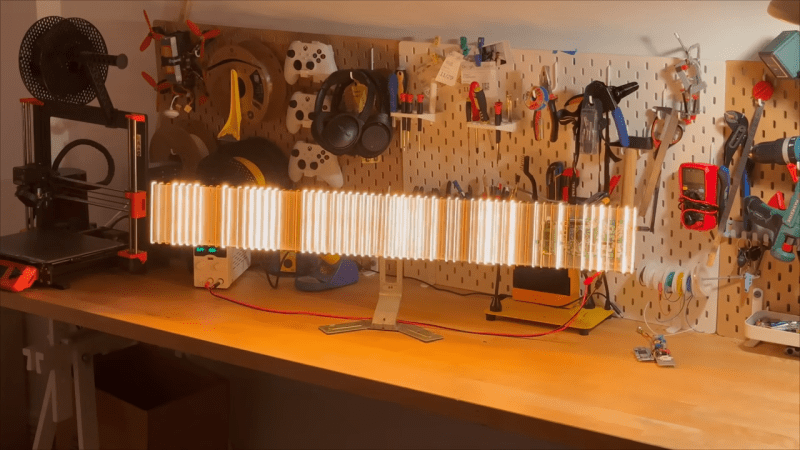
When it comes to electromagnetic waves, humans can really only directly perceive a very small part of the overall spectrum, which we call “visible light.” [rootkid] recently built an art piece that has perception far outside this range, turning invisible waves into a visible light sculpture.
The core of the device is the HackRF One. It’s a software defined radio (SDR) which can tune signals over a wide range, from 10 MHz all the way up to 6 GHz. [rootkid] decided to use the HackRF to listen in on transmissions on the 2.4 GHz and 5 GHz bands. This frequency range was chosen as this is where a lot of devices in the home tend to communicate—whether over WiFi, Bluetooth, or various other short-range radio standards.
The SDR is hooked up to a Raspberry Pi Zero, which is responsible for parsing the radio data and using it to drive the light show. As for the lights themselves, they consist of 64 filament LEDs bent into U-shapes over a custom machined metal backing plate. They’re controlled over I2C with custom driver PCBs designed by [rootkid]. The result is something that looks like a prop from some high-budget Hollywood sci-fi. It looks even better when the radio waves are popping and the lights are in action.
It’s easy to forget about the rich soup of radio waves that we swim through every day.












Jump to 6:20 to actually see the thing working.
First rule of maker videos: show the finished product FIRST so we can decide if we want to see the build.
Thanks.
counterpoint: make people watch the whole video and each of its ads before they can see what they want
ads?
Or check out the project’s linked page — the first link in the post. There you can read through it all in a few seconds.
It’s so rare one of these youtubers bothers to actually write something down I didn’t even register it… but that’s not the point, as Mark Topham says below showing the thing you’re going to be talking about first is just a good video structure, especially given the amount of clickbait out there that is designed to make you wait for the disappointing reveal.
Show me the result and I can decide if I need to know how it was made.
There were some videos I saw previously demonstrating binaural recording and the video starts off showing some final results, then walks through the build, then shows more detailed examples.
It was an awesome structure and presentation and YouTube effectively punishes creators like that.
Buildling?
Speilchekc is yuor freind.
A “buildling” is a young building, of course.
No complaints here. Very cool.
Huh. I think I would enjoy it more as a standard “visualizer” display, using neopixel strands to display signal strength at each frequency rather than vary the brightness of the LED “filaments”. To my eye, this display is unnecessarily bright and intrusive. I like using those filaments, but not in excess.
Could this be done for 2.4Ghz only with a NRF2401? it covers the band in 128 1Mhz steps?
Cheaper than HACKRF 1?
Thank you for this marvelous project! Seeing it work, I could fathom a sociological test with the intensity of the light emitted depending on WiFi usage. I will build a similar one for lower frequencies, comms wavelengths. Thank you again.