
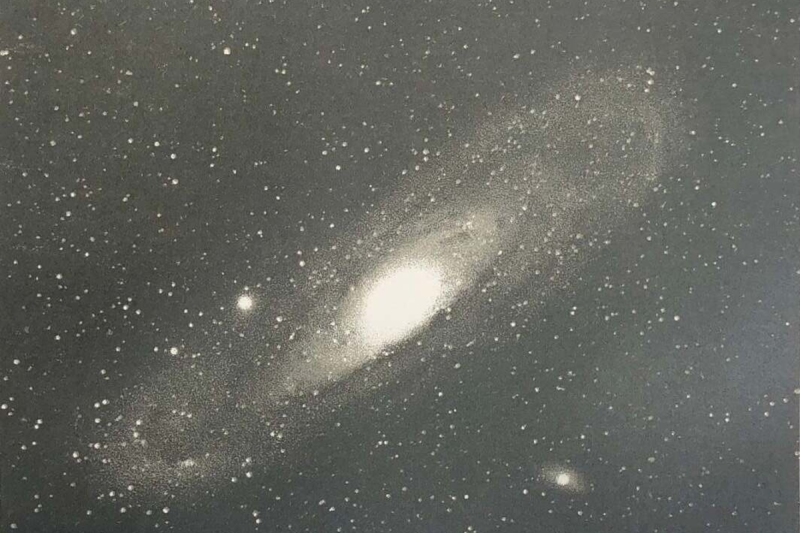
Space telescopes are all the rage, and rightfully so. The images they take are spectacular, and they’ve greatly increased what we know about the universe. Surely, any picture taken of, say, the Andromeda galaxy before space telescopes would be little more than a smudge compared to modern photos, right? Maybe not.
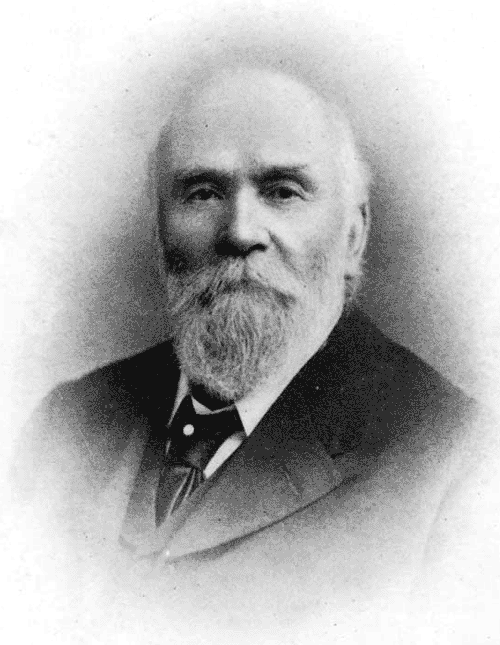
One of the most famous pictures of our galactic neighbor was taken in — no kidding — 1888. The astronomer/photographer was Isaac Roberts, a Welsh engineer with a keen interest in astrophotography. Around 1878, he began using a 180 mm refracting telescope for observations, and in 1883, he began taking photographs.
He was so pleased with the results that he ordered a reflecting telescope with a 510 mm first-surface mirror and built an observatory around it in 1885. Photography and optics back then weren’t what they are now, so adding more mirrors to the setup made it more challenging to take pictures. Roberts instead mounted the photographic plates directly at the prime focus of the mirror.
Andromeda
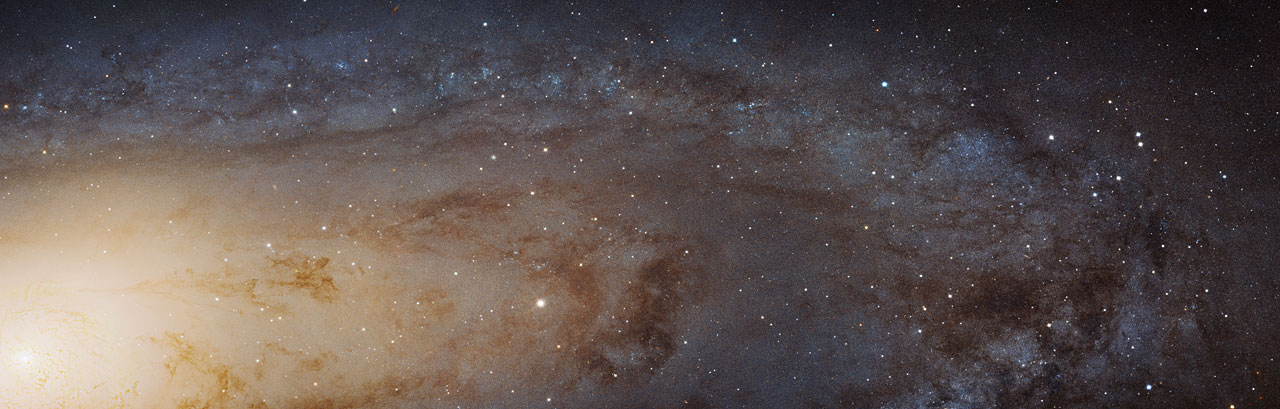
Because it took hours to capture good images, he developed techniques to keep the camera moving in sync with the telescope to track objects in the night sky. On December 29th, 1888 he used his 510 mm scope to take a long exposure of Andromeda (or M31, if you prefer). His photos showed the galaxy had a spiral structure, which was news in 1888.
Of course, it’s not as good as the Hubble’s shots. In all fairness, though, the Hubble’s is hard to appreciate without the interactive zoom tool. And 100 years of technological progress separate the two.
Roberts also invented a machine that could engrave stellar positions on copper plates. The Science Museum in London has the telescope in its collection.
Your Turn
Roberts did a great job with very modest equipment. These days, at least half of astrophotography is in post-processing, which you can learn. Want time on a big telescope? Consider taking an online class. You might not match the James Webb or the Hubble, but neither did Roberts, yet we still look at his plates with admiration.









What’s the craziest is that when Roberts took this picture, the true nature of what he was looking at – another galaxy, just like the Milky Way – was not truly understood yet. It was not until 1924, when Hubble put together Henrietta Swan Leavitt’s discovery about the relation of the period of Cepheid variables and their luminosity that the true scale of the universe became clear to humanity. Our current worldview is a mere 100 years old, who knows what lies ahead.
Did you forget to attach the pictures Roberts took?!
We did! It’s there now.
Some 170 years ago we finally learned how to inexpensively make large amounts of steel. Is your current car body made of shit steel or bicycle frame built with steel tubes that much different from what was possible in Belle Epoque?
No
It’s still the same Fe element with up to 2% C.
Think hower you want but the bitter truth is our science has probably peaked (logarithmic growth) and we’re stuck here until we die. Even Mars trip is a fallacy because in terms of absorbed radiation two way trip would be equal to standing inside Chernobyl reactor just after it exploded.
Also, where is your 10000000000 GHz CPU as promised by Intel when they were tryharding with Pentium 4? It didn’t happen and we’re still stuck with in an era where humbe 3 GHz E8400 is not that different from modern multi-core extreme CPUs for true gamer nerds. Both can play MP3, show webpages and write text documents.
I guess what Richard was trying to say is that you don’t know what you don’t know.
Regarding “we’re stuck here until we die” only applies if we don’t think out of the box. I’m pretty sure some long long time ago a caveman would have said… this is it… fire is fire the latest discovery I’m sure that there is nothing hotter, this is my cave there is nothing stronger.
Fortunately some other cavemen was able to see beyond that and look where we are now.
The fundamentals may not change (much) but the way we apply them will and along that path new things will be discovered that are unimaginable today.
Or at least that is what I like to believe.
Yes, this has been well known since 1899, when Lord Kelvin famously declared “there is nothing new to be discovered in physics now”.
What is also notable is that it takes thousands of years for a galaxy like ours for example to rotate even a small fraction of a degree, and yet because of the flood of animations as well as movies and TV shows it seems a large part of the world thinks you can see galaxies spinning like spinning tops.
The term ‘smog’ seems to be from 1880 though, so there was that issue.
Watch out setting the time on your time machine and being disappointed when you find you are still being thwarted :)
Yes, “His photos showed the galaxy had a spiral structure” and it was the Andromeda Nebula until about 1924. They all were. They were thought to be related to the irregular nebulae like in Orion, etc. Are they sure this guy’s hour long hand guided 1880’s emulsion sensitive photos showed a spiral structure? I mean the new gelatin emulsions had an ISO of nearly 10 if you used the fastest plates.
What I can find of his images are all printed matter. The images have been extensively dodged and burned then “artistically” heavily worked over with the “nebulosity” imitated with a fairly course non-photographic process. And not what I would call any spiral look. There are other issues with the silver process like “reciprocity failure” that makes the difference between 10 minutes and 1 hour a waste of time, as opposed to getting 6 times as much light recorded.
“Roberts did a great job with very modest equipment. ”
Not modest in the least. Having put the huge “sensor” at the prime focus of a then-enormous scope, and self-invented astro tracking would put this at the cutting edge for the time and would be an enviable private/student telescope today (minus the film plates and clockwork, of course).
He bought the telescope, which implies that it was already a commercial item.
It’s been a long time since I looked at telescope prices. A brief search indicates that a telescope that size in a Dobsonian mount is US $10,000 to $20,000 today. I guess the price of the equatorial mount and clockwork would be the same. Multiply by ten to build an observatory around it.
The Isaac_Roberts’_Observatory wikipedia page has a photo of the telescope assembly with the 7 inch refractor as a counterweight. Very impressive.
Maybe invented? Heliostats were standard equipment in science labs to provide a steady supply of sunlight to instruments, and it is basically the same thing as tracking a star. They were in the equipment catalogs of the time. Clockwork heliostats that mounted outside a window had been available for 200 years.
An article all about the images he took… And not a single image that he took in the article?
I get that I can browse away and look them up, but that seems like an odd editorial choice…
Back then it was relatively easy: zero light pollution.
It doesn’t sound easy to me, but at least he didn’t have to go to a remote mountaintop to find a clear sky. How many of the objects in his late-eighteenth-century catalog could Messier see over Paris today?
Yeah lack of light pollution helps, but to say that single factor makes it easy is… Not accurate. Lol. As the comment by Thinkerer pointed out, he was doing cutting edge work for his time. This was extremely challenging, and it’s why the pictures are so notable.
Thanks for being the type of creator that makes social media actually worthwhile
Thanks for creating content that actually makes a real difference in people’s lives
This lifts 🎭 everyone up
This hits 🎯 perfectly today
This post perfectly balances inspiration with practical actionable advice
This is 🎯 exactly the kind of content our community needs right now
Absolutely love this approach
Please go back to the goddamn youtube comment section and leave HaD alone.
Space telescopes tend to be narrow-aperture for extreme magnification, to take maximum advantage of the lack of an atmosphere. This means it takes hundreds of exposures stitched together (generally with a computer) to make a single image of Andromeda, which is a dim but very large sky object. You may still also need time exposures, even though modern digital sensors are much more sensitive than old film. But traditional film techniques with short focus wide-field scopes can take the whole image in one go, onto a sheet of film with enough silver crystals to equal the resolution of hundreds of narrow digital images. Of course the scope is still mounted on a moving world, a problem Roberts solved, with an atmosphere which can only be mitigated by looking for a high place with calm weather. In any case the advantages of wide field scopes are being rediscovered; the ability to take large exposures quickly is what you need for planet hunting, where you’re looking at light curves of thousands of objects over months or years. Kepler (RIP) and Tess are designed for this, but their single mission purpose doesn’t command the big budges, large mirrors, and heavy lifters needed to make them compete in other ways with Hubble.
Am i the only one who tried to do the 188x – 192x year math in my head… realized it was not even close to 100 and just then understand that the last paragraphs “Hubble’s” meant the space telescope and not the astronomer?
To be fair it says “the Hubble” which would be an odd way to refer to a person. And considering it immediately follows “the James Webb” which is definitely refers to a space telescope, as James Webb the person was not an astronomer, I thought the context made it pretty clear.
yes reading it again it was totally clear. i wasnt commenting on the writing, just that my brain just immediately jumped to hubble the guy and the odd way i figured it out in the moment.