
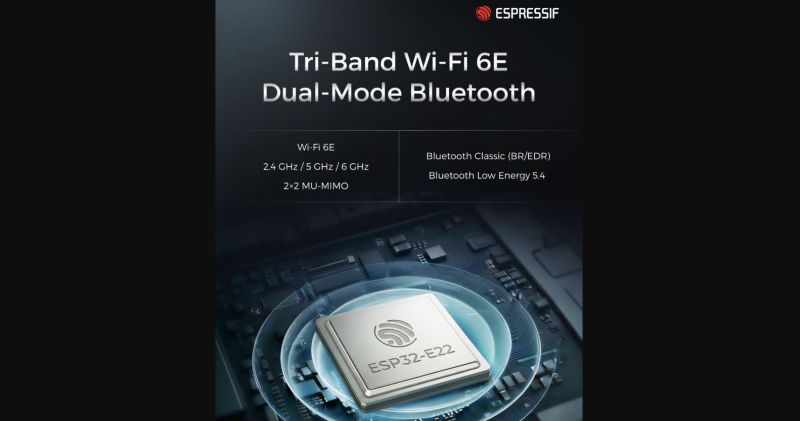
Espressif has unveiled its latest major chip in the form of the ESP32-E22. Officially referred to as a Radio Co-Processor (RCP), it’s intended to be used via its PCIe 2.1 or SDIO 3.0 host interface to provide wireless communications to an SoC or similar.
This wireless functionality includes full WiFi 6E functionality across all three bands, 160 MHz channel bandwidth and 2×2 MU-MIMO, making it quite a leap from the basic WiFi provided by e.g. the ESP32-S* and -C* series. There is also Bluetooth Classic and BLE 5.4 support, which is a relief for those who were missing Bluetooth Classic in all but the original ESP32 for e.g. A2DP sinks and sources.
The ESP32-E22 processing grunt is provided by two proprietary Espressif RISC-V CPU cores that can run at 500 MHz. At this point no details appear to be available about whether a low-power core is also present, nor any additional peripherals. Since the graphics on the Espressif PR article appear to be generic, machine-generated images – that switch the chip’s appearance from a BGA to an LQFP package at random – there’s little more that we can gather from there either.
Currently Espressif is making engineering samples available to interested parties after presumed vetting, which would indicate that any kind of public release will still be a while off. Whether this chip would make for an interesting stand-alone MCU or SoC along the lines of the -S3 or -P4 will remain a bit of a mystery for a bit longer.
Thanks to [Rogan] for the tip.











I other words, a wifi chip attached via PCIe like the typical realtek to bcom ones? Pretty much every wifi chip these days is stuffed full of firmware, sometimes loaded by linux and sometimes not. It doesn’t mean they’re usable as standalone micrcontrollers.
It makes me wonder though, considering espressif licenced the wifi IP in many of their previous chips, who supplied this wifi IP?
the end users network will assign the IP as allowed by the Internet Assigned Numbers Authority (IANA). expressing can’t assign IPs
By IP, they mean Intellectual Property, referring to the hardware, firmware, and software. For example, multiple different hardware platforms use Synopsys Designware USB hardware.
how many blobs and spy hardware inside?
https://www.cve.news/cve-2025-27840/
Espressif: releases co-processor
Community: it’s our main processor now.
Exactly what I was thinking. 500 MHz and full bluetooth? This is the SoC.
Isn’t that where it started. Wasn’t the 8266 intended as a companion to a full fat microcontroller rather than the microcontroller itself. It’s a Wi-Fi chip that just happens to have a microcontroller inside, the same way the broadcom chip in the original Raspberry Pi is a GPU that just happens to have an ARM core attached to handle user input buttons.
I recently had to ventured into the space of USB WiFi adapters. They’re all terrible with linux and even on windows the drivers are extremely shoddy. If you’re happy with a 150Mbps USB2.0 adapter, I guess its fine, but if you want say 600Mbps + Bluetooth, good luck finding something that’s supported on Linux without reverse engineered Windows only drivers. Realtek is a REAL PoC in this space.
If you have a PCIe slot to spare, just buy an Intel PCIe WiFi+Bluetooth PCIe card and spare yourself the trouble.
I’m hopeful something like this ESP32-E22 plus a USB or PCIe MCU/SoC will show up and eat Realtek’s lunch and save us from garbage drivers
Do you have this adapter? If so how does it work and what distro are you running? Was looking at getting it , however there is conflicting information on its reliability to work in monitor mode. Went with the AWUS036ACHM. although later wouldn’t mind a AWUS036AXML. Atleast for wifi6 connection speed. just wondering about the monitor mode reliability.
Are you sure you just aren’t on a very old kernel? I find virtually every realtek stuff works out of the box, and you only need to patch if you’re doing things like packet injections (which I know is a big thing for some).
Bluetooth adapters are similarly bad. Out of frustration trying to connect an xbox controller I’ve salvaged an Xbox 360 RF board and made my own adapter, rather than persevere with connecting it’s younger brother over Bluetooth. I think I’ve sent 8 Bluetooth adapters back to Amazon.
I’ve found the (now obsolete) Intel AX200 to work well for Wi-Fi, but it’s a PCIe card. I got one after similar frustration with USB Wi-Fi adapters. It also has USB Bluetooth but it seems hit and miss if it’ll work.
I was very interested in the E22 since this is the first ESP chip with dual-BT since the original one.
I had some back and forth emails with Espressif sales regarding the E22 and they finally told me:
“Regarding the ESP32-E22, I’d like to clarify that it does include an I2C interface. However, please note that the E22 operates only in slave mode and is designed as a communication passthrough module that does not support secondary development.”
That sound like it’s doesn’t support custom FW development.
If they only offered the M.2 module that would make sense to me.
But they showed a typical ESP devkit pcb too.
We are close to the 10 year anniversary of the original ESP32 and still no real successor with Dual-BT.
Thank you for those comments from Espressif. It does indeed sound like they intend the -E series to be purely auxiliary ICs and not stand-alone MCUs/SoCs. Considering the rated performance it makes you wonder what kind of Espressif chips they envision pairing it with. Maybe the -P4?
There’s no PCIe device on P4. And the USB device is anemic. So, no, I don’t think so
They told me today to wait for the unannounced ESP32-S31, there already some commit in the esp-idf for it. Look like a P4 + WiFi + BT dual
Non hackable radio ☹
“10 year anniversary of the ESP32”
I wanted to throw a party of the anniversary of the ESP8266, i found some vidéos where i was playing with it in 2013.
“My mom always said espressif is like a box of chocolates. You never know what you’re gonna get.”
Let us wait for some PDF and the first samples to see what we get.
What about ESP32-C5? Supposedly it fits between C3 and C6 AND gets upgrades.
No. It lacks power, which is why it needs the pedals, plus it’s very small, so it needs a flag on a stick to make it more visible.
ah man they removed my post. you do know that all mon mode is not for packet injection . WIDS
plus the underlying question was tangential to chipset driver compatiability. oh well, what ever
What I find interesting, is that every bluetooth adapter I have ever encountered is usb, even ones on a pcie card utilise a usb interface. It sounds like that could change
“The ESP32-E22 processing grunt is provided by two proprietary Espressif RISC-V CPU cores that can run at 500 MHz. ”
Other ESP32’s handle WiFi, Bluetooth, with only 240 MHz, single core…. Fair game to extrapolate that next-gen ESP32’s will be running at GHz speeds?