
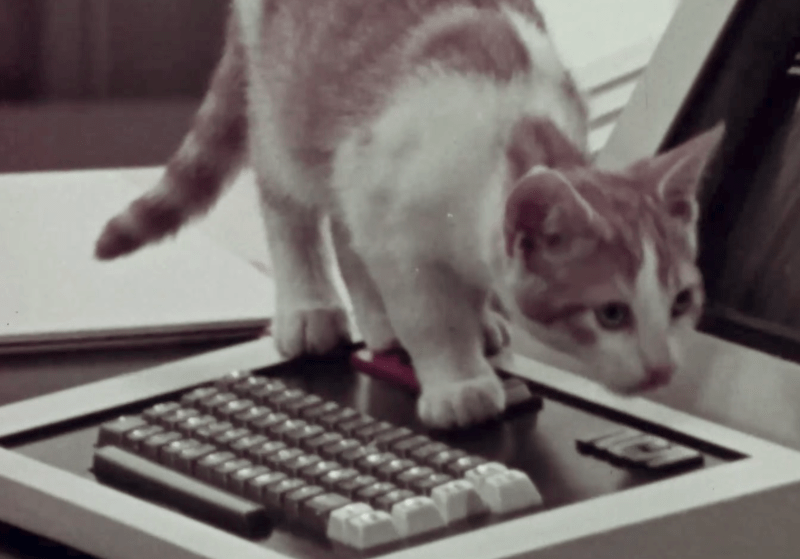
If you follow electronics history, few names were as ubiquitous as RCA, the Radio Corporation of America. Yet in modern times, the company is virtually forgotten for making large computers. [Computer History Archive Project] has a rare film from the 1970s (embedded below) explaining how RCA planned to become the number two supplier of business computers, presumably behind behemoth IBM. They had produced other large computers in the 1950s and 1960s, like the BIZMAC, the RCA 510, and the Spectra. But these new machines were their bid to eat away at IBM’s dominance in the field.
RCA had innovative ideas and arguably one of the first demand paging, virtual memory operating systems for mainframes. You can hope they were better at designing computers than they were at making commercials.
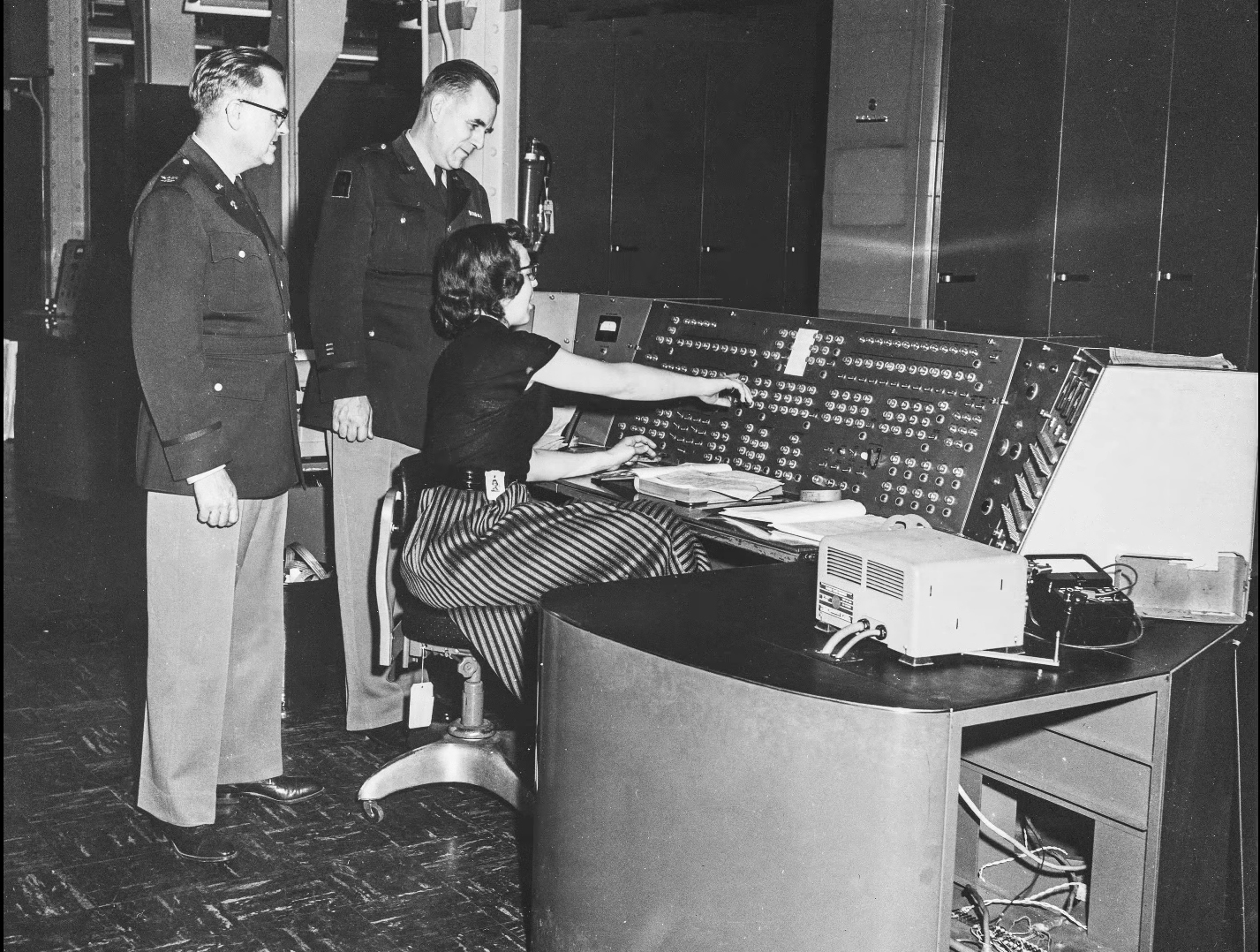
In 1964, [David Sarnoff] famously said: “The computer will become the hub of a vast network of remote data stations and information banks feeding into the machine at a transmission rate of a billion or more bits of information a second … Eventually, a global communications network handling voice, data and facsimile will instantly link man to machine — or machine to machine — by land, air, underwater, and space circuits. [The computer] will affect man’s ways of thinking, his means of education, his relationship to his physical and social environment, and it will alter his ways of living. … [Before the end of this century, these forces] will coalesce into what unquestionably will become the greatest adventure of the human mind.”
He was, of course, right. Just a little early.
The machines were somewhat compatible with IBM computers, touted virtual memory, and had flexible options, including a lease that let you own your hardware in six years. They mention, by the way, IBM customers who were paying up to $60,000 / month to IBM. They mentioned that an IBM 360/30 with 65K was about $13,200 / month. You could upgrade with a 360/30 for an extra $3,000 / month, which would double your memory but not double your computing power. (If you watch around the 18-minute mark, you’ll find the computing power was extremely slow by today’s standards.)
RCA, of course, had a better deal. The RCA 2 had double the memory and reportedly triple the performance for only $2,000 extra per month. We don’t know what the basis for that performance number was. For $3,500 a month extra, you could have an RCA 3 with the miracle of virtual memory, providing an apparent 2 megabytes per running job.
There are more comparisons, and keep in mind, these are 1970 dollars. In 1970, a computer programmer probably made $10,000 to $20,000 a year while working on a computer that cost $158,000 in lease payments (not to count electricity and consumables). How much cloud computing could you buy in a year for $158,000 today? Want to buy one? They started at $700,000 up to over $1.6 million.
By their release, the systems were named after their Spectra 70 cousins. So, officially, they were Spectra 70/2, 70/3, 70/5, and 70/6.
Despite all the forward-looking statements, RCA had less than 10% market share and faced increasing costs to stay competitive. They decided to sell the computer business to Sperry. Sperry rebranded several RCA computers and continued to sell and support them, at least for a while.
Now, RCA is a barely remembered blip on the computer landscape. You are more likely to find someone who remembers the RCA 1800 family of CPUs than an actual RCA mainframe. Maybe they should have thrown the cat in with the deal.
Want to see the IBM machines these competed with? Here you go. We doubt there were any RCA computers in this data center, but they’d have been right at home.












Oddly, I think that the teletype in the Andromeda Strain was an RCA branded one. I have an 1802 membership card.
My memory of it is that the RCA goal was to make IBM compatible mainframes, but the RCA engineers had trouble with this, and blamed the problem on IBM using undocumented machine instructions in their software.
Amdahl and other companies managed to make IBM compatible mainframes. RCA needed better engineers.
Did RCA pioneer cat-attracting keyboards or was that a prior innovation?
Either way, the legacy lives on!
We stand on the shoulders of giant cats.
Did RCA innovate kitten-attracting keyboards or was that already a thing?
Also, I have this strange sense of deja-vu as I post this comment.
OK, I’m not imagining things. When I posted this (the second time), all the previous comments had disappeared: archive.org snapshot
Yeah. We got hit by a comment-reporting attack. Someone is getting multiple IP addresses and hitting the “report comment” button, which sends them back to moderation until one of us re-reads it and pulls it out.
It’s really dumb, and we’re sorry for the inconvenience.
Perhaps it is time to update the forum software. It really is kind of showing its age – including its vulnerability to attack.
Not to throw shade on you all or what you provide here, but my 1993 WWIV BBS had more features :)
“including its vulnerability to attack.”
I imagine article that starts with “In his post [Mystic] exploits our comment section vulnerability…” that ends with “We had no way but to finally update our forum script with no edit option enabled with respect to tradition” ;-)
I’ve been working on building a replica of the RCA 70/752 Video Data Terminal keyboard purely from the maintenance manual for the last 5 or 6 years, still not finished but it’s at a (mechanically) powered state, next to do is the mountings for the interposer microswitches. I’ve used other Selectric parts, 3D printed parts, and handmade metal parts to replicate what the RCA engineers did. This terminal came at a time of conjunction of technologies: mechanical, valve(tube), transistors and early IC’s all in the one unit, it’s absolutely wild.
Wait… What?!
I’m invoking my power as President of the Internet to DEMAND you share photos/more info!
Kidding aside, this sounds like a really cool project. As President of the Internet I respectfully request you share photos/more info!
Well the project came about because I had a pile of IBM Selectric typewriters and I really wanted to build a replica IBM 1053 golfball printer. Also it was just my luck I had “inherited” four large fishing tackle boxes of IBM Selectric and other printer parts both NOS and used as well as special tools from a retired IBM Office Products CE.
So anyway with the removal of a pile of screws the Selectric can be cleanly split into two distinct sections, the ‘power frame’ containing the motor, op shaft (incl cycle clutch), tilt/rotate and print mechanism. The other is the ‘keyboard frame’ containing the keys, interposers and interposer latches. So I get two projects out of one typewriter, woohoo!
RCA moved the cycle clutch to the filter shaft and drove it from a synchronous motor. They also added a latch interposer to get 7 bits and ASCII from the microswitches. IBM actually provided a bit 7 interposer slot in the Selectric (even in the regular office variety one) but not the latch interposer itself. I made one from a scrap of sheet metal and added a frame for spring loading these, as this is usually done in the power frame.
These photos are from a couple of years ago. It is being test powered by a LEGO M Technic motor running off a LEGO Train Controller. A vintage IBM AC synchronous motor is at right waiting to have support brackets machined before fitting
Top https://www.surfacezero.com/g503/data/500/RCA_Spectra_70-752_keyboard_recreation_WIP_01.jpg
Underside showing homemade 7th bail rod and 7th bit (rightmost) latch interposer (clevises to microswitches attach to these), spring-loading frame and filter shaft with recreated spring clutch and 3D printed bearing brackets. The clutch trip has been moved from the normal centre on a Selectric to the end to be inline with the clutch, waiting for the RCA clutch pawl to be made .
https://www.surfacezero.com/g503/data/500/RCA_Spectra_70-752_keyboard_recreation_WIP_02.jpg
Powered filter shaft. Note that some keys eg. Return do not operate through the keyboard interposers but operated against the op shaft in the power frame
https://www.surfacezero.com/g503/data/500/RCA_Spectra_70-752_keyboard_recreation_WIP_03.jpg
One day I might write it up as a project, thing is I have three lifetimes of projects I am currently working on… the oldest is one I started in 1978 or so. Can’t hurry these things!
Another photo of the right side Selectric keyboard frame being machined out to accommodate the RCA filter shaft spring clutch
https://cdn.thingiverse.com/assets/34/1c/e9/9b/46/large_display_after_boring.jpg
«thing is I have three lifetimes of projects I am currently working on…«
Same here… but your’s is a cool project. Thank you for sharing.
In the ‘70s, IBM’s main competitors were referred to as an acronym “BUNCH” – Burroughs, Univac, NCR, Contil Data and Honeywell.”
To that list add Scientific Data Systems, later bought by Xerox.
Is Sperry Rand still around?
Sperry Rand become just Sperry and was acquired by Burroughs. The combined company changed its name to Unisys.
Huh. The university I attended (77-81) had a Univac 90/70, which was apparently largely based on the tech they acquired from RCA… It was a pretty nice machine – emulated an IBM 360 but ran interactive timesharing well enough to be the “general access” engineering computer.)
The video is certainly correct that the 70s were a period of revolution in the computer industry!
(RCA introduced the CDP1802 microprocessor in 1974 (single chip version in 1976.) I don’t know whether that’s a sign of their forward thinking, or whether its weird architecture was a sign of their mis-steps…)
It was a nice symmetric architecture but quite slow in execution even for an 8 bit machine, taking 16 or 24 clock cycles per instruction.I built an ELF in late seventies, unfortunately don’t have it anymore. But I do have the 1802 Membership Card. :)
really cool video actually — the guy is so low energy, super dry sense of humor, and the whole thing has that behind the scenes production crew vibe – the scene behind the scene. love it.
Also wow computers were expensive! Literally hundreds of thousands of dollars a MONTH for the higher end. what an incredible business model that must have been! What an absolute disaster microcomputers were for these guys. Imagine trying to shepherd a corporate culture from this to selling PC-XT’s w DOS and Windows. (OS/2 we hardly knew ye…)
“RCA had innovative ideas and arguably one of the first demand paging, virtual memory operating systems for mainframes.”
I’m genuinely curious. Did they actually have these “innovative ideas” or did they simply steal them from others?
Don’t get me wrong… RCA was a very important player in the Golden Age of radio, and their dominance might arguably have benefited the industry as whole, at least in terms of steering standards and making things affordable through economies of scale.
I would add I have a soft spot for RCA as a player in early computing, as my first computer was a COSMAC 1802.
But my reading of history has left me with an impression of David Sarnoff as a horrible person… a predator of sorts… an industrial version of the schoolyard bully who smashes one kid’s lunch, routinely steals another, and when called out by the victims says, “What are going to do about it, punk?”
Read about Sarnoff’s treatment of Edwin Armstrong (who ended up un-aliving himself) or Philo Farnsworh, for example. Both later won cases against RCA (or at least settlements), but by then it was too late, anyway.
I thought that Burrough’s large systems had the first virtual memory operating system.
“The lineage began with the B5000 in 1961 and the B5500 in 1964, introducing groundbreaking concepts like virtual memory and stack machine instruction sets years before widespread adoption by competitors”
Like many other concepts, virtual memory was pioneered in academia. The University of Manchester implemented it in a computer in the late 50s.
I did not think Hackaday would share this video, but I am so glad they did.