

LED lighting is now commonplace across homes, businesses, and industrial settings. It uses little energy and provides a great deal of light. However, a new study suggests it may come with a trade-off. New research suggests human vision may not perform at its peak under this particular form of illumination.
The study ran with a small number of subjects (n=22) aged between 23 to 65 years. They were tested prior to the study for normal visual function and good health. Participants worked exclusively under LED lighting, with a select group then later also given supplemental incandescent light (with all its attendant extra wavelengths) in their working area—which appears to have been a typical workshop environment.
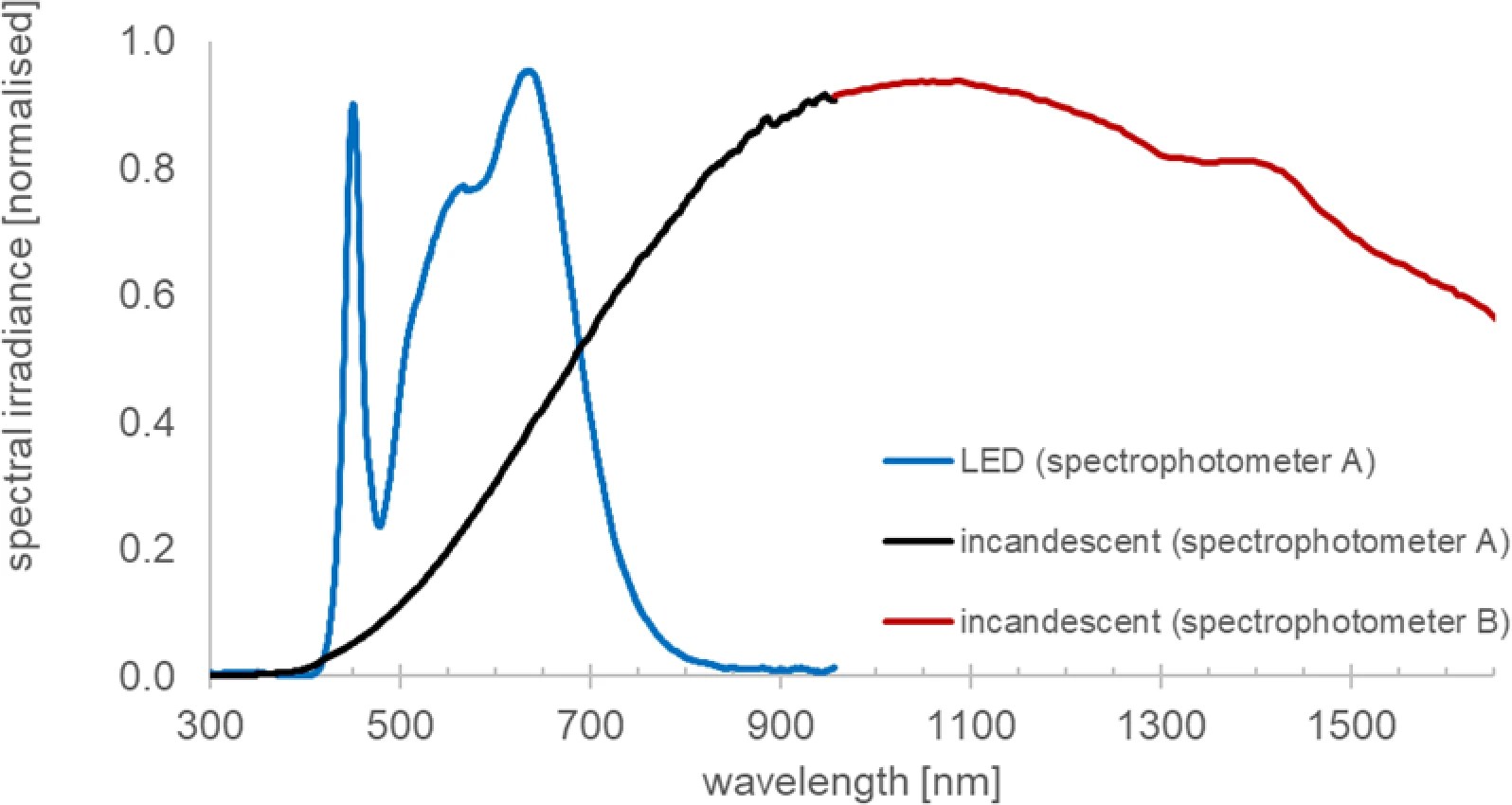
Notably, once incandescent lighting was introduced, those experimental subjects showed significant increases in visual performance using ChromaTest color contrast testing. This was noted across both tritan (blue) and protan (red) axes of the test, which involves picking out characters against a noisy background. Interestingly, the positive effect of the incandescent lighting did not immediately diminish when those individuals returned to using purely LED lighting once again. At tests 4 and 6 weeks after the incandescent lighting was removed, the individuals continued to score higher on the color contrast tests. Similar long-lasting effects have been noted in other studies involving supplementing LED lights with infrared wavelengths, however the boost has only lasted for around 5 days.
The exact mechanism at play here is unknown. The study authors speculate as to a range of complex physical and biological mechanisms that could be at play, but more research will be needed to tease out exactly what’s going on. In any case, it suggests there may be a very real positive effect on vision from the wider range of wavelengths provided by good old incandescent bulbs. As an aside, if you’ve figured out how to get 40/40 vision with a few cheap WS2812Bs, don’t hesitate to notify the tip line.
Thanks to [Keith Olson] for the tip!












Wow, who knew, adding a task light to your work place improves performance. I scrolled through the research paper and i couldn’t find the control group where they gave the people LED task lights instead of incandescent task lights. That is a huge oversight.
Also only 22 participants.
Furthermore, they appear to have used very shitty LED lighting. That huge blue pump diode peak is not there in good quality lamps. Some of it is there but the YAG phosphor output can follow the incandescent curve in the blue direction quite nicely. Some deep red may be missing, but LED chips with multiple dies (blue+YAG+monochrome red) are in development. I guess you could add IR leds to that too.
That would be the proper test if IR light improves wellbeing and/or performance. Led overhead with led task light, and then the task light with or without additional invisible IR radiation.
Right, but are “quality lamps” what most people are going to be exposed to, day to day?
Talking about “day”, where is the line for “actual daylight”?
It’s hard to find high CRI lamps in the stores because people just don’t know to demand them. They don’t know what it means, they’re less efficient and slightly dimmer, and they cost significantly more, so they don’t sell well.
When you go to the hardware store to buy a lamp, it’s all the same cheap junk, at any price you may wish to pay. You have to go out of your way to find a LED lamp with a CRI of 95 or better.
Not to mention the products that people buy out of the bargain bin… you’re lucky if it doesn’t strobe at line frequency like a dying fluorescent tube in a freezer. “Warm” colored bulbs might even cast pink because of the blue diode in combination with a deep red, missing almost everything in between. It just looks wrong, which is why many swear by the cooler “daylight” bulbs instead, which are far too blue for normal living spaces and lighting intensities.
People use terrible lights, and because the color rendering is poor, the color temperature is mismatched for the amount of light, and the light is unstable at worst, it feels like you can’t quite see properly. Like you can’t focus your eyes. To compensate, people install more powerful lamps and light their living rooms like office spaces and factories.
I would say it’s changing. I started noticing CRI ratings appearing on even cheap lamps recently. Of course the ratings are fabricated as these are cheap products from China but their presence indicates growing customer demand.
Yes, they tend to print them if it’s above 80 like everything else, and leave it out if it’s below.
In comparison, the old spiral CFL bulbs never went above CRI 85 to 87 and people hated them, for various reasons, until they banned the regular light bulb and that’s all you got. Most LED products on the market are just as bad or much worse – the only practical difference is that they don’t take a minute to warm up.
Also remember that the CRI number was printed on compact fluorescent bulbs 20 years ago as well, and the consumers didn’t get the point then either.
Some models were made with CRI above 90, but they were more expensive and nobody stocked them because they didn’t sell well. You couldn’t get a good CFL tube to compare, so the consumers never thought to ask for them, so nobody made them. Progress halted at the lowest common denominator and the lamps were cost-optimized barely above the point of the average consumer developing a migraine.
Same thing with LEDs. Phillips did the L-Prize 60 Watt equivalent LED bulb that got CRI 99 simply to win a competition and collect some sort of a subsidy, then priced it at $50 a pop, and soon pulled it off the market. They never wanted to sell them, because they wanted to cost-optimize the LED bulb for lower quality and greater profit.
https://en.wikipedia.org/wiki/L_Prize
So not quite 99 but up there with the best. Notice also the light output, where these days a “60 Watt equivalent” is considered to be anything from 600-800 Lumens. It didn’t fade, it didn’t shift color. It was as close to an incandescent bulb as you could get. and it was 20 years ago.
So why do we have all this crap on the market now? Because consumers don’t know what any of this means, the manufacturers aren’t too keen on telling them or selling them anything other than the cheapest junk at upmarket prices, and most people just don’t care.
You buy them from home improvement stores, because people want the lighting they just installed or whatever to look as good as possible, at least at first.
I’d think it’s not THAT hard to locate an LED bulb made by Osram or Phillips which will be at least halfway competently made compared to the “cheapest possible junk” that floods the market without having to source professional lighting gear.
This has enough flaws in it just from what Lewin posted that I didn’t even go to the article. Its entire premise seems to be that mild optical illusions (misprocessing by the brain) exist, and they can be learned to be processed out. Thats not even getting to the small sample size or light quality. This feels like it was a PhD paper, or a publish or die quota filler. I hope HaD doesn’t have a publish or die quota that caused a garbage paper to be seen as exciting…
It does read like a textbook example of the Hawthorne effect.
Whether you add lights or dim them down, the fact that you’re changing things and measuring the outcome makes people change their behavior for the better.
Ignoring the small n in this, the comparison between LED and incandescent in a workplace environment pointedly ignores heaps of data that already exists. The difference is that the LED is, in fact, just another fluorescent light (UV emitter + phosphors) and that work has been done for decades. Remember the cold, blueish glow of cubicle farms, factory floors, and waiting rooms? They went somewhat by the wayside with better phosphor mixes and that’s been continued as LEDs grew from tiny indicators to whole-building light sources. It seems that the authors never considered this.
This leaves the question of why the work was done in the first place. Usually things like this pop up at the behest of industry/trade groups or advocacy of a particular technology or product (light pipes anyone?) but Barrett seems to be a lighting uber-geek so it may be he was up for tenure. Nature publications never hurt with that.
We’ll see if he pops up selling “health lights”, “Light guided meditation”, “lighting systems for improved productivity”, or continues doing interesting and fairly diverse things. If he goes over to the Dark Side (administration) we can be assured the office will be well-lit.
Lift the ban on true blackbody radiators. Let the market decide which lamp they want to buy.
I’ll take an incandescent bulb lighting my book over this huge waste of power called “AI” any day.
That’s so true. I didn’t give up incandescent to save electricity just to pay more so someone else can waste it.
Hint: incandescent appliance light bulbs are still available. You can even find frosted bulbs, and they’ll last longer than the standard halogens, though ironically they’re even less efficient. They’re the same as “rough service” lamps – old fashioned tungsten bulbs with sightly thicker filaments and more supports.
They’re officially supposed to go in your oven or fridge, but there’s nothing to stop you screwing one into your desk lamp or ceiling light fixture. Just make sure it can handle the heat – modern ones are made with a plastic that will melt.
Each kind of lighting has its own look.
I liked that the old sodium and mercury vapor lights made the night hideous. Them and camcorder tech in the early days of the show COPS looked properly dismal as compared to LEDs and digital cameras that make the night too clean.
The latest
https://phys.org/news/2023-04-rethinking-incandescent-lightbulb.html
https://www.spacedaily.com/m/reports/A_nanophotonic_comeback_for_incandescent_bulbs_999.html
https://www.nature.com/nnano/journal/vaop/ncurrent/full/nnano.2015.309.html
Yeah, that’s been tried. Placing the filament between IR reflecting mirrors recycles the heat back, but it’s expensive and the average consumer is already trained to accept lower quality LEDs instead. The problem was never really efficiency. Lighting only consumed a small portion of household energy to begin with, and fluorescent tubes and others were available for where efficiency did matter, for whom it mattered, so it was up to choice.
People chose incandescent bulbs because they were more pleasant. We didn’t actually need the LED bulbs – we only wanted them because the CFLs we were later forced to buy were so terrible. The real problem was that the incandescent bulb was too cheap and too good, and everybody could make them since the patents had long expired.
If you sell the same thing as everyone else, you have to compete with price or quality. If the quality is already the best it can be, then you have to compete with price. If you compete with price, you don’t make great profits. To make money, you need to avoid competition, which means differentiating your product somehow. You need to change it, then patent it, trademark it, copyright it, do whatever to make it exclusive – hire Hollywood stars to pretend that it’s chic to use your special light bulbs. Hire activists and lay down astroturf to pretend that it’s an environmentally conscious and responsible choice. Anything to persuade the public to at least try.
But still, if the product you’re differentiating from is already optimal, making changes means making bad compromises, which won’t attract people away from the original. You have to force the change, which means you have to get rid of the competition entirely. Pay the government to ban it, under some flimsy excuse of ineffective environmentalism.
That’s the real light bulb conspiracy, The companies that made light bulbs didn’t want to sell incandescent bulbs any longer, because it wasn’t a monopoly any more. They couldn’t innovate anything better, so they made it worse.
That incandescent bulbs produce heat should not be a disqualifier.
One such bulb might just be more efficient than having both a dedicated heater and LED lighting for isolated storage rooms, perhaps. The bulb burns out, then the other two activate, and the higher draw tells you a filament has broken.
Not to mention that a regular incandescent bulb is Earthy-friendly and almost completely recyclable.
Try that with your “lasts for 20 years”, plastic-encased LED lamp that failed 2 years in.
Some more food for thought – as our eyes age and loose our blue sensitivity, we loose much more with LED sources that simulate white light:
https://www.mikewoodconsulting.com/articles/Protocol%20Winter%202020%20-%20Our%20Ageing%20Eyes.pdf
“lose”
I wonder if this is similar to why any non warm-white & shitty “color accuracy” LED bulbs meant for replacing incandescent and fluorescent bulbs always put me in a shitty mood long-term.
Though I always bought high-end warm-white LED fixtures if I had to buy the type advertised as having non-replacable light source.
Partly because I didn’t want to replace a whole fixture if LED’s die or get sufficiently dull relatively early, or cobble up a replacement part for it if the OEM one is some weird shape or voltage/current requirement.
Whether cool white (4000k) or daylight (6500k, which is NOT sunlight – sunlight is closer to 3500k in western europe) is appropriate depends heavily on the illumination level. Search for ‘Kruithof diagram’.
The darker it is, the lower the color temperature needs to be (which is why dimming incandescent lamps is pleasant). In a brightly lit (say 500lx or more) electronics assembly line, the warm color of incandescent lamps is detrimental and unpleasant, and a 4000k color temperature feels much nicer.
6500k daylight at medium levels like 300lx in an average office particularly unpleasant. Everything feels gray and cold. But up that level to 800lx and suddenly you have a refreshing activating atmosphere.
This is also why 6500k LED street lighting in residential areas makes it feels so bleak. At those levels, the 2200k golden white/yellow of old school high pressure is more appropriate. Good municipalities use 2700k LED lighting in residential areas, which is really comfortable. It’s dimly lit, but feels cozy.
I use both 2500k, 2700k and 4000k >90CRI LEDs at home. The 4000k ones i use in the daytime in autumn and winter to remove the gloomy sensation of the everlasting dutch cloudy weather. 4000k matches the outside light with heavy clouds very well.
2700k and 2500k are used in the evening with low light levels in the order of 75lx.
I agree that the narrow spectrum peaks of LED lighting may cause some perception oddities.
However, given that most of us are exposed to broadband lighting at some point during the day (incandescent or sunlight), the claim that exposure thereunto shifts color sensitivity in a lasting way makes me very skeptical about this set of claims.
We do know that color perception renormalizes to try to compensate for the lighting available; the Land effect. Under orange halogen street lights, a red car may be seen as grey, as we try to subtract out the overall lighting bias. It is possible that seeing specific objects under broadband light allows us to recalibrate our expectation of, and therefore perception of, their colors.
I do have to say that replacing the old fluorescents in my workshop with “daylight” LED fixtures made the space tremendously more pleasant for me. But that may be because I also nearly doubled the lighting level.
I will also point out that historically switching offices from incandescent to fluorescent lights produced both positive and negative reactions from those working in these spaces. (As evidence, I cite the lyrics of the song “Coffee Break” from the musical How to Succeed In Business (Without Really Trying), where fluorescent lights, though desirable, rank below coffee.)
I do like decent fluorescent lighting. But one thing that LED’s don’t but fluorescent lighting does is HUMMMMMMMMMMMmmmmm. Okay, I know it not the light that does it, it’s the ballast but still, it’s pretty noticable. On the other hands, it doesn’t distract from the BBBBBBBRRRRRRRRZZZZZZZ of the coffe machine, the WHEEEEEEEEEEEEEE of the fans in the patchpanel cabinet or the RRRRRRRRRRRRRRRRRRRRRRRRRRRRRRRRRR coming from my PC fan. Sure my co-workers complain about my loud typing YTERWYTVWYTBFWYTBFWYTBFWYTWB but that does not seem to bother me personally and it keeps me awake preventing me from falling… ZZZZZZZZZZZZZZZZZZzzzzz ZZZZZZZZZZZZzzzzz ZZZZZZZZZZZZZZzzzz
I have not seen (or heard) a magnetic ballast in this millennium. They and their radioactive starters went the way of the dodo. Ballasts have been solid state and quiet for decades now. (that is, RF noisy, but acoustically quiet.)
Could be, but I happen to work in an old building with an installation that dates back to the end of the previous century. I’m fully aware of modern ballasts, but there is no reason to throw you entire fully working installation away and replace it just because you can. We’ve done some experiments with LED replacement tubes, but they caused more trouble than they were worth. As the units tested seemed to produce a lot of RF noise, which was not to be preferred at that moment. Things got better, but we never tried those (yet).
Although regulations will eventually force us to upgrade. But until then the oldskool chunk of metal and copper wire will remain solidly mounted to the ceiling directly above my head. And to be honest, it has it’s charm, especially when once in a while an old tube gives up the ghost and starts blinking like hell, but the fun begins when a second tube goes and the start to blink out of sync (might take a few extra months to get to that point) sending out that late 90’s vibe of a first person shooter game where you walk your character through darkly lit rooms with heavily flickering broken fluorescent lighting. Regarding the radioactive starters… that’s a bit of an overstatement with radiation to be neglected. Regarding the dodo, people ate them, people did not eat starters, perhaps the people who did eat the dodo’s did eat a starter first but those are different kind of starters as these had not been invented at that point. Anyway, both went a different way, although you are right that both are not as common as they used to be.
Some of the old fluorescent lamps hum, most do not. I have one solidly made two tube fixture from early 70´s and the ballasts absolutely do not hum at all. Once I added a large capacitor in series to other ballast for phase shift to reduce flicker. It worked well with some minor buzz noise and more heating of the ballast in use and random popping while starting. Eventually the capacitor failed open and I removed it. I have couple of fluorescent desk lamps and they do hum.
Considering most indoor work environments at the moment are lit with either LEDs or florescent lighting, I’m not sure what the relevance of these findings are.
{trollmode} simple. solve it with MOAH LIGHT like they do with cars. that makes everything better… {/trollmode}
Bring back tallow candles
I much prefer whale oil lamps
And carbide acetylene headlights.
It might be hard to imagine some future government with kooky ideas about technology and health coming to power, but bear with me: a country where masked police roam the streets with spectrometers looking at people’s illumination at night and kicking down the doors of those not using “proper patriotic” bulbs!
The future is here and now.
… and arrrressssting those deemed “obtaining bulbs from unfriendly countries” …
We already had that – when the government told you you couldn’t have incandescent bulbs anymore.
They were very prescient, those technocrats – they knew we were going to need to save money for Silicon Valley’s AI datacenters so people could generate pictures of politicians in bikinis.
LED lighting is poorer for task lighting, just compare to a halogen lamp and you will notice SMT rework is so much easier.
When I researched the “why” behind this, the papers said high (long wavelength) red spectrum is essential. So warm white LED’s, no flicker as well, are much better than “pure white” malarkey.
This sure looks like the Hawthorne effect – Wikipedia https://en.wikipedia.org/wiki/Hawthorne_effect
Yeah I thought the same. I didn’t read the study though, Hawthorne effect is so classic that I would have expected them to consider it.
When you have a predetermined goal you only worry about the effect if it’s negatively impact your goal.
Why would you share a google link instead of pointing directly to wikipedia?
Why ask? The tasty, tasty involuntarily-provided metadata should speak for itself, right?
Fixed. We don’t need to be hosting those either.
Isn’t it 20/20 vision you’re looking for, not 40/40?
Would there exist some kind of filters toning down the blues AFTER?
Considering the short IR exposures needed (3 minutes already had an effect), maybe we should just go outside during the day.
IR could readily be added for evaluation with LEDs.
Then you might not be on your phone!
That graph of spectrum is one of the most deliberately misleading graphs I’ve seen in the past several years.
We can’t see anything outside the 400nm to 700nm band. Pretending that the huge swath of 700nm and longer is relevant can only be there because the authors are either ignorant or trolling.
780nm is visible if it’s bright enough
No. You think you can, but all what you see is stray light and harmonics of the source, which are all in fact lower wavelengths.
There are genetic variations, and some people even have four different color receptors in their eyes. The longest reported wavelength that people may be able to see is 850 nm.
Yes, tetrachromacy exists, however that cone type is between the M (green) and L (red) cone type spectrum. It doesn’t give you the ability to see near infrared.
Entirely aside from whether we can or cannot see light in the 700nm-850nm band (we sorta can, we practically can’t, in the sense that it does not contribute to how well you can do a task or perceive something), the entire portion of the graph to the right of that? Just pure lies.
Oh, I don’t know about that. It’s -7 degrees outside right now, and I have a 400-watt source of 1000-2000 nm radiant light right behind me. It’s making my space much easier to do tasks in.
Just because your eyeballs don’t see it doesn’t mean it has no effect.
But doesn’t that 780+nm output create a WARM and fuzzy feeling? ……
It kinda sounds like that was the goal of the paper in the first place – just from reading the summary and a few comments it sounds like there was no proper experimental control, no blinding, etc.
There is an increasing body of work in addition to this report indicating beneficial effects of InfraRed and Near infrared not limited to the visual experience of light. Not only have we lost these wavelengths in LED light but they are filtered out of daylight through windows and glazing due to glass treatments to reduce heating from sunlight and to retain heating inside the building at night and in winter. I would like to see the paper this comes from.
Yes, do read it! It’s not all that long. The link to the paper is at the top of Lewin’s summary. The summary is, of course, shorter than the paper, and leaves out some info that would have been helpful to the commenters above.
For instance, there was a control group. The hypothesis was about visual improvements after regular exposure to wide-spectrum infrared, not visual improvement during exposure to that lighting. The visual contrast tests were not taken under the work lighting conditions, but in a dark room. The contrast tests don’t sound like the kind of thing that would be very subject to the Hawthorne effect.
So, I’m not saying that the paper’s conclusions are necessarily correct, but I do find their results difficult to dismiss without further evidence.
There are several studies indicating that limited exposure to natural light outside leads to the development of myopia.
I became interested in this because I am nearsighted and I believed, and still believe, that the entire related sector happily exploits this factor… a huge business.
But now you might say that this is all nonsense. Well, first, you could look at what has been observed in the studies I mentioned, but I want to add my own personal experience, which all nearsighted people can verify for themselves: when you realize you can no longer focus, expose your eyes to the sun (obviously not looking directly at it) for half an hour without glasses, then go back indoors. You’ll immediately notice that the approximately 0.25 diopters you lost have been regained. And, mind you, this isn’t the result of a temporary constriction of the pupil, because if that were the case, it would only last a few minutes.
The problem of artificial light is unlikely to surface because people are unaware of the topic and because there are people who make a living from it in various sectors—opticians and optometrists, for example—who have made, and continue to make, tons of money. Furthermore, few of them are aware of the importance of sunlight, and those who are aware don’t care for this obvious reason.
Yeah, this could have been “researched” by asking anyone working under this lighting for five minutes. It’s worse than those “greenish” florescent’s of the olden days.
The effect may not even be mediated by the eyes!
“Longer wavelengths in sunlight pass through the human body and have a systemic impact which improves vision”
https://www.nature.com/articles/s41598-025-09785-3
LED lighting has replaced fluorescent lighting, like the fixtures shown in your articles picture, not incandescent lighting. I haven’t seen widespread use of incandescent lighting in commercial or industrial spaces for over 50 years. Sure the odd desk lamp was incandescent or halogen (remember those) but the energy efficiency of fluorescent lighting pushed commercial lighting away from incandescent over half a century ago. The adoption of “warm” fluorescent bulbs in response to wide spread dissatisfaction with the cold glare of old fluorescent bulbs indicate that people were well aware of the impact of light quality on human performance and I’m sure many older studies exist. https://youreyeinstitute.com/is-office-lighting-affecting-your-vision/
It seems obvious that the closer a light mimics the visible solar spectrum the better my eyes, which evolved over millennia to make use of this solar spectrum, will function. As others noted good full spectrum LED lighting exists if you are willing to pay for them. The same was true of halogen lights, fluorescent lights, whale oil lanterns etc.
remember incandescent light manufacturers are the perpetrators of the largest conspiracy documented? maybe people should get outside?
fluorescent lights have been in most work places for nearly 70 years? they produced little IR lught?