
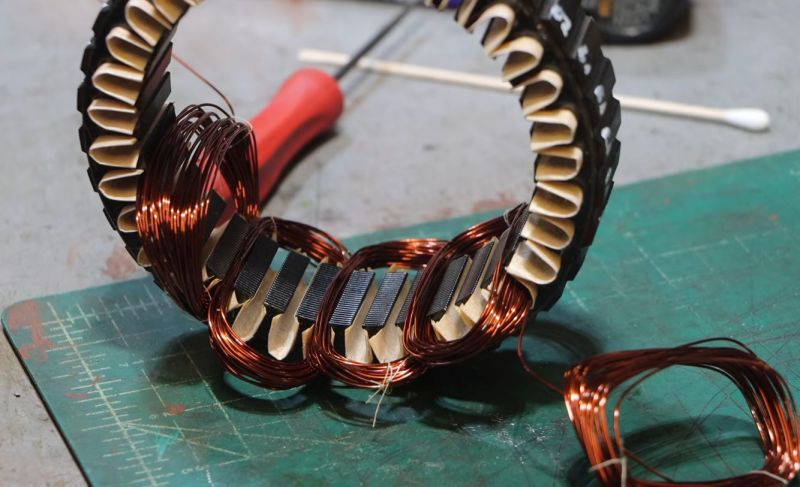
As part of his quest to find the best affordable generator for his DIY hydroelectric power system, [FarmCraft101] is trying out a range of off-the-shelf and DIY solutions, with in his most recent video trying his hands at the very relaxing activity of rewiring the stator of an alternator.
Normally car alternators output 12VDC after internal rectification, but due to the hundreds of meters from the turbine to the shed, he’d like a higher voltage to curb transmission losses. The easiest way to get a higher voltage out of a car alternator is to change up the wiring on the stator, which is definitely one of those highly educational tasks.
Disassembling an alternator is easy enough, but removing the copper windings from the stator is quite an ordeal, as they were not designed to ever move even a fraction of a millimeter after assembly.
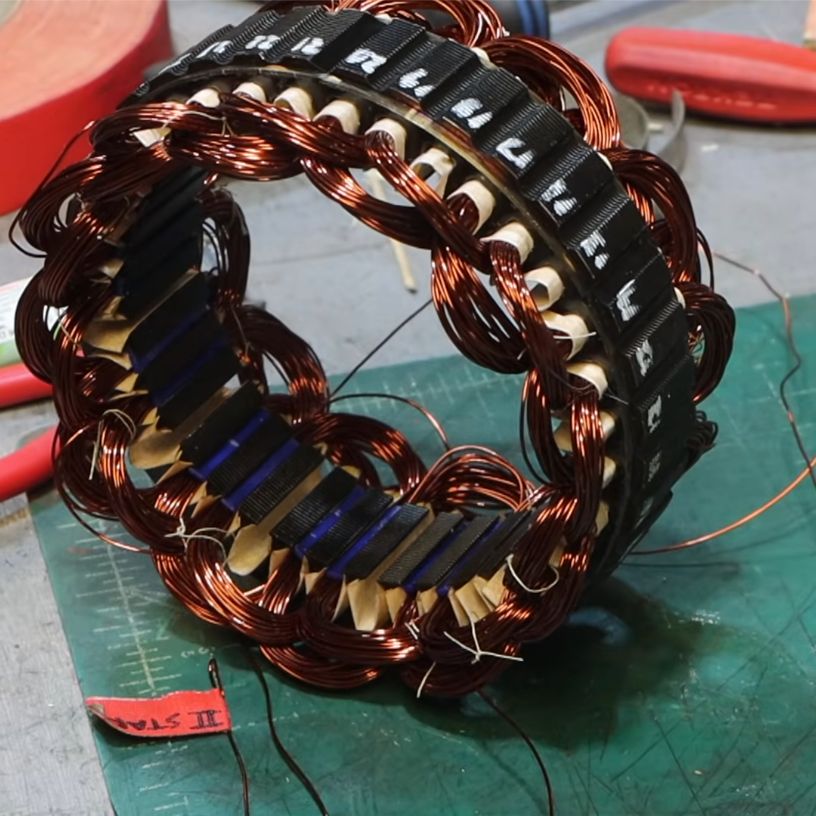
With that arduous task finished, the rewinding was done using 22 AWG copper enamel wire, compared to the original 16 AWG wire, and increasing the loops per coil from 8 to 30. This rewinding isn’t too complicated if you know what you’re doing, with each coil on each of the three windings placed in an alternating fashion, matching the alternating South/North poles on the rotor.
Each phase’s winding is offset by two slots, leaving space for the other two phases, which then correspondingly are 90° out of phase when running, creating the three-phase AC output. This is further detailed in the video.
To make sure the windings do not short out on the stator, each slot has a bit of Nomex insulating paper placed into it, and a PETG 3D printed slot holder makes sure that none of the windings sneak out of their slot after installation.
The phases were connected in a Wye configuration, which gives it the maximum possible voltage rather than optimizing it for current as in a Delta configuration.
With the rewinding done, the alternator was reassembled, and the three-phase output of the new stator tested. After some trial and error it was able to do 200 VDC after passing it through an external rectifier, for a total of 700 Watt.
While not an unmitigated success, it seems quite possible to use this alternator as a higher-voltage generator with the hydro setup, especially after the upcoming replacement of the rotor’s electromagnet with neodymium magnets to further simplify it. As a bonus, if he ever needs to rebuild a broken alternator from scratch, rewinding a stator is now child’s play.











Back in the day, there was an ad that often ran in the back of magazines like “Popular Science” for a device that could modify an alternator be be able to produce 120 volts (and revert back to 12 volts with the flip of a switch). I assume the alternators involved had external regulators (and maybe external diodes?).
Does anyone know how these worked (if they worked)? The claim was that you could get enough power to run electric saws and such. There was a lot of “snake oil” sold via ads like that, so I’m not at all confident that it was real.
They apparently existed for real and did actually work:
https://www.ford-trucks.com/forums/417225-electrical-outlet-plug-in-under-the-hood-what-is-it-2.html
They play some funny games to get 120VAC out of the alternator. From the way folks talk, they worked but had a fair chance of killing your alternator if you overloaded it.
The alternator back then were rated for 40 or so amperes. At 12VDC, that would be close to 500 watts.
Supposedly, you could get about the same power on AC. 500 watts at 120VAC is around 4 amperes. If your AC device needed more than 500 watts or drew more than 4 amperes at any point, it would overheat the windings and burn them out.
I did read an article about those years ago. all they do is run dc to the slip rings, more dc in, more voltage out. that’s all there is to it. although the wattage of the motor scales the bearings do not.
More stick-to-it-iveness than me. I didn’t have the patience to rewire a stator. Faced with a similar problem I first thought about just using a 3-phase transformer then rectifying to high(er) voltage DC. Instead, I just put the alternator DC output directly into an DC-DC boost converter to make 60 V. Good enough to push 500 W a few dozen meters with good efficiency over 12 ga wire. The load is a 48V battery. For longer haul or higher power I would have picked a COTS AC inverter and push 240 Vac instead.
Yeah I got burnt out just watching him do this. I get why he did though, he’s gotta find some solution for what he wants.
did you check what output voltage you could get without the regulator?
And manually set the field current? No. Didn’t bother. Built-in bridge & regulator — didn’t bother opening it. I just take the 14.6 V, 13.8 loaded.
I think this is a cool project, I totally get doing things the hard way just… because. While I was looking at this I also thought “Wouldn’t a transformer (or actually three, or six) be the right way to go?” Well, ok, yes, a lot of magnetics on both ends – three step up transformers on the alternator end and three step down ones at the load. But in principle it shouldn’t be hard to boost it up to several hundred volts.
The fun part is you could use then step down by the same ratio at the load end. Run a fine-gauge wire from there back to the regulator, still attached at the alternator end, and you have regulated 12V (probably 13.6 really) at the load that compensates for line losses. That skinny little 24 guage wire or whatever wouldn’t care more than a few mA, no problem – it’s just a sensing lead.
Yeah, it’s pretty hard/impossible to find a small 3-phase transformer, and rolling your own would be even harder than rewinding the alternator stator. It would have to be three ordinary transformers, which makes the DC-DC converter look attractive.
There used to be a Lindsey Publications booklet called Alternator Secrets. Someone posted a copy here:
https://www.otherpower.com/images/scimages/1431/Alternator_Secrets.pdf
Sanity check: 90 degrees out of phase, or 120?
Yep. You’re sane.
Years ago I got a tall stack of (then) old Mother Earth News magazines from the 1970’s. There are a lot of surprisingly practical projects in there, including several reworkings of alternators to use them for wind and other power. I recall that one exchanged one set of windings for permanent magnets. They also had a project where one was used with a lawnmower engine and chassis to build a stick welding machine.