
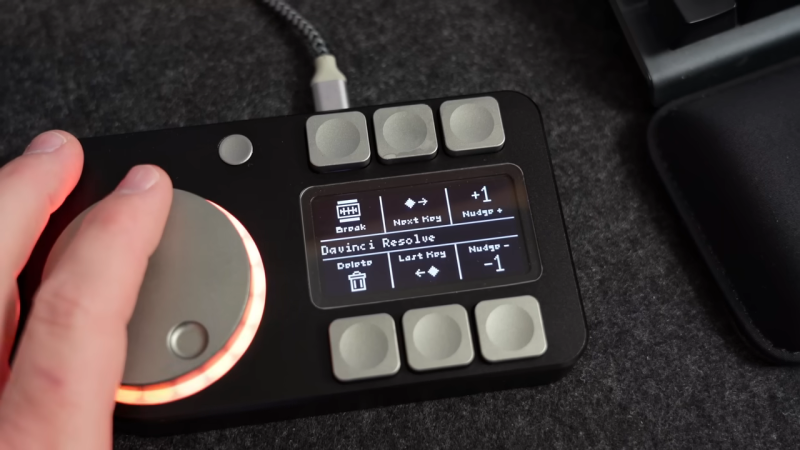
Macropads can be as simple as a few buttons hooked up to a microcontroller to do the USB HID dance and talk to a PC. However, you can go a lot further, too. [CNCDan] demonstrates this well with his sleek macropad build, which throws haptic feedback into the mix.
The build features six programmable macro buttons, which are situated either on side of a 128×64 OLED display. This setup allows the OLED screen to show icons that explain the functionality of each button. There’s also a nice large rotary knob, surrounded by 20 addressable WS2811 LEDs for visual feedback. Underneath the knob lives an an encoder, as well as a brushless motor typically used in gimbal builds, which is driven by a TMC6300 motor driver board. Everything is laced up to a Waveshare RP2040 Plus devboard which runs the show. It’s responsible for controlling the motors, reading the knob and switches, and speaking USB to the PC that it’s plugged into.
It’s a compact device that nonetheless should prove to be a good productivity booster on the bench. We’ve featured [CNCDan’s] work before, too, such as this nifty DIY VR headset.










All good and cool and all.
The macropad itself has haptic feedback for functions. OK, good.
But what “normal” software provides any kind of haptic feedback? It would be neat, for example in DaVinci Resolve, to let the wheel freewheel when scrubbing through a video, but “hit a wall” and stop at the end of the track. Or hit detents between clips. Or vibrate for a warning or error.
Is there any kind of standard for this sort of feedback?
I think this one-way only. i.e. you set up your macros and wheel behaviour in the macro pad, then choose which set to use, based on your current running application. There doesn’t seem to be anything coming back from the PC to change modes, or to change what’s on the screen. Scope for future improvement, perhaps? Or implemented by another project somewhere?