
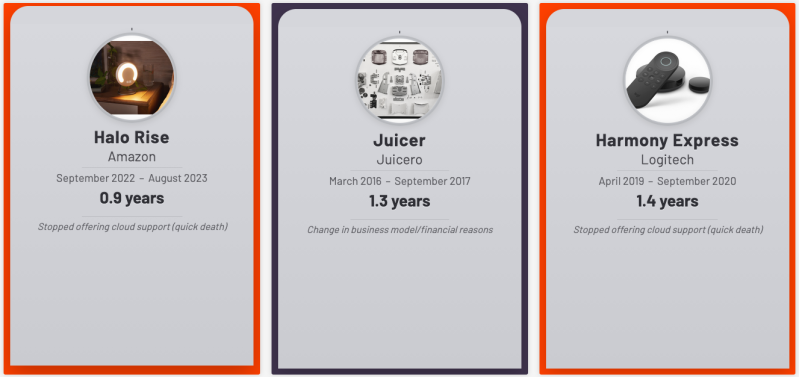
Everyone here can think of a cloud-connected product that was killed because the company that made it stopped supporting it. While these corporations have forgotten their products, the US PIRG Education Fund has immortalized them in their Electronic Waste Graveyard.
With an estimated “130,000,000 pounds of electronic waste” produced since 2014, the amount of wasted resources is staggering. The advent of the cloud promised us reduced waste as lightweight devices could rely on remote brains to keep the upgrades going long after a traditional device would have been unable to keep up. The opposite seems to have occurred, wreaking havoc on the environment and pocketbooks.
Of course, we can count on hackers to circumvent the end of companies or services, but while that gives us plenty of fodder for projects, it isn’t so great for the normal folks who make up the rest of the population. We appreciate PIRG giving such a visceral reminder of the cost of business-as-usual for those who aren’t always thinking about material usage and waste.
If PIRG sounds familiar, they’re one of the many groups keeping an eye on Right-to-Repair legislation. We’ve been keeping an eye on it too with places like the EU, Texas, and Washington moving the ball forward on reducing e-waste and keeping devices running longer.












Where I used to work, the guy who ran the model shop had a board with all his “expired” electronics on it. Cell phones, handheld games, I think he even had an Apple Newton…pretty neat display.
Say goodbye to aftermarket firmware for legacy devices dependent on defunct cloud:
https://en.wikipedia.org/wiki/Cyber_Resilience_Act
I did read the text, and I’m not sure it says what you think it says.
This assumes the devices become waste when software updates stop.
Something like a Zune HD, while abandoned and obsolete, can still have music loaded onto it without any software updates. Therefor the essential functionality is there.
An old Chromebook that doesn’t have a supported browser is at best a device that must be repurposed into a Linux machine before it can avoid the landfill.
Juicero was over-engineered, but the distribution model of vegetables in packets might have worked splendidly. They could even have been transparent: “You can squeeze our packs by hand, or here is a manual squeezer for $49, or consider our deluxe Wi-Fi-enabled model that has juice ready when you wake up.” The real money was in the ongoing purchases, not in the hardware. They could have even done a monthly subscription, shipping to the house.
Hey maybe I should do this lol
There’s a guy I watch on YouTube called AvE. He did a teardown of a Juicero and discussed the business plan as he tore it (both, really) apart. It’s worth a quick google.
But why? Why can’t an average person buy whole fruits and vegetables and make their own juice to consume? Either with a machine or through the time honored traditional of human mastication?
Buying day old vegetable pulp that lacks any preservation seems hardly better than buying a bottle of juice to me. But I also don’t see the point of juice in general.
Because they like the idea of freshly squeezed juice, but don’t want to deal with washing the blender every time.
It’s an old health fad that became normalized. Of course people had made juices since pre-history, mainly to make alcohol and vinegar, but the modern habit of having a glass of orange or carrot juice at breakfast started with one Norman W. Walker who moved to California and started a business selling “colon cleansing” fresh fruit juice health tonics in the 1930’s.
The guy was a strict raw-food vegetarian and refused to pasteurize the juices, so he got banned several times for violating health and safety regulations. He believed that most ailments are caused by slow bowel movements and “putrefying feces”, which would be remedied by drinking copious amounts of juice to the point that you’d basically get the runs. Other quacks copied the idea and juice therapy and juice diets were invented… Eventually the agricultural corporations realized that they could press and preserve their surplus produce as juice and sell that, so they started running along with the fad.
These fads and the paternalistic attitudes of the people who created them prompted George Orwell to comment:
“…there is the horrible–the really disquieting–prevalence of cranks wherever Socialists are gathered together. One sometimes gets the impression that the mere words ’Socialism’ and ’Communism’ draw towards them with magnetic force every fruit-juice drinker, nudist, sandal-wearer, sex-maniac, Quaker, ’Nature Cure’ quack…”
Fascinating. Given the rather apparent bent of the sort of people screaming about “muh socialism” like paranoid lunatics nowadays, it’s rather fascinating that Orwell both wrote 1984 and entirely misjudged which particular group of people would be most interested in enacting such a society, huh?
Oh, but I’m sure you would describe yourself as a Libertarian, in which case I would highly encourage you go go join those folks in New Hampshire who realized their dream of having a town literally overrun by bears.
Name does not check out. Post causes one to think, “WTF.” No detection taking place.
It was rather an observation and a complaint about the type of people who showed up.
Orwell made a complaint about the sort of bourgeois middle-class poser socialists who were completely disconnected from the affairs and manners of the actual working class. To them, socialism was just an excuse to reject convention and act according to their own delusions and perversions. There was another case where he observed a couple of eccentric old men on the bus:
There’s much truth to this even today.
To wit: George Orwell was himself a socialist – he was a critic of the failures of his contemporary socialism and he was unfortunately right on many things.
Animal Farm and 1984 were not warnings, they were observations and predictions.
The main point of juice is that it’s flavored sugar water. That’s all there is to it. That’s why people drink it – it tastes good. Like soda but without the bubbles.
Fruit juices made sense in an era when most people were mainly eating lard, potatoes, white bread and meat for a diet. Food was poor and people were suffering from deficiencies. Being real fruit or vegetable, and being freshly squeezed without preservatives etc. is still the excuse to why you should drink it, to pretend it’s healthy, even though it’s just extra calories most people don’t need anymore.
You won’t be suffering from scurvy if you don’t get your morning glass of OJ, because ascorbic acid is added to the wonderbread you eat – as a preservative.
I have an idea for a stupid internet appliance, so hear me out: people would buy various branded mineral powders that get added as cartridges to an IoT device connected to your plumbing. The device would distill the water (thus it could actually use sewage or ocean water as a water source) and then add those minerals in microdoses to match certain branded waters like the kind from Fiji or whatever. This would eliminated all the plastic bottles and expense of shipping drinking water around the world. And it would probably use less energy do to all those savings despite the energy-expensive distillation.
Fiji is a Branded Water, however it is not a Blended water.. Good luck trying to match that taste..
The ONLY water I’ve ever had that tasted close to it was from a Mountain Well feeding a Small town in Mountains of Eastern California..
That was a far cry from the Water I grew up on in the Oil fields of California,, you could see that water as well as taste it and smell it!
You can not Replicate Everything in Nature..
Cap
The Fiji company ran an ad campaign saying “The label says Fiji because it’s not bottled in Cleveland”.
Wikipedia:
I did not say it was Pure, I said it was good..
The water I grew up on Had Bentonite, Oil, and asbestos..
So far I lived through it, from the middle part of the last century..
Cap
Well, lead acetate does have a sweet taste to it.
I don’t buy plastic water bottles for the taste. I couldn’t tell any of the water brands apart in a blind taste test nor do I really care. I buy it because of the bottle. The plastic bottle is the only reason I’m buying it. Making it taste like brand x or y doesn’t prevent me from buying a bottle. I often reuse the bottle for a week and just refill it with tap water before buying a fresh bottle. And if I know the water came from sewage water or ocean water, it’s just a reason to buy a different brand that doesn’t do that.
“And if I know the water came from sewage water or ocean water”. All water is sewage water or ocean water. Reservoirs are just big toilets and sex clubs for fish and birds.
The point of water is that it doesn’t taste like anything. If it’s got a taste, it’s probably bad water.
The idea that mineral waters are good for you comes again from an era when people had bad diets and were lacking in several important nutrients because they were eating just meat and potatoes, and boiling all their food for hours to destroy any vitamins that might be in it.
I think you might be just making stuff up there. No one who had to split wood or shovel coal or carry water would boil all their food for hours.
Not if you were simply making dinner. Houses were heated by the same ovens used to cook food, or boil water to wash laundry, or themselves etc. so they were pretty much burning stuff all the time.
Boiling stuff to mush was pretty much the common wisdom in the 19th century. They didn’t understand germ theory well yet, and boiling food made it safe to eat. The invention of canned food had a big part in it. Botulism was a big problem because of poor hygiene, so eating canned foods was a risk – except if you boiled the can: the toxin breaks down by heat even if the bacterium spores might survive. That meant you boiled your canned foods many times: once when canning, twice when eating, and a bit more for good measure.
130 million pounds over 11 years… is less than humans produce in fingernail clippings — much less.
My dog eats my fingernail clippings. My dog can’t eat the milled aluminum vise inside a juicero.
Not without training….
My question, what is considered a reasonable length of support? There are devices on there with less than a year of support, while others are reaching the 8-10 years. I believe we need to reduce electronic waste, and making this last longer and easier to recycle is a great goal. What is the expectation for companies to provide software updates and cloud support?
This is from someone who still is upset at Logitech for cancelling their Harmony Remote support!
Kudos to Logitech that they supported these so long – I got my first Harmony remote in 2013, so to shutter their servers in 2025 was a good life. However I have the Harmony desktop app which uses the Logitech servers to authenticate, which succeeds as of today and lists my remote. I’m wondering if this still works as there always was a clear distinction between online (administeredd via their website) and offline accounts (uses your Logitech ID to login, but works mostly locally). One day I’ll plug in a backup Harmony and see if I can program it!
I just programmmed my Harmony Elite two weeks ago. Still works like a charm. If it dies one day, it will be hard to find a decent replacement.
Using the standalone app I assume?
2024 I thought, based on some buttons being worn out (superglue and tin foil helped but it doesn’t cope well longtime with the flexing of a button) i’d scour ebay for replacements, I have a 650 so 650/700 would be fine, ended up with one extra 650 and a 700 for around £10 each.
Double irony is that at that time, I moved the media devices around never got round to setting up the PC that the harmony was good for, and the Fire Cube remote suffices for most things… The extra remotes were for a new setup in the living room, which again is dealt well so far with the TV remote (HDMI-CEC was shall we say broken in my 1st gen setup so the Harmony was a god-send). This then coupled with me being smug at having an extra 2 remotes shortly followed by the news from Logitech.
Would have been good if they provided some details on how the programming hex files are created for the remotes given the shutdown, but I guess there might be some proprietary nonsense that prevents that.
Ahh your Harmony Elite isn’t in the kill list (yet)…
A reasonable length of support for a consumer electronic device would be 15-20 years or until there is hardly anyone left using the device.
I don’t see anything but a press release. Is there a link I’m skimming-past?