
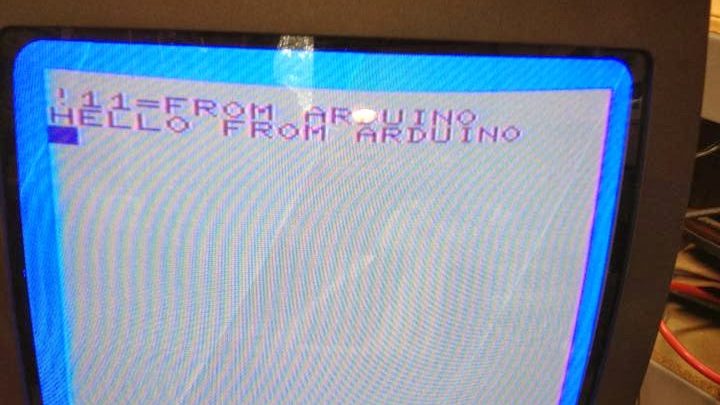
The Commodore Amiga was famous for its characteristic Say voice, with its robotic enunciation being somewhat emblematic of the 16-bit era. The Commodore VIC-20 had no such capability out of the box, but [Mike] was able to get one talking with a little bit of work.
The project centers around the Adventureland cartridge, created by Scott Adams (but not the one you’re thinking of). It was a simple game that was able to deliver speech with the aid of the Votrax Type and Talk speech synthesizer box. Those aren’t exactly easy to come by, so [Mike] set about creating a modern equivalent. The concept was simple enough. An Arduino would be used to act as a go between the VIC-20’s slow serial port operating at 300 bps and the Speakjet and TTS256 chips which both preferred to talk at 9600 bps. The audio output of the Speakjet is then passed to an LM386 op-amp, set up as an amplifier to drive a small speaker. The lashed-together TTS system basically just reads out the text from the Adventureland game in an incredibly robotic voice. It’s relatively hard to understand and has poor cadence, but it does work – in much the same way as the original Type and Talk setup would have back in the day!
Text to speech tools have come a long way since the 1980s, particularly when it comes to sounding more natural. Video after the break.
[Thanks to Stephen Walters for the tip!]









I remember in the early 90’s installing a call logging solution in St. Dunstan’s school for the blind in Brighton and there was an external module that used a TSR under DOS on a 386 (may have even been a 286) to read off the screen to the user. I remember being really impressed at the time – and it sounded almost exactly like this.
“created by Scott Adams (but not the one you’re thinking of)”
How do you know what I’m thinking. That is scary! Not only am I scared, I’m also very confused since I’m thinking about: https://en.wikipedia.org/wiki/Scott_Adams_(game_designer)
I though it was the American R&B and soul singer Scott-Adams.
In th ‘80s I fiddled with software that allowed the Atari 800 to speak by typing in phrases phonetically. Amazing at the time and loads of fun. Could make it say anything to the dismay of my teacher LOL
Please do a series on 8-bit TTS!
When I was a young lad, somebody loaned me the Beeb Speech Synthesizer box for the BBC micro model B (another 6502 based machine, although with more memory than the VIC-20). Eventually I had to return the box, but was then gifted a speech synthesizer ROM. I am trying to figure out which one I had, it might have been a TMS5220 kit, or maybe Superior Software’s “Speech!” ROM, or something else.
It had a “say” command, which would pronounce english words from text, like “I am a robot” and sound like slower version MC Hawkins. Awesome! But it also had a “speak” (or was it “speech”) command that would give a lot of flexibility and allow stretching and modulation of speech (phoneme is the term I think), this mean you could give your 1980s AI experiment a Scottish accent!
The VIC-20 had a really nice keyboard for time, that made it attractive, although a bit pricey. (Coming from a ZX81 owner. Who also took secretarial studies at high school just to get access to computers with better keyboards…)
Sometimes we run oldies-but-goodies. It was new to you, no?
But yeah, we usually note that they’re not cutting-edge in the writeup as well, so as not to confuse.