
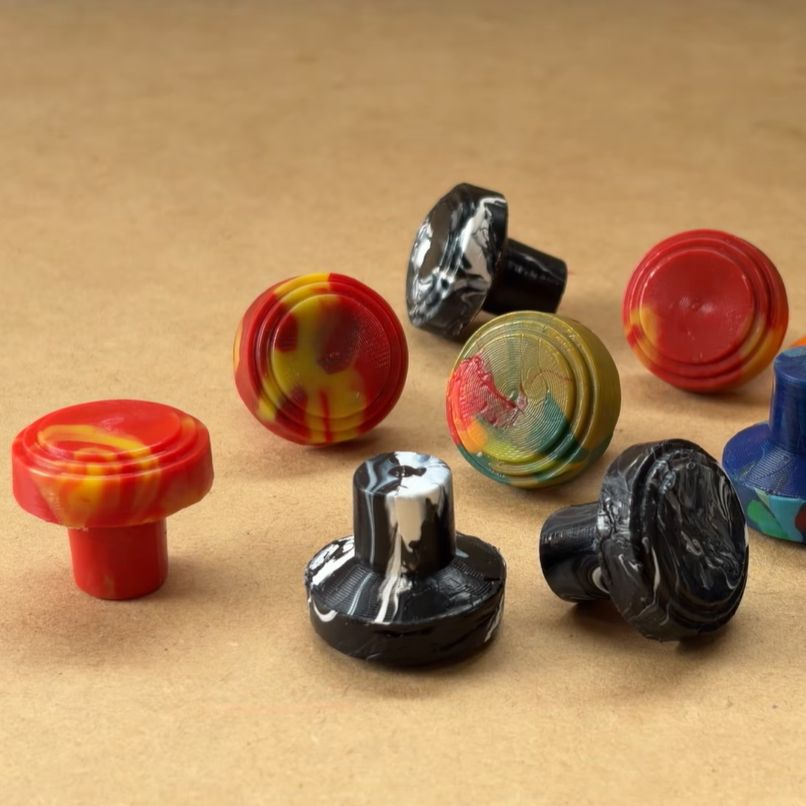
 Recycling plastic at home using 3D printed molds is relatively accessible these days, but if you do not wish to invest a lot of money into specialized equipment, what’s the most minimal setup that you can get away with? In a recent [future things] video DIY plastic recycling is explored using only equipment that the average home is likely to have around.
Lest anyone complain, you should always wear PPE such as gloves and a suitable respirator whenever you’re dealing with hot plastic in this manner, just to avoid a trip to the emergency room. Once that issue is taken care of, there are a few ways of doing molding, with compression molding being one of the most straightforward types.
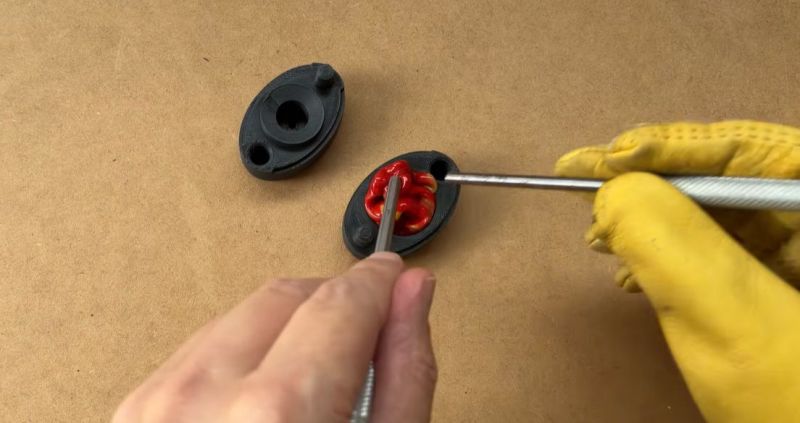
With compression molding you take two halves of a mold, and one half compresses the material inside the other half. This means that you do not require any complex devices like with injection molding: just a toaster oven or equivalent to melt the plastic, which is LDPE in this example. The scrap plastic is placed in a silicone cup before it’s heated so that it doesn’t stick to the container.
The wad of goopy plastic is then put inside the bottom part of the mold before the top part is put in place and squeezed by hand until molten plastic comes out of the overflow opening(s). After letting it fully cool down, the mold is opened and the part released. Although the demonstrated process can be improved upon, it seems to work well enough if you are aware of the limitations. In terms of costs and parts required it’s definitely hard to come up with a cheaper way to do plastic molding.












Oh WONDERFUL, just what I need, another hobby. ¦)
Looks like fun, and I already have a 3D printer and very little regard for my own safety.
Win-win!
Honestly this seems much easier to do than any kind of art resin injection with 3D printed moulds that i can do. I’ve made silicone parts with 3D printed moulds as well, and they too turn out well. I really believe 3D printing is of great utility for making one off moulds for parts that’s you will make probably only a dozen or so of. I seldom see people using 3D printers for making moulds though, that’s a gripe i have
But that’s nothing against when my father “borrows” my soldering iron with its nice and clean, properly tinned hakko tip and uses it to melt holes into a plastic project box. Never, never loan out your tools, at least the ones you cherish
Great video and concept. I work as a machinist making commercial compression molds and have learned a lot about the design nuances. In particular I’d like to suggest incorporating a “shear edge” around the perimeter of your cavities so that the two halves act like a pair of scissors to automatically trim the flashing away at the end of the compression stroke.
That’s a great tip, indeed. Removing flashing has to be one of the most annoying tasks with molded shapes. Using the compression mold to also tackle that task is genius :)
Not sure a FDM plastic mould would be able to retain a sharp enough edge fit to actually do that with the hot plastic inside. I suspect that thinner sharp edge with suitably tight tolerance would be more easily put under a force it can’t survive – warmed up enough by the charge to end up too soft at that cutting edge to take the forces involved. Be interesting to see it tried though, and no doubt the filament of choice for your print will make a huge difference.
Is compression molding low pressure injection molding? Why would someone do one over the other assuming the equipment for either was available? It seems like compression molding would impact less stress on the material
Injection molding takes tons of preasure to inject plastic into the mold. That is something no at home person is going to be doing anytime soon. This on the other hand is perfect for home hobbyists.
I have worked in plastic for a good part of my life, from extrusion, thermoforming, and injection molding.
This is basically manual thermoforming
There’s are some small cavity injection mold systems available for the home user. They’re not fast, they’re not producing huge parts but they are true injection molds. The Crafsman at Steady Crafting on YouTube featured one.
They make ’em plenty small.
But the cost does not scale.
Cheapest, non drill press conversion, I’ve seen is 10k$.
Without a screw in the cylinder, just a piston, you have to pour molten plastic in.
The tiny IMMs used for prototyping tiny shot things are F’ing amazing, no hydraulic oil anywhere.
Size of a Pelosi fridge.
But almost as expensive as an entry level production machine from same manufacturer.
Used to make single cavities work before going full tilt gang. (That sounds very dirty…Just me?)
Perhaps in another 10 years they’ll get old and cheap, show-up at surplus.
Max pressure is at hold, not injection.
Molten plastic is a compressible liquid.
A 1 or 2% squeeze helps make parts strong.
If it doesn’t hit the pressure, the part is scrap.
Plumbing high pressure molten plastic isn’t for everyone.