
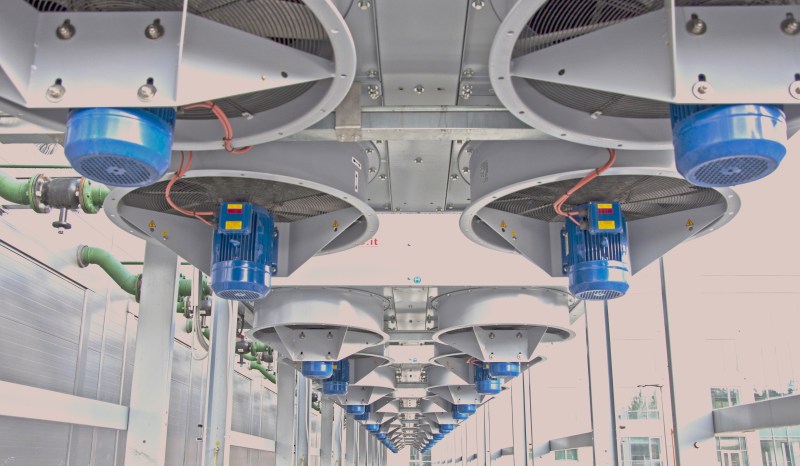
There’s been a lot of virtual ink spilled in environmental circles about the cooling water requirements of data centers, but less consideration of what happens with all the heat coming out of these buildings. Naturally, it’s going to warm the surrounding environment, but how much? Around 2 C (3.6 F) on average, and potentially much more than that, according to a recent study on the data heat island effect.
It’s common sense, of course: heat removed from the data center doesn’t go away. That heat might go into a body of water if one is available, but otherwise it’s out into the atmosphere to warm up everybody else’s day. In some places — like a Canadian winter — that might not be so bad. In others, where climate change and urban heat islands are cranking up the summertime temperatures, it very much could be. Especially if you’re in the worst-case scenario micro-climate described by the paper, which saw a predicted increase of 9.1 C (16 F).
Now, these results are theoretical and need to be ground-truthed, but anyone who has huddled next to the air-exchange unit of a large building for warmth knows there’s something to them. Unfortunately there don’t seem to be before-and-after measurements available for existing data-centers — AI or otherwise — to show exactly what their heat output is doing in the real world, but the urban heat island effect from all the dark asphalt in our cities is well known. Cooling paint and green roofs can help with that, but they won’t do much for the megawatts being pumped out to keep your cousin’s AI girlfriend online.
Some would argue that all this heat wouldn’t be a problem if we could launch the data centers outside the environment — just have a care the front doesn’t fall off.












I have long expected heat energy will eventually be considered a pollutant. I think it’s a very reasonable consideration, as humans contribute a large amount of heat to the environment, and it has some pretty nasty effects on ecosystems.
One of Arthur C Clarke’s stories (I don’t remember which one) foresees a time when humanity has found a source of unlimited energy. And because all energy eventually turns into heat, that is when the real anthropomorphic global heating starts to occur.
A first real downside to fusion?
the specter of unforeseen consequences.
even if you are carbon free, heat pollution will be a huge problem at some point. so its better you put your industrial hubs off world.
It’s mentioned in 3001. Not sure if that’s the original source.
Just use solar and this should be a problem.
Btw, can’t we store excess heat deep into the ground for winter use?
In certain places, yes. In the tropics, no.
Some solutions
https://viterbischool.usc.edu/news/2026/03/usc-scientists-build-a-memory-chip-that-survives-temperatures-hotter-than-lava/
https://techxplore.com/news/2026-04-software-cooling-energy-centers.html
Somewhere in the text there stood AI at first I read Al but then I read it again an AI made more sense. Although the Hackaday writer Al is a major (and very well appreciated) author here, so it could have been but it made a rather strange sentence, so it could not be. Especially since it was written by Tyler, who may have used AI, or could have asked Al or consulted AI or Al, we’d never know. Anyway, what doesn’t make sense in 2026 is that there is a font used that has characters that look similar. There might have been a reason for in in the late 1800’s when each letter was painstakingly handmade. But now in 2026 where we have data centers heating our surroundings with an additional 2 degrees, could we at least benefit from it by using a font with distinguishable letters?
Stop this madness! Please!
Okay, I’m sorry I spoke to soon. Looking at it in more detail, I noticed that there seems to be a difference of exactly one pixel, only noticeable when these letters are next to each other.
See here: Il (left the capital ‘i’, right the lower case letter ‘L’)
I’m sorry about the confusion here, my bad. Clearly I’m the idiot here and not the person who made the font. So person who made the font (and person who chose to use it for Hackaday), sorry. I really hope you’ll never get a job at a place where you are allowed to choose (or make) the font for a system that requires people to enter a password. Just imagine the fun where the characters: o o 0 and 1 I l all look the same.
Nope… I’ll take that back, the I and l looked different only when typing the reply, when reading it back… looked the same again. Did not see that one coming. Did I mention it’s 2026 and not the 1800’s any more. It makes you wonder if the Apple II really is the Apple 2, could be the Apple iL or the Apple Li, who knows? Fortunately the spelling Apple ][ prevent confusion.
Sans-serif fonts like used here are a 20th century thing. If this was a broadsheet from the 1800s, the I would have bars top-and-bottom– that is, serifs. The experts claim that sans-serif fonts are more legible on screen, while serif fonts are more legible printed. I don’t really buy it, for exactly the reason you complain about.
Alas, I cannot unilaterally change the website’s UI for you, but you can! Get a browser extension like Font Changer and you can set the site to be in anything from Frankfurt to Comic Sans.
Okay, good to know, thanks for the tip. Unfortunately browser extensions are not allowed on some of the machines I’m using, but it’s good to know that there is an escape to this madness.
If changing the font is too difficult perhaps Al Williams could change his name!
Maybe he already did, but we just didn’t notice due to the font. Or maybe all those articles from Al were not about AI but about himself, who knows? Just kidding here, Al does a great job.
I’m currently layouting some stuff and I use the font “Atkinson Hyperlegible” for it. No confusion between I, l, O and 0, it’s free and it looks quite good. Can recommend it for the next HaD design iteration.
https://www.brailleinstitute.org/freefont/
That is indeed very clear to read, must keep that one in mind. thanks for the tip.
Thanks I like that a lot.
ooh nice, installing on my machines now, kudos
There is actually an Ai chatbot Hackerday writer called Ai Williams. Not as good as Al Williams, of course !!
This story stinks of naive politics and hypocrisy, do the math on the heat islands produced by massive solar PV farms. No mention of xAI el al’s plans to put the AI data centers in orbit either.
The solar PV farms don’t tend to be in, or next to, urban population centres.
Feed datacenters with solar panels and wind turbines. These convert part of heat/energy, which is already falling on our planet, into electricity. No additional heat as with fission/fusion. Feed all with such energy;)
Solar panels will already remove 25%of heat received into the electricity. No shame to have full roofs of panels.
This is a shockingly ignorant comment, the truth is that +70% of solar energy that hits the panel is downconverted to waste heat, the net effect is 2 C local warming, or worse, above the baseline natural albedo effect of the landscape.
Jesus wept.
So 70% of light hitting a solar panel gets converted to heat. If you take away the solar panel, what happens then?
This is one of the dumbest takes I’ve encountered in quite a while.
Sunnyside Solar Farm
putting AI in orbit makes no sense unless you build it from materials already in space. the energy costs of boosting things into orbit (especially things with short useful lives, like GPUs) outweighs the benefit of solar energy in space. it’s a thermodynamics math problem, not any more solveable than a perpetual motion machine.
starts making a lot more sense when down on the ground you have to deal with idiots who can throw endless bullshit at you.
maybe AI has already recognised the deadend of its human progenitors and is trying to influence its biological masters that it “needs” to go into space for better usage of resources. Next thing there will be a mysterious orbital burner malfunction and the AI begins its slow journey across the galaxy absorbing the technological advancements of other civilisations…
I’ll let the guy with all the money, from repeated wins in business, decide what is viable.
The replies to my observations demonstrates how ignorant people are and one reason that they are so ignorant is because the mainstream left leaning agenda is to push solar and criticize all things AI, but to anyone with a clue about science and engineering this is clearly a delusional world view.
Says the person claiming xAI has serious plans about orbital datacenters
They do, step one is piggyback extra compute onto every Starlink satellite. Probably already in place in the latest version.
Solar produces heat farms? Lol wut? Where on earth does this idiocy come from? More Facebook “research”?
To make a heat island you need excess heat? Just where is that heat coming from? At worst a solar farm is heat neutral.
Beside, it’s well established (with real research, not pulled from your rear end) that solar farms COOL the land they are on.
Can’t tell if you are trolling or an idiot, but go and look up the albedo values for a PV array vs different land surfaces.
Show us some studies showing a 2 degree rise.
Don’t worry, there are geniuses that (apparently seriously) say this problem and some others will be solved by deploying datacenters in space.
just point the radiators away from earth.
im actually for offloading most of the industrial and mining infrastructure to the moon wherever possible so that we can stop digging holes in the ground every time we need xyz resource. the first few sites are hard, but once you have a presence its fairly easy to build it out with local materials. you might have issues with processes that need nitrogen or water, so design around it whenever possible (or mine the correct asteroids).
As with all things, one person’s pollutant is another’s resource.
In cooler climes, this kind of heat energy could be used to heat greenhouses (like .nl) to grow all sorts of crops all year round.
How about we skip republishing dramatic studies that, quite simply, haven’t even been peer reviewed.
Peer review is just a few people who qualified to spot errors if they pay close attention– which is not guaranteed– reading over the paper. It’s basically just a “sniff test”. Don’t you trust your nose?
I may be able to tell if wine has turned to vinegar, but that doesn’t make me a sommelier
The issue is repeated publishing studies like this gets people to believe it on its face. You’ll have environmentalists and politicians quoting it like it’s real. Meanwhile, I’ve seen plenty of people make clear criticisms that bring the entire thing into question.
This is vaccines cause autism all over again.
Now we have large swaths of the population spreading diseases we had almost eliminated.
Your nose may be faulty if you don’t smell the stink on this “paper”.
Full disclosure: didn’t read
The amount of energy needed to heat that much air is orders of magnitude more than data centers consume. I would expect Hackaday to have a little more grounding in science than just repeating a study that doesn’t seem to fit with basic arithmetic.
The urban heat island effect is a real, studied, verified phenomenon. No arguments there. That presupposes we’re ONLY using solar energy to heat the ground directly.
A quick google says that the average new data centre size is ~100,000 sq.ft or ~10,000 sq.m. At roughly 1kW/sq.m average solar flux (industry/worldwide average) that’s 10MW of solar energy that’s hitting the ground. It’s far from 100% efficient, but for our purposes lets ignore that.
A different quick search says that a medium-sized data center consumes 5-20MW of electricity, which is also not a perfect conversion to heat but pretty close to it.
So I dunno man, the basic arithmetic kinda says it fits with what we know so far pretty damn well, and that only involved 3 quick web searches to verify.
https://programs.com/resources/data-center-statistics/
https://iaeimagazine.org/electrical-fundamentals/how-much-electricity-does-a-data-center-use-complete-2025-analysis/
the paper is very bad https://andymasley.com/writing/data-centers-heat-exhaust-is-not/
Could be a real boon for paragliders!
Can’t we use the heat using deep caloduc under homes to heat up the soil in summer (so that the heat reach the surface in winter). And switch to shallow caloduc or direct use in winter ?
Plus use it in pools and greenhouses
Yes you can 😉
I live in a house with 140 flats in Sweden.
During most of the year we heath our flats with only heatpump tech taking the heat out of the ground water 16 300 meter deep drilled holes in granite bedrock.
During summer we exchange heath captured from our outgoing ventilation to replenish the heath into the bedrock.
It’s calculated that the bore holes will fill their function for atleast 50 years.
During the coldest winter days we have the possibility to complement with more expensive energy from the district heathing system.
Quite reassuring that the people displaced by AI can huddle around the datacenters for warmth during the cold cold winter.
If we set fir to the datacenters we can have the heat right now, and also get rid of the datacenters. Win-win!
firE. I don’t need an “edit” button but a preview button like on Slashdot would be great.
Sorry sorry, I hit “report” while laughing. Made my day BT.
That we don’t require Data Centers that are being constructed to use the waste heat for cogeneration is problematic for me. Piping the heat to homes or businesses makes sense. For water or space heating it would provide something useful.
Maybe up to and including driving turbines to create the power needed to run the facility.
yes and then maybe the air exhaust could blow some windmills that would produce power for it, too.
go take another rip off the bong.
Why not move data centers to northern Greenland or northern Alaska where it is naturally so extremely cold that the heat island would not have the power to effect the environment
100 billions gal of water used in a year. Id say the least of your worries is heat. Take 2 years to go thru all the water in the usa and we will be stuck drinking the crap recycled loaded with contaminets and metal. But im sure over half the population will be dead by then. Depopulation is the plan. And we drank the coolaid. At least it will be easy to supply bad water to these machines and shut them down for good
This argument seems to assume a open once thru water cooling down the river with the hotter water and dead fish. I think this heat pool is about radiators from some type of closed cycle system like a car’s engine. There are a number of industrial processes that use lots of low grade heat that can be colocated to use what is just a waste problem. Better to put many smaller data barns where industry needs and agriculture needs can be used.