
It’s easy to think of online console gaming as an invention of the 2000s. Microsoft made waves when Xbox Live dropped in 2002, with Nintendo and Sony scrambling to catch up with their own offerings that were neither as sleek or well-integrated.
However, if you were around a decade earlier, you might have experienced online console gaming much closer to the dawn of the Internet era. As far back as 1990, you could jump online with your Sega Mega Drive. But what did an online console feel like in the dial-up era?
Mega
The Sega Mega Drive was launched in Japan in October 1988. The company was in a tough battle with Nintendo for gaming dominance, and the new 16-bit console was intended to best its rival’s offerings across the board. With a forward-looking attitude, Sega quickly developed an online offering for the console, which went under a few different names. It was known as Mega Net, or alternatively, the Sega Net Work System.
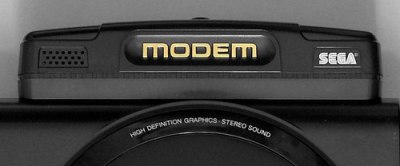
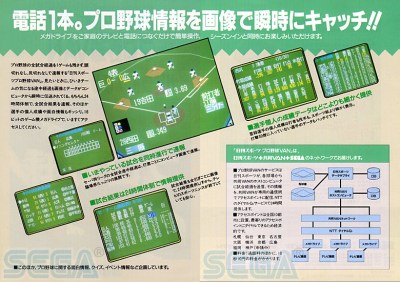
The system hit the market on November 3 1990, exclusively for the Japanese market, with Sega talking up a future launch in the US under the “Tele-Genesis” name. The initial Mega Net kit cost ¥12,800, which included the Mega Modem accessory—a simple 1,200 bps dial-up modem which plugged into the “EXT” DE-9 port on the back of the Model 1 Mega Drive. Access to Mega Net service came at a cost of ¥800 a month. Users got a copy of Nikkan Sports Pro Baseball VAN, which provided live updates and statistics on baseball matches when connected to the service.
The Mega Net pack also included the “Game Library” cartridge. This allowed users to dial up to Mega Net and play a variety of downloadable games. These titles had to be incredibly compact, usually under 128 KB. This was both because of the glacially slow 1,200 bps modem, and because the Mega Drive had no real storage capability to speak of. 42 games were released on the system, and titles would take about 5 to 8 minutes to download. The vast majority were single player experiences. However, two games – Tel-Tel Stadium and Tel-Tel Mahjong – featured online play via Mega Net. Perhaps unsurprisingly, both games were turn-based—a practical necessity given the limited speeds and latency achievable with the slow Mega Modem. A handful of games from Mega Net would later see cartridge releases of their own.
Users could also engage in multiplayer gaming with certain cartridge-based titles. However, this was not using a server-based online system. Instead, this merely consisted of point-to-point dial-up play between two consoles equipped with the Mega Modem.
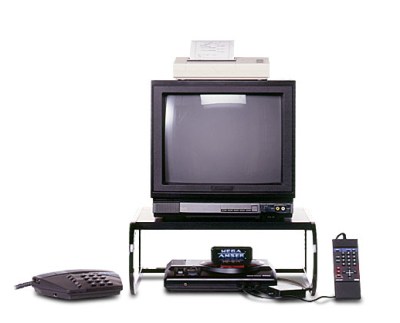
Mega Net wasn’t just limited to gaming, however. Sega explored more utilitarian uses for the Mega Drive with the release of Mega Anser. This came as a package that included the Mega Modem, the Mega Anser software, and a numeric keypad controller called the Ten Key Pad. There was also an optional printer that plugged into one of the controller ports. The most notable use of the Mega Anser was for online banking. Depending on your bank, you could manage your funds with the Naisu-kun Mini, Osaka Ginkou no Home Banking Service My Line, or Sumisei Home Tanmatsu.
Unfortunately, the technology wasn’t quite there in 1990 to support a fully-vibrant online gaming service. By 1992, Sega realised there wasn’t a large market for Mega Net and Mega Anser services, and the hardware started turning up in bargain bins for drastically reduced prices. By 1993, Sega had released a remodelled Mega Drive which eliminated the EXT port required for the Mega Modem, making it clear that there was no interest in taking the service any further.
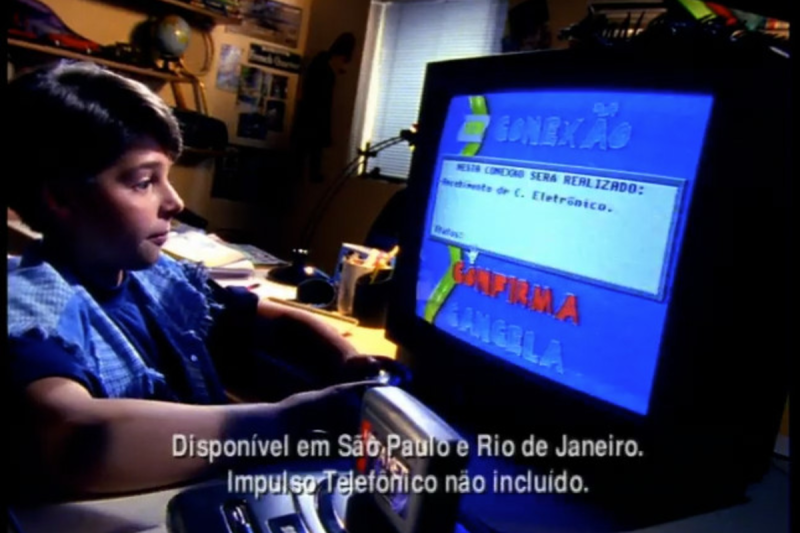
The end of Mega Net in Japan was swift, but the name would live once more. That time came in 1995, when a similar service saw a last gasp release in Brazil, of all places. Supported by local distributor Tectoy, it ran using a unique modem accessory that plugged into the cartridge slot. The range of services on offer was quite different—users could access emails, fax messages, and read an electronic magazine called Revista Eletrônica. The system was designed to be used with the Sega Mouse for a more computer-like interface experience, and prices started at R$5 a month for access to the service. The service was, in many ways, completely unrelated to the original Sega effort, but was inspired by it and wore similar branding.
Brazil’s Mega Net was more modern and had additional ways for users to interact with each other.
Sega’s early experiment with online console gaming was not a grand success. It failed to attract a huge user base or offer any ground-breaking features. However, it did give the company a base to work from when it came to getting later consoles online, like the Saturn and Dreamcast that arrived years later. Ultimately, Sega would largely be out of the console market by the time online gaming really took off in that world, but you can’t fault the former Japanese titan for trying to get in early.












Brazil got their fancy Mega Net around the same time that North America got the Sega Channel, which was yet another of Sega’s technologically innovative but only modestly successful efforts.
The Sega Channel used cable TV networks for data distribution and a custom cartridge that could connect and download a rotating collection of games. This was before the era of cable modems, so there was no bidirectional data transmission; the game and other data was just broadcast on a repeating loop for the system to retrieve if requested. Unlike the original MegaNet it had enough RAM to store a regular-sized Genesis game, and it was intended as a way for SEGA to compete with the video game rental market (as in, the “go to Blockbuster and rent a cartridge” market).
I have no idea what bitrate the system achieved, but game downloads were reportedly pretty fast, taking just a few minutes.
Ahhhh the Sega Channel… It was remarkably decent for the system and the era. I remember a neighbor having it and we would have a blast with some Bomberman on the Sega Channel. It was fast for then, probably due to lack of a large amount of users. He got it thru Comcast iirc and I remember there was a modem cart with a coax ya had to plug in but yeah it was pretty good for then :)
If I’m not mistaken, Phantasy Star II was one of the first Sega games to play with expansion packs (basically new campaigns/games for different characters, but same game engine). Pretty sure there are ro….ahem…. downloadable… versions out there.
But Sega’s misplaced faith in their technology got wins, just not where you would think. Phantasy Star IV, easily considered the crowning RPG of the Genesis/MegaDrive, was supposed to be a Sega CD game. When the system fell off, the game got condensed. That cartridge was $70 (about $150 today counting for inflation). And kids think PS5 games are expensive.
That would be amazing since that was a sms game … ps3 was the first on megagen
“probably due to lack of a large amount of users”
The number of subscribers had nothing to do with it. Just like the NABU, the games were broadcast to everyone, not a bi-directional request. The cable adapter waited for the packets necessary to build the game in RAM, and once the full image was downloaded it could run. From what I’ve been able to surmise, they had around the same size loop of data as the NABU, so you had to wait less than a minute for your game to cycle around.
Time Warner distributed it in Greenwood, IN.
I had the Sega Channel and it was amazing! So much fun to play new games I couldn’t afford.
They recently discovered a bunch of information about it: https://www.youtube.com/watch?v=CWCUmTTVjMY
Hi, just in case someone’s wondering as to why 1200 Bit/s were used.
It’s probably because of cost and simplicity and definitely not state of the art for 1990!
Real, intelligent Hayes modems for PC did 4800 and 9600 Bit/s by that time (V.32 standard).
However, for up to 2400 Bit/s (or Baud here) the simple (A)FSK modulation method can be used on a simple voice channel (requiring ca. 2-3 KHz bandwith).
Using lower speed gives a better signal-to-noise ratio.
That’s also why Packet Radio on FM CB radio topped out at 2400 Bit/s (1200 being standard without FSK port on a radio).
Here, in FSK, symbol rate (Baud) and speed (Bit/s) are still same because of simple modulation method and no compression.
If something like DPSK or 4-PSK was used, then an 1200 Baud modem would have been able to transfer 2400 Bit/s.
https://en.wikipedia.org/wiki/Frequency-shift_keying#Audio_FSK
Another reason is the serial interface itself.
The EXT port is like another controller port and doesn’t do real RS-232 in hardware.
It uses TTL signals and the serial port is being implemented in software.
The C64 did something similar and was limited to 1200 and 2400 Bit/s.
Other old computers such as IBM PC had a dedicated interface chip (UART FiFo) and could do 115 KBit/s since the 80s.
Last but not least: line quality.
In 1990, both US and Europe, the POTS was internally being in transition to a digital network/fibre, but the last mile(s) consisted of all sorts of phone wiring.
Some better, some worse. That’s why line quality did vary a lot, depending where someone lived.
Of course, a modem has its troubles keeping communication over a line that crackles or has other types of noise.
In poorer places the wire used iron instead of copper, also, which in practice offered a smaller audio bandwith (East Germany comes to mind).
Not all of the wires were twisted-pair, either. Which negatively affected noise canceling. Older installations maybe had simple audio wire, merely.
There were multiple factors, in short.
Interestingly, the Famicom modem did do 2400 Bit/s:
https://www.sega-16.com/2006/11/disconnected-the-telegenesis-modem/
Quick correction: the Mega Drive serial interface is implemented in hardware. Two of the pins in the port can be repurposed to implement TTL UART at one of four speeds (300 bps, 1200 bps, 2400 bps or 4800 bps), always at 8n1. The only real advantage is being able to work in the background, because if you really want to send a lot of data then bitbanging is genuinely much faster.
The part about the EXT port being a third controller port in disguise is true however, as all three ports feature this (the only difference is the shape of the connector).
XBAND came out some years later and still did only 2400 bps so I assume that there must have been a good reason to avoid higher speeds.
My bad, thank you! 😅😃
The article is mixing up several unrelated services as if they were part of a single network. The modem itself is the Mega Modem, which was a 1200 bps dial-up modem connected using TTL UART (not RS-232, i.e. using 0V/5V instead of +12V/-12V).
First of all: the Mega Modem predates the web, the norm was to dial directly to the service (or for on-line games, to dial the other player’s phone number). That’s how all of this software worked; most of these were games, some were other services however.
Mega Anser was a home banking application and was sold as a bundle with the console, modem, ten key pad and printer (there were multiple sets depending on what parts you wanted to buy), it also seems to be the earliest software supporting the modem as it predates the modem numbering in the ROM header. For the record, it was probably cheaper than buying a computer to do the same, and cheaper than clogging a phone line doing a normal call (for both the customer and the bank), as it only needs to stay on the line for a few seconds.
The game download service is Sega Game Toshokan / Sega Game Library and yes, games were small — from footage uploaded to YouTube some years ago we found out that they were limited to 48KB at most (that’s 3/4 of the system RAM) and took about 7~8 minutes to download (and had to be redownloaded every time you wanted to play). The cartridge does seem to provide some code for games to reuse however. An early interview from before the console release mentions that Sega originally planned to let you download games to floppy disks, so I wonder if this is what came out of those original plans.
MegaNet was a Brazil-specific service provided by TecToy and it didn’t use the Mega Modem, instead it supplied its own modem into the cartridge. It actually seemed to have a decent run and people could access their e-mail using it. MegaNet does not refer to any of the services above.
One fun fact about the Mega Modem: it has a microphone and games can use it (the ROM header even has a field to declare support for it). I heard that Cyberball supports it to let you talk to the other player between matches (voice and data seem to be mutually exclusive), but I haven’t confirmed it.
There was also SanSan which was the last game to use the Mega Modem… as late as 1994. Sunsoft offered a modem adapter so a standard modem could be used in lieu of the Mega Modem. There was also the Mega Terminal, for which little is known but it used ISDN instead of dial-up. Seems to have been supported by Go Net and SanSan at least.
Also, if I am not mistaken, TecToy also still manufactured Sega Master Systems long after other markets stopped. I think Brazil even had some exclusive titles I have not seen in Sega’s traditional markets.
TecToy did stop to make Master System in 2024 or 2025 but it’s possible to find some units yet (the last model sold by them, “Master System Evolution”, was just a SoC running an emulator and not real hardware).
And there was XBAND, which was repackaged in Brazil as Mega Net 2.
https://www.youtube.com/watch?v=k_5M-z_RUKA
No mention of the Sega Channel? That was probably the Mega Drive’s most notable trip into Internet.
Still have my SegaChannel adapter tbh. I collect things Idk why.
It should be noted for timeline accuracy that the Famicom network system came out a month earlier in September 88. It also survived MUCH longer thanks to an online horse track betting system that only shut down relatively recently.
It should be noted that even by the time the famicom existed the idea had been around the block a few times including modems for intellevision systems and broadcast services for those, atari and the like
yep yep. Several attempted networks before these two.
Arpanet had a multi-player tank game in the late 70’s. You had to have an account to use the terminal. I knew of one terminal on campus.