
Building A Die Filer From Scratch

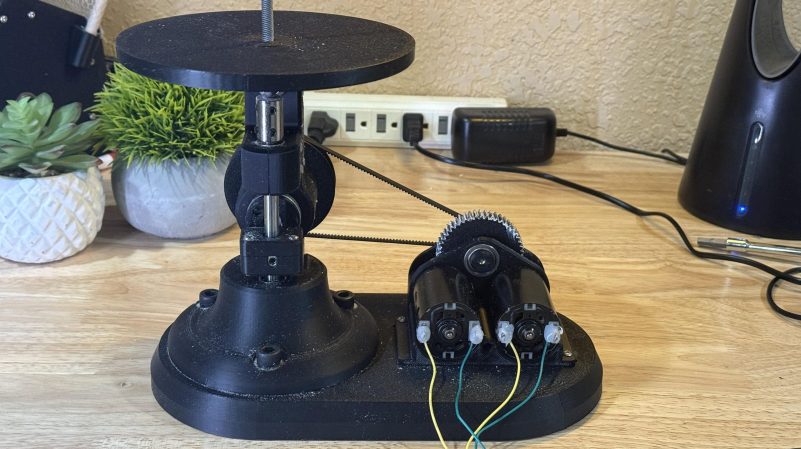
A die filer is a useful tool to have if you find yourself filing parts on the regular. It’s basically a machine that reciprocates a file up and down for you so you can focus on filing the part to your desired dimensions. They’re not commonly manufactured these days, so [Richard Huberjohn] set about building his own. 

This die filer relies on a simple mechanism to turn rotational motion from a motor into reciprocating linear motion in the vertical plane. A rotating shaft is connected to a crank, which turns a pin in a slotted carrier attached to a linear bearing. As the wheel turns, the pin slides in the carrier, driving it and the linear rod up and down in turn. Attach a file to this, and you have a working die filer. In this case, the rotating shaft is driven by a pair of DC brushed motors, with output stepped down via a gearbox and then a short belt drive. Speed is varied with the aid of an off-the-shelf controller.

If you’re regularly filing small parts, a build like this could speed your work to a great degree. We’ve featured other DIY machine tool builds before, too. If you’re cooking up your own gear for the home workshop, don’t hesitate to let us know on the tipsline!

Building Your Own Filing Machine From A Kit

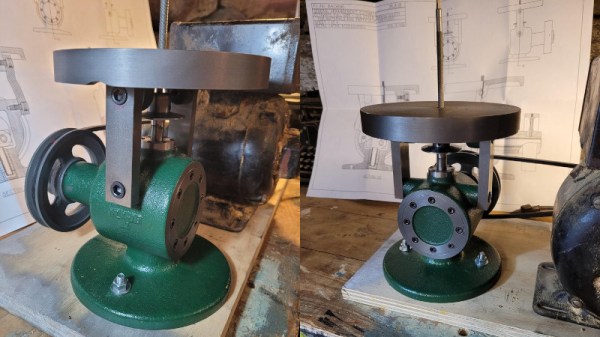
Files are a very useful important tool if you’re machining your own parts. They can do plenty of shaping themselves on smaller parts in particular. Powering such a tool just makes sense, and a die filer or filing machine is essentially just that, reciprocating a file up and down for you. They’re highly prized amongst clockmakers and model builders, and [jeanluc83] decided to build one at home.

The design chosen was the MLA-18 filing machine, for which castings and parts can be purchased from a company called Metal Lathe Accessories. However, it’s far from a simple screw-together kit. [jeanluc83] goes through the full process of painting, machining, and assembling the kit, which takes quite a bit of work to do properly.

Notably, the design is quite old fashioned in that it does not include its own power source. Instead, the MLA-18 filing machine is fitted with a pulley, such that it can be driven from a motor on a bench. A 1/4 horsepower motor running at roughly 1725 RPM is recommended for best results.

Filing machines aren’t exactly something you’ll find at every hardware store or Harbor Freight, so you might find building your own is the right way to go. Hackaday is, after all, full of examples of hackers building their own tools!








