Historical Hack: Henri Giffard’s Steam Injectors

Here’s a historical hack for you: you have a big, rolling pressurized kettle, also known as a steam locomotive. It needs water to make up for the steam constantly chuff-chuff-chuffing away, or bad things happen. How do you get water from an unpressurized tender into a high pressure boiler with no moving parts? What you need is a some way to inject steam with no moving parts — a steam injector, if you will. [Marc Flint] found that the steam injectors were the hardest part of a loco to understand, so he made a video for all of us once he’d figured it out.

The steam injector isn’t a new idea. [Henri Giffard] came up with it back in the 1850s to replace expensive and maintenance-hungry pumps. It’s rather ingenious and uses the fluid mechanics uncovered by another European bloke by the name of Bernoulli. First, the high-pressure steam from the boiler goes through a converging-diverging nozzle to drop its pressure and speed its flow up, just as you’d guess if you’ve seen Bernoulli’s laws. Even more vacuum-inducing is the presence of water: the steam, already cooled by its expansion, hits the water in the pipe open to the tender, and condenses into it, shrinking a couple of orders of magnitude, creating a vacuum that draws in no small quantity of feed water. That one we did not expect from Bernoulli, but it makes sense. So how to get from below atmospheric pressure to the 180-odd PSI or more in the boiler?

Well, the water is now moving at a good clip, between the Venturi effect and the momentum gained from absorbing that steam, so another converging nozzle is the trick. Bernoulli’s law, once more! A one-way valve lets the now-pressurized water into the boiler, with a gap in between to dump water while the pressure builds up. It’s a clever trick, and since the steam coming from the boiler makes it back inside along with at least some of its heat energy, it’s much more efficient in both coal and water than running a pump. It’s also a bit of a head scratcher how it works unless someone sits you down to explain it, so we’re glad [Marc] did.

Not many of us are likely to use this knowledge directly — unless we’re firing up a 90 year old boiler or building a new steam locomotive — but seeing how great engineers of years past made use of basic physical laws can serve both as education and inspiration.

Continue reading “Historical Hack: Henri Giffard’s Steam Injectors”

The “Tin Blimp” Was A Neither Tin Nor A Blimp: The Detroit ZMC-2 Story

That fireball was LZ37. Nobody wanted to see repeats post-war.
Image: “The great exploit of lieutenant Warnefort 1916 England” by Gordon Crosby, public domain.

After all the crashing and burning of Imperial Germany’s Zeppelins in the later part of WWI – once the Brits managed to build interceptors that could hit their lofty altitude, and figured out the trick of using incendiary rounds to set off the hydrogen lift gas – there was a certain desire in airship circles to avoid fires. In the USA, that mostly took the form of replacing hydrogen with helium. Sure, it didn’t lift quite as well, but it also didn’t explode.

Still, supplies of helium were– and are– very much limited, and at least on a rigid Zeppelin, the hydrogen wasn’t even the most flammable part. As has become widely known, thanks in large part to the Mythbusters episode about the Hindenburg disaster, the doped cotton skin in use in those days was more flammable than some firestarters you can buy these days.

That’s a problem, because, as came up in the comments of our last airship article, rigid airships beat blimps largely on Rule of Cool. Who invented the blimp? Well, arguably it was Henri Griffard with his steam-driven balloon in 1857, but not many people have ever heard his name. Who invented the rigid airship? You know his name: Ferdinand Adolf Heinrich August Graf von Zeppelin. No relation. Probably. Well, admittedly most people don’t know the full name, but Count Zeppelin is still practically a household name over a century after his death. His invention was just that much cooler.

That unavoidable draw of coolness led to the Detroit Airship Company and their amazing tin blimp. The idea was the brainchild of a man named Ralph Upton, and is startling in its simplicity: why not take the all-metal, monocoque design that was just then being so successfully applied to heavier-than-air flight, and use it to build an airship? Continue reading “The “Tin Blimp” Was A Neither Tin Nor A Blimp: The Detroit ZMC-2 Story”

Books You Should Read: The Perfectionists

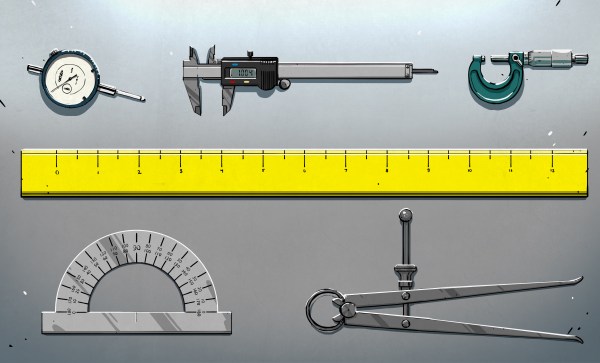
After pulling late hours in my school machine shop for a few years, I couldn’t help but wonder, who measures the measurement tools? How did they come to be? I’d heard anecdotes from other students and engineers while they inspected my freshly machined parts, but these stories were one-offs. What I wanted was a tale of industrial precision from start to finish. Years later, I found it.

The story of precision, as told by Simon Winchester, is captured in The Perfectionists: How Precision Engineers Created the Modern World. Published in 2018, Winchester’s overview stretches as far back to the Antikythera mechanism and brings us to present day silicon wafer manufacturing. Of course, this isn’t a chronology of all-things made precisely. Instead, it’s a romp through engineering highlights that hallmark either a certain level of precision manufacturing or a particular way of thinking with repercussions for the future. Continue reading “Books You Should Read: The Perfectionists”