
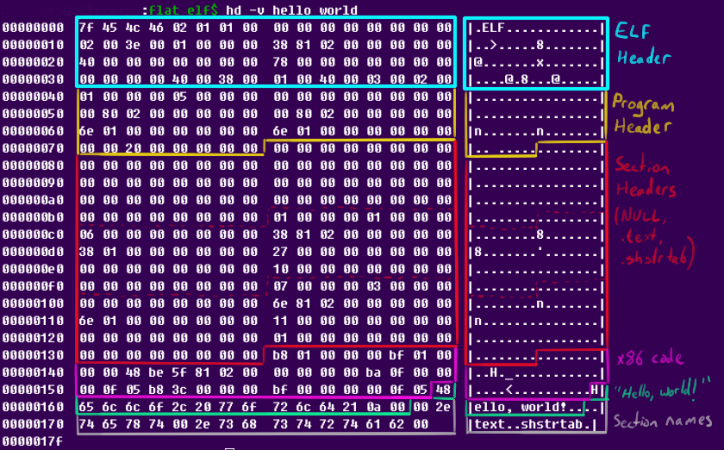
A hex dump of the first iteration of the small ELF file

How Small Can A Linux Executable Be?

With ever increasing sizes of various programs (video games being notorious for this), the question of size optimization comes up more and more often. [Nathan Otterness] shows us how it’s done by minifying a Linux “Hello, World!” program to the extreme.

A naive attempt at a minimal hello world in C might land you somewhere about 12-15Kb, but [Nathan] can do much better. He starts by writing everything in assembly, using Linux system calls. This initial version without optimization is 383 bytes. The first major thing to go is the section headers; they are not needed to actually run the program. Now he’s down to 173 bytes. And this is without any shenanigans!
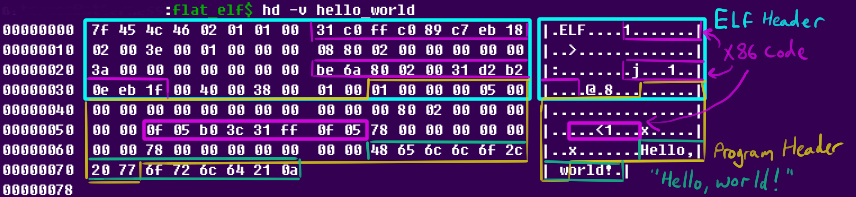
A hexdump of the final ELF file, significantly smaller than the original
The final tiny ELF file

The first shenanigans are extreme code size optimizations: by selecting instructions carefully (and in a way a C compiler never would), he shaves another 16 bytes off. But the real shenanigans begin when he starts looking for spaces in the ELF header that he can clobber while the program is still accepted by Linux: now he can move his already tiny x86_64 code into these “vacant” spaces in the ELF and program headers for a final tiny ELF file weighing in at just 120 bytes.

P.S.: We know it is possible to make this smaller, but leave this as an exercise to the viewer.

Javascript Art Is In The URL

[Alexander Reben] makes tech art, and now he’s encouraging you to do the same — within a URL. The gimmick? Making the code small enough to fit the data portion of a link. And to help with that, he has set up a webpage that uncompresses and wraps code from the URL and inserts it into the HTML on the fly. His site essentially applies or un-applies all the tricks of JS minification in the URL, and turns that into content.

So, for instance,https://4QR.xyz/c/?eJzzSM3JyVcIzy_KSVEEABxJBD4 uncompresses to a webpage that says “Hello World!”. But the fun really starts when you start coding up “art” in Javascript or HTML5. There are a few examples up in the gallery right now, but [Alexander] wants you to contribute your own. The banner is from this link.

Something strikes us as fishy about passing JS code opaquely in links, but since the URL decodes on [Alexander]’s server, we don’t see the XSS attack just yet. If you can find the security problem with this setup, or better yet if you write up a nice animation, let us know in the comments.









