Skip to content
Logo

Hackaday

  • Home
  • Blog
  • Hackaday.io
  • Tindie
  • Contests
  • Submit
  • About

spacial haptic device

1 Articles

Open Source Haptics Kit Aims To Democratize Force Feedback

January 21, 2015 by Sonya Vasquez 27 Comments

If you’ve been keeping up with augmented and virtual reality news, you’ll remember that spacial haptic feedback devices aren’t groundbreaking new technology. You’ll also remember, however, that a professional system is notoriously expensive–on the order of several thousand dollars. Grad students [Jonas], [Michael], and [Jordi] and their professor [Eva-Lotta] form the design team aiming to bridge that hefty price gap by providing you with a design that you can build at home.

A quick terminology dive: a spacial haptic device is a physical manipulator that enables exploration of a virtual space through force feedback. A user grips the “manipulandum” (the handle) and moves it within the work area defined by the physical design of the device. Spacial Haptic Devices have been around for years and serve as excellent tools for telling their users (surgeons) what something (tumor) “feels like.”

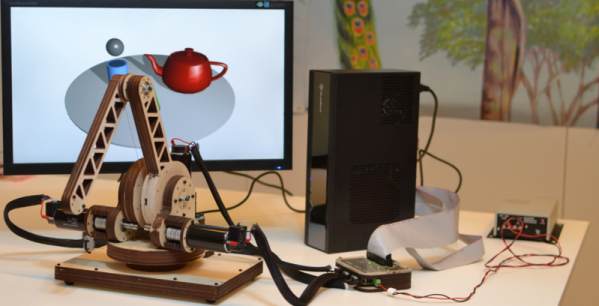
In our case, this haptic device is a two-link, two-joint system grounded on a base station and providing force feedback with servo motors and tensioned wire ropes. The manipulator itself supports 3-degree-of-freedom movement of the end-effector (translations, but no rotations) which is tracked with encoders placed on all joints. To enable feedback, joints are engaged with cable-drive transmissions.

The design team isn’t new to iterative prototyping. Hailing from CS235, a Stanford course aimed to impart protoyping techniques to otherwise non-tinkerers, the designers have drawn numerous techniques from this course to deliver a fully functional and reproducible setup. In fact, it’s clear that the designers have a strong understanding of their system’s physics, and they capitalize on a few tricks that don’t immediately jump out to us as intuitive. For instance, rather than rigidly fixing their cable to the motor shaft, they simply wrap the cable around the shaft a mere 5 turns such that the force of friction greatly exceeds the threshold amount that would otherwise cause slipping. They also choose plywood–not necessarily because of its price–but more so because of its function as a stiff, layered composite that makes it ideal “lever arm material” for rigidly transferring forces.

For a full breakdown of their design, take a look at their conference paper (PDF) where they evaluate their design techniques and outline the forward kinematics. They’ve also provided a staggeringly comprehensive bill of materials (Google Spreadsheet). Finally, as justifiably open source hardware, they’ve packaged their control software and CAD models into a github repository so that you too can jump into the world of quality force feedback simulation without shelling out the twenty thousand dollars for a professional system.

[via the 2015 Tangible Embedded and Embodied Conference]

Continue reading “Open Source Haptics Kit Aims To Democratize Force Feedback” →

Posted in Virtual RealityTagged haptic feedback, haptics, robot arm, spacial haptic device, stanford

Search

Never miss a hack

Follow on facebook Follow on twitter Follow on youtube Follow on rss Contact us

Subscribe

If you missed it

  • Marion Stokes Fought Disinformation With VCRs

    39 Comments
  • Tolerating Delay With DTN

    19 Comments
  • Optimizing Software With Zero-Copy And Other Techniques

    19 Comments
  • ISS Medical Emergency: An Orbital Ambulance Ride

    45 Comments
  • Clone Wars: IBM Edition

    51 Comments
More from this category

Our Columns

  • What Isaac Roberts Saw Without A Space Telescope

    12 Comments
  • Keebin’ With Kristina: The One With The Ball-Joint Keyboard

    4 Comments
  • Hackaday Links: January 18, 2026

    6 Comments
  • Get Bored!

    37 Comments
  • Hackaday Podcast Episode 353: Fantastic Peripherals, Fake Or Not Fake Picos, And Everything On The Steam Deck

    2 Comments
More from this category

Search

Never miss a hack

Follow on facebook Follow on twitter Follow on youtube Follow on rss Contact us

Subscribe

If you missed it

  • Marion Stokes Fought Disinformation With VCRs

    39 Comments
  • Tolerating Delay With DTN

    19 Comments
  • Optimizing Software With Zero-Copy And Other Techniques

    19 Comments
  • ISS Medical Emergency: An Orbital Ambulance Ride

    45 Comments
  • Clone Wars: IBM Edition

    51 Comments
More from this category

Categories

Our Columns

  • What Isaac Roberts Saw Without A Space Telescope

    12 Comments
  • Keebin’ With Kristina: The One With The Ball-Joint Keyboard

    4 Comments
  • Hackaday Links: January 18, 2026

    6 Comments
  • Get Bored!

    37 Comments
  • Hackaday Podcast Episode 353: Fantastic Peripherals, Fake Or Not Fake Picos, And Everything On The Steam Deck

    2 Comments
More from this category

Recent comments

  • Leonardo on Self-Powered Top Spins For Hours
  • Leonardo on Can Skynet Be A Statesman?
  • Johnu on Marion Stokes Fought Disinformation With VCRs
  • Rastersoft on Block Devices In User Space
  • Cogidubnus Rex on Demonstrating The Sheer Lack Of Security In First Gen Cellular Networks
  • Daniel on Block Devices In User Space
  • Nath on Marion Stokes Fought Disinformation With VCRs
  • Misel on RAM Prices Got You Down? Try DDR3. Seriously!
  • E. Rodommoc on What Isaac Roberts Saw Without A Space Telescope
  • Dude on Marion Stokes Fought Disinformation With VCRs
Logo
  • Home
  • Blog
  • Hackaday.io
  • Tindie
  • Video
  • Submit A Tip
  • About
  • Contact Us

Never miss a hack

Follow on facebook Follow on twitter Follow on youtube Follow on rss Contact us

Subscribe to Newsletter

Copyright © 2026 | Hackaday, Hack A Day, and the Skull and Wrenches Logo are Trademarks of Hackaday.com | Privacy Policy | Terms of Service | Digital Services Act | Do not sell or share my personal information
Powered by WordPress VIP