
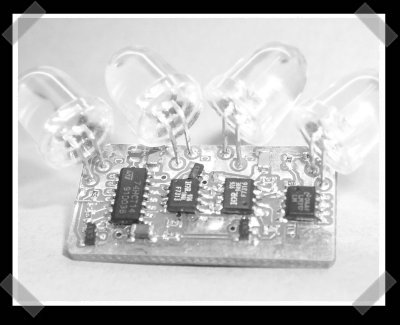
More of my EV kick coming through. A solar tracker is used rotate a solar panel to get optimum energy from the sun. This one uses LEDs as the light sensor and mosfets to drive the output to rotate on a single axis. He even reduced the duty cycle on the fets so no heatsink is needed. Mounting in a peanut butter jar keeps the circuit dry and allows the sun to shine through. (The designer sells these, but has circuits up on the site)


18 thoughts on “LED Sensor Solar Tracker”
Leave a Reply
Please be kind and respectful to help make the comments section excellent. (Comment Policy)









I don’t want to be a grammar nazi, but when you say “to rotate on a single access” the word you want is ‘axis’ not ‘access’.
I deserved it on that one. Thanks!
Ah here we go. good work
Very nice. I’ve tried using LEDs as a photosensor before, but couldn’t get enough of a signal.
What’s a good book or primer to learn about circuit boards, eprom programming and stuff? Would hack-a-day consider a section to newbies like me who want to pop their heads out from being neck-deep in code all the time?
Awesome! Excellent work. I’ve considered taking a stab at something like this myself, but not with SMT chips. Way to go!
while using a pic is certainly adequate, isnt it a bit overkill? the linked page mentions BEAM style solar tracking, and i speak from personal experience when i say that such circuits utterly simple, far less expensive, and equally as effective.
search for BEAM with respect to an ivore or a photovore, sunhead, sun tracker, solar tracker, etc
Some good examples: http://costaricabeam.solarbotics.net/Circuits_Main.htm
-steve
bfr – reducing the duty cycle doesn’t mean increasing the frequency… just means that they are in an “high” state less often, therefor less voltage and less power
Re to #5
nickjohnson, LEDs, function almost like a photodiode. Photodiodes, however, are optimized to detect light not emit it. You’re right though, you won’t see much a signal at all from a LED, your best be would be to use a phototransistor, as this amplifies the signal.
I actually participated in a solar energy course in university. The problem with solar tracking systems is the energy it requires. If you write down the energy gain vs. loss, it turns out that fixed angle is more efficient for most of the panels/motors out there. A solar panel works even it sees the sun at an angle (even more efficently in some cases, for example double glass heat capture types), and drop from the optimum in such a condition often does not compansate energy needed to rotate the system. A simple calculation yields 40′ N at 23′ panel slope in my country for optimum yield.
good to see the EV post trend. That project has been posted for YEARS [I used that very site to build mine about 4 years ago]. It works great!
So… where is the hack? Or is this yet another commercial for a product in the box?
I thought LED meant Light Emitting Diode. How is an LED being used to DETECT Light? Please pardon my ignorance and someone post a reply.
I thought LED meant Light Emitting Diode. How is it being used to DETECT light? Pardon me for my ignorance but would appreciate someone explaining this.
Thanks
i want more information about sensor. please sent to me please.
Or you could use an LED and Op amp. Pretty standard stuff to get an Opamp to, well, amplify the signal from the LED then us that output to drive a power transistor…..
would love to purchase 2 led sensor solar trackers the one on the web sight
Did you poat the location to purchase the diode based solar tracker? Thanks