
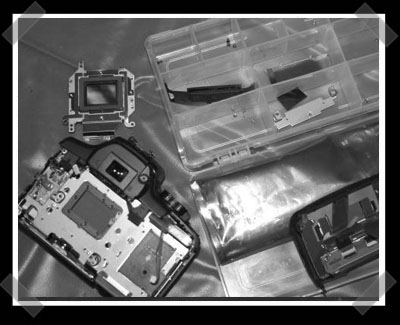
[ash] wasn’t satisfied with these instructions, so he provided a complete how-to on gutting a Rebel XT to remove the glass IR filter. This one involves pulling everything down to the CCD. Once the IR glass is removed, it’s replaced with some high grade glass from Edmund Optics. If you’re into camera modding at all, and own a Digital Rebel, the reference links at the end of the how-to are worth a read.


10 thoughts on “Digital Rebel XT(350D) IR Removal”
Leave a Reply
Please be kind and respectful to help make the comments section excellent. (Comment Policy)







First Post
Neat hack but theres something about exposing the naked cmos sensor of a $800 camera that just seems wrong
The only thing holding me back from doing this to my old rebel 300d is some weirdness regarding autofocus: part of the reason why the stock filter cuts the IR spectrum so completley is for the AF to work. From what i gather, companies who do such conversions will usually calibrate it to work the autofocus with a specific lens (other lenses work, just might not focus right)
If i did do this, i would likely also add an aftermarket focusing screen and just use manual, which is half the fun of SLR’s anyway
@1: its for a specific purpose- for use with a telescope. @2: considering that the objects will be at infinity, and the use its intended for, i don’t think autofocus would be needed. Way cool hack though
In addition to andrew’s post, there seems something wrong about dismantling an expensive camera while grounding yourself via *a foot on a radiator*. At least the other site recommends a good grounding strap and anti-static bags.
Interesting point about the autofocus, but a) yes, manual focus is half the fun of having an slr and b) I gather the major reason for doing this is astronomy photography, where you have to focus using the telescope and a camera’s conventional autofocus gets a confused anyway.
As long as you put some type of spacer in where the filter went (one article used AR coated glass) the autofocus still works perfectally. And most new cameras have an automatic whit ballance adjustment (you take a picture of a white surface and then it adjusts the ballance for you)
Although I will admit that the [camera] ir filter removal hacks are getting a tiny little but old…
Although I am not that familiar with why some one would want to remove the IR filter from photographic equipment I seem to remember the old SONY HANDICAMs with very sensitive to IR ccds getting some interesting low light captures of “temperature gradiant” on human beings and animals? What is the real efficacy for astronomy other than picking up more tiny spots of light? Certainly the commercial, inexpensive, ccds are not cooled or stable enough for high end?
A buddy of mine who is thinking of getting into IR photography pointed out this site with a lot of IR conversion info…
http://www.lifepixel.com/IR.htm
No. 3: “a) yes, manual focus is half the fun of having an slr “
It’s nice sometimes, but of the additional controls that you get from having a DSLR over a point-and-shoot, focus is I think least interesting. Full exposure control, RAW shooting, white balance, and interchangeable lenses are all much more useful than manual focus IMO.
Depends what you’re doing I guess.
No. 6: “I am not that familiar with why some one would want to remove the IR filter from photographic equipment…”
Doing IR photography can produce some really neat effects. Add an IR filter and the results can look like a B&W photo with really odd correspondences between what objects produce black and what objects produce white. Sometimes there are colors in it too, depending on how the IR’s registered and how good the filter is at blocking visible light; those can look even more surreal. See, for example, http://dpfwiw.com/images/r72_gardens.jpg
Astronomers do this hack because the IR filter blocks the most important wavelength of light – 656 nanometers. This is in the deep red portion of the spectrum and is the primary visible wavelength from emission nebula in space. So if you want good images of nebula then you have to take the filter out. Otherwise you will get pictures missing about 85% of the nebulosity.
I have done this hack with a Canon 300D and it makes a world of difference. The camera was practically useless for astronmy before. Now its awesome. I don’t care what the hack does for regular daytime photography. Its for astronomy only.
How about you learn how to use the camera? What a waste of time. Not to mention possibly destroying a perfectly good camera.