Holiday Hackit: Automated hard drive destruction

posted Dec 25th 2007 1:39pm by
filed under: HackIt, misc hacks, pcs hacks


One of our recent posts took an interesting tangent: physical hard drive destruction. First, [wolf] wanted to use a 20ga shotgun shell on his hard drive. [brk] suggests an electromagnet applied to the drive while it’s still spinning. Everyone thought thermite might be interesting… Finally, [wolf] noted this commercial auto destruction drive that floods itself with an acid mist. I’ll suggest a few ideas and let you guys take it from there.

I’d suggest pneumatic injection of two part epoxy into the drive mechanism. Remove the top of the casing using the diy clean room method, add a port for the epoxy and use a cheap CO2 bike injector to force the liquid into the drive on demand.

So, got a better idea? Let’s hear it.


163 Responses to Holiday Hackit: Automated hard drive destruction

  • ryan says:

    well, you could always go the ‘will it blend’ route.

  • Matt says:

    I’d say you drop it a story onto concrete, start the thing up, and let it vibrate itself to death.

  • Tuisk says:

    put some tnt in the hdd and the ignite it.

  • thip says:

    sell it to the government and say it contains details of “what really happend”

  • munger says:

    I think you should just connect a larger battery to the hdd and if a special switch is pressed it offloads into the hdd and fries it.

  • Matt says:

    Give it to a 3 year old with a 30 foot extension cord so it will be running while they bash it into every piece of furniture in your house.

  • Weirdguy says:

    My dad has this hard drive all shot up. Maybe I will take a picture and send it to you? Very effective!

  • Dean says:

    Why not put a little C4 in there? Some plastic explosive will do the job nicely. Maybe that acid burns off the raised portions of the disc so it reads as blank… That would be nice instead of destroying the drive, albeit extremely hard to pull off.

  • John says:

    put in a solenoid injected syringe of mercury. Should dissolve the surface of the platter and leave a nasty surprise for whoever you were trying to hide your data from, when they open it. Would say a glass vial which gets crushed by the solenoid for old school school style, but theres too much potential for loss if the drive ever gets dropped.

  • TheClockSmith says:

    The easiest/cheapest way I can think of is vibrating the hard drive with strong vibrations over some amount of time. I’m not sure how long it takes to erase the whole thing. Someone find out.

  • cheesewheel says:

    a ride in the washing machine with a brick for company

  • Simon says:

    Only thing that will work is heating it up to the Cürie point (when the metal looses its magnetic abilities)

    so fire up that oven

  • Jesse says:

    Something that sets a large amount of strong epoxy (or molten lead) onto the platters when something is tripped seems a good idea. Or resin, or metal shavings, or maybe house current across the platters, or a strong acid that dissolves the ferromagnetic coating on the platters, or dropping a MIG welding tip onto the spinning drive while active, or…

  • EdZ says:

    Epoxy wouldn’t do much good. It’d stop you running the HDD, but wouldn’t destroy the data. A forensic examiner could simply remove the platters and insert them into an identical drive and read the data off (barring iny drive-specific encryption, in which case some ship re-soldering would be required. In any case, the data is still in a readable state).

  • happy gilmore says:

    oxy-acteylene cutting torch. done.

  • Barry says:

    The only sure way. Only problem is that is stinks really bad.

    http://web.mac.com/barrywoods/Site/DOD_drive_wipe.html

  • pistolpete3521 says:

    put it in a electromagnetic can crusher coil and watch it implode. i’d rate that a 5/5 on youtube.

  • Wolf says:

    I’m thinking scrappy was probably right about piercing method, ie, if you can just punch a whole through the platters, the recovery would become too costly for all but the most valuable data. This could be done easily by sharpening the point of a small piston, fixing it to the top of the drive, and filling it with some gun powder.

    Of course, the same idea could be implemented with thermite, since dab about the size of a penny would probably be enough to melt through the aluminum top and burn a hole through the platters. But not enough to burn through the rest of the drive and case.

    Once nice thing about thermite is its cheap and commonly available.

    http://cgi.ebay.com/Thermite-100-grams-Fe2O3_W0QQitemZ230206230007QQihZ013QQcategoryZ1267QQssPageNameZWDVWQQrdZ1QQcmdZViewItem

    You could light it either with a magnesium powder starter, or by mixing it with potasium permanganate (definitely misspelled) then adding glycerin, which will react with the potassium permanganate and spontaneously combust at high temperature, setting off the thermite.

    If I have some time once my college apps are done, I may put together a video testing this out.

    Also, about frying the drive with a battery, all that would be fried is the controller hardware, so the data could be recovered by replacing the controller or moving the platters to a new drive.

  • pistolpete3521 says:

    step 1) do soemthing illegal so that the feds have a reason to come after you and or your computer

    step 2) wait for suspicious knock on the door and verify with security camera visuals as to if it is the men in the blck suits

    step 3) ignite the magnesium ribbon you have connected to a electrical igniter which is connected to a saftey toggle switch and stand the hell back while a few grams of thermite eats your computer as you throw it out the back window of your house.

  • k1ngfunk says:

    A while back I read that taking a nice electric drill with a large bit (quarter inch or larger), then just drill a few holes right through.

    Otherwise, my dad has a really old “nail gun” that actually works like a gun. It has a gun powder-filled shell, but instead of a bullet, it fires a nail. The device is designed for nailing things into concrete, but I’m thinking it’d blast some nice holes right through the drive. Plus, it’s fun!

  • J.Metzger says:

    flash freeze the drive while it is still in operation by enclosing the drive in a freezer box (battery powered thermocouples that activate upon power failure) combined with a nitrous-oxide bottle or freon charge bottle for fastest results. You would then need to include in the case a solenoid activated hammer to smash the platter when it is frozen so that no data would be recoverable.

    Now reality must sink in, any drive platter no matter what the damage can have its data recovered by oblique lazer scan this process was used to recover 90% data from disks that were mangled during 9/11
    Twin Tower collapse.

    No method for HD destruction can truly be effective unless you can reduce the platters to less than 20% of the original surface mass while totally reoranizing the magnetic tracks obliterating all information entirely.

    Forensic data recovery has recovered platters that have been acid etched burned exploded and crushed

    It is all just a matter of how bad the purchasers
    of forensic recovery are willing to expend financial and other resources to gain access to the data in question.

    Deep pockets will always find a way to learn what was
    hidden or destroyed as long as that destruction is not 100% complete.

  • Vincent says:

    If you don’t have a lot of money, but you live in a high-rise. Hang your hard disk out the window, with nothing to hold onto it but the SATA cable. Then cover the hard disk with a protective lubricated condom, to keep the drive safe from rain and snow.

    If anyone grabs for the hard disk, the SATA cable will disconnect, and the protective lubricated condom would make the drive too difficult to hold. Thus the drive will plummet 50 stories to it’s destruction.

  • pt says:

    Where I work my department used to manage the local landfill. We had the 50 ton compactor drive over them.

  • xyzzy says:

    Put some sand inside and let the drive spin. It will not be long until all magnetic material on working surfaces is dust. Good luck recovering data from *that*.

  • medix says:

    I would have to vote for simpler means of data destruction..

    1. Immerse said drive in LN2.. drop (or smash against) and drive should be no more..

    2. Drill a small hole and add about an 1/8th teaspoon of carbide dust (think diamond grit) and power up drive. You may be able to use one of the ‘covered’ vent holes (the ones that say ‘removal voids warranty’)

    3. Usually a good physical impact of the drive (flat side) against a hard floor (ie. concrete) will provide enough force to render the drive un-readable (by conventional means). I’ve even heard of some drive platters shattering under this type of impact. (could probably build a machine to do this)

    4. Place desired drive to be ‘destructed’ into a fire.. (outdoors and/or well ventilated) eventually the Al should melt (if hot enough) and the platters de-magnetize..

    5. (this one’s not so simple, but it would be awesome) Perfom specialized high-impact projectile testing and record high-speed images. (why? Because it would be sweet.. http://www.cordin.com/images.html I’ve been in the lab listed first on that page. Good stuff)

    6. Finally (I’m sure I’ll think of more later) why not just fill the drive with black powder and set it off with some good ‘ol cannon fuse? (similar to anvil blasting.. only I’m sure it’d be better.. might want a good shield for shrapnel)..

  • markie says:

    Well, even though destroying something can be fun of course, if you start out with encrypting the complete disks which carry sensitive data, you won’t run into this problem when the drive dies…

    For instance (this is my own fileserver and already was featured here):

    http://www.hackaday.com/2007/08/19/diy-encrypted-nas/

  • Oliver says:

    Use a powerful degausser – at its simplest, just a large coil of wire around a core connected to an AC source. This method effectively flip the bits hundreds of times a second. After a quick check it seems commercial variants that are NSA / DoD approved so they must be relatively effective against modern recovery techniques. The most effective version of this would be one where the coil had a letterbox shaped slot in the centre for the hard drive.

    If hard drive companies wanted to introduce ‘self destructing’ hard drives they could simply design a physical kill switch on the controller board. When this is set to ‘destroy’ and power is applied, it automatically starts writing random data over the platters. The distinguishing feature of this process could be that the power applied to the coil on the heads would be much greater than usual – as much as they could dissipate continuously.

    It is unlikely epoxy would be an effective deterrant – most epoxy resins can be softened / dissolved.

  • The Yikes says:

    Give it to my ex wife for 10 minutes conversation, trust me that’s the kinda thing that’ll kill anything!

  • Gareth says:

    We had a bunch of drives left when we moved offices all full of name and address info, so we left 2 member of senior management with a center punch, a small funnel, a bottle of full fat coke and a UPS battery rigged up to a molex adapter. They sat there and quite happily made candy floss for a few hours.

  • phate says:

    Step 1.) Stick a neodymium iron boron rare earth magnet on top of the drive and let it sit for 1-5 min.

    Step 2.) Flash freeze the drive, using preferred method of freezing

    Step 3.) Sandwich between explosives, what ever you have around, then blow it up.

    If all goes well all of the magnetic data on the platters will be wiped, additionally there should be about 100,000+ pieces of HDD scattered about your yard.

  • altpersona says:

    i could take em to work w/ me at the steel mill and mix em in… 3k degrees, and they will be part of a new buick…

  • Mike Nelson says:

    i ignited some thermite on an old hard drive of mine, wasn’t really doing it to wipe the data, more to see what the thermite would do to it.. it melted through pretty well, course that was also the time i was dumb enough to try to pick it up right after the thermite went out.. got 2 fairly big blisters almost instantly…

  • Wolf says:

    I just bought enough iron oxide and aluminum to make about 3 pounds of thermite, and I’ve got about ten sub-gig drives lying around.

    Should make for a hell of an experiment.

  • mike says:

    There’s always this:

    (Down near the IDE killer) http://www.fiftythree.org/etherkiller/

    you could always turn the HD into an HD speaker, but also wire the audio to the write head, then (theoretically) when sound is played, you randomly rewrite the data on the disk, then use any form of destruction you wish. Like attach the platters to something like a router to skill saw, then spin it up until it reaches centripetal instability and shatters, or just slam it into something at high speed…

  • t0ny says:

    If you destroy you HD be sure to the magnets out of it first. The ones where the base of the rw arm is are crazy strong. Its worth it destroying old drives just for the magnets.

  • skunklover says:

    i think thermite works the best, a thermite grenade would totaly ruin the drive and be easy to trigger, but for the average person, i guess total drive encryption, and somehow destroying the chip that holds the encryption /decryption key would make the data unrecoverable

  • Solenoid says:

    You could just take low level control of the drive and magnetically wipe it down, off track and otherwise, then reformat for another use.

    If you were really paranoid you could seal the drive and pump all of the air out of it, then rig a vial of liquid tritium to blow off inside should your stuff get seized.

  • Ali Raheem says:

    Most of these ideas will leave sections of the platter unaffected with potenially retreivible data as for the magnet idea I’ve heard you’d need a rather strong magnet to wipe the drives does anyone have any figures?

  • macegr says:

    I don’t think epoxy is a good idea, because that could potentially be dissolved and leave the platters intact. also, any idea dumping current into the drive controller simply fries that part, and doesn’t affect the platters either.

    if you know they aren’t going to cut the power, maybe keep your drives on eSATA inside a microwave, which turns on either remotely or tied to a dead man switch or house alarm.

    if you want a solution that works after they cut the power, mod the drives with dissolvable plugs or windows, and use solenoid mounts to hold the drives suspended over a bath of acid or other substance you know will eat the magnetic surface. if the power goes out, the drives drop into the acid bath.

  • Skyler Orlando says:

    Destroying a hard drive…

    Hmm… well, assuming the idea is to destroy the data beyond all recognition, you’ll pretty much have to annihilate the magnetic disk. I like the thermite idea, but if it were me, I’d want the damage to be as localized as possible, so I can recover the rest of the computer. Suppose… a butane torch, aimed directly at the disk… or a plasma torch. I’d test it first to see if it worked, though, before relying on it to protect the evidence- I mean, top-secret documents… or whatever.

    Just remember, if you can cut it apart, they can put it back together. Burning or melting is a lot harder to reverse.

    Something else you could do is get a thin metal beam with teeth, then lower it ont the platter so it shreds it. As long as your data wasn’t *too* valuable, that’d deter everyone except the NSA.

  • dandin1 says:

    How long does it take to erase a hard-drive the normal way? If the battery can last long enough you could power the hard drive and fill it with random data through IDE. Much less destructive or toxic, but not exactly a perfect method since you have to hope that the thief does not rip off the battery before the erasing is done.

  • Clay says:

    A very simple and effective destruction method is to use a horizontally mounted bandsaw. I bought such a band saw for around $200.

    http://www.amazon.com/Capacity-Horizontal-Vertical-Bandsaw-414458/dp/B000XQ9LB0/ref=sr_1_12?ie=UTF8&s=hi&qid=1198636065&sr=1-12

    Gravity does a lot of the work so it is safer then a lot of other methods. The band saw also works for tapes and stacks of floppy disks. For CD and DVD I use a shredder designed to handle optical media.

    A pleasant surprise was that it is rarely necessary to cut all the way through the drive, or even half way. When setting the blade to cut slightly off center of the axis the platters usually shatter and only a cut of about an inch is needed.

    So, for less than $300 one can get all the hardware needed for media ‘sanitizing’.

  • HaX80r says:

    I once set up a 1 GB hard drive in a linux server with some M80s wired to a model rocket engine starter that was triggered when a relay was tripped by a signal from the COM port. I had a simple shell script to take care of it. I ended up using it once. Quite interesting.

  • Robbie says:

    If I wanted to do it easily, I’d get a hammer and smash it. If I was rather bored and wanted a more difficult method, I’d drive to the highway and toss it out at rush hour.

  • skunklover says:

    for my method just destroy the chip by massive power overload….

  • skunklover says:

    the problem here is what you want to do.
    I see two categories:
    1:destroy datat when you have time and want to get rid of it.
    2:destroy when someone busts down your door and you need the data removes quick.
    If you want option 1, its easy…
    option 2 needs more thought…

  • Chris says:

    hydroflouric acid , injected.

    will eat the platters, the drive mechanism and everything else on its way to the floor

  • zat says:

    didnt see it… but what about a small electro magnet in the hdd case itself?… not the most secure way but if setup with minimum um… noticable wires hanging out of it maybe it would go unnoticed long enough from a theif that stole the whole computer… or if you just needed a slow wipe or something? *shurgs* just what i thought of…

  • Jonathan Wilson says:

    I still think the idea of acid or something else that will destroy the drive is good. Just wire it up to a button on your PC or something, if someone you dont like (e.g. FBI or whoever) comes knocking, press the button and by the time they get to the drive, its an unreadable pile of goop or whatever.

    Of course, then you get sent to pound me in the ass prison for “interfering with a federal investigation” or “illegal destruction of evidence” or some other such trumped-up charge.

  • Jonathan Wilson says:

    Or better yet, someone should invent “physical stenography” where you hide a storage device (e.g. hard drive) inside something that the feds would never waste time seizing but which would have a legitimate reason to be plugged in to the electricity.

  • CalcProgrammer1 says:

    The whole idea of hard drive destruction is lame. If the thing still works, format it over and over again with something like Boot And Nuke, then re-use the drive. If it’s completely shot, take out the platter, smash it or something, and use the rest of the components for something useful…or just build an HDD speaker or HDD clock out of the dead drive.

    But if you absolutely must destroy (for you are crazy), then some explosives…or even just a sledgehammer…would do the trick.

  • the_english_speaking_monkey says:

    @CalcProgrammer1: Some drives have to be destroyed by law. Anything with secured government information has to be physically destroyed as well as digitally. I did an internship with a government organization and we had to do a DoD wipe (they had a special disk but Boot ‘n’ Nuke will do it too) and then take a pickaxe to perfectly good 80GB drives… so wasteful.

    I’ve got a couple of methods, one is just plain fun and the other leaves absolutely no way of getting anything back.

    The “self lathe” method (not guaranteed 100% destruction)
    [note: if you're safety paranoid you may want to wear "protective eyewear" because you could get some flying metal shavings.]
    1. Pull the top off, since you don’t give a crap about the data it doesn’t need to stay clean.

    2. Power up the drive so that the platters are spinning.

    3. Take a cheap flathead screwdriver (there’s a risk of messing up the screwdriver so you don’t want to use a nice one) and touch the corner of the blade to the top platter, you’ll see a groove start to form, run that groove completely across the platter.

    4. Shuffle the platters around until you’ve thoroughly scratched up both sides of all the platters.

    The “let’s see you recover this” method. (nobody is getting squat off the drive after this)
    1. Pull the circuit board(s) off the drive, throw them in a microwave you don’t care about for 15 minutes (should be toast in a few seconds but why risk it)

    2. Open the drive up and remove the platters.

    3. Fire up the forge.

    4. Heat a platter until it’s a nice orange, then remove from forge and hold over the edge of an anvil.

    5. Hammer the platter over onto the side of the anvil to begin a fold.

    6. Finish the fold and hammer flat.

    7. Repeat steps 4-6 seven or eight times with each platter.

  • skunklover says:

    well, just put current through the chip that does encryption on a whole disk encrypted drive…….fry the chip key, and no way that data is coming back……….

    I saw this enclosure at Fry’s that encrypts data on the fly into the drive, just somehow fry the chip in the enclosure that stores the hash, and, boom, unrecoverable, unless someone can randomly get YOUR PARTICULAR HASH…

  • Barry says:

    Or just use laptop drives for the “sensitive” data. They’re all pretty much glass platter anymore. Weld a nail to a rat trap and mount the drive in the rat’s place. Someone comes knocking, pull the string attached to the activation lever, snap! Nail punctures the top of the drive shattering the platters. Though depending on who’s knocking, they might have interns sitting around building pretty little shiny puzzles. :) I still think my forge is the best way though…

  • the chef says:

    i would hack together an induction burner (magnetic hotplate) with the drive if they are in contact when the induction burner comes on it would degauss the whole Drive

  • sumguy says:

    I would make an nas with a mini or nano itx motherboard and power supply, then put it in a steel box lined with refractory cement with thermite above the drive, electrically ignited. With a combination lock for good measure.

    It could be triggered by trying to breach the safe or by remote over the net. I also like the idea of testing to see if anyone is breaking into the box by playing a subaudible tone into a speaker within the box and listening with software and a mike for any change, if the box is opened or cut into than the harmonics will change and the thermite will destroy everything.

  • dosman says:

    Sorry for the cross post, but in case someone is interested I’ve done some testing of degaussing hard drives and found some interesting results. Essentially I found that you can count out hiding an electromagnet large enough to do damage inside your case for an auto-destruct.

    http://www.packetsniffers.org/bitbucket/degaussing.html

  • evan says:

    Ok, so most of these involve melting it, but that’s going to destroy your case, and won’t leave you time to get out of the country after the feds notice that your computer is melting. We need something that can be done on the fly, with little risk of accidentally setting it off. I think maybe using the “lathe” method described here earlier is most “practical” in the scheme where you need total destruction of data. There has to be some other way… will have to think about this…

  • HybridBlue says:

    I had some classes with a guy that got direct access to the drive heads and motor via software and forced the drive to spin at full speed while slamming the read/write head onto the disk. Funny thing is it would totally screw up the drive…he said one drive actually got so hot it caught fire.

  • Zensthoth says:

    this is simple but we used to do at work was a simple 0 gauge drill bit. 1 in the motor and 3 in the platers. quick and effective. also one realy fun way we found was the screen out of a 52 inch projection tv makes a huge magnifine glass that can melt through the platers and board of a HDD in under a min.

  • Nick says:

    At the DoD there are two approved methods. Four 1/4 inch holes through the platters, or several sweeps through the Gauss machine. Personally, I think a pic programmed to turn a battery powered electromagnet on and off as the drive spins. Thus pulling all the bits around on the drive, scrambling what was once legitimate data.

  • necronum says:

    remove the cover of the hard drive and plug it into a power supply, heat the disks inside with an oxy/mapp gas torch and at the same time hold a rare earth magnet to the disks with a vice grips, the magnets youll need are located inside the hard drive.

  • Hutz says:

    Hows about the good old Microwave, set it to very high throw some beans in there with some cheese aswell, and you have a nice fireword display and nice fried HDD and some lunch at the end of it ( warning Contents maby be hot ) you have seen what microwaves do to Cd’s so why not microwaves

  • Frogz says:

    hm, what about a external car battery with internal electrodes that on demand make contact to the center spindel and outer edge of the platters
    a few hundred amps at ~12 volts running through a thin aluminum disk = HOT disk = data goes byebye
    or same thing with 120v connection through some type of current limiter(ie, a resistor) so it’ll operate at the maximum power the circuit can handle without tripping the fuses/circuit breaker
    then there is always embedded magnet coils that connect to the ac line(although for th emost valuable data, im sure it’d be possible to recorver somthing from trace magnetic remnants)

  • Leif says:

    I knew a guy who worked at a place that recovered data off of hard drives for a living. We’re talking 20-30 grand per dive in almost any condition. He said the only thing that prevented recovery was if the drive was soaked in bleach. Not much fun factor – but complete secure destruction of data.

  • Vincent says:

    Microwave? hahahahaha

  • quizme2000 says:

    Don’t forget the RAM when destroying your data, its the forensic back door to data recovery.

  • bfo says:

    Permanent magnets can be demagnetized in the following ways:

    * Heating a magnet past its Curie point will destroy the long range ordering.
    * Contact through stroking one magnet with another in random fashion will demagnetize the magnet being stroked, in some cases; some materials have a very high coercive field and cannot be demagnetized with other permanent magnets.
    * Hammering or jarring will destroy the long range ordering within the magnet.
    * A magnet being placed in a solenoid which has an alternating current being passed through it will have its long range ordering disrupted, in much the same way that direct current can cause ordering.

    The thing when the FBI or CIA or whatever is hunting you, probably you would not have time to destroy your HD. A powerful encryption could do the thing, because even the supercomputers would need years and years to open it.
    Else you could just melt the drive or smash it into tiny bits of dust! How to do it is time consuming thing, because you don’t wont to activate it by accident or don’t wont to fail in its function.

    And what about if you have a flash disk! What then! :D

  • Troll says:

    How about scrapping out a microwave for the magnetron and the needed parts, duck tape it to the drive and nuke your data. I don’t really know what that would do to a HD but it works great for cd/dvd disks

  • Alexander says:

    Simply encrypt it with PGP whole disk encryption. Make your passphrase long enough, and nobody will ever get your data.

    This allows you to retain your data without going crazy paranoid on your drive. Also prevents ‘false positives’ when it comes to accidentally deleting your data.

  • TMIB says:

    I do blacksmithing and have a homebuilt gas forge. I regularly heat up metal to non-magnetic state in it.

    It’d be a simple matter to toss the drive into the forge and heat it up the the point of total data loss. This would also likely melt most of the non-metal components.

    You could go even hotter, using a foundry set up and melt the casing down too. (lots of folks do backyard aluminum casting.)

  • Edd says:

    The disc platter is a substrate material with a magnetic layer added above and below it, so running a coil of thin nicrome wire through the substrate, coated with a highly flammable material, and finally making the substrate of a material with low melting point, like a plastic should reduce the platters into a gloop in a few seconds :)

  • A_Blind_man says:

    As many others said thermite works best but for other ideas hmmmmmm burning acid liquid nitrogen, putting a shotgun shell next to the drive and using that… electromagnits

  • Although I like the idea of destroying things for the fun of it, this doesn’t seem worth the effort, if you are truely wanting to make the data on the hard-drive unattainable then one should target the entire platter surface. Remember that if you deep format a hard-drive the data can still be retrieved because the magnetic surfaces show traces of what was the ‘old’ state … you have to sweep of the hard drive a couple of times in order to remove these traces. Keeping that in mind, any destruction method should completely dissolve the layer of the platter that stores it…360 degrees of it =)

    I guess the question is what quality do you want: every bit and byte gone or make is as hard as possible or both ;)

  • just read the comment about pgp encryption and making your pass phrase long; this would work very well in America as you can always plead the fifth =)

    although can’t say they won’t water-board you for it

  • hmm also I wouldn’t trust encryption yet; quantum computing is around the corner and DARPA has great interest in this field as it can be used to factor large prime numbers at speeds magnitudes higher than any super computer available today; if you encrypt something now … will it still be uncrackable 20-30 years from now ?

  • Cole says:

    open the drive with the DIY clean room, then fill it with nitrogen tri-iodide. the recipie for that is on instructables.com/
    nitrogen tri-iodide is quite the dangerous contact explosive-once that drive is started up, there wont be much left of it.

  • Q branch says:

    lets just put this this way-check out my flamethrower instructable

  • Darrel says:

    I’d say it would be easy and time efficient just to cut it in half with a metal band saw (or other metal cutting saw).

    When you are done, can I have the magnets?

  • howard says:

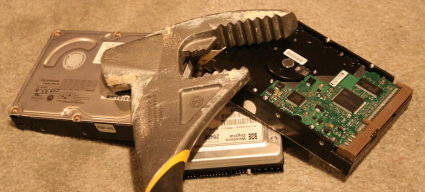
    What is that hammer / wrench thing called in the picture? I don’t know what it is but I needs me one of those.

  • Matt says:

    I like the co2 injection idea. But I think I would opt for a low grit grinding compound somewhere around 200 grit and just let the spinning of the drive destroy itself.

  • linux nut says:

    dd if=/dev/zero of=/dev/hda

  • Cole says:

    maybe just launch the drive out of a very big gun at a concrete wall? or if youre lucky enough to own a tank, just back over it.

  • holden caulfield says:

    This is the best discussion thread on HAD in a long time.

    When I was younger and into computer networking I had several methods set up to destroy a hard-drive quickly. I once attached a model rocket engine to the hard-drive, so that the flame would enter into the enclosure just above the SATA cables. I just used everything I bought at a hobby store; a rocket engine, the igniter, and controller. Eventually I had two rocket engines mounted in a metal case that my dad helped me weld to the hard-drive (I didn’t tell him what it was for).

    Later on I got into explosives and packed thermite strips (in chewing gum paper) under the engine exhaust. It was my hope that the super hot rocket would indeed ignite it, but it was doubtful. I instead opened my hard-drive and inserted chewing gum strips of firework gun-powder, because I knew they would ignite and burn.

    When I was about 16 and I tested my rocket-engine theory with a very old 4 gig hard-drive. The engines ignited just fine, and burnt a small hole in the metal casing and melted all the plastic near by, but the hard-drive disks themselves were hardly damaged. We then proceeded with stuffing it full of firecrackers to no avail. Explosives just blow the disks apart into large-than-you-think pieces, you actually need a steady chemical fire inside the hard-drive case to destroy the disks.

    The magazine 2600 had a similar discussion in it a few years ago that’s worth reading. It talked about magnets, chemicals, and explosives to destroy HD’s.

    I’ve spent the last few hours researching the best ways to do it, and the DoD has published many finds.

    http://all.net/books/standards/remnants/standards.html

    Gotta love google.

  • light says:

    @78 The tool is a Stanley FatMax FuBAR.

  • paige says:

    I found the magnet trick works on a hard drive as far as usability. I needed to get mine replaced after a brief run in with a rather large magnet. I am sure I may have been able to recover (some of) the data but if you apply a purposeful magnet on a hard drive your data will be safe.

  • fujifoo says:

    Perhaps you could cut off the top of the hard drive shell and replace it with some thin rubber sheet (like a balloon material perhaps), and keep some powerful acid in a syringe somewhere. That way when the feds come, you can inject the acid yourself into the drive. This is so that you don’t have the chance of pressing a “self destruct” button accidentally. Goes nice with some data encryption too. ;)

  • fluxorz says:

    i suggest using a timer-operated electromagnet (with the strength of a rare earth magnet) that is positioned in whatever the prime position is for wiping your hard drive. let’s say your base of operations is stormed by a swat team that a mole called in. you just hit the little red button under the desk, and in, say, 5 seconds, the electromagnet kicks on, wiping all your data in about 10 seconds or less.

  • aspartame says:

    A _Color_ picture on hackaday?!?!

  • Ram says:

    Simplicity is usually the best option, like heating your hard-drive to maximum operating temperature. The thermal expansion of the surface would work as a physical “encryption” of the drive. Only at the same temperature you could read it, and nobody would remember heating the thing to recover data…

  • chris says:

    take the drive apart. remove platers. walk to vice in shop. insert plater. put on safety glasses. start up 4 1\2 inch grinder. reduce platers to dust.

  • chris says:

    it ain’t automated but when i need to be absolutely sure.

  • Cherebrum says:

    Hex edit a hard disk parking utility to make it ram the heads into the side of the drive repeatedly.

  • Wow – A lot of folks can’t read instructions – He’s looking for an *automated* means of drive destruction.

    I think, if you wanted to completely destroy the drive when the machine was disconnected, I’d wire a linear shaped charge to a lithium battery and solenoid that’s held open by either/or the power LED feed or a Power-Over-Ethernet feed. When both are off, the solenoid closes and sets off the shaped charge.

    I’d recommend that you experiment with the charge to Get It Right: Too little, and The Bad Guys Have Your Stuff. Too much, and you killed somebody – videos of successful tests will probably come in handy when you’re standing trial for killing a FBI agent “By misadventure” or whatever.

  • brad says:

    The way I would do it is to drill a hole through the top of the drive, over the platters. Then mount a nail on a lever with a rather weak magnet holding it up. Aim the nail toward the drive, so the nail will go through the hole and into the platters. Wrap about 20 turns of magnet wire around the drive, and hook them to a 120/240 voltage doubling transformer, which gets plugged into a wall socket or whatever. Now, whenever you need to destroy the data, simply activate the transformer. The coil will rapidly draw the nail into the platters (shattering them). The coil will also create a pretty severe magnetic field, screwing over what is left of the platters. Depending on what kind of time I have over the holiday, I might just build this….I’ll be sure to post results :)

  • strider_mt2k says:

    Crushing.

    definitely crushing.

  • [GS] says:

    I say, we blast off this rock and nuke it from orbit.
    It’s the only way to be sure!

  • Leave a Reply

    XHTML: You can use these tags: <a href="" title="" rel=""> <abbr title=""> <acronym title=""> <b> <blockquote cite=""> <cite> <code> <pre> <del datetime=""> <em> <i> <q cite=""> <strike> <strong>

    Hack a Day serves up fresh hacks each day, every day from around the web as well as hacking related news.

    Send us your hacks


    Hacks

    Resources