
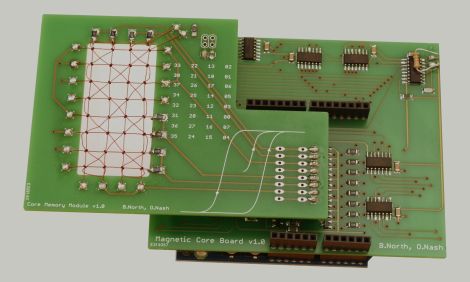
Magnetic core memory turns 60 years old today, and as a tribute [Ben North and Oliver Nash] have created a 32-bit magnetic core memory board for the Arduino.
Magnetic core memory was used from the 1950s through the 1970s, and provided a non-volatile means for storing data, as each magnetic core retained its orientation, even when the power was cut. While it sounds a lot like a modern hard drive, these devices were used in the same fashion as RAM is utilized today.
While the pair used surplus ferrite cores manufactured just before magnetic memory stopped being produced, they did allow themselves to use some modern components. Items such as transistors and logic gates were not available to the first magnetic core memory manufacturers, but the use of these items helped them complete the project in a reasonable amount of time.
Their final result is a magnetic memory board which can be used by any USB-enabled device and is reliable enough to withstand billions of read/write transactions.











This is really impressive, actually. Unless this inspires enough other people, surplus cores from the 70’s are still available on ebay (although, occasionally shipped only from Bulgaria).
It’s a especially tricky to get this to work nowadays, because the specs on the cores themselves are hard to come by (meaning that you have to guess at their coercivity), and most of the ICs developed for their drivers and (more importantly) sense amplifiers are basically impossible to find. In order to correctly drive these, there’s only a narrow band in the hysteresis curve that the select currents have to fall into. This is further complicated that when these memories are used for serious computing, everything heats up, which changes the drive current (which necessitates temperature feedback circuitry).
If you want to learn more, one of the better sources they list is hosted here:
http://ed-thelen.org/comp-hist/Byte/76jul.html
very, very cool.
I will have to try this when I have some more free time, I’ve read through a copy of “Business Data Processing” from 1968 which I found lying around and learnt about the core memory from there (very good explanations).
A freind of mine who worked at IBM back in the day used to tell me stories about some of the things he’s seen, and one was when he was visiting one manufacturing site, and he saw hundreds of women weaving giant looms of this type of memory.
It’s interesting to see it being brought back to life… Now, who’s going to do a delay line memory Arduino shield?
The apollo lander computer used this AND had weaved “ROMS” it’s amazing we were able to do anything computer wise in the 60’s.
I thought “they” were working on vapor-deposition magnetic core memory. That would be capable of making fast, non-volatile RAM at high densities. I wonder what the roadblock was? Maybe not fast enough; SLC is getting pretty fast, but not really RAM speed yet.
Very impressive work.
If you’re looking for the new version of this look at FRAM. TI just announced an MSP430 line with FRAM instead of flash. It’s about as fast as slow DRAM, lower power than flash, and has way more write lifetime.
Something to dump at last!
I just bought a little can of the buggers from the Bulgarian seller a month or two back. 50,000 are in a package about the dimensions of a Gamecube memory card (for lack of a more universally accepted measurement standard), massively tiny.
A note: for at least the ones I bought (package code 5221.3-3M4.53, although the M looks more like a mu or two lambdas), 36 gauge enamel wire is probably the ideal choice. Three strands of 32 gauge will fit through it, but the cores are brittle and there’s greater chance of breakage with larger gauges.
Neat project, wonder how much core memory you could fit into a pendrive sized case?
Finally, my diy Jupiter probe’s memory will gain significant radiation resistance… now to deal with the CPU.
Really excellent work.
@bothersaidpooh: probably a few dozen bytes… not particularly dense. But certainly a unique conversation piece.
Is there an easy to use USB Mass Storage Device library for any common microcontroller family? A 4K USB flash drive is one of the projects I’m considering for my cores (although 4K certainly won’t fit in a standard sized drive enclosure).
Back in the early 80’s when I was serving in the Navy as a Data Processing Technician the 2nd generation Univac computers they were using at the time had magnetic core memory. The matrix was encased in a brass colored cube. I often used to try to visualize the data moving around in there. Fortunately the entire front end of this refrigerator sized chasis was covered with panels of lighted switches that gave all the registers instructions and data, permited stepping through the program, and you could change anything using the indicators. As you can imagine it was really amazing to watch with the lights out.
This project is cool and nostalgic, but it needs more lights and switches…
One of the space shuttles used core store memory.