
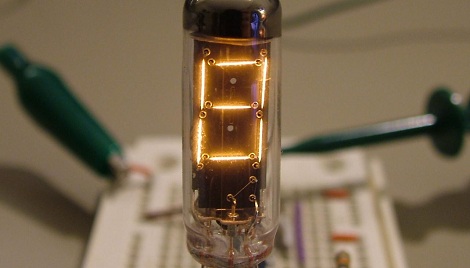
Nixies and VFDs are great displays, but when using them you’ve got to deal with some fairly high voltages, at least for the micro projects we see on Hack a Day. Luckily, there’s another ancient technology that can be driven at tiny voltages. [Kenneth] put up a great tutorial on Numitron tubes to show the Internet how to get these guys working.
Numitron tubes are like Nixies, but instead of the ten number-shaped filaments in each Nixie, Numitrons are old-school seven-segment displays. [Kenneth] picked up a few on ebay and the seller was kind enough to include a Russian data sheet. Each filament in his IV-9 Numitrons required about 20mA to light up, perfect for the constant current LED drivers [Kenneth] picked up
The test circuit consisted of an ATtiny2313 and an A6278 LED driver. The code on the ATtiny cycles the digits 0 through 9. This is sent through the LED driver and lights up the tiny filaments inside the tube. Check out the video after the break to see the Numitron in action
[youtube=http://www.youtube.com/watch?&v=fcs1IpGQDKs&w=470]











I’ve been using these tubes in a clock kit I’m working on. The A6278 is a discontinued driver, so good luck finding what remains. But, the TLC5916 is a nice, cheap drop-in replacement.
Here is my Arduino implementation of a single-digit Numitron tube:
http://timewitharduino.blogspot.ca/2014/05/single-digit-numitron-tube-clock.html
This is all well and good, but the A6278 LED driver is obsolete and can’t be found anywhere (DigiKey, Mouser, Newark, anything from findchips.com, or eBay)
Please suggest a replacement for your readers ;-)
http://search.digikey.com/us/en/products/STP08DP05B1/497-6271-5-ND/1641765
I just went to Digikey, went to the “LED Driver” category, and asked for through-hole 8-bit shift registers. They’re all drop-in replacements.
Why the need to current limit? It’s been many years since I played with numitrons but I seem to remember that they were designed to work directly from +5 volts without any current limiting. Just hook them up to a driver like the 7447 and go. Add a single silicon diode to the power rail to increase their life dramatically by running them at a slightly lower voltage.
The filament will draw a big current surge as it’s heating if it’s directly connected to 5V. Current limiting should increase the life of the tube and prevent overloading the driver chip.
I believe they’re actually designed to run at 4.2V, so yes, a diode on the power rail is a good idea. If you don’t limit current you’ll blow out the filament (word on the street – I haven’t tried sacrificing a tube yet).
https://github.com/openfly/arduino/blob/master/demos/arduino-numitrons_sn74hc595_demo.c
That’s some demo code for using an arduino with an 74hc595 shift reg to drive numitrons.
You can drive segments of GPIO of the avr chips… just no more than 2 at a time.
Fun little tubes I have a few on my flick feed.
FYI I’ve heard thermal shock can kill filaments from an EE who used to build drivers for them. The idea is to keep current on the filament as much as possible to keep it warm.
Thanks for the info guys. I’ll definitely do some research before building something with the six tubes I have in a box somewhere.
I wonder if their operating voltage changed over the years. They were often used in gas pumps prior to LCDs (1970s) because they were visible in sunlight. I remember finding a display board at a junk shop. It was nothing but a TTL driver and the display.
FYI you can within a limited range get some PWM out of the numitrons.
However like any filament bulb… upping the voltage means you burn off more of the filament and the filament will then meet its gory end faster.
But… PWM on a numitron. Consider the possibilities. Especially if like me you have several hundred of them.
+1 on the use of 7447s and a silicon diode to increase tube life. That’s use I used for my Numitron clock. Because they were intended to be used behind colored filters, you can run them dimmer and still see the well indoors.
mmmmm, tubes.
the internet is a series of them.
Nice tubes. Definitely and alternative for “retro” looking projects.
Im struggling to find a chassis mount for the IV-9 tube, are there any out there what are suitable? or is it just a case of soldering it directly to the PCB?
Those are meant to be soldered directly into a PCB.
Couple questions on setup:
I am using an Arduino, Numitron IV-9 and 7H4C595 Shift registers.
The Diode: does this go on every leg of the Numitron or just on leg #1 (common)?
7H4C595 to Numitron: What’s the connection scheme from the shift register to the IV-9?
The 595 has outs for Qa – Qh.
The IV-9 has legs for each segment where:
1 = common (Vcc)
2 = decimal point
3 = B
4 = C
5 = A
6 = F
7 = G
8 = D
9 = E
So I am hooking up like this:
Shift : Numitron leg
Qa 15 : 3
Qb 1 : 4
Qc 2 : 5
Qd 3 : 6
Qe 4 : 7
Qf 5 : 8
Qg 6 : 9
Qh 7 : —
I am using the code from Matt above, but it is not working correctly. I am getting filaments lighting up, but they are not spelling numbers. Any help on the hookup?
I know it is 2 years since yr question but someone else may be helped by my reply. Are you sure you send the right data to the 595.
here is aprogram for regular 7 segment display, but for the Numitron exactly the same: http://arduinodiy.wordpress.com/2012/05/06/7-segment-display-on-arduino-with-595/
I just wanted to point out a small error in what you said about Nixie tubes. A quote:
“Numitron tubes are like Nixies, but instead of the ten number-shaped filaments in each Nixie, Numitrons are old-school seven-segment displays.”
Nixies don’t have filaments. They work on a completely different principle. They are actually neon lamps with multiple cathodes shaped like numbers.
http://en.wikipedia.org/wiki/Nixie_tube
There exists some other display devices with individual filaments shaped like numbers but they are not called nixies.
th
Hooray some love for PIC microcontrollers!
Hey guys, any idea how I could use 2 of these tubes to display my volume setting on my DIY tube amp ?
I’m building the amp together with my father, he’s the brain, I’m just following and trying to learn.. I’d like to surprise him with 2 such tubes for his almost-ready tube amp project. What I would like is to have the actual volume displayed on a scale of 0-99 between the 2 end points of the volume control knob.
Many thanks !
That would require some digital electronics.
you could measure the voltage at the Input grid after the volume control into a series of 10 cases you could display what is required (but that assumes a constant voltage :( )
The next option is to include a rotary encoder or potentiometer with the turning function of the volume knob (asuming its already a dual ganged one for stereo you would need a 3 ganged on)
then you could apply a constant DC voltage to the 3rd ganged pot and measure it. If you are using 6.3v tubes you could Rectify the Heater lines to make 6VDC (better against noise) and run that at one leg and put a resistor to the wiper and to ground.
With an arduino read in the analog voltage and compare 0=0 .00-1 =1 , 1-2 = 2 , 2-3 = 3 etc.
A rotary encoder would work too and just measure the x amount of steps = percentage of turn of the volume knob.
those are 2 ways to go about it
I made a Numitron clock with an FPGA and did a short writeup here: https://www.george-smart.co.uk/clocks/numitron-clock/
It may give others some ideas.
George, M1GEO.