
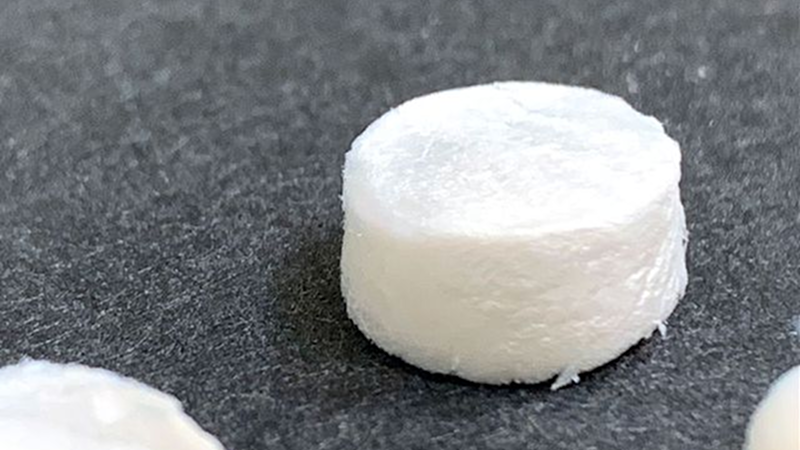
Aerogels have changed how a lot of high tech equipment is insulated. Resembling frozen smoke, the gel is lightweight and has extremely low thermal conductivity. However there’s always a downside, traditional aerogel material is brittle. Any attempt to compress it beyond 20% of its original size will change the material. Researchers at UCLA and eight other universities around the world have found a new form of ceramic aerogel that can compress down to 5% of its original size and still recover. It is also lighter and able to withstand extreme temperature cycles compared to conventional material. The full paper is behind a paywall, but you can view the abstract.
Traditional aerogel is more likely to fracture when exposed to high temperatures or repeated temperature swings, but the new material is more robust. Made from boron nitride, the atoms have a hexagonal pattern which makes it stronger.
The new material stood up to hundreds of exposures to sudden and extreme temperature spikes ranging from -198 C to 900 C over a few seconds. In a separate test, the gel lost less than 1 percent of its mechanical strength after being stored for one week at 1,400C.
Oddly, this material reacts differently to heating. Unlike most materials, it contracts as it gets hotter. This, apparently, has something to do with its ability to withstand thermal cycles and extremes better than other aerogels.
Aerogel makes great 3D printer insulation. We don’t know exactly how to make the special boron nitride material, but it is possible to create aerogels in a reasonable home lab.












That’s hot.
Funny, that’s what I think also.
I thought the article was about compressing aerogel, but the title mentions stretching it.
“Oddly, this material reacts differently to heating. Unlike most materials, it contracts as it gets hotter. ”
Tiles fall off space vehicle.
more from thermal shock, and cold as much as heat
Or your ship gets a nice little check pattern burnt through it where the tiles contracted and left a gap?
https://sci-hub.tw/http://science.sciencemag.org/content/363/6428/723
There, the full paper is now happily dancing in front of the paywall.
God bless you sir and God bless scihub
May any suitable anthropomorphic personification of science bless him and scihub!
http://science.sciencemag.org/content/suppl/2019/02/13/363.6428.723.DC1
videos of its compression/recovery.
Title: “Ceramic Aerogel Meets Stretch Goals”
Article: “… that can compress down to 5% of its original size…”
“stretch” and “compress” are not the same…they’re kinda opposites
That’s called a joke…
After it’s compressed, it returns to it’s original size. It’s a clever title. If you are going to troll it, try to have a half valid point.
This is Hack a Day, not reddit. Keep quality high and “Report Comment” when dummies like this post irrelevant comments.
If it can survive to 1700C then it could make a good re-entry heat tile, although as it shrinks as it gets hotter you’d probably need to overlap the tiles somewhat.
I read “stretch goal” and thought, “an aerogel on Kickstarter?”
Ditto, a bit sad there are no kickstarter to get ceramic aerogel :(
won’t be long now before we have hover vehicles using quantum locked super conductors
What is fogbank?
It is a velocity moderator used in the physics package of a nuclear weapon.
Anyone else want to see the lab gear that can produce hundreds of sudden spikes spamming more than 1000 degrees from well below freezing to ‘holy shit that’s hot’ over a few seconds?
See? Yes! Touch, no…
I assume it was two separate devices – a couple of steel rods dipped in liquid nitrogen and a furnace respectively?
Does this ceramic aerogel also dry like the regular one? I’ve heard that after few days in open air the aerogel looses it’s moisture and shrinks to little piece of goo or something…
That is incorrect to create an aerogel you have to dry it. More likely you mean the fact that aerogel can draw water from the air and then degrade into goop.