
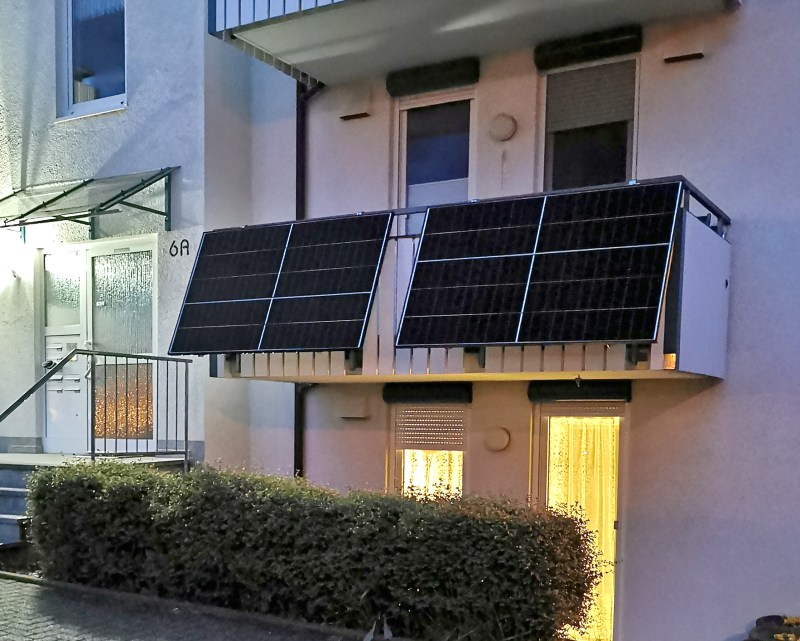
Solar power has been around for a long time now. Once upon a time, it was mostly the preserve of research projects and large-scale municipal installations. Eventually, as the technology grew ever cheaper, rooftop solar came along, and cashed-up homeowners rushed to throw panels on their homes to slash their power bills and even make money in some cases.
Those in apartments or rented accommodations had largely been left out of the solar revolution. That was, until the advent of balcony solar. Popular in Germany, but little known in the rest of the world, the concept has brought home power generation to a larger market than ever.
Pop One On
Photovoltaic solar panels were very expensive to manufacture, a long time ago. This made it difficult for solar power to compete with traditional energy sources like fossil fuels. High install costs and limited power output made the business case difficult, even if the energy from the sun itself was effectively free. However, as the desire for cleaner sources of energy ramped up over the years, solar panel production ramped up in turn. Economies of scale did their thing, and panels grew cheap enough for individuals to consider installing them on their own homes. This led to the widespread uptake of rooftop solar, with installations commonly in the 5 kW to 10 kW range with inverter hardware to allow feeding energy back into the grid in a safe and controlled manner.
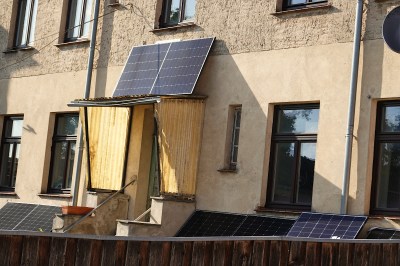
The problem with rooftop solar is that not everybody owns their roof. A great many people around the world live in apartments, or rent, and are not in a position to make permanent adjustments to their home. These groups were largely left out of the solar revolution. That was, until solar panels grew so cheap and power bills grew high enough that even small-scale installs started to make financial sense.
In Germany in particular, small solar installs have become quite popular, and the country has become a hotbed for so-called “balcony” solar installations. These involve simple setups of one or two solar panels which are designed to be easily mounted on a balcony or other outdoor area of a home, rather than permanently installed on a rooftop.
They come with small inverters to convert the DC output of the solar panels into AC power, which plug straight into an existing home power socket. This do-it-yourself install method eliminates the need for hiring an electrician, further improving the affordability of the system. The inverters used with these systems include anti-islanding protection so that the solar system does not power any circuits if the grid has been deenergized for service or repair.
Balcony solar does have some limitations compared to rooftop installs. Often, installation angles are imperfect for making the most of the sun available. There are also limitations to how much power you can get out of such a system. Germany’s initial regulations for “balkonkraftwerk” systems stated that feed in power had to be limited to 600 watts to avoid potential issues with household wiring and sockets that were never designed for feed-in solar power.
Updated regulations allow up to 800 watts of feed-in, with an additional regulation that the installed panels do not exceed a level of 2000 watts peak output. It might sound like a mismatch, but it’s possible to use the excess power from the panels to charge a battery when the output exceeds the 800-watt limit. Having larger panels with higher peak output is useful, too, for when the sun isn’t shining so bright. A 2000 watt peak panel setup will be outputting 800 watts or more far more often than a set of panels that only delivers 800 watts in peak conditions.
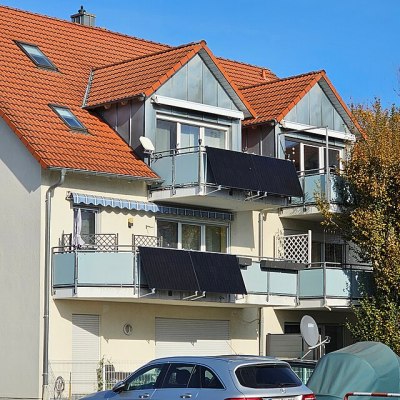
Despite the limitations, or perhaps because of them, it’s a cinch to get yourself going with solar in Germany. Just head to your local big box store, purchase a kit, and hang it off the side of your house. Once you plug it in to the wall, you’re pretty much done. Most kits come with some sort of app for monitoring the system so you can keep an eye on how much your panels are generating. The ease of access has led to an explosion in installs, with over 1 million balcony solar setups already operating in the country.
Thus far, balcony solar has been largely a German thing. However, other parts of the world are catching on. Other European nations like Spain, France, and Belgium have all got on board the train already. In the United States, the state of Utah has already approved a framework for balcony solar installs, and Virginia is following close behind. The key has been carving out special measures to allow easy, cheap DIY installs for small solar systems.
Typically, setting up rooftop solar in most states requires signing an agreement with the local utility regarding power feed-in to the grid, as well as hiring professional contractors for the installation. This adds a huge amount of cost which a small solar system would never recoup in a reasonable amount of time. By eliminating these hurdles for small-scale plug-in setups, they become viable and far more accessible to more of the community.
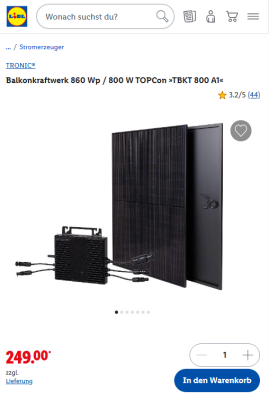
Balcony solar is unlikely to be an instant gamechanger that drastically shakes up the power grid. Most installs are low power. Their juice is mostly sucked up to run a fridge and a TV or two, and few make major feed-in contributions to the broader grid. However, their popularity in Europe shows that there is a serious eagerness amongst the broader community to get on board the solar train any which way or how. At the very least, balcony solar is a grand business opportunity and one that is bringing sustainability to more corners of the urban and suburban landscape than ever before.
Featured image: “Sogenanntes Balkonkraftwerk” by [Triplec85]












Widow AC manufacturers should start building units with a separate solar power input, so they can switch between wall and panel power,
Makes a lot of sense if that’s your biggest energy consumer. I’ve got a portable AC that can be powered off DC and it claims it consumes about 15% less power in that mode. With inverter losses maybe it’s 25% less power overall.
It would also be cool if fridge/freezer manufacturers would start manufacturing their units with DC input, DC compressors, a rectifier for wall power, and enough LiFePO4 batteries to cover 1 day of operation. That way you could stick how ever many panels you need for your locations sunlight hours to charge the batteries and know your food is secure, And if you dont get enough sun that day, when the solar stops feeding, the BMS can top the batteries off from the wall (if the power isnt out).
That’s the thing, the ONLY thing in the fridges that need 120/220 AC is the pump. The rest of the circuitry is some kind of cheap s**t that can run on a variety of voltages, probably between 5V and maybe 12V DC. I am also pretty sure all the uber-expensive “controllers” are nothing more than some kind of perhaps ESP32S3 level of “complexity” that might as well be Arduino Mega instead.
Meaning, if one can convert some kind of base voltage DC, say, 24V/12V into these two, there is no reason why fridges should be powered by the mains to start with (I also suspect the pump may even run more efficiently when powered by PWD instead of the mains’ sine AC).
The pump doesnt have to be AC. DC compressors exist. DC fridges and freezers exist. DC appliances are niche market so they are crazy over priced. The replacement compressors cost no more than their AC counterparts. My cousin converted a Craigslist bought used freezer by swapping out the compressor with a $100 DC compressor for use at his offgrid fishing camp.
So the only thing stopping appliance manufacturers is demand.
A large number of fridges today also power their compressors with DC power from a rectifier. These models that say “inverter” on the label, have exactly that, a built in inverter to generwte varying frequency AC power to the compressor from DC power from a rectifier. But that usually runs at 180v or more.
A portable version is the EcoFlow Glacier.
They have a portable AC-Units with LiFePo4 pack also.
Or you just add a small EcoFlow power station to your fridge.
It has all power management options.
You can even set discharge levels.
E.g. keep 30% when switching from solar/battery to AC so you have some emergency power left if the AC fails.
I don’t work for them not get bonus for ads, I just love the stuff.
I completely disagree about adding batteries. It’s a huge additional cost and complexity and and extra point of wear and failure.
Load shifting should be an option though. Super-cool the freezer section during the day, and turn the compressor off during the night, leaving just the circulation fan, or jest fgood airflow design. Same with deep freezers. Just add some glycol/water bottles to buffer temperatures to -18C or whatever.
thermal cycling is not ideal for most cold storage. You want to maintain a fairly narrow continuous temperature range to best preserve the contents.
A 17 cu ft chest freezer uses around 2kwh per day. A 24V 100ah LiFePO4 in single unit quantity will only cost you around $2-300 with built in BMS and should last 10-15 years. A manufacturer buying them in production volume would obviously be paying less, while this consumer would gladly pay and extra $3-500 for the feature.
Add a power controller to switch between PV/Battery and direct wall current, and you have 2 additional potential points of failure with minimal complexity.
This is far more efficient than losing freezer space to a bunch of glycol/water bottles. And avoid the moronic waste of power and potential wear and tear on components incurred by overrunning the system during the day when it is already the least efficient time to chill.
When you build your fridge freezer into a wall cubby, insulate the sides and the top. You wont see it, but your compressor will thank you.
It also doesn’t hurt to have some small PC fans just blowing air from below over the coils.
Run your own modelling, it’s worth it.
EG4 makes one..!
https://signaturesolar.com/eg4-r32-solar-powered-12k-btu-mini-split-kit/
Where others say this makes sense, it doesnt much feom a power point of view. Start up requirements often exceed 1.5-3kW, and ongoing you can expect a modest unit to be drawing 1kW or more. You cannot fit that sort of energy capture on a window unit.
I have 13kW roof mounted solar and a home battery and am running 3 heat pump / split system aircons and a portable from it comfortably. Panel sizes, however, are large. A standard European unit may well be much better off putting 5-10 panels on their roof for somewhere between 2.5kw and 5kW, and integrating a small battery.
I didnt say the solar panels should be ON the window unit. I said they should have DC input so you can wire panels into the window unit. The idea is to avoid pushing solar into the home wiring by applying the panels power directly to the unit, Not to have a self powered AirCon unit.
My 5000btu window unit runs at around 500W with a momentary spike to ~1kw at startup. The dual power design I described would allow it to draw startup power from the wall current then switch over to a single 500W panel, or possibly just pull the ~500w extra it needs at startup from the wall. Doesnt matter which really,
Midea/Gree did it for a standard split AC.
Sadly they use alternating current compressors, and have a built in inverter. It would be better to build the unit with a DC compressor, DC input being used directly without any inverter loss, and wall power being run through a rectifier.
But there must be a DC bus between the AC input rectifier and the VFD for the motor. That’s where you could potentially inject DC, albeit at a voltage in the mains range.
You seem to be missing the point. There is no need for all of that. There are AirCon compressors on the market that are designed to be used with direct DC power. No inverter, No VFD just a simple 12/24V input. The whole premise Ive presented is that an AirCon manufacturer could EASILY opt to set a system up that would allow a couple of solar panels to offset the power draw during the highest demand period of use without adding and significant complexity or expense.
I’m pretty sure they’re not running on traditional brushed DC motors, so there must be some sort of a VFD/BLDC converter in there.
And RV power is low power. The 12-24 Volt aircons are typically rather small, because it would take enormous currents to turn more than a few hundred watts.
@Dude
“RV Power is low power”
My parents winnebago had a 5kw generator in the 80s,
My boat has a 12000BTU unit it pulls 4kw.
My window unit is only 5000BTU.
Not that it matters to the discussion at hand. A DC compressor can be scaled and implemented in a windows AirCon unit allowing solar power from a small number of panels to be directly fed to the unit, with a simple circuit allowing wall current to supplement or replace solar when it is insufficient or unavailable.
Yes, There are newer units that DO use brushless motors and VFD, and are more efficient. No denying that. But there are MANY direct DC single speed compressors, theyve been used in RV, and cabin ACs at least as far back as the early 80s, and probably well before that.
5 kW at 12 Volts would be 417 amps. That is quite a lot of Amps – not a trivial thing in terms of wiring it around the house rather than just a few feet inside an RV or boat.
And I’m still doubtful that any DC fridge/AC had or would use a traditional brushed motor, for the point that the commutators are noisy and high maintenance for continuous use.
@Dude
Those were examples to show that RV power is not LOW power as you claim.
More relevant to the discussion at hand:
My 5000btu window unit runs at around 500W with a momentary spike to ~1kw at startup. The dual power design I described would allow it to draw startup power from the wall current then switch over to a single 500W panel, or possibly just pull the ~500w extra it needs at startup from the wall.
At that rate it would need to be wired with:
0-10 feet: #4 AWG Copper
10-15 feet: #2 AWG Copper (recommended for safety)
15+ feet: #1 or 1/0 AWG (consider higher voltage to reduce size)
as for your doubts surrounding brushed dc motors being used, My personal 80s experiences of having to change brushes in both AirCon and Fridges are enough for me to ignore your assumed expertise in this matter, We all know youre the authority on all things without qualification.
But AI agrees with my memory:
Based on historical and technical data regarding off-grid refrigeration and air conditioning, companies that have used brushed DC motors in the past generally focused on smaller, marine-grade, or portable units before the industry-wide shift to brushless DC (BLDC) technology.
Danfoss (now Secop/Nidec): Historically, Danfoss manufactured many of the small DC compressors used in off-grid refrigeration and early 12V/24V marine or RV air conditioners. While many modern units are BLDC, older units often used brushed motor technology.

Marine & RV Component Suppliers: Many early 12/24V rooftop air conditioners used in boating (marine) and "back-woods" RV applications in the 1990s and early 2000s utilized brushed motors for their simplicity, notes a 2007 report on DC compressor research.

Custom/Niche Manufacturers: Companies like Duryea Technologies have a history of creating DC motors for specialized AC units.

Older Industrial/Automotive HVAC: Before widespread BLDC adoption, many mobile or auxiliary AC systems in heavy machinery or specialized vehicles (like those supported by Nidec Motors) used permanent magnet brush DC motors.
It’s incredible that these things are legal. Back-feeding power through a wall socket renders fuses and ground fault circuit protections on that circuit pretty much moot.
Fuses should be OK, I don’t know about circuit breakers and ground fault protection.
That’s exactly the point. This thing will power a fault and reduce the amount of current through the fuse, so it will either trip slower or not trip at all.
This is a big part of the power limit. At 240VAC, the 800W limit is still below 3A. A 16A circuit should not have any meaningful negative effect here. If the 800W source can power a fault to detriment, the protection device won’t trip anyway. GFCI/RCD should be fine, as a fault to ground through you will still lead to an imbalance, assuming the solar source is properly grounded into the main system.
A true fault (say 10X rating or more), rather than typical overcurrent condition, will still trip the protection in once cycle or less.
Given that overcurrent devices have a pretty broad range of overcurrent cutoff values (usually. I have dealt with some deeply expensive commercial units that have pretty tight tolerance– +/- one or two amps at hundreds, but they are NOT residential use devices) that are also time dependent, +/- <20% for 3A isn’t a concern. Many residential breakers are ;’inverse time’ characteristic, with a tolerance of +5 to +15% or more for an eventual guaranteed trip, and +50 to +150% (24 to 40A for a 16A protection device) for a trip in less than 1 minute. One second trip generally needs at Least +200%, maybe +400%. Fuses are worse.
It will increase the limit where the system will trip by feeding the fault two ways.
A 16 amp regular wall socket is not rated to supply 16 Amps continuously. The true continuous rating is about 13 Amps. By allowing up to 19 Amps (16 + 3) without tripping the fuse is really pushing the limits.
The concern here is that people will be tempted to connect more devices on the circuit they’re feeding with their own solar panels. Come to think of it, why not plug in two such inverters? Or three? Nothing says you can’t.
Dude: It is clear here, and has been in a number of other threads, that you aren’t concerned with what is correct, but only with contentious argument.
You are wrong. Deal with it. These keep things well within the tolerance band of certification for all devices involved. You don’t have to like it. But believing hard and yelling loudly don’t change reality.
Fun fact: in the US under NEC, you can connect a device that draws up to at least 27A to a 15A protected, 120V receptacle. Similar in Most EU jurisdictions. There are conditions (duty cycle, maximum duration of overcurrent vs overcurrent value, and so on) The continuous duty rating (80% of protection in NEC) is not because at 101%, things catch fire. It is because things like starting load for a motor or tungsten lamp, intermittent loads that bring a circuit to or slightly above limit, and so on, as well as voltage drop considerations.
If you want a truly Byzantine collection of rules, read the electrical requirements for classed commercial ships (pick a class. Any class. BV. ABS. DNV. NK. They are rectifying the rules between many of the classes over the last decade or so). In many cases there, you can find clear justifications, as opposed to, say, NEC in the US.
The UK government have reviewed plug in solar and the independent advisor that writes UK electrical code have changed their opinion from it being unsafe to being generally safe. https://www.gov.uk/government/news/government-to-make-plug-in-solar-available-within-months
The UK government electrical code is one of the most rigorous and safety conscious in the world.
I’m sure they know better than you.
@Dude in the UK we have 13A sockets and a 32A breaker. Figure that one out.
Nice to hear that UK plug in solar is “generally safe”, as I’ve found for the past 4 years, it’s totally safe.
Yeah, you have 13 A fuses in the sockets, and also in the appliance cords at least sometimes that I’ve seen.
The British standard socket has to have a fuse by code. The continental sockets don’t, so the only protection is the 16 A fuse or breaker up in the panel, and supplying power to the same circuit through another socket will bypass that. See how that can be stupid?
Also note that there isn’t just one Dude. People who I’ve offended keep impersonating me, which I can’t do anything about.
Ok, so I got that backwards. Fuses in the cords, sometimes in the sockets as well.
Either way, each device is individually protected, which isn’t the case for the continental EU power system.
With Germany being Germany, I’ll not be surprised if it’s also legally required that the inverters have a RCD function, since if it’s connected to protective earth through the house wiring socket, it’s got someplace for the misguided electrons to go and thus trip the inverters RCD implementation.
And knowing that the solar panels metal structure themselves also has to be grounded for legal reasons ( unintentional electrical potential elimination ) + maybe even referencing PV panels negative/neutral connection to PE somehow, suddenly the whole solar installation has working RCD functionality.
It’s amazing what problems can be solved if you used your noggin’, instead of immediately defaulting to what’s basically “YOU CAN’T DO THAT, THAT’S ILLEGAL…”
Any RCD that was supposed to be on that circuit will be made less sensitive by adding a second supply that injects power past the breaker, because the other suppy is also powering the load/fault and reducing the amount of current drawn through the RCD.
That is also the case from the point of view of the inverter’s RCD circuit. It can’t know what the actual fault current is, so having the RCD is more of a token gesture towards safety than actual protection.
The trick and why this is legal is that in many countries you don’t need to have RCD for regular household wall sockets, at least as of yet. The point is, if you want it and have it, adding the suicide plug power supply will make it moot.
Each Socket should have their own Fuse to beign with so this is not realy that much of an issue.
The European Type F sockets don’t.
Or, you might actually sell it as a “fuse saver”. You can overload the circuit when it’s on and not trip the fuses/breakers.
Might cause the wires in your walls to overheat though…
Indeed, which is why I’d never plug one in to the most convenient circuit it could be connected to here – the workshop has grown power hungry enough there isn’t really enough headroom to run everything even though its a dedicated 32A ring main of its own. And I’d certainly not want my grandparents getting one, as I know their wiring while perfectly safe used as intended is really old and IIRC its just one giant ring for the whole building…
So yeah I really don’t think such things should be legal – just get folks buying those battery/MPPT/inverter units like a delta flow and plugging in their always on devices like the fridge and freezer. Way way safer for the normie that doesn’t understand electricity, and doesn’t want to hire an electrician – the small amount of PV you can fit on a balcony or in most European gardens probably won’t be enough to even entirely offset those essentials all day every day anyway. But with the way energy prices are going and look likely to keep going its going to be very very worth it.
It is enough to offset those devices. Also, it needs not perfectly and entirely offset it, the Grid (well, local supply network) exists to let us draw power from next door or the street when the kettle goes on, or from a windfarm, fission boiler, or whatever big source is backing it.
Now, if you want this to be dangerous, point to the reports of fires and such from Germany, please. Or, shhh!
It almost certainly isn’t for such small setups – at peak solar panel output sure, but across the day with how much angle of incidence matters you are only getting a fraction of that peak, and then you have night time… You will through much of a day be getting enough to fill the battery some, if you really have a big balcony or a really well angled one to catch that really really good performance peak maybe even enough to last through the night on many days…
I do agree its still worth it, taking load off the grid, and with the current energy price trends looking to continue it will pay for itself promptly.
No I don’t want it to be dangerous, but factually it just is, not dousing yourself in petrol and having a smoke dangerous, but so many points of failure, and it normalises the suicide plug concept that is stupidly dangerous but the not technically minded will go ‘If it was good enough for that supermarket purchase it must be safe’ – far better to mandate the connector must be one that is always safe rather than exposed conductors that now you are feeding power from the wrong end COULD be live. Yes the balcony solar inverter is supposed to cut off when it can’t see the mains any more, but that is not a fail safe system, its a rather fail deadly system. Also while YOUR wiring, maybe even most of Germany’s wiring might have so much safely margin it can afford to lose some how many older but perfectly safe wiring and already at the limits cable runs are out there!
The often 100% saturated breaker as I already have here with a workshop that can draw too much if I am not mindful of that is safe, as the breaker trips to protect the wire should I ever do something stupid – dumping heaps of power behind the breaker means it won’t know the wires are over current rating, and potentially staying there for hours. The whole point of the breaker/fuse is to trip out BEFORE the wiring (etc) is at risk, but it can’t do that if it doesn’t see the fault condition because the current isn’t passing it!
One way to prevent wiring overload is for the balcony system to periodically turn itself off briefly. If the circuit is overloaded the breaker will trip. People will figure it out if the power on one circuit constantly trips the breaker and remove the extra load.
What if the user has two solar inverters in the same circuit?
Nothing says they can’t plug in more than one unit.
These things are sold also by the energy provider.
https://www.enel.it/it-it/blog/guide/fotovoltaico-balcone
So I believe that they know what are doing.
https://www.enel.it/it-it/blog/guide/fotovoltaico-balcone
This is sold by an energy supplier in Italy. I think they know what they’re doing.
Or just don’t care.
https://www.gov.uk/government/news/government-to-make-plug-in-solar-available-within-months
One of the safest electrical codes in the world. You are wrong!
Since when did the UK electrical code apply in Italy?
Note:
UK electrical code: devices must be protected at the plug/socket.
Italian/EU electrical code: devices don’t need to be protected at the plug.
In Italy this setup can feed power to into a socket without going through any breakers. You honestly think that’s a good idea?
Oh you sweet summer child, if there’s a problem with German regulatory authorities, it’s that they often care TOO much…
Hell, it has reached meme status that if you got something TÜV approved in Germany, most other European countries equivalent regulatory authorities basically considers that approval a “cartè blanche” approval in their country too, simply by how stringent and thorough (and not to mention, well documented) the approval process can be in Germany.
So good job putting your unfiltered ignorance on display for the whole world to see. Hope you’re proud of yourself.
Yes, but we’re talking about an Italian energy supplier in this case.
That’s what makes this so incredible. Why did they allow this?
What this thing is doing is essentially creating the equivalent of a ring mains connection in the circuit. This is not allowed in Germany/EU if it’s done at the breaker panel, because it will fail to protect individual outlets for overload, yet somehow it is legal when a consumer plugs a generator into a wall socket and creates the exact same situation.
Everyone’s going “Well they know better than you! It must be safe!” – but that’s just an appeal to authority. They’re the rule-makers so all the rules they make must make senses! It’s not possible for them to be the rule-makers if they didn’t make sense, because that’s not allowed.
A perfectly circular and a perfectly German train of thought if you ask me.
So you think every big company “knows what they’re doing”?
Like Google, Meta, Monsanto…
Or maybe you just give “clean energy” a break, and believe whatever they say/do.
Governments multiple of them, all agree that it is safe. Do you trust your governments electrical codes? Because every single regulation is written in blood. For them to start deeming things as safe after it was previously ruled as not safe means major improvements. https://www.gov.uk/government/news/government-to-make-plug-in-solar-available-within-months
Not always. They’ve made some dubious choices in the past, and I’ve no doubt they will continue to make them in the future.
No system is perfect.
This is where the 800 W limit comes from: at 250V this is 3ish amps. Your typcial european socket is sharing a circuit with a few others behind a 20A breaker.
So you are looking at worst case pushing 23 A instead of 20.
The inverters are also specced to cut power if the grid goes off.
My breakers are 16 A because the standard Schuko socket/plug is rated for 16 A.
If your country allows a 20 A breaker to feed a 16 A socket, they’re doing something very stupid, because the breaker would allow overloading the socket. If you back-feed another 3 amps behind the breaker, so one 16 A socket could draw up to 23 Amps and not trip any safeties, that’s close to criminally stupid.
Yours is the safer approach, no doubt, but across the world it is very common practice to install multiple lower-amp-rated sockets on a slightly higher-rated breaker.
Pretty much every house in North America will have 15-amp outlets running off 20-amp breakers. In fact the classic duplex receptacle that you see everywhere in the US/Canada/Mexico has two 15-amp sockets and a total rating of 20a. Japan does something very similar.
(and no, I’m definitely not suggesting these systems are ones to emulate, just that they’re used by nearly three quarters of a billion people)
Which is a point in favor of saying that even the regulators and the people who should know better (energy companies) often don’t know or just don’t care.
That way round is fine though – if you are actually using the full 30 Amp of your dual sockets the 20 Amp breaker will trip, which is a mild annoyance but very safe. But as you are likely only using 3-5 Amp from each of the two sockets its just far more convenient than having some sort of power splitting unit on every socket to allow you to have two desk lamps that won’t even come close to the socket’s limit.
Where a 20A breaker on a 16A socket you are going to be able to deliver 4A of extra power the wiring and socket wasn’t sized for and the breaker won’t trip to protect you. Plus its probably more like 6A given most breakers are not hair trigger but allow some over current for a period, which just makes sense as everything can handle it and the inrush current can be rather higher than the operating.
Unless you have an extension cord with multiple sockets…
I’ve seen “brown snakes” on vinyl flooring in places with older code electrics, before grounding was mandatory. The wires and the sockets had enough of a resistance that the fuses didn’t trip, so the cord to some appliance of a previous tenant had basically burned up and left its mark on the floor.
The landlord had an electrician come in and swap the socket out, but they didn’t do anything else. Who knows what the wires were like inside the wall. Needless to say, I never used that socket.
That way round isn’t fine, it’s exactly the same.
In all cases we’re talking about, you have multiple 15 or 16 amp sockets connected to one 20 amp breaker.
Whether those sockets are in the same receptacle or multiple receptacles doesn’t change the fact that you have a breaker and wiring designed for 20 amps and sockets connected to it designed for less than 20 amps.
I don’t think anyone was talking about connecting a single 20 amp breaker to a single 16 or 15 amp socket, that’s not a sensible (or generally legal) scenario.
None of these setups prevent the scenario where a single device might have a defect/partial short/etc which allows it to draw more than the rated 15 or 16 amps, but less than the 20 amps that would trip the breaker.
“Pretty much every house in North America will have 15-amp outlets running off 20-amp breakers.”
Not if they are wired per the NEC. And you do know that you can buy a 20 recp.?? right???
Lowes/Home Depot has both 15 and 20 amp recps.
If you have 15 A receps. you must have a 15A protection.(per NEC)
@Tom RE NEC requirements
Youre confidently incorrect. A 15-amp outlet requires a
15-amp circuit breaker when wired with 14 AWG copper wire. 15-amp receptacles can legally be used on a 20-amp circuit if paired with 12 AWG wire, which common practice with multioutlet strings.
@Tom
Bringing the receipts:
NEC 2002, 210.21(B)(3).
Table 210.21(B)(3)
https://inspectapedia.com/electric/NEC%20Table%20201.21(B)(3).jpg
We have fuses in our plugs. Often for 3 Amps. We also tend to have rings. Really, this has been thought about. Even the USA electrics were thought about. Earlier.
20A? Unless we’re talking about something like the “funny” systems used in parts of Britain, it’s 10A for older installations and 13A for newer~ish ones, per single-phase “group”.
But yeah, there is the tolerance margin to keep in mind though, which is also time period dependent.
No they don’t. These units stop supplying when the grid reference disappears, so they always shut down in case a breaker trips.
The ground fault protection is not affected (unless you have two simultaneous faults that are exactly opposite, which is less likely that your GFCI failing in the first place)
Theoretically, there is a possibility to use 800W more on a given circuit than the breaker (typically 16 or 20A on 2.5mm2 wiring) allows.
Judging from the fact that these plugin converters have been used in .NL for small fixed, rooftop installations since 1990, I don’t thinks they are particularly dangerous.
Can be safe somewhere, sometimes yes – but dumping a few hundred watt and normalising the concept of suicide plugs (even if these are supposed to be auto cut off) is just a bad idea. Far better to make these kits really easy, with the electrician needed for those regular homeowners only to replace a regular socket with a IEC60309 caravan style one IFF the circuit isn’t overloaded so the breaker is likely to work without the cables melting etc…
As those connectors are darn nearly idiot proof fail safe, and changing that socket – where the active protection required for those suicide plugs is definitively fail lethal, and while most folks in Europe at least with the 230/240 volt design are not likely pulling enough current to put the wiring at risk it could happen, especially in older homes with old wiring.
My micro-inverters cut the power within a cycle of being disconnected, it’s impossible to suicide yourself, but I get where you’re coming from. They would have to be non-compliant devices (not approved by the relevant authority) to cause an issue.
In theory – but that is entirely reliant on an active protection that could fail and for something you probably expect to use for 20+ years… When if it fails seems to me its as likely to fail dangerously as safe (not seen the circuit design, so maybe it is possible they are more fail safe, but seems unlikely).
But still it is far better to design the hardware in ways the reliable laws of physics make it rather bullet proof as a baseline of safety, even if you can then enhance the protection with smarts, when the result of a failure is potentially multiple fatality building fires. So a socket/plug combo that doesn’t look like the suicide plug is far better.
The people who approved them thought of that kind of thing.
Every one of these systems monitors the voltage on the line. If it drops or goes wonky, they shut off. When the GFCI trips, the system recognizes that the power is gone and shuts itself off as well. You have to power the system off and back on again to reset it – that is, you have to push a button to intentionally reset the solar system after an error.
An 800 watt system can push about 3.5A through the outlet. It is recommended to reduce the 16A circuit breaker on that circuit the 13A.
The people who design this stuff know what they are doing. All such systems sold in Germany have to meet standards, and those standards are enforced.
But these things can actively prevent the circuit protections from working in a fault.
These are not safe for the same reason as why British ring mains circuits are not safe – a problem which was remedied by mandating that the sockets must have fuses in them. It is partially solved by reducing the main breaker of the circuit, but that should be mandatory – not a “recommendation”.
Why they were approved is a mystery. Obviously the people designing this stuff know that they’re creating a problem.
Interestingly, you were very vocal, and wrong, in another thread recently. I wonder what you’ll be wrong about next!
In particular, here, these plug-in power sources are safe, because they have been designed to be safe. The “problems” you are so concerned about are known, and have been taken into account.
Secondly, British ring mains have fuses in the plugs, not the sockets. They are safe, and why they were approved is no mystery. After WWII supplies of building materials, including electrical wiring, were scarce. The ring main design saved about 25% of required copper compared with previous British wiring standards.
Please read a book or something.
Makes no difference to the general argument: in the UK the system is safe because each device is individually protected. I was never in disagreement with that.
There’s no fuses on the Type F Euro plug or socket. It’s all up in the breaker panel. The problems have not been accounted for in the majority of countries using the standard continental system.
The reason we have ring mains is widely published and not the slightest bit obscure.
(The design solved a different problem).
The reason for the ring main circuit is to reduce the amount of copper. The resulting danger is that any socket may be supplied two ways, so the main breakers do not necessarily protect it in a fault.
The remedy in the ring main system is to individually protect each device by rule. This rule is not present in the continental system which does not allow ring mains: the standard sockets and plugs/cables in the EU are not individually protected – they are only protected at the breaker panel.
The introduction of the suicide plug power supply effectively turns an EU power circuit into a ring mains circuit, which it was not designed to deal with, and which would otherwise be illegal – except for some reason here it isn’t.
Also mind: in some countries it’s common that GFCI is integrated into the outlets. In Europe it’s common that the ground fault protection is per circuit, not per outlet.
Suppose your solar panel is powering all the load in the circuit and pushing the excess out through your meter panel. How does the GFCI at the breaker box detect that someone is getting electrocuted, when it is not passing power into the circuit in the first place?
In that scenario, the ground fault protection is “working backwards” and seeing the power grid as it’s load, and since the power grid is balanced it detects no fault, won’t break the circuit, and the solar inverter remains on.
Or, another scenario: there is a ground fault, and it is detected by the interrupter, but how much of the fault is being fed by the breaker and how much by the inverter?
The solar inverter may be feeding the same fault, so the ground fault detection can see less current than the trip limit and simply not operate. It depends on where the fault is and how big of a fault it is.
Wouldn’t both these concerns mostly be a factor if the solar inverter doesn’t have its own functioning GFCI?
In my experience, microinverters are extremely paranoid about such things and will shut off if you as much as look at an alternate ground path.
Even if it does, the same problem remains: two sources feeding the same fault means each interrupter sees less current than if it were alone.
In the worst case the trip limit becomes double, so a circuit that was originally set up for human safety will become lethal despite having ground fault detection.
That may be more due to ill behaving switching loads in the circuit putting GFCI’s on the edge of tripping anyways. Non-linear loads don’t work well with inverters and inverters don’t work well with them.
Trip current for these GFCIs is typically around six milliamps, which is what I was alluding to. The type of load / power factor / etc isn’t relevant unless maybe we’re talking about some Aliexpress special.
Not to mention the building regulations problems with hanging all that weight off something it was never designed for in high winds. 2 reasons any insurance broker will just walk away unless you do it right. At least plug in units are becoming safe and legal in the UK soon.
yeah i don’t know good idea vs bad idea but it seems pretty wild to me. definite game-changer!
I love how you jump to the conclusion that these are dangerous without even pausing to think, let alone read up on how they actually work and manage to be compliant with electrical + product safety regulations in countries with some of the strictest regulations in the world.
Even at a basic level – you really think Ikea are going to willingly sell something that could electrocute people?
If RCD/GFCI is not mandatory in the country then it doesn’t matter if it doesn’t work properly. Likewise, if the local code allows you to feed power in past the breakers, then it’s legal. Who’s to argue with that?
Yes. If it’s legal, it’s legal. Do you think money has morals?
The point is, it’s incredible that regulators are tightening the thumbscrew on what is and isn’t permissible in electrical installations, adding extra demands like ground fault detection where there was none before, but then they just make suicide plug power supplies legal. How? Why?
Also, as I’ve noted above, feeding power into a circuit from two ends is effectively creating a ring mains setup, which is already illegal in the EU electrical code because the sockets and plugs are not individually protected to deal with that situation. It wouldn’t be safe, by the code that already exists.
Yet here we have a special exemption that was made legal. Why?
The best answers I’ve seen so far is that the standard sockets have enough safety margin to pass 3 more amps. To me that is not a good excuse, because that’s removing the safety margin from the rest of the system.
My best guess is that back-feeding power into the circuit was somehow neglected as a loophole in the law, and now that the products are already on the market and getting popular, they don’t dare to close that loophole anymore.
I have seen these on AliExpress for years.
I wonder how they regulate the power so you can use the full output and only send 800W back to the grid? Seems like that would require data from the service feed to be sent back to the inverter, which has a wall socket as its only connection.
The energy counter is bidirectional
The energy counter is bidirectional. All energy counter in Italy are remoted operated.
The “balkony solar”-approved microinverters are hard-capped at 800W, it simply never produces more than that. When the Solar panels provide more than that, the remaining solar energy just goes unused. See Solar panel characteristic curves, you stop using the maximum power point as the inverter lets the panel voltage rise (up to the panel open circuit voltage) when it caps the power output.
800W is the full output. Easy as that.
But you can do more sophiscated setups.
An energy meter reader can provide feedback to an home asisstant instance as example which can control your inverter/batteries etc…
The idea is great but often not really possible to get them installed because the building owner association in many places still prohibits anything added to the facade.
Its a EU regulation that is half baked like the banning of combustion engines, but not mandating cities install chargers for on street parking.
Combustion engines are not banned.
On street parking is often suboptimal.
Every city I know in recent years is installing charging arrangements of several sorts.
The building owner is not allowed to outright ban them.
At least not here in Germany.
The building has to be under monument protection or similar to forbid it.
Funny that this comes up now. I was just looking at HB 4060 in the Oklahoma legislature that hopes to make 1.2 kW plug-in units legal; and started looking into units that would fit the bill. For the time being, I still need to focus on better insulation as the more cost-effective energy saving solution.
In the USA, the state of Utah allows this as well, up to 1200w. I believe some other states also allow this.
I helped a neighbor put such a system on her balcony. It actually looks pretty good – it’s like a black privacy fence around the balcony. Her balcony has rails around it instead of a wall.
It works OK – at least, she has never complained.
The neighbor below her complained because some moss fell off of her balcony onto his while we were putting up the solar panels.
The weirdest thing was another neighbor who complained that he could no longer look through the balcony rails into her living room to see if she were at home. My best guess is the dude was creeping on her (playing peeping Tom,) and was miffed that he couldn’t peep any more.
Yes, you are right, its 16.
This still does not change the logic, the added current should be within a rezonable quantity to not cause an issue.
I don’t know how it was calculated or tested, but would be curious to know.
That’s playing with the idea that a 16 Amp circuit “should” have safety margin up to that much by code, so they’ could have made a special exemption on that.
Problem is, you’ve then taken out the safety margin.
Back-feeding power behind the breaker can stop it from tripping in a fault.
The ground fault circuit monitors whether the same current is going in and coming back out. It won’t protect you from the power that you’re back-feeding into the circuit, so you can electrocute yourself without tripping the protection.
Or the mishaps are rare enough and aren’t getting reported.
Tje GFCI will trip at a fault of 7W either way. Even if the fault is fed from the solar system, it means return current going out to grid will be reduced in one leg but not the other, instantly tripping.
You are confusing power and current.
At first blush, this seems analogous to folks in the US who gin up three prong “gender changers” so that they can plug a backup generator into a grounded wall socket rather than pay an electrician to properly integrate it into the main breaker panel.
For the moment, I’ll take it on faith that the other commenters are correct that these units fail safe when the mains go out.
I have no doubt they’ll fail safe when the mains go out.
I have doubts they would fail safe when the mains don’t go out: when the fault is not in the grid, but in the wiring or some connected device, or when a human is put into the circuit.
I’m not 100% sure two of them plugged into the same circuit/service will fail safe if the grid goes out.
It has been considered, the claim is that they can tell the difference, but ‘made in China’.
Also: Wind loads, good fun when these go flying.
Especially for landlords, assuming the upthread horror of German Fascist green laws banning sane rules is true.
Also also: consider that you don’t want these going offline when the grid browns out…Detecting other inverters simply on voltage is difficult as it naturally varies so much.
You also have to consider German wiring.
‘crete walls mean the outlets (which where never originally in the right place) are wired with bodged up exposed wires that wouldn’t be to code anywhere with sensible stick built houses.
Germans say: ‘This is fine.’
Sell kits to install exposed wiring at bauhaus.
They usually include double sticky tape plastic conduit, like that makes it better.
I was wondering when you’d show up. At least you don’t even pretend to know anything.
That’s your job.
I’m just a humble electrical engineer.
You do remember how Dunning-Kruger works?
The way grid-tie inverters detect missing line is because they’re always trying to push power into the grid. They’re trying to forcibly advance the grid phase as much as they can, so in a situation where a single inverter is left in an outage it will sense the frequency shooting up and detects a fault condition. Suddenly there’s no push-back from the grid.
The fundamental idea is that when the power goes out, the supply and demand in your little power island no longer matches and the frequency goes up or down rapidly. How quickly that happens depends on how large the island is, and what sort of loads and sources are in it.
That’s also a problem, because if many people have grid-tie inverters that behave like this, you get instability and power outages like in Spain. The inverters have no inertia and they snap off as soon as something “weird” happens with the grid frequency, which causes further instability and cascade failures on the grid.
So all you need for the thing to F-up is one non compliant inverter (or generator operated by a full idiot) to set the frequency?
Alternatively enough AC motors in the load to hold the frequency, ‘well enough’.
What nation are these inverters built in again?
The single inverter case is almost certainly 100% safe, as it the case of multiple inverters from the same manufacturer.
But a local transmission area?
With transformer hysteresis between dozens of inverters?
Made by ‘randomstringcorp’ and manufacturer self certified to ‘China Export’ standards?
Lineman has always been a dangerous job.
No line is dead until tested then hard wired to ground.
Despite the concerns that several seem to have, I think this is a good idea.
My install install was 2 x 300 watt panels, then expanded it to 4. But that was an ground mount system. I also had a professional install an outside transfer switch, which gave me four outside breakers, so I could run power to my shed (where my panels also connect to, via a small sub-panel). I later had a pro install 6 more 400 watt panels. Of course, this is because I have a house with a small yard.
I did the original two panels because i wanted to offset my “phantom” power load, and it grew from there.
In my opinion, the apartment solar panels do give someone a change to put their money where their mouths are, as to renewables, even if its is just one or two panels.
The only limitation to adopting this in the US is the use of 110 vs 220 (what the majority of micro-inverters supply). Of course, if someone designs one specifically for this purpose that might change.
For belgians around, the situation moved last year:
https://brusselsmorning.com/belgium-launches-800w-balcony-solar-panels-from-april-17/70877/
But not sure the building owners allow the renters to add panels to their balcony.
Here in the UK the government has recently announced these are going to be legalalised. Here the 13A sockets (often double sockets) on a power circuit are wired in a ring, with a 32A trip.
Small solar is great – but just shoving more power into your wiring as a know nothing homeowner is dumb, as it just opens up so many ways to have electrical fires with older house wiring etc as the homeowner knowns nothing and assumes its all safe. Also somewhat normalises the suicide plug as ‘safe’ when it really really isn’t – these inverter might always actually trip and be safe, though that is dubious enough to me anyway as if it fails its as likely to fail deadly as safe, but it is really dumb to normalise the idea as the know nothing, morons and children are going to just assume that method is safe in cases where there are no protections at all!!
Now if you could only paint them to match the building they are on rather than stand out like sore thumbs …. Going back to Ford where you could get any color as long as it was black :) .
Do any of these have a current clamp to sense the grid power, or do they just export the excess?
Some systems do. Mine is a collection of batteries some of which have solar inputs but all are attached to house wiring. They communicate and limit their house wiring outputs to 800W combined and I can limit that output further on a schedule (e.g. overnight output 100W, daytime 150W) or use a CT clamp that communicates with them all. They can also charge each other so if the ones with solar panels attached are getting full they can output 800W to house wiring while a battery elsewhere consumes 800W, minus whatever the house is consuming.
It’s all very clever and while it’s a long way from paying for itself it makes me feel warm and fuzzy.
they just push up to 800W into the “grid”.
If you consume it yourself that’s great – whatever is left goes into the public grid.
If you have an old mechanical meter it might even turn backwards a bit and you save money (you basically use the grid as storage for free).
Newer digital meters don’t count backwards (or do it separately) and you get nothing for your energy exports.
Not sure how they count if your PV generates power on eg. phase 1 while your main consumption is on phase 2.
Optionally you can buy special battery storage for those balcony PV installations with at least one in-between-plug/socket to measure some of your own consumption and supply it from the battery at night / without sun.
Variants are even DC only – going in between existing panels and inverter (so with own inverter and panel faker inside).
AFAIK anything more goes into more professional installations.
But with stuff from eg. Victron you can build your own almost-island thing without any export into the public grid but still connected to it.
Here in Germany the usual three-phase installation has a balancing meter, meaning it will count the sum of consumption across all phases. If you supply 500W on L1 and use 300W on L2 and 200W on L3 it will simply stand still. Even the old mechanical ones do this.
It was quite common to install a second meter to sell your solar power, because the guaranteed subsidized selling price was greater than the cost of electricity.
So instead of using the solar power behind the meter and selling the excess, you sold everything and bought it back instantly, and pocketed the difference in price.
Germany, summarized in one post.
Gaming the system is the national sport.
My under standing is GFCI’s in the US (certainly the ones i have used) compare the out going current on the live and compares it to the return current on the neutral and dont rely on an earth circuit. Just that a fault means the current went somewhere and didnt come back.
In the UK (dont know about else where) the neautrals are commoned up and the consumer unit and the breaker trips on excessive current or a fault to ground.
So in a US circuit if a live wire was leaking current to somewhere the GFCI on the house circuit should trip as there is a imbalance, the solar system isnt going to magic up the missing return current.
I dont see why this isnt safe.
It’s not going to completely remove the fault current, but it will reduce it.
Part of the fault current will be supplied by the solar inverter, part through the breakers at the house panel, so the breaker panel sees less missing current. How much from each depends on the resistance of the wiring from the fault to each source.
The system doesn’t trip instantly on a small imbalance as there are many loads (mostly switching power supplies) that normally leak ground currents through their filtering capacitors anyways. There’s a limit of 20, 50, 100 mA… whatever is the required level for equipment, fire, or human safety. Adding more than one source of power to the same circuit and therefore more than one supply for any fault currents means the system becomes less sensitive to trip on a ground fault, and the original safety design intent goes out the window.
Solution is simple – a UPS like system. Or call it hybrid / off-grid. If you have sun, feed the load and battery. If you haven’t sun, draw from battery. If battery is empty, switch to grid. No backfeed, no mess with breakers etc. All you need extra is separate circuit for you load, usually for such low powers one extension cable is enough. Finito. Functional in Europe, America, Asia, even in Africa:)
This sort of 800W to 1200W nanoSolar (we already have microSolar and microFit to 10kW) would work very nicely to provide for and offset the base load in a household. My cottage seems to be about 400W continuous according to the utility smartmeter. With no one there and the fridges, cameras, Alexa, freezer, etc drawing their “parasitic” power, an 800W to 1200W sunny source will be visible to my utility for the difference as exported power. In the least, a netmetering arrangement is required to get credit for the export. Nothing exists right now for this sort of nanoSolar concept at my utility (in Ontario, Canada).
Without a NetMetering agreement, the utility will absorb the exported power and not pay for it. They might even provide a nastygram for the illegal backfeed that will be detected via smartmeter, since they don’t have proof that the grid-tie inverter will cease export if the utility goes down. Inspections are part of the NetMetering process.
All the safety and economic angles on this and much more are carefully considered and debated all over the world. The political will to proceed (or not) is the issue. YMMV.
“…Their juice is mostly sucked up to run a fridge and a TV or two…” about sums up that these can simply run on such system by themselves, independently of the mains, hence, minus all the headaches and weirdness included in any regulations as read by the for-profit providers.
I mean, if I am to buy and run UPS for my computer, might as well juice it up and feed it from the solar panels instead and be over with figuring out the rest.
I am also very NOT found of the idea that IF I am generating excess power and try to “return it to the grid” for a fee, I will be essentially voluntarily giving that excess power for the for-profit company to resell at the market prices. I’d very much prefer to just NOT generate extra power I won’t be using instead, since I am removed from the free/liberal market (ie, if I am to ell extra power for profit, I would WANT to sell it for the highest price during the peak demand hours to maximize my ROI, and NOT just giving it away at the below-market prices for the unlimited resell).
Something like that. Discard once half-read.
Peak energy trading from battery systems is a thing in many places. Look up Ambee Energy in Australia, for example.
This is why we can’t have any nice things. Seriously?! What kind of sociopath standpoint is that?
If you want to get money for that do a proper bigger installation, register it with whoever runs your grid, get a two way meter installed and get a contract about the exported power.
See how much work that ^^ is?
It’s pretty much not worth it for small 600/800W installations.
You’d still make your money back when you run heavy loads intentionally on sunny days instead of whenever.
Especially if you’re renting.
Would I prefer if everyone installing such a small PV system get money back for energy exported into the grid? YES of course!
But preferring to rather not produce “free” power at all instead of giving it away???
I am renting and the “It’s pretty much not worth it for small 600/800W installations.” explained everything. Aside from cloths drier, oil-filled radiators (we use those strategically during cold months) and hot irons I don’t know any other appliances that would need anything in excess of 800W. Water boiling carafe? It runs twice/trice a day and can probably be upgraded/revised to run off a car battery. The rest of things we use daily are low-power, and what we are usually whacked with the most is the nebulous “delivery fee”, we LITERALLY pay for the network to deliver us the electicity we use. Yes, the “delivery fee” costs us more than the electricity we consume. I am ALREADY sponsoring the feking grid, even though I ALREADY partially paid for it with my taxes.
You didn’t read my reply in its entirety – if I am to invest into good solar system WHY would I won’t to sell the excess below the market price? Because I am so filthy rich I decide to sponsor the for-profit enterprises? No, I’d want the maximum ROI, sold for the maximum market price possible, because that’s how business plans work, and I refuse to be shoehorned into the non-profit territory against my wishes. I am not in the biz of supporting the mega-profits of the for-profit companies (another reason why refuse to pay tips, unrelated, but the same logic), I am in the non-profit biz of sustaining my family, and this does NOT involve giving for-profit companies an easy buck off my hard-earned moneys.
Sociopath is a strong word, no, making common sense. I invest, I expect juicy return. Power-making companies do the same with the humble me, btw, and regularly double-charge me; re-read the paragraph above – quite a lot of the US power gird infrastructure is partially paid for with MY TAXES because bizes pay close to zero taxes (unrelated, but I find it triple-weird). I am still charged at the “market prices” for the electricity on the top of that, even though me, taxpayer, should be given a discount for already paying for the parts of it.
Yes, I am renting, so this post applies. I’ve considered solar more than once already, and every time my analysis came back as “uncertain ROI” – I may end up moving out sooner that I break even. I also calculated that I’d do better doing the opposite – reviewing our electricity needs and cutting down the ones we clearly don’t need/use – for example, placing power strips with switches so no feking phantom power draws for, say, TV.
Thanks to many politicians changing their minds many times over the decades, introducing tax-breaks, taking them away, introducing again, taking them away again, we have no clear path forward in the US as far as the average Sam goes with his tiny four-people rental place. Oh, lights, I can light entire place, outside yard and all, with solar-powered thing already, so that’s what was in my plan long time ago, maybe this summer I’ll make it happen. Fridge, too, and then there is TV and soldering iron, yep, solar.
Commie Fight!
Common sense has nothing to do with the failed economic systems (or political propaganda) but sure, I am listening where/why I am wrong.
I also do not like the corporate propaganda in any way or form – and in very real sense it is commie propaganda told from the other side. The two seem to be quite similar duping us to believe we need them both to survive. No, not really :-]
Pushing your excess on the grid is apt to cause trouble for others, because it shows up as supply/demand fluctuation that other people have to respond to with grid balancing systems.
Even if it’s a small issue individually, lots of people doing the same thing turns it into a big issue, so it’s rather good thing that your power generation is isolated from the grid, preferably for both supply and demand, so you’re not switching your loads on at random when the sun isn’t up either. Just run them in a completely separate circuit.
everything counts in large numbers.
it may be 800W per install. but there is 1M of them. so it counts. that is effin 800MW! that is like pretty big coal power plant.
Some years ago i’ve installed a 3kW UPS into a small server room. And doing so i thought about electrocution risks, since most UPS only have a fuse to limit maximum total current, but no GFCI protection on their outputs.
So i decided to install a small electrical box with a GRCI for each UPS output.
Also, the UPS had various outputs: 2 with a 20A break for each, and 2 groups of 4 with again a 20A breaker for each group. But here in France a standard power socket is limited to 16A (you can have special 20A or 32A sockets for high power appliances like dish washers or ovens) and most power strips are limited to 16A, and even the APC rack PDU was limited to 16A, so i also added 16A breaker to each output circuit.
I was very surprised to realize i never saw such kind of protection added to any UPS i’ve seen anywhere, at least for small/personnal or middle sized one. May be very big ones in bigger server rooms or datacenters are better protected, but i’m unsure.
Reading comments above, i realize that the same question about lack of protection could apply to at least some of the solar power systems. At least the ones with batteries having power sockets directly available on them (like, as a randomly picked up example Ecoflow Delta3). They are really an UPS with only a different kind of recharging power source, and i’ve not read their manual, but i don’t think they have some kind of fuse/total current protection, but probably no GFCI. So adding some would be a good idea i think, when you use them in an house and they are also connected to main and earth.
When used in portable/outdoor condition, may be not.
For the system based on inverters, there are opposite opinions in the comments about electrocution risks and if GFCI will work or not. In this case, would it also possible, and a good idea to add a GFCI to the inverter output ? Would it work as intended to protect you?
On a UPS you probably don’t want to have a GFCI. After all you want the UPS to protect the computer from sudden power loss, eventually caused by a tripping GFCI upstream. Instead you want isolation monitoring, that informs you about a ground fault inside the computer before opening it up for maintainance.
For the breakers you have to consider if the UPS is able to deliver at least the short circuit tripping current into the fault. A 3 kW UPS at 230 V probably never trips a 20 A circuit breaker, even on a dead short at the terminal, and then you may as well omit it in the first place.
A GFCI on a solar inverter will normally not work, since the AC side is normally isolated from the rest, and a ground fault does not create a closed circuit loop with a current that could be detected. To be sure on a given system, draw a circuit diagram including all the grounds, and see if any ground fault creates a loop including the GFCI. If not, the GFCI will never trip and can be omitted without risk.
A big power bank or a UPS may be effectively operating as an isolation transformer, which means the line and neutral output are not referenced to the grid line and neutral so they are left “floating” in respect to the mains circuit ground as well.
In that case your ground fault detection won’t work, because on a ground fault there’s no ground current. What happens is just that one of the outputs, line or neutral, becomes tied to ground and they become one and the same. Fortunately there’s no immediate electrocution hazard either until you find the other remaining wire and cause a short between them.
It’s illegal, thanks to your local HOA.
HOAs dont make laws. They make community regulations. Their power doesnt extend beyond your deed restrictions. They certainly dont have the sort of influence required to make any meaningful lobby even with their local government let alone state or national ones. Most HOAs
Yet, new subdivisions are required by law to have HOAs.
Most of the USA.
Freedom means living in an older or rural area.
HOAs have different means of “persuasion” to make your life difficult if you don’t follow their arbitrary rules.
This was written in response to the statement:
“It’s illegal, thanks to your local HOA.”
I get that youre a vehement cuntrarian but youre adding nothing to the actual discussion,
I am EXTREMELY surprised to see this coming from Germany, I honestly dont think you can do this anywhere in EU let alone Germany where bureaucracy is king.
the norm may be bought at https://www.vde-verlag.de/normen/0100923/din-vde-v-0126-95-vde-v-0126-95-2025-12.html … maybe somewhere is a version for the interested hobbyists; the faq is at https://www.dke.de/de/arbeitsfelder/energy/normenhinweise/faq-zur-dinvdev012695 (but it asks for cookies before allowing language switching or reading, maybe disabling style sheets works)