
If you’re an American and you use the Internet at home, it seems probable that routers are going to be in short supply. The US government recently mandated all such devices be home grown for security reasons, which would be fine were it not that the US has next-to-no consumer-grade router manufacturing industry.
So if you’re in the US and you need a router, what can you do? [Noah Bailey] is here from Canada to point out that almost anything (within reason) in computer terms can be made to perform as a router.
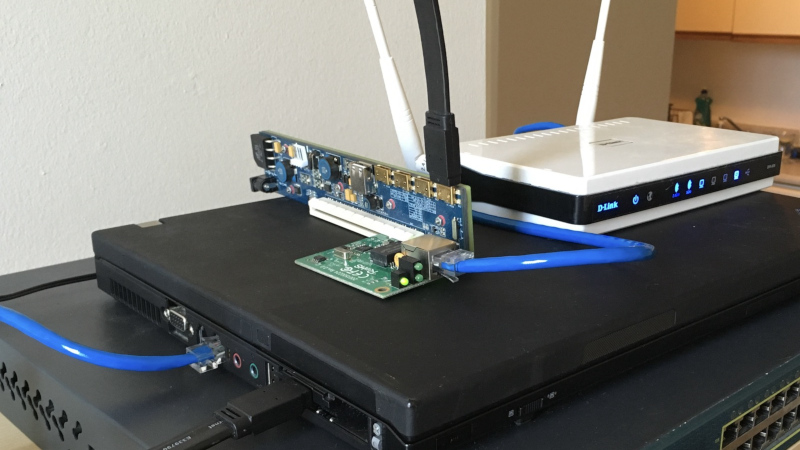
The piece is really a guide to setting up a Linux router, which he does on a small form factor PC and a hacked-together assembly of old laptop, PCI-express extender, and scrap network kit. In its most basic form a router doesn’t need the latest and greatest hardware, so there exists we’re guessing almost two decades of old PCs just waiting to be pressed into service. Perhaps it won’t help the non-technical Man In The Street much, but maybe it’ll inspire a few people to save themselves a hefty bill when they need to connect.












Routers are NOT going to be in short supply stop the FUD.
Let me guess: You’ve hoarded a big stack of those things and want to maximize your profit when prices go though the roof.
I think everything evolves into routers or crabs….
did someone mention Rust?
FUD is a cringe term. And you’re right, but only because there’s no way this fcc order will hold up in court.
whether or not court stops it isn’t relevant to the claim because the FCC is only stopping issuance of licenses for new designs (I don’t know how minor revisions work out under the order). the US will be stuck on old router designs temporarily.
nobody outside IT (and us homelab weirdos who don’t even work in the field anymore) will notice unless FCC issues zero waivers and courts allow the order to live for 2+ years.
to debunk something not stated before it needs to be, too: there is an FCC waiver as part of this order specifically issued for firmware updates, and it expires by default in March of next year. while it would be dangerous (for Americans who don’t pay attention to their router security and assume everything updates automatically) if the FCC did not extend that waiver, I don’t have a clue how they’d enforce it — I don’t have any routers (and not sure I’ve ever seen a router) where you can’t upload a firmware file yourself to the router.
Plenty of routers where the user doesn’t have rights to do it from the interface; in the states it’s mostly units owned by the Cable Company ISPs where agreements with legacy content providers require them to lock down their combo router / cable modem units.
Comcast and AT&T are notorious for this.
The irony in that the current US’ administrations default modus operandi is to spread patriotically glazed FUD at every given opportunity.
Meanwhile in the EU, local companies are springing up to substitute Chinese made network gear without the need for import tariffs or bans, because it makes geopolitical sense. I just bought network gear from Lithuania myself. There’s a Chinese proverb saying “become a pig to catch the tiger”. I say better spend money on friends than on ingratiators.
It seems that US patriotism is in name only: the people can be persuaded by a little bit of money to betray their own better interest, and then the liberals complain that following the better interest is wrong because it puts people in a worse economic situation. That’s understandable as a rhetoric because it does hurt in the short term to pay more for stuff made in the country, but it’s also understandable in the sense that the big corporations that are importing the cheap stuff from China don’t want to lose business to local competition. They don’t care if the people are losing over the deal, as long as they’re profiting.
Nah. That’s the companies pestering you about cookies. If they weren’t spying on you, they wouldn’t need the cookies and there’d be no need to bug you about it.
The EU simply made it so that they have to ask before syping on you, and that the companies have to respect it when you tell ’em to stuff it.
If you want to bitch at somebody, bitch at the bastards who think they have every right to track you and your activity all around the internet.
From the original FCC article, and also from Ars : “Routers already approved for sale in the US can continue to be sold,”.
So, no “shortage” of routers. Just no new models also, but the older models continue to be imported & sold. What may ( and probably will happen ) is that cheap things from the usual cheap places will have all the same model designation on the outside, while containing the board-of-the-day-special in the insides.
But an article about a well configured diy-router, with firewall, upnp, ipv6 and vpn is always welcome.
Nice! I kind of feel that if you want to get into the nuts and bolts of configuring Linux to be a router manually you probably don’t need the guide though.
A more apt replacement for a “typical consumer” router might be a router-distro. I like OpnSense which is a fork of PfSense, which is still pretty popular too. I’ve heard good things about DynFi which is forked from OPNSense but with my OPNSense setup already working well I’ve had no reason to switch. Of course, those are not Linux. They are FreeBSD under the hood. Supposedly that is better for router use… I don’t know enough to say why. If you do want to stick with Linux I see that OpenWRT can run on a PC. I don’t know how hard it is to get installed on a PC as I have never done so but if you are used to inexpensive Chinese routers… it will give you a very familiar interface since most of them are based on it. And no, that is not meant to say it is “cheap”. OpenWRT make a very nice router OS.
The router with the bad WAN port was a good find. You don’t need a WAN port on your access point for this sort of configuration. But… a thrift-shop find is probably not going to be the latest WiFi spec. In the more populated areas… those original 2.4GHz WiFi channels can get pretty crowded! If you aren’t on a very strict budget I wouldn’t skimp on the WiFi. The other alternative… just stick a WiFi card in your computer. Or I guess a USB WiFi adapter if it’s a laptop… (USB network devices have gotten much better but I had so much grief troubleshooting them back in the day…) Anyway, your router distro should have the ability to use a WiFi adapter built into the machine and be it’s own access point. Just make sure that the chipset is supported BEFORE you make a purchase you cannot take back.
Building your own router this way can have some advantages. For example… run your own VPN server. Now you can access your LAN at home when you are away. Yes, you can do this on many OpenWRT consumer routers… but it can be harder to get it working. The one time I managed… the router bricked itself a couple of days later. I think they justs aren’t made for that sort of thing and it burns up the NAND. You can also set up ad blocking. Or if your internet is less than fast, maybe caching. Many many years ago, back in College I used such a PC based router to share dialup internet access with my roomates so we could all be on at the same time. I had it caching all the non-ASCII files such as images… despite being mere dialup, if someone else had visited the page before you it would pop up instantly!
My friend made a nice storage shelf from 5 Cisco 2800s + 4 vertical rack rails in his office.
everything old is new again. in the late nineties i build a home router / webserver on a mac IIci with webstar and a router package i cannot remember. used timbuktu to log in remotely. was not power efficient, but learned a lot. 8mb of ram and a 40mb harddrive did the job under mac os 7.5.5
I read these stories about routers and rules and wonder if the thing being “attacked” is not the routers, it’s Ethernet. If you mandate all new stuff and a lot of people use wireless of some sort for connectivity, a new crop of “approved” routers might just not be wired at all. I feel like, and considering that I really like old equipment, there is always a push to get people to buy new stuff. This thing with the routers smells a little like that. And now I will put on my tinfoil hat and say, it is much harder to spy on a wired network (assuming it is physically secured) than it is to spy on a wireless network. Make everyone go wireless and you open up people’s homes to “visitors”… kinda like teevee owners in England.
I feel like this highlights the ambiguity between router and like “glorified hub”. Like, i have a fiber modem, an ethernet switch, and 2 wifi APs. And all of them have some routing capacity but truly i’m just using them as a direct bridge, basically nothing more advanced than passively watching ARP packets to pick which port to forward to. All my “routing” (NAT, firewall, VPN) is on a PC that has two ethernet cards.
Which is just to say, i have no idea how this law will work out but i can’t imagine a future where i can’t buy a cheapo “chinese” wifi AP or ethernet switch, and the fact that i already use a linux box as a “router” doesn’t affect that desire at all.
Openwrt…