
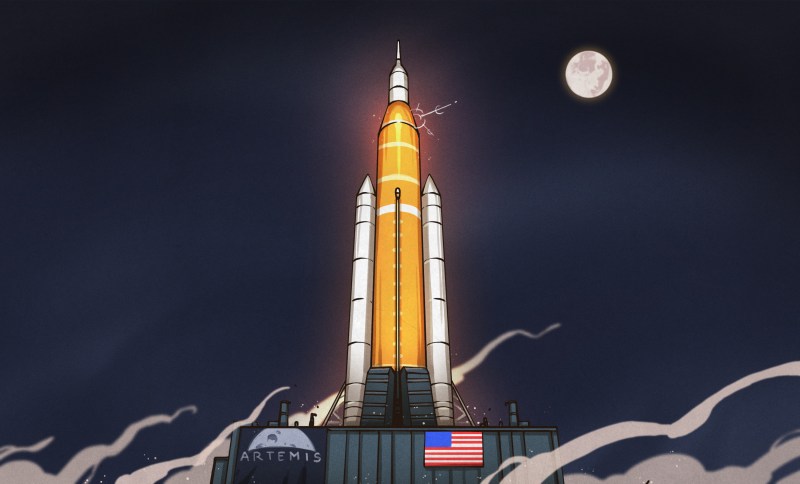
As NASA’s Artemis program trundles onwards at the blazing pace of a disused and very rusty crawler-transporter, the next mission on the list is gradually coming into focus. This will be the first crewed mission — a flyby of the Moon following in the footsteps of 1968’s Apollo 8 mission. As part of this effort, NASA is looking for volunteers who will passively track the Orion capsule and its crew of four as it makes its way around the Moon during its 10-day mission before returning to Earth. Details can be found here.
This follows on a similar initiative during the Artemis I mission, when participants passively tracked the radio signals from the capsule. For this upcoming mission NASA is looking for Doppler shift measurements on the Orion S-band (2200-2290 MHz) return link carrier signals, with the objective being to achieve and maintain a carrier lock.
Currently penciled in for a highly tentative April 2026, the Artemis II mission would fly on the same SLS Block 1 rocket configuration that launched the first mission, targeting a multi-trans-lunar injection (MTLI) profile to get to the Moon using a free return trajectory. The crew will check out the new life support system prior to starting the MTLI burns.
Because Artemis II will be on a free return trajectory it will not be orbiting the Moon, unlike Apollo 8’s crew who made ten lunar orbits. Incidentally, Apollo 8’s crew included James Lovell, who’d go on to fly the world-famous Apollo 13 mission. Hopefully the Artemis astronauts will be spared that level of in-space excitement.



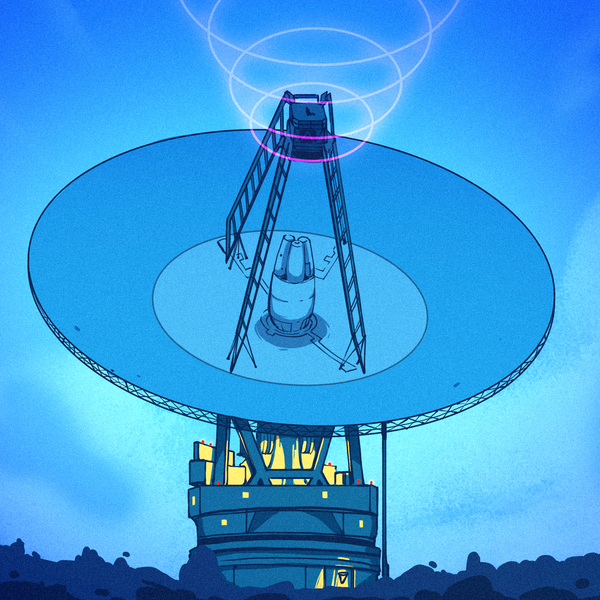







They had me at 9 meter parabolic 📡 antenna. Suddenly my back yard doesn’t seem like it’s going to cut it.
Speaking of big antennas, the Bochum Observatory in Germany has a parabolic mirror that’s big enough.
In its past, it also received signals from Sputnik 1 and Apollo missions.
https://en.wikipedia.org/wiki/Bochum_Observatory
https://www.honeysucklecreek.net/other_stations/bochum/main.html
https://universemagazine.com/en/people-were-on-the-moon-the-main-evidence/
Seems like an agency wilh trillions of dollars in government funding shouldn’t need volunteers to do work for them?
Some folks voted for less money for space. I as a european look a bit sad to this. Yall spend so much money on all kinds of things, except doing real cool science and research. Back to this topic, its cool if they keep the normal folks in the loop.
“except doing real cool science and research”
Real cool science and research:
List of uncrewed NASA missions:
https://en.wikipedia.org/wiki/List_of_uncrewed_NASA_missions
List of just NASA’s largest science missions:
https://en.wikipedia.org/wiki/NASA_large_strategic_science_missions
On SPAM in a CAN human spaceflight as Chuck Yeager called it, we landed on the moon in 1969, so we won the “race” to the moon 55 years ago. No human has been back to the dead, dusty ball orbiting us since then because the vast cost isn’t even remotely worth the scientific or other return. Apollo was 99% political and, spurred on by the aerospace lobby, their bought politicians, and joy rider passengers at taxpayer expense (astronauts) promoting it, the “race” is on again and is, again, it’s mostly political.
NASA wastes 50% of its funding on human spaceflight and the ISS has cost almost twice as much of all of the incredible, uncrewed NASA science probe/lander missions since 1958 listed at the link above. Just the cost to support the ISS each year costs NASA about the same amount as the total cost to build, launch, land and operate the Curiosity Mars rover for 13 years.
If I were the head of NASA I would cancel all human spaceflight, de-orbit the ISS, and when the Chinese eventually put humans on the moon I’d welcome them to the club we started 55 years ago and say that because it’s no longer the 1960s, we prefer to use robots now.
Book: The End of Astronauts: Why Robots are the Future of Exploration (2022)
I don’t understand how hard it is to accept that putting robot on a dust sphere in space is a 5mn-focus news, but putting a human on the same sphere is a one month focus news. People don’t care for robot. They don’t identify with them. Robots don’t make people dream. Robots death is, well, doesn’t exist in fact, since they don’t live. All in all, you’re putting money not only for the science, you are putting money for giving next generation dreams and directions to follow. And no, robot won’t do that, they’ll never do.
What also is to consider, I think: The reach for the stars.
It’s not just about plain science, but also spacecraft exploration.
We, as an united humanity, have the opportunity to found colonies in space.
Within our own solar system for now, at least.
On space stations, on moon, small asteroids, planetoids, on the moons on the outer planets..
These projects also unite us as a civilization. It gives dreams and hopes, inspires generations, makes us ambitions.
Just like the moon landings did. Unfortunately, corporate America doesn’t get it. It has no heart, just money on the mind. That’s why it’s slowly making itself obsolete, also.
^sorry about the typos. The auto-correction got into the way.
The difference, I’m afraid, is that the US is more of an economy of consumers rather than a society of citizens (like the rest of us).
Not going into great detail here, but it might explain why 1960s America was different and managed to accomplish certain things.
Don’t worry, this will happen sooner than you (we) might think.
Both NASA itself and China are already in the process of making NASA obsolete, international partners are withdrawing.
China already has a functioning space station derived from Russian technology (Mir) and is considering future international cooperation.
If the situation doesn’t change, no one will want to do future business with NASA in a few years.
Ultimately, the US space program could end up like the 1979 film “Alien,” in which a for-profit organization (Waylan) employs poorly paid personnel.
This is a sad change from a once internationally renowned civilian, federal organization like NASA.
Or as we would say in Germany, “der Lack ist ab.”
(the paint is off, meaning all the glamour is gone)
Personally, I’get even further and suggest to just close down NASA before it’s reputation and its role in the history books is totally ruined.
Edgy post. Nice.
Sadly let down by facts. NASA’s fiscal year 2024 budget was $24.875 billion, a 2% cut relative to 2023. Not quite “trillions”.
But, thanks for posting!
Thank you.
I agree 100%. But they know there are just too many gullible people that want to be part of “NASA” they will drink the cool aide just to think there part of something.
https://idlewords.com/2024/5/the_lunacy_of_artemis.htm
+1
Yeah… This scheme isn’t working, and if they insist on going forward with it they are going to kill the crew
“The following file naming convention should be used: Artemis II Tracking_RFI_company name.doc.”
“Company name” -> Ah yes, here we have it again, the typical US American corporate thinking.
So this rules out private people and non-profit organizations, radio clubs, goverment organizations, universities and schools.
No, you just use your first and last names. Can’t believe there will be too many individuals doing this, the antenna required would be an impediment, but I’m sure [curiousmarc] and his gang will try. Gotta start checking GovDeals for surplus parabolic antennas and mounts, I guess.
Hi, thanks for the info. Speaking of the antennas, worldwide there might be a few dozen to few hundreds die-hard radio amateurs into moon bounce hobby.
Some individuals might be into amateur (radio) astronomy, too.
It’s not impossible that they do have 3m parabolic mirrors or greater.
Satellite dishes for TV in Alaska were round about that size – at least that’s what my teenage travelling brain recorded back then. So surplus should be easy to come by.
Not at all unusual for Ham Radio Op’s to build antenna’s for specific functions, and geometries to suit……not to mention the downstream receiving and processing systems
All of those are companies
😂🥲
Here’s the thing, and I’m having trouble believing that a 9 meter dish is really required. It seems bananas. The moon is far, sure, but how wimpy would the transmitter have to be to not even be able to send a carrier wave to anything less than an enormous dish? Guessing 44 dbi gain? How many milliwatts is this enormous space ship transmitting? Are they using some bootleg broken omnidirectional WiFi antenna from Amazon? Am I missing something?
And yeah it kinda seems a bit weird, like they’re asking the public to fund the science and also to do it too? Although yes the earth station is definitely the cheaper part of this equation.
NASA trying to recruit cult members?