
As humans, we tend to consider our emotional states as a direct response to the experiences of our lives. Traffic may make us frustrated, betrayal may make us angry, or the ever-grinding wear of modern life might make us depressed.
Dig into the science of the brain, though, and one must realize that our emotional states are really just electrical signals zinging around our neurons. And as such, they can even be influenced by direct electrical stimulation.
One group of researchers found this out when they inadvertently discovered a “switch” that induced massive depression in a patient in mere seconds. For all the complexities of the human psyche, a little electricity proved more than capable of swaying it in an instant.
Electric Feel
Deep brain stimulation has, in recent decades, become a well-established treatment for multiple conditions, including Parkinson’s disease. The treatment regime involves using precisely placed electrodes to deliver high-frequency pulses of electricity that help quell undesirable symptoms, such as tremors and muscle rigidity. When implanting electrodes deep in the brain tissue, surgeons aim for an area called the subthalamic nucleus. It’s a small region deep in the brain where electrical stimulation can dramatically improve motor control in Parkinson’s patients. In turn, this can reduce a patient’s reliance on medications, allowing them to treat their condition with fewer undesirable side effects.

In 1999, a team of surgeons carrying out this routine work discovered something unexpected. Move the point of electrical stimulation just two millimeters lower, and you don’t treat Parkinson’s at all. Instead, you can accidentally trigger profound, immediate depression.
The patient was a sixty-five-year-old woman who had suffered from Parkinson’s disease for three decades. Despite treatment with high doses of contemporary Parkinson’s medications, she suffered tremors and other serious motor control symptoms. With the pharmaceutical treatment having limited effect, the decision was made to pursue therapy via brain stimulation. During the implantation of four electrodes in the patient’s subthalamic region, surgeons followed the then-standard protocol. Stimulation was tested through four different contact points on each of the four electrodes, intending to find the sweet spot that best alleviated the patient’s symptoms without causing side effects to speech, movement, or posture. Typically, electrical stimulation through some of the contacts would lead to therapeutic benefits, while others would have no effect or negative effects.
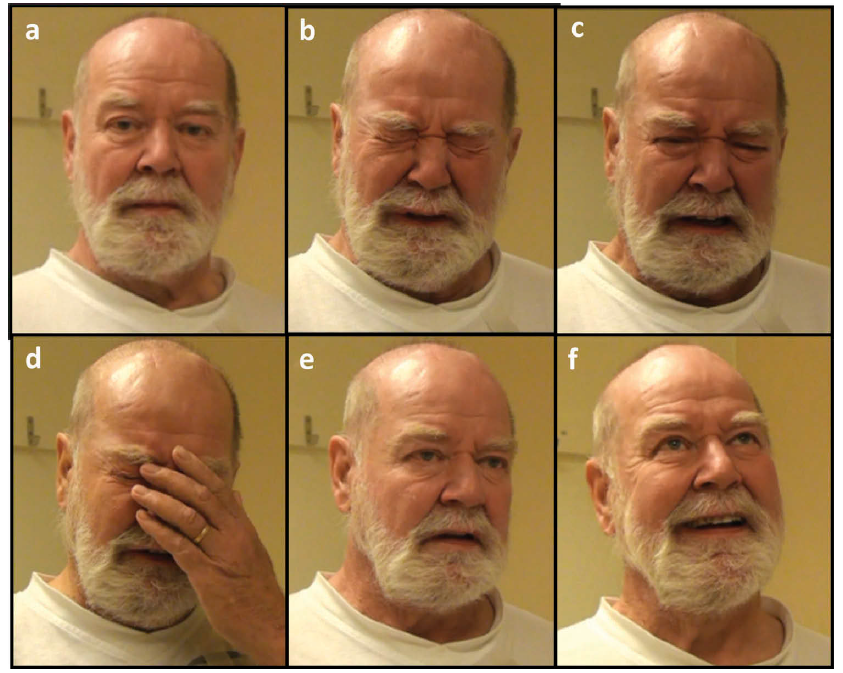
After the surgical implantation, contact zero of the leftmost electrode sat in the substantia nigra. When researchers applied a stimulation of 2.4 volts at 130 Hz through this contact, a reaction was noticed within mere seconds. As seen in images captured during the test, the patient’s face rapidly transformed into an expression of profound sadness.
The patient leaned over, cried, and verbalized strong negative feelings of hopelessness and worthlessness. “I’m falling down in my head, I no longer wish to live, to see anything, hear anything, feel anything…” the patient was recorded as saying in the research paper. “Everything is useless, always feeling worthless, I’m scared in this world.” No feelings of physical pain were reported; the symptoms seemed strictly limited to intense emotional distress.
The patient’s distress is readily visible in images taken during the stimulation procedure. The research paper notes that on a clinical basis, the patient’s self-described feelings fulfilled most of the diagnostic criteria for major depressive disorder. As quickly as the negative feelings arrived, though, they would soon disappear. The depressive state vanished for the patient within ninety seconds of switching off the stimulation to the contact in question. Soon enough, for several minutes after, the patient was reported as being in a “hypomanic” state, more positive and making jokes with the test examiners. Notably, the patient was aware of the adverse event and able to recall it clearly.
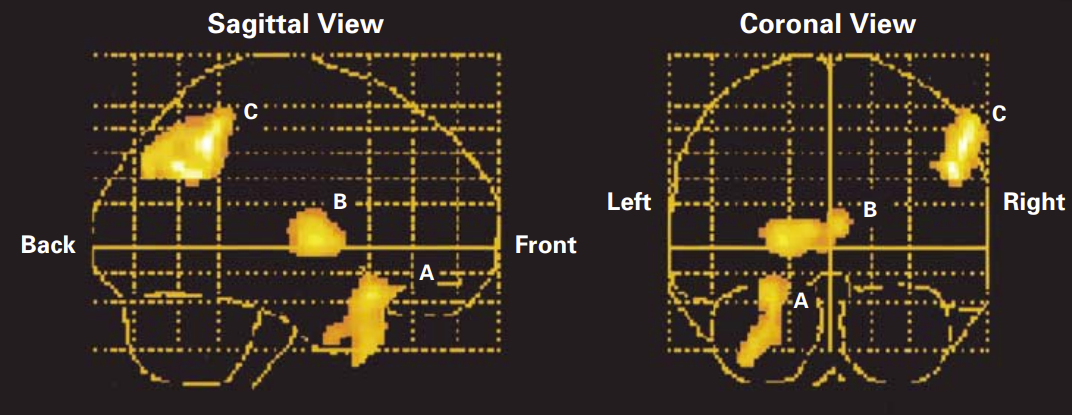
The researchers would later verify the phenomenon was reproducible by repeating the stimulation in tests on a later date. During these tests, the patient was unaware whether stimulation was real or simulated. The same response was noted—stimulation through the contact in question zero produced immediate, severe depression that resolved within a minute of cessation.
Crucially, simulating the stimulation had no effect whatsoever, and the same depression-causing effect was noted whether the patient was or wasn’t taking the typical levodopa medication. Meanwhile, outside of this strange effect, the stimulation implant was otherwise doing its job. Stimulation through contacts one and two of the left electrode, positioned just two millimeters higher in the subthalamic nucleus proper, dramatically improved the patient’s motor symptoms without affecting mood. Medical imaging would later confirm that contact zero sat in the central substantia nigra, while the therapeutically-beneficial contacts were clearly within the subthalamic nucleus above.
The startling results led to a research paper. Beyond that, further work was limited, likely for multiple reasons. For one, there’s not a whole lot of utility in making patients feel deep despair, and furthermore, there are grand ethical reasons why that generally isn’t allowed.
Nevertheless, a similar effect was later apparent in another patient. A paper published in 2008 reported the case of a 62-year-old man with Parkinson’s disease. Similarly to the original patient, stimulation to the substantia nigra caused an “acute depressive state” in which “the patient was crying and expressing that he did not want to live.” In much the same way, cessation of stimulation led to the feelings ceasing in mere seconds. Ultimately, n=2 is a small number, but it served as more evidence to suggest that this was a reliable and repeatable effect that could be generated with electrical brain stimulation.
This accidental discovery provides a somewhat stark example of how emotions work in the brain. The fact that major depression can be switched on and off within seconds by stimulating a few cubic millimeters of brain tissue suggests that for all our thoughts and experiences, what we feel can potentially be manipulated with mere electricity. Ultimately, the sheer complexity of the brain makes it hard for us to glean greater insight, but regardless, it reminds us that we are perhaps little more than very complicated machines.










Have they tried reversing the polarity? Do they need a test subject?
Look into TMS. 25 years of treatment resistant depression gone within 2 weeks of starting TMS.
Reversing polarity of 130Hz signal?!
Wow, horrifying and enlightening in equal measure. I don’t want anyone to implement this out of cruelty, and it’s terrible to think that we’re simple enough machines to have a suffer button.
But equally, it’s incredible that even with our relatively primitive poking around, we can discover workable ways to manipulate the brain in a high-level way.
I dream of a day where the reverse treatment is available to patients suffering from depression.
I think what’s more amazing is that glitching the brain doesn’t just cause it to crash or release the magic smoke, and that once the stimulus is removed, it recovers itself – even without being turned off and on again!
“Somewhat stark”? Are you far come on the path to liberation? The terror and the beauty are not diminished further on.
You are not the machine that you think you are,
pay attention to cultivating detachment,
then you will understand what you are.
Not the gears you grind in dawn’s quiet hum,
the body’s clock or mind’s relentless spin,
you’re the vast sky, unmarked, where storms may come
and go like breath on a winter pane.
Sit still, unhook the chains of want and fear,
let thoughts drift past, leaves on an autumn stream.
In that empty gaze, the riddle clears:
no machine to mend, just this,
the watcher, whole, forever here.
Thank you ChatGPT.
Let’s hope we can blame it for this.
ChatGPT undoubtedly scanned the entire internet’s collection of Vogon poetry.
Blame?
Not really possible, one of the features of such neural nets is they detach responsibility.
‘Must be the training dataset!’
But really no way to trace node weights to particular training data.
I’d be surprised if the ‘AI’ saves state enough to reproduce the output.
Makes debugging JS or SQL look like fun.
Job security!
There is a conflation in modern psychiatry between true depression and just being sad; as if any deviation from some kind of nominal mean emotional state is the sign of a disorder, no matter the external stimuli that may be causing the feelings. This assumption would indicate some kind of psychotropic treatment regimen – which can be as harmful to the brain and personality, if not more so – than a true pathological disorder. Every drug has a side-effect, so more drugs are prescribed to manage those, and they have side effects – eventually one’s neurochemistry is a confused, fragile mess.
It really seems like it a solution in search of a problem. That’s not to say that there are people that would benefit from these treatments; but they are much too frequently prescribed.
What the hell does any of what you wrote have to do with the article? Bot post?
I am guessing this writer’s some kind of nutjob about psychiatric treatments.
Nothing in this comment is correct
Yes it is, depression the condition that you get treatment for is a disease.
So if used in medicine would these electrodes be doing something about the condition or merely be suppressing symptoms? And if you do not treat the condition (likely chemical) but just suppress symptoms won’t you in the end end up worse?
I’m sure anybody working in the field worth anything will ask that question too.
This made me think of an article I read recently about the large divide between people who like AI and those who don’t. Give it a read if you’re interested:
https://theconversation.com/why-do-some-of-us-love-ai-while-others-hate-it-the-answer-is-in-how-our-brains-perceive-risk-and-trust-268588
I find the article marginally interesting, and don’t agree with most of the claims. Furthermore, I believe the article to be largely generated by ChatGPT.
the article is absolutely whack. I know how an AI works. I don’t trust it because it’s not truth-seeking and doesn’t validate. It’s a statistical word generator. I’m not “craving emotional cues”. The LLM gets facts wrong on the regular because I worded my prompt in a way that biased the word-predictor. Trash take.
That site is written for innumerate morons.
We are not the target audience.
Browse at risk of self injury from eyerolls.
https://theconversation.com/us/technology
One part new age BS, one part woke, one part lit crit major.
100% ‘can’t add two fractions’ type readers.
Who think the calculator answer is ‘correct’ and will argue, but make no sense.
Oh, there are glaze-bots now? Fun.
Oh good, the normal depression switch in my brain was getting boring. I look forward to what strange depression switch does.
Although I’m not a big Michael Crichton fan, The Terminal Man was somewhat prescient.
My sense is we are mostly stumbling in the dark and when we find something interesting we draw all kinds of dubious conclusions about how the brain works.
Someone many years ago compared this process to people who know nothing about radios disassembling one. They pull out a component, say a resistor, and announce “we have discovered the squeal surpressor” “when we replace this component the squeal stops, ergo …”
Is the Hackaday Prize still a thing? If so, I’ve got a wonderful idea!
I kinda want this now. I’m not quite 50, but would love a get-sad-then-get-over-it button. I have severe, disabling, treatment-resistant dysthymic disorder. You can be diagnosed with Depression if you have two depressive episodes in a year. Dysthymia is continuous.
The drugs I take do nothing to raise my mood or return lost cognitive flexibility to me. Their function is to put a foundation beyond which I can expect not to fall. As long as I take my pills, things only get really bad occasionally.
I have also tried talk therapy and electro-convulsive therapy. The former is good for figuring out how much damage this illness has done, but not much else. Shock therapy didn’t really do much anything.
I would put up with brain surgery to be able to hit a button that triggered a full-strength attack for one minute followed by some kind of euphoria. Not only would being able to control how much I hurt be fantastic, knowing that it’s going to be followed up by some kind of relief is better.
Sorry that you are continuing to go through that!
Have you tried a full dose of psilocybin? The evidence is growing as to it’s effectiveness in treating drug resistant depression (especially with talk therapy after a psychedelic session to “unpack” the experience)
If that were true, I’d be one happy camper.
WTF is a ‘full dose’?
Grumpy is the rational place to be.
We live in a universe created by a god that is a rotten kid on an anthill with a magnifying glass.
Once you see that, everything is funny.
Also god has PMS, on a 4000 year cycle.
Check calendar and go fishing.
No lightening yet…
Dead quiet mad…
Also note:
Some years ago, they accidently found a spot in the brain.
When they zap it, you think you feel a spiritual presence, dog is right there in the room w you.
Religious people, who are in the habit of feeling such things, report it’s the same feeling.
I don’t know if they ever tried it on a Satanist.
Would have been at the top of my list, just for fun.
‘Anybody who would see a shrink, ought to have their head examined.’
Groucho, not L. Ron.
I wonder if some approximation of this type of stimulation occurs with the use of microwave radiation (as is discussed as being the method of “attack” in Havana Syndrome), or ELF (extremely low frequency) or targeted high-pressure sound being explored/used by governments… Targeted RF attacks obviously wouldn’t have the same type or intensity of effect as direct brain stimulation, but it isn’t entirely unlikely that the wireless attacks targeting brain stimulation were inspired by these types of studies or accidental discoveries.
This is a thing, for medical use. Its called TMS.
this is also a thing: https://en.wikipedia.org/wiki/Mass_hysteria
Note the ‘signs and symptoms’ list in that article, isn’t it odd how it correlates?
I wonder how our cellphones affect us. When I had a BlackBerry I would leave it on my bedside table, next to my old clock radio. The BlackBerry’s transmit power was so high the AM radio would buzz even though there was no power to the radio.
It occurred to me that my cranium was subjected to the same intense RF when I was talking on the BlackBerry. What effect does this have on my brain? Could the RF induce mood swings or health problems?
My wife worked for a law firm in the early days of cell phones, when cell sites were few and handsets had to transmit at high power to connect. Several partners in one firm died of brain cancer. I can’t prove causality but suspect the intense cranial RF exposure caused some genetic damage.
Back then the transmitting frequency was also on a lower band to go through obstructions like walls and trees, which meant less absorption to human tissue.
There’s some studies done on nematode worms that did show genetic changes, but only when subjected to such ridiculous power densities that it was equivalent to standing in front of a military radar dish 24/7. The heating stress alone could have caused it.
There is also the old study of technicians on the old arctic ICBM radar stations in the 1950-60s.
They regularly stood in front of radar dishes to warm up and showed no excess cancer.
Except what’s normally expected for electronic techs of that era, some from the old flux fumes, some from solvents.
Followed to the grave at this point, gold standard in that sense.
Not a huge population, but thousands.
There are enough cell phones on the planet for over nearly half a century and an apparent complete lack of any cancer pandemic to demonstrate there is no real effect from cell phone emissions, beyond run of the mill brain rot from social media use.
It’s one of the widest ranging and longest running experiments humanity has run, I don’t see a bunch of brain cancer around, unless the radio waves are what’s actually causing the obsession with and downwards spiral into social media….. hmmmmmmmm…
I mean, quarter century…. derp.
You really think that there is absolutely not difference in disease occurrence between now and 25 years ago NFM? I mean I’m absolutely not saying cellphones cause cancer but if you look at raw health differences between now and 25 years ago there are quite a few.
Obviously you should not ascribe those to phones, there are tons of things that change over time that can affect health in various ways (sometimes for the better), but your imaginary argument that nothing changed is factually not correct.
Most likely (almost certainly) the buzzing wasn’t because of transmit power but because the Blackberry was using TDMA. TDMA phones of any type were absolutely notorious for causing audio interference at the same frequency that time slots (the “T” in TDMA) would go by. This was on the order of 300-ish hertz if I remember right, but don’t trust that number.
It’s interesting how everybody including official bodies are only considering cancer as a possible issue with EM and if it’s not an effect then everything is honky-dory.
Interesting and uhm.. insane.
“This accidental discovery provides a somewhat stark example of how emotions work in the brain….it reminds us that we are perhaps little more than very complicated machines.”
I’ll explain myself in a somewhat haphazard manner, but I hope you understand.
The brain is designed to respond to impulses coming from something called consciousness, and so far no one has ever been able to say what it is or even where it is located.
Your current state of awareness is the result of your past experiences, but also of those you allow yourself to be guided by in the precise moment you’re living, both external and internal: uncontrolled thoughts, various sensory stimuli.
Emotions, therefore, in my opinion—in addition to being one of the central pillars for giving meaning to life—are responses to multiple “requests” originating from the individual. These requests are extremely heterogeneous, sometimes the result of self-defense mechanisms, so to speak, which are instinctive, others deriving from the jumble of stimuli/habits induced by society, other times the result of that broad sphere we might define as spiritual.
Now, the person who wrote the article believes that having found a way to stimulate a part of the brain that generates an emotional state could essentially mean that we are just machines.
He follows exactly the same argument as those who maintain that the state called falling in love is the work of dopamine, oxytocin, serotonin, etc. I suspect that the attack on emotions is a surrogate to hammer away at, in order to avoid being able to provide an answer about the nature of consciousness.
Paradoxically, the proponents of these theories somehow support what the mystics claim: the reality we perceive is illusory.
Of course, the former because they unconsciously conceal from themselves their desperation for this human condition that has a limit and is as if they were crying out for help; the latter because, in my opinion, they know what they’re talking about.
But therefore the thesis would be that if I demonstrate that this emotion can be artificially stimulated, this would inevitably entail proof of its purely “mechanical” action.
1- A mechanical action that produces an unmeasurable feeling, I would say, creates some difficulty in explaining its source; at most, one can argue that it opens a path for the flow;
2- Even when, as I said previously, emotions arise from stimuli that are not spiritual, that is, from uncontrolled thoughts and external stimuli, they are useful responses for understanding what is happening, especially if they prompt reflection;
3- If I remember correctly, Huxley (but I don’t think it was his idea; I’ve seen the concept proposed by someone else before him) said that the brain essentially acts as a valve, a filter that limits the amount of reality we can perceive. Well, point 1 could be evaluated from this perspective.
These are just brief reflections, but I want to say something more important.
I think that rampant scientism is the problem of today’s world’s problems; theology, philosophy, mysticism, and metaphysics are now considered rubbish for the poor, and at the same time I observe the multiplication of the perversity of evil.
Now find the calm and happy trigger and i am ready to wire my brain to a 9V battery.
Handicapper General would have loved this idea.
The future of replying to articles online. Everyone will turn it into an effort to find out who is cheating, using AI to write their reply and who is really writing their own response.
If I’m one of the suspects, given that I’m the one who wrote the longest comment, it seems to me that we can already have some indications of probability in that sense; there are ways to analyze the writings.
I write extremely rarely here, and my ego isn’t strong enough to state my name; I express what I’m capable of extracting from my brain, and since I only studied until I was 13 and have a poor memory, this requires more effort.
Since a topic that interests me has been touched upon, and I mentioned a second one, the state called falling in love, which I’ve had to reflect on from my personal experience, what I’ve written is the fruit of my modest thoughts, because I still retain a modicum of dignity.
P.S. The various errors in syntax and spelling, etc., are due to the fact that I use an automatic translator as I don’t know how to write in English.
If you are actually a Frenchman, prove it by taunting the forum.
Don’t just regurgitate python, new taunts.
This headline makes me strangely depressed.
Imagine if a Neuralink electrode were implanted in that area… I don’t know much about Neuralink or where they put the electrodes but it sure is a scary thought.
Especially if it got hacked. “Send me 0.1 bitcoin and i will let you feel happiness again”
The thought occurs to me that in a dystopic future, this could be used as a punishment for criminals.
Perhaps an option? “You have been found guilty. You have a choice: 20 years’ imprisonment, or, we implant this electrode and you instead spend 1 year in a secure medical facility with the blackest, unceasing, most crippling depression. Choose.”
Nah there’re drugs that cause despair already. No self-respecting neurosurgeon is going to get involved with legal fictions like crime & punishment if they can at all avoid it.
And I thought advanced interrogation techniques were limited to waterboarding. No more terror now!
Waterboarding is a hack.
If you really really want to get the truth from someone, all you have to do is prevent them from sleeping for about 4-5 days.
Then play ‘good cop/bad cop’.
This has been known for decades and is much much better than torture.
You get the truth, not whatever the subject thinks will make the pain/terror stop.
You also don’t turn your interrogators into monsters.