
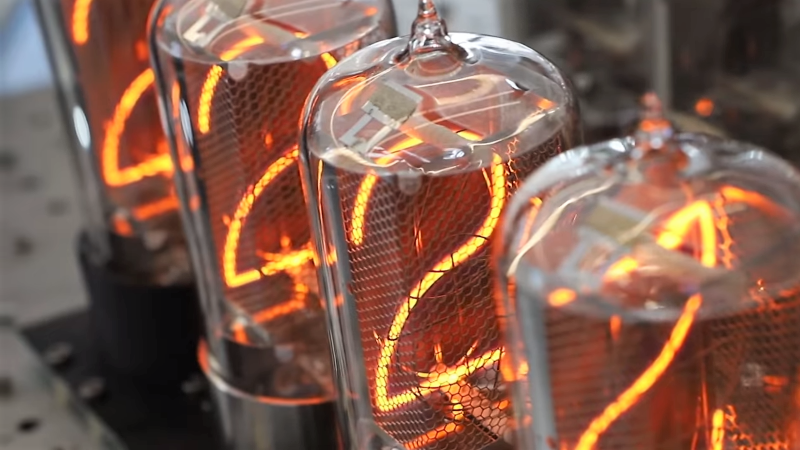
One of our newer writers, [Tyler August], recently wrote a love letter to plasma TV technology. Sitting between the ubiquitous LCD and the vanishing CRT, the plasma TV had its moment in the sun, but never became quite as popular as either of the other display techs, for all sorts of reasons. By all means, go read his article if you’re interested in the details. I’ll freely admit that it had me thinking that I needed a plasma TV.
I don’t, of course. But why do I, and probably a bunch of you out there, like old and/or odd tech? Take [Tyler]’s plasma fetish, for instance, or many people’s love for VFD or nixie tube displays. At Supercon, a number of people had hit up Apex Electronics, a local surplus store, and came away with some sweet old LED character displays. And I’ll admit to having two handfuls of these displays in my to-hack-on drawer that I bought surplus a decade ago because they’re so cute.
It’s not nostalgia. [Tyler] never had a plasma growing up, and those LED displays were already obsolete before the gang of folks who had bought them were even born. And it’s not simply that it’s old junk – the objects of our desire were mostly all reasonably fancy tech back in their day. And I think that’s part of the key.
My theory is that, as time and tech progresses, we see these truly amazing new developments become commonplace, and get forgotten by virtue of their ever-presence. For a while, having a glowing character display in your car stereo would have been truly futuristic, and then when the VFD went mainstream, it kind of faded into our ambient technological background noise. But now that we all have high-res entertainment consoles in our cars, which are frankly basically just a cheap tablet computer (see what I did there?), the VFD becomes an object of wonder again because it’s rare.
Which is not to say that LCD displays are anything short of amazing. Count up the rows and columns of pixels, and multiply by three for RGB, and that’s how many nanoscale ITO traces there are on the screen of even the cheapest display these days. But we take it for granted because we are surrounded by cheap screens.
I think we like older, odder tech because we see it more easily for the wonder that it is because it’s no longer commonplace. But that doesn’t mean that our current “boring” tech is any less impressive. Maybe the moral of the story is to try to approach and appreciate what we’ve got now with new eyes. Pretend you’re coming in from the future and finding this “old” gear. Maybe try to figure out how it must have worked.












like cats, we’re drawn to the heat/dynamic energy imho, nothing like a warm glow to lift the spirits too :-D
Agreed – there’s a smoother, broader spectral distribution from black body radiation sources and to a lesser extent extent phosphor excitation à la VFDs and CRTs. An acoustic analogy would be white or pink noise generators vs. the shrill whistles that LED sources equate to. Broader spectrum yields more varied perceptual source material – it becomes an interacting, integrated element of the environment rather than purely a data point.
“Teacher, mother, secret lover…”
“But why do I, and probably a bunch of you out there, like old and/or odd tech?”
Makes you think about trains. Every boy child I know had this episode of playing with trains and once you are older seam powered trains are even more interesting :)
I find there is like a parabola curve. As a kid you love it and want to see it get better, then you go through your twenties and your priorities go to building your life, family, education, all the while thinking you might be to old and its a waste. But once you start to get some stability and resources it starts pulling you back….
One personal example. As a kid I really liked RC vehicles with this one fond vehicle that had tracks and was amphibious. skip 15 years later and I have recently bought a 1/16 RC Tank with metal tracks, which ofcourse i’m going to modify the ***p out of! :P
I thought the word ‘crap’ was the clean form, that was OK even for the sensitive.
I find that there’s something about obsolete display technologies in particular.
I’ve watched many hours of Fran showing off ancient digit displays and I’m sure that’s the norm for HaD regulars.
I don’t think old and obsolete is sufficient. Nobody drools over old low-contrast LCD displays.
Yet.
Oh yes, I do!
Yeah. It has to have been the good stuff once, but superceded.
You might be right. Most of the examples I could think of were displays…
I had retrocomputing also in the back of my mind when I started writing, but that might be something else entirely.
People also like tubes and old radios.
And old mechanical machines, like water powered turbines and their fancy decorative iron wheels for instance, to name a random thing.
Even pre-iron stuff like windmills and their wooden gearing. Where there are quite a few people who prefer their external looks to the modern electricity producing windmill.
And how about the classic look of pre-digital age cameras? Seems popular too with a group of people.
So it’s not just displays.
“Little-a arduino is fine. It’s open source, can’t be taken away.”
Qualcomm could change the software and make older versions incompatible with their design and if it’s taken up enough because the hardware of the old design would not be compatible the people making that cheaply available will move to the newer more locked design, and the makers of software libraries might then too move there, and then yes its taken away for a large part.
It has happened before that things died that did not have to per se, but the crowd just abandoned the good thing and that made the supporting infrastructure collapse.
This reminds me how I saw somebody complain about a youtuber making an ad, and somebody in reply said that the video was long and in sitcoms that length you see more ads. So that person decided to push the horrible expectations of (US) commercial TV towards a standard we should expect on the internet and from youtubes. And I fear we will see that more and more, and so you see the crowd can be idiotic and make things worse and shoot themselves in the foot.
There is research and terms for that kind of thing in psychology.
Oh yes I remember trying to maintain digital displays with 8 hard to reach incandescent lamps per digit. A retrofit would have been nice except for the fact that a logic one was minus twelve volts. Good times!
I admit once in a while I get a hankering to get an orange CRT terminal and hook it up to the serial port on my computer and compute like it’s 1984.
I still have one… I still need to hook it up.
Old tech was made with effort. Modernism is low effort flat monochrome designs.
Sounds like we must do it ourselves.
Hey come over, let’s lathe some aluminum knobs and give them a brushed finish.
There’s a lot of engineering behind modern tech. We’ve just squeezed a lot of it below the level of human perception.
Where did skeuomorphism go? Baudrillard would say we have reached a simulacrum that resembles nothing real. What is more humane design: A know you can turn or a hamburger menu?
Look no further than med tech, there the old inputs still exist, because the are simply better, if we can afford them.
A physical knob you can turn is useful. A graphic knob on a screen that you have to twiddle with a mouse is a pain in the ass.
That’s why many graphical knobs have a little plus and minus symbol besides them.
So you can klick the symbol instead of turning the knob.
That’s at least how it used to be in late 20th century, on OS/2 Warp and Windows 3.1x.
That then defeats the point of it being a continuously variable knob.
It’s just a terrible GUI element. It doesn’t translate from the physical to the virtual in any useful way.
?
The GUI element isn’t to be blamed for the resolution of the digital units in an application, I think.
A digital mixer of, say, a soundcard is operating in certain pre-defined steps, too.
To make it “analog” it would create a an A/D converter with a very high resolution that would drives the actual, analog amplifier chip.
In the real world, there also digital knobs..
A modern ham radio transceiver such as Yaesu FT-817 has a “digital” dial that works in steps.
A big part of it is that there’s about 1 million years of evolution behind manipulating physical objects. You could probably throw an object into a waste basket from across the room, but I bet you can’t input into any sort of computer interface the forces and vectors involved.
There used to be a HiFi brand that attached flywheels to the knobs on their equipment, because it made it easier to make small manipulations by feel.
Weighted musical instrument keyboards are another example.
Humans have evolved to do the calculus of force mass and motion without even thinking about it.
Hi, there at least were quality standards, that’s right.
Computers had to have metal shields and FCC compliance stickers.
Here in Germany (W-Germany), our FCC pendant had required computers and game consoles to have FTZ stickers (later: BZT stickers). And often, the TÜV sticker, too.
https://de.wikipedia.org/wiki/Fernmeldetechnisches_Zentralamt
https://en.wikipedia.org/wiki/Federal_Office_for_Approvals_in_Telecommunications
https://en.wikipedia.org/wiki/T%C3%9CV
Then, by turn of the millennium came the CE sign and Europe was flooded by cheap Chinese tech.
Suddenly, electromagnetic noise was everywhere. Cheap switching-PSUs popped out of ground..
It’s been 25 years now and I’m still having watery eyes. But not because of joy.
Nostalgia for old tech lets us sit in a space before those alternate realities diverged. Nixie tube clocks, DIY 74xx CPUs, cyberdeck luggables, even the mechanical keyboard resurgence are echoes from those worlds.
Enshittification is all around us. Arduino, the open source entry to hardware and embedded for many, is the latest casualty with their newly oppressive EULA. So many creations arising from the hacker ethic of making the world a better place through sharing and openness have been turned against us.
We can escape for a bit in experiencing microprocessor trainers and fixing old test gear with available schematics and come back reminded of those possibilities and with motivation to claw back what we were once hopeful for.
“Enshittification is all around us. Arduino, the open source entry to hardware and embedded for many, is the latest casualty with their newly oppressive EULA.”
Called it the day the takeover was announced. Time to ditch Arduino.
Because of the Qualcomm thing ?
Isn’t that a bit too quick? The Arduino Uno (and earlier Wiring board) itself is independent, at very least.
It can be built from scratch, the bootloader “Optiboot” is free, too.
There are also many Arduino Uno/Mega compatibles boards made from all over the world.
So it’s not a single company that has total control over it, as it is with the LoRa chips.
https://docs.arduino.cc/retired/boards/arduino-serial-single-sided-3/
https://github.com/Optiboot/optiboot
So why “ditching” something that has a large community and a huge library of existing projects? I don’t understand that.
I can understand a boycott of buying new Arduinos or not using Arduino website, though.
The Arduino T&C is an overreaction, IMO. If you read those T&C, they are for the use of “the platform” which is their website and forum. Not the code, not the hardware.
Little-a arduino is fine. It’s open source, can’t be taken away. Big-A Arduino, the company … well, companies do company things. Only time will tell how Qualcomm treats it.
Qualcomm doesn’t have the best track record for making things better for the end user. “The Platform” is EXTREMELY vague and can be used however they want, and even if they can’t, there will be a EULA update in 2 months, and then in another 2 months, and then in another 2 months, until one of them finally slips it in there.
A company that filed one hundred twenty thousand parents over the course of 20 years is absolutely, positively NOT going to be doing anything good for us.
Hi, is it about the part about users from USA (s21. “Dispute Resolution”)?
But that doesn’t affect 96% of the people of the world, even. No big deal, thus!? ;)
So far.
There’s also the survivor fallacy.
We love certain types of old tech because it’s only those types that were loveable, and we put all the other tech into the trashbin of history.
Casette, 8-track, VHS, Betamax, 7-inch floppies, 5-inch floppies, 2.5 inch floppies, CD-ROM… I don’t see those being on the “best loved” list any time soon.
Records are on the list, there’s a big sub culture of people who still love playing records.
Also Kodachrome cameras, Kodak is now making two new Kodachrome film types after 10 years of not making any film at all.
Certain sewing machines from the 1940’s have survived into the modern age, and people love these for their robust design and usability. But people don’t see the hundreds of sewing machine models that didn’t stand the test of time – complex mechanisms that jammed or broke, plastic gears that wore out, or inscrutable interfaces that required learning effort to use.
Some tech has stood the test of time (pencils come to mind), while others have not.
Those might not make the list for you, but with billions of humans on the planet there are all sorts of weird subcultures. There’s no accounting for taste, and there’s no guessing what weird old tech people will fall in love with.
For example, I know cassette and VHS both have followings, still. Any new movie you care to name, you can get a VHS bootleg made for you on Etsy, complete with box art– if it’s a popular film, odds are there’s already a listing for it. Some bands have started doing limited cassette tape runs, just like vinyl. The others on your list don’t appeal to me either, but I would not be at all surprised if there was a thriving community of enthusiasts for each of them. People are weird– one guy even still likes Plasma TVs!
Kodak never stopped making photographic film. What evidence is there that Kodak is now making Kodachrome?
Kodachrome was discontinued in 2009, and processing ended in 2010(which was decent of them) Kodak has reintroduced Ektachrome. This film can be processed more easily. I disagree with “those types that were loveable” which is so vague as to not be useful. I think brands that were overwhelming best sellers, where parts, if not the entire items, are stocked up. Or situations like Atari computers in Poland, or perhaps more apropos, Sinclair 8-bit clones in Eastern Europe, when the lifespan of the product was stretched out. It’s not just “loveability”, it also has to with availability, and enough tinkerers who can repair and restart the items. Monopolies may be undesirable in many ways, but they also can leaves a “heritage” that lasts long after the manufacturer stops making their product, or goes out of business.
Just assembled a z80 based cp/m single board computer. 64K, terminal only interface. Reminds me of the day when computers were understandable, and fun to work with.
I think you hit the nail on the head here – understandable. I find I much more appreciate tools and technology where I understand how they work, and by extension, could probably repair if I needed to. My automobile has exactly zero computers in it, and I love it for that.
I get what you’re saying, but the love people have for these things is not usually based on still using surviving examples in daily life. People aren’t cultishly attracted to pencils either.
All of those media have rabid collector bases lmao. I collect Video8 commercial releases and dub modern movies to blank tapes, and I collect Japanese VHD, which is their iteration of video on vinyl similar to CED. If you can name a nerdy thing, there is a group of nerds on the Internet doing that thing for fun.
Not plasma TVs but older stuff was much more hacker friendly with larger components, published schematics and so forth. And because of that more repairable to the average shadetree hacker. Cars too. Steam trains too. A first ham radio project is usually a simple code practice oscillator then a qrp CW radio instead of a full featured microprocessor controlled all-band rig.
Old
TLDR old Stuff tends to be conceptually easier and physically easier to hack on.
+1
Also old-timey hardware wasn’t locked down with DRM, wasn’t dependent on the continued availability of cloud infrastructure and wasn’t remotely brick able.
That, and the fact that when you powered up an old tube it suddenly made the air crackle and your hair stand on end, you could feel and trace the surface of the screen without actually touching it.. made it feel oddly like summoning a living creature from the ether. Long live videodrome, long live the new flesh.
Part of our appreciation comes from it being less-common, absolutely. I think part of it also comes from it being more tractable to the human mind.
Take a steam engine: a young boy can hold the image of a working engine in his mind, and picture every single part on the engine and what it does. A modern diesel-electric? It’s both too complex and its workings too obscured to be able to do that. The steam engine lets it all hang out, and there’s something wonderful about that sooty honesty that makes up for low thermodynamic efficiency.
A nixie tube is aesthetically pleasing, but it’s also intellectually pleasing– like the steam engine, you can hold its entire operation in your mind’s eye. LED character displays and VFDs are more complicated, especially the driver circuit, but they’re still much easier to wrap your head around than an OLED. We might know the basic principles behind the OLED, but most of us can’t hold the exact details– never mind the driver libraries– in our noggins.
Arguably the Plasma TV doesn’t have this going for it to near the same degree: it’s more like an OLED than a nixie tube. The grid of electrodes and the plasma discharge makes perfect sense, but what about the control electronics? That’s… a little fancier. It’s not a circuit you could put on a napkin, like you can a monochrome CRT. That might be why they’re even more of a niche taste than CRTs, despite arguably being more practical: a Plasma TV lacks some of the appeal of tractability.
The older stuff that we can understand is technology. We like that. For all that you can intuit its inner workings, most new stuff might as well be magic. I think the human species is just biased to produce more technologists than sorcerers.
tl;dr: Clarke’s law sucks, because hairless apes don’t want to be wizards.
+1 insightful
I’m with you on everything except the steam trains. It’s so much easier to understand and operate a diesel train – normal engine with generator and motor. Watch a “starting a steam train” video online and you’ll charge your mind. It seems like diesel trains were also much less efficient but because of the reduced maintenance and cost of labor to run them, they pushed through.
There’s also a new factor in this phenomenon, in that it used to be only hand-made objects which became valued antiques. Now there’s an overwhelming about of mass-produced items that were central to our childhoods, or otherwise nostalgic that now as a society we’ve decided to value. One obvious case is PC clones, in the late 90s into the early 00s, many people were trashing micros like Apple II’s, and C64s and 808x PCs, and the masses were sure they wouldn’t ever be valued the way old hand-made wood furniture was. But there are no alternatives, in this case. Even “hand-built” PCs were made mass produced parts. The vast majority of people can’t solder or hand wire a Cosmac Elf, or Kennebak, or else they estimate it would take too much time and effort. I could get dark about how mass-produced, robot-manufactured our lives have become, but maybe I can also just accept it for what it is.
Love them 1980s boomboxes. Not 1970s, 1980s, when they started becoming more portable and less luggable. I own 500+ of them, yes, 5 with two zeroes, and the have The Vibe unmatched by any other. Mostly compact/budget kind, though, I do have few iconic must-have Pioneers and Sharps. Sound is okay, since they were budget/low-cost to start with, most have okay sound, but few were notable solid steps in the right direction (matching amp/speaker/soundboard), like Panasonic RX-C series (I think 45 was the most sold in the US, and it does deliver great sound over the compact/budget design), and I am sure Sanyo had few, so did Toshiba with their RT-SX (yep, that’s silver Toshiba RT-SX1 in the hands of John Cusak in “Better off Dead”), and Fisher with their PH.
Oh, in case you were wondering, attaching detachable speakers to a boombox adds to the soundboard, given it can push low frequencies (though, not many can, sadly). Entire boombox becomes part of the soundboard, so detaching these in order to increase the “stereo base” ( : – ] cheap trick, though, does work somewhat, kinda) removes passive resonant body.
Are these usable? Kinda sorta, I have 5+ boxes of cassette tapes in state of gradual fading, there is no cure, magnetic tapes just fade over time, starting with the highs, and the longer they are kept wound (and not regularly re-wound back and forth to release the tension) they more they acquire inevitable cross-magnetization, so eventually some will have a faint “echo” of their back- or forward- version few seconds apart.
Regardless, I’ve been asked if I ever tried powering as many as possible at once, which I did when I had under 100. Results were terrible. Different circuits push different bands, so some frequencies suddenly drown, whilst others suddenly amplify, mostly at unexpected times. It is a mild cacophony at best, though, firing up the same kind together (I own 6 Panasonic RX-C45) worked, and I can mimic what professional sound engineers do, dedicating one stereo channel to one particular frequency band. If tuned properly, the sound becomes clearer, but it has to be the same maker, and, ideally, the same model. Not the Wall of Sound I was hoping for, but close enough. Also, some boomboxes have RCAs, both in and out, so it is possible to chain-wire them into one Megaboombox adding few watts in the process. Sort of. Otherwise my only option is FM transmitter and tuning to the same local frequency, which works, too, but then again, cacophony and endless sound tweaking starts. It is still work in progress.
Old tech, no, tech left out and no longer proactively being developed. Analog tech in particular never goes out, it is used all the time everywhere, still, no matter what (over-the-air or fiber optic – these ARE analog tech).
Serious question—what is the boombox that the punk (Kirk Thatcher) has in Star Trek 4(1986)?
https://www.reddit.com/r/cinescenes/s/XbQZ9MYokx
JVC RC-M90
Actually its a Tisonic PR-9000. Fun fact, The punk kid (Kirk Thatcher) wrote and recorded the song being played in this scene “I hate you” with his band Edge of Etiquette. An updated version is featured in Star Trek: Picard S01E04
Edit:Star Trek: Picard S02E04
If I were going to send a probe to Venus, for it’s electronics, I would use vacuum tubes. The surface temperature is 900 degrees. This will fry any semiconductors, but tubes start to work correctly at those temps. Use fancy computers and semi conductors to get the probe on the surface. Then let the probe warm up, and the fancy stuff fry’s, and the old vacuum tubes start to take over. For a mission to Venus, old tech might just be essential to complete the mission.
Nanoscale vacuum tubes.
https://science.nasa.gov/science-research/science-enabling-technology/nanoscale-vacuum-electronics-back-to-the-future/
https://www.sciencedirect.com/science/article/pii/S2589965124000023
+1
Tubes and ceramic based material for the electronics (resistors etc).
Not exactly off-the-shelve parts, but certainly doable.
In most simple design, an analog radio transmitter with some analog sensors could modulate the measured values into different channels, using different modulation schemes (AM, FM etc).
All you need for a basic probe is an energy source, thermionic valves, resistors, capacitors, some analog sensor (“feeler”), a coil and a quartz crystal for radio frequency.
Or 1920s radio technology, in short. But built using tubes and electronic pars made of stones.
Building a sensor such as a microphone is easy.
Some carbon sticks are enough, already.
It’s all about turning vibrations or radiation into electric pulses.
Often, people talk about old vs. new technology rather there being different technology.
Like Federation vs Klingon/Romulan technology, if you will..
In my humble opinion, TTL logic not seldomly was different to microcontroller logic, for example.
The first one was discreet, usually being based on a “program” implemented in hardware, while microcontroller technology (integrated circuit) is all about a program being written.
It’s wiring vs writing, basically. Two related, but different concepts.
So maybe there’s more than rose-colored nostalgia of a time gone by?
Perhaps, people like prior technology because it felt different, just like steam engine technology vs electricity?
The tube fans not seldomly are into steam punk, too for example.
They love to thinker with “warm”, non solid-state technology.
It’s because of old technology that you can more easily see and understand how it works. In this era of fakeness, we all crave authenticity.
Sometimes good tech either fails to get a foothold or just fades away as fashion changes. My two biggest TechNostalgias
QWERTY Slider phones. I hate screen typing. If some major player put out a qwerty slider tomorrow Id be waiting in line to buy,
I have an old Zbrush perpetual license (no need for the minimal features added to the subscription only versions since the Maxon buyout).
But my go to organic modeller is Sensable’s Freeform with the Phantom Omni haptic controller. I keep an old computer running a licensed copy of freeform 14. A stylus on a screen will NEVER feel as natural as the haptic arm.
Because with weird old tech, the creative engineering, design work, and manufacturing techniques to make the device work is plainly visible! Now days gadgets are “black boxes” in comparison.
I had to service my 2007 Pioneer plasma TV (which still has an awesome picture) recently, it turns out the thermal paste on the main SoC was dried out… the entire 50″ screen area is FULL of incredibly dense PCBs loaded with large power electronics and digital ICs cascaded to drive all the rows and columns with the weird voltages plasma displays needed. A crazy amount of electrical engineering on full display to produce a beautiful image with better motion handling than new high end TV’s. Sure, LG OLEDs are an engineering marvel as well, but they’re just a black glass slab with a tiny power supply PCB and raspberry pi-sized motherboard inside.
I’m curious — have you tested this approach in real-world situations or larger workloads?
The question of “Why Do We Love Weird Old Tech?” could, possibly, have already been answered by Douglas Adams:
“The major difference between a thing that might go wrong and a thing that cannot possibly go wrong is that when a thing that cannot possibly go wrong goes wrong it usually turns out to be impossible to get at and repair.”
Oh that’s good!
(Not sure I could repair a plasma TV set. Maybe a nixie tube / VFD, but would require some practice…)
I’m thinking of older tech than a plasma tv but here’s my list…
5) Nostalgia – hey, we all get old.. or don’t.
4) You can often see how it works easier.
3) Some things one might wish developers / “the market” had gone down a different path so items from before that “fork in the road” become desirable.
2) Often times older items are more open, newer stuff has been commoditized, glued together, walled gardened and basically packaged for non-tech consumer use.
2-A) Old stuff can be more customizable.
2-B) Old stuff can be more repairable. See the previous.
1) The smell. A vintage piece of gear all warmed up has a certain smell that is great. An old-school electronics junk shop, rooms full of the stuff.. it’s unbeatable.
many rotor, knobs, keys and switch
I’m no need menu, options, only put, touch or move
In the art world there is some real anxiety about the obsolescence of CRT displays. Interlaced video looks like crap on LCDs and B&W looks bad on anything other than than a B&W CRT if you show early video art on modern equipment it just looks wrong.
Most of the art world’s video equipment is maintained by one guy, and with a dwindling supply of old parts.
I tossed a 27 inch B&W Sony video monitor 10 years ago and immediately regretted it.
Those neon red plasma displays are pretty neat, the color ones with phosphors never really appealed to me.
Which one guy/company?
Why?
Because autism!
“Whatever you now find weird, ugly, uncomfortable and nasty about a new medium will surely become its signature…CD distortion, the jitteriness of digital video, the crap sound of 8-bit—all of these will be cherished and emulated as soon as they can be avoided.” – Brian Eno
I’m a Video Editor and I have yet to find a consumer TV set better than my (now ancient) Panasonic P65VT50 plasma screen. The colors are rendered beautifully without blooming saturation. It’s just mellow and natural. Plus, it’s HD resolution (1920×1080) rather than 4k.
This is actually an advantage because most streaming and broadcasting is still HD rez. Yes, there is a lot of 4k content out there, but HD is still the standard and will be for a while. The advantage I mentioned is that 4k monitors have to upscale HD resolution to 4k, and most don’t do a very good job at it. The result is a fuzzy, blotchy image that leaves much to be desired. The great part for these older models is that streamed 4k will downscale to HD nicely. No blurry images. No blocky crap.
Once 4k market penetration goes beyond 90%, or my Panasonic gives up the ghost, I will consider a new monitor. I’m not a Luddite, but at that time I will hope that technology has caught up to what it was when Panasonic made plasmas.