

Sunday night, around 7:00 PM local time, a bright fireball streaked across the western German sky, exploded, and rained chunks of space rock down on the region around Koblenz. One of the largest known chunks put a soccer-ball-sized hole in someone’s roof, landing in their bedroom. Fortunately, nobody was hurt. But given the apparent size of the explosion, there must be many more pieces out there for the finding, and a wave of hopeful meteorite hunters has descended upon the region.
But if you wanted a piece of the action, where exactly would you start looking? How do scientists find meteorites anyway? And what should you do if you happen to see a similar fireball in the night sky?
Citizen Science
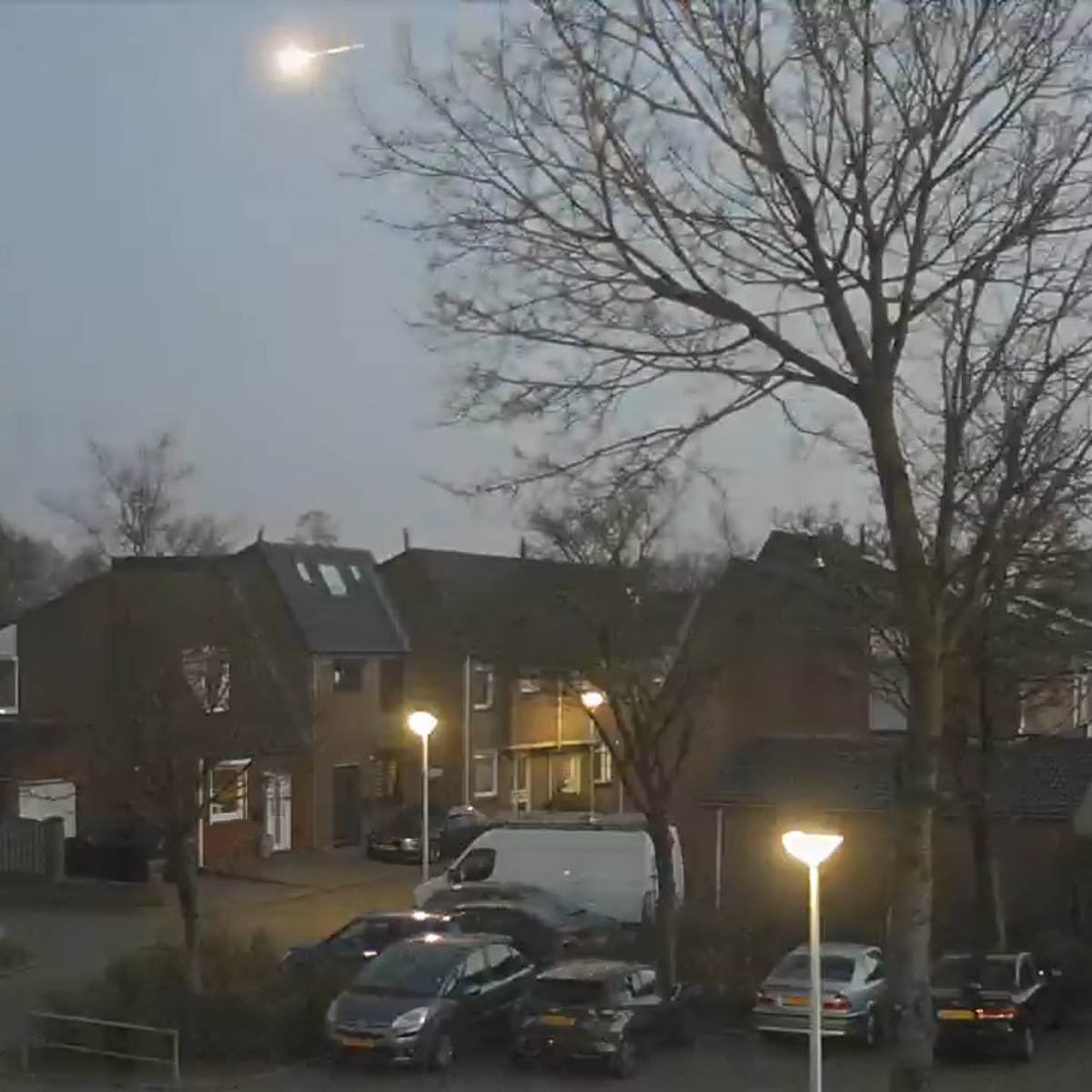
In the age of always-on dashboard cameras, ubiquitous smartphones, and other video recording devices, it’s hard for a shy meteorite to find a quiet spot out of the public eye. That makes them a lot easier to find than they were in the past. Indeed, the International Meteor Organization, which aggregates amateur meteor observations, received more than 3,200 reports of this one, including several with video documentation. Some are stunning, and others may not even be of the event at all.
By collecting reports from many locations, they can hope to piece together the meteorite’s trajectory. However, if you look at the individual reports, it’s clear that this is a difficult task. Nobody is expecting a bright fireball to streak across the night sky, so many of the reports are reasonably vague on the details and heavy on the awe.
This report from [Sophie Z], for instance, is typical. She records where she was and roughly the location in the night sky where the meteorite passed, along with the comment “I’ve never seen anything so amazing and large before in my life.” Other amateur observers are more precise. [David C] (“I have a Ph.D in physics”) managed to record the start and the end heading of the meteorite to a couple of decimal places. He must have had a camera.
We’d love to know the exact algorithm used for combining the reports. It’s worth noting that reporters get an experience score, and the system presumably takes this into account when producing the average track. However, the system works, though, with 3,200 reports of a once-in-a-lifetime meteorite, it’s bound to come up with a pretty good estimate. But for smaller meteorites, like this one that flew by on Monday night, there are fewer observers, and deducing the actual track is a lot more difficult.
Everyday meteorites are better tracked by taking a more systematic approach. We’ve covered a few of these networks before, because the equipment needed to contribute meaningfully isn’t all that much more complicated than a single-board computer with a network connection, a camera module, and a weatherproof housing to keep it working all year round. We’ve covered the French meteorite-hunting network, Fripon, before, and have featured other amateur sky-camera builds to boot. But we’re not amateur astronomers, so we’re not in the loop on what the current state of the art is. If you know about coordinated citizen-science meteorite tracking efforts, let us know in the comments.
Geologists Get Into The Astronomy Game
This meteorite was big enough and loud enough when it exploded that participation in tracking wasn’t limited to those who are looking up. Geologists at the Karlsruhe Institute for Technology (KIT) found that the explosion registered on their seismometers. (Via Heise Online.) These have the advantage that they are in very well-known locations with extremely precise timestamps. After all, that’s what they’re used for every day, although the medium that the pressure waves travel through is usually the earth rather than the air.
This was also a particularly lucky event for the KIT team because it happened over a particularly dense network of seismological stations in the Eifel mountains, allowing for greater resolution. And as they point out, using the sound of the explosion has the additional advantage of not being hindered by light conditions during the day or clouds at night. This makes us think of how easy it would be to set up a distributed system of microphones to do something similar.
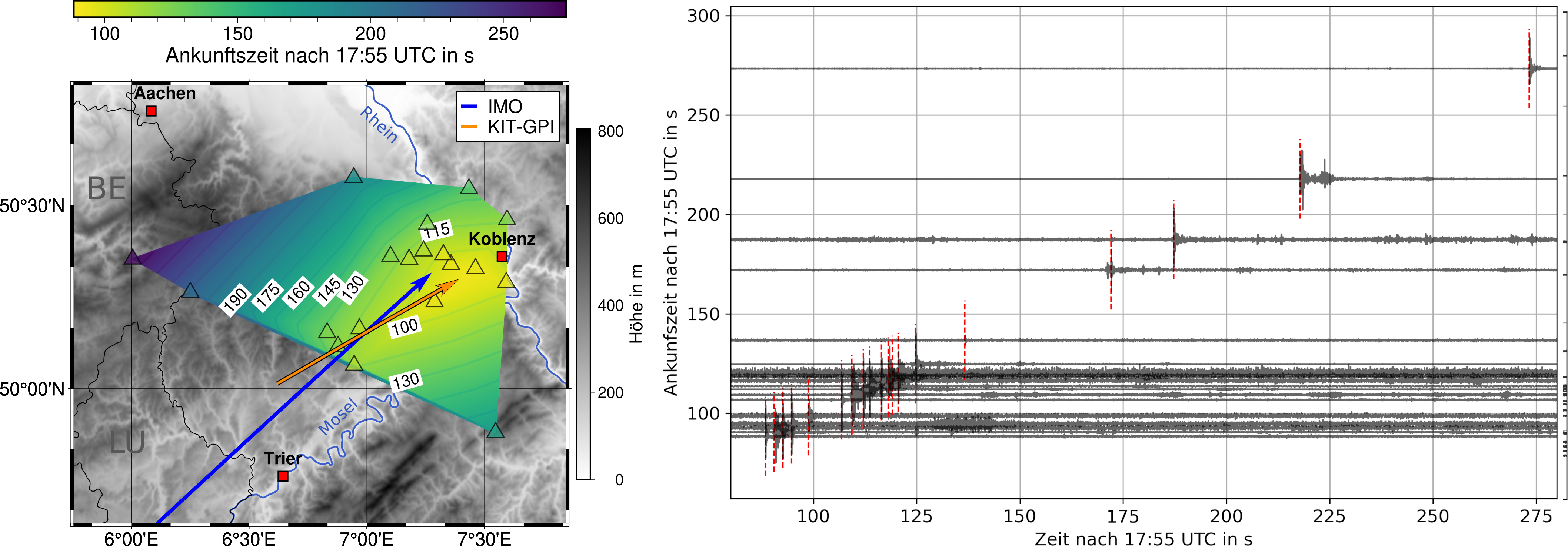
The KIT track estimate lines up fairly well with the aggregated estimate from amateur observers, but it’s not exactly the same. Who is right? We’ll see where more of the meteorites are found on the ground, presumably, in the next few weeks.
Meteorite Hunting
If the meteorite fell through our roof and chunks were scattered all around our bedroom, we’d count ourselves lucky. But would we get to keep it? Of course, it depends on the local laws, and in Germany, you can keep the meteorites in most cases, unless the state decides that it’s of special value for whatever reason, and then they get first dibs.
Apparently, the going rate for meteorites is between 1€ and 5,000€ per gram, so we’re not entirely sure that it will cover the damage. Maybe our homeowners’ insurance would? We’ll have to go dig out our policy to be sure, but however that plays out, we’d just be stoked to have the meteorite chunks and a good story.
While very big fireballs like this are rare, NASA estimates that around 44,000 kg of meteoritic material falls on the Earth every day. (Whoah!) Most of this burns up in the atmosphere, but some falls to the ground. Most of that fraction is in the form of micrometeorites, which are sand-grain-sized bits that are very likely raining down on us every day. Indeed, if you’re interested, you can try to collect them, and all you need is a tarp on the roof or a magnet in your downspout, a good microscope, and a bit of knowledge. So if all you want is some extraterrestrial rock, and you’re not worried so much about the size, maybe micrometeorite hunting is the path to success.
Have you gone looking for meteorites? Know of any up-to-date amateur fireball-hunting networks? Sound off in the comments!












I saw it fly across the sky when is was on the A10 road in amsterdam just before i went into the zeeburgertunnel heading sounth. I thought it was a drone in distress, just flying 100meters above ground. i did not locate the splash where it went down. the reason i thought it was much closer was because of its speed and because of the overcast sky, letting me to belief that it was way lower than it actually was.
15 minutes? More like 15 seconds ;)
There is a town in Bavaria close to where I spent most of my youthful summers. It is called Noerdling. It is the site of a meteor impact a long time ago. They built a wall around the crater and had the town built over the top. Another cool thing about that area was that the NASA astronauts that landed on the moon had visited over in Germany to do the “crater sample tests” nearby. Nothing like “Kalkstein” (Calcium Carbonate) quarries nearby. Oh…Lithographs were done there as well.
Okay, I need to decaffeinate. Have a good one, and like Jack Horkheimer said on the PBS show “Star Hustlers”…”Keep looking up.”
CJ: You know when you post as your callsign you’re basically saying “Here’s my name and address” right?
I sincerely doubt Chris is worried about that: https://www.qrz.com/db/KC8KVA
As long as he knows, I don’t care. Be free, Baby! Be free!
Good of you to step for him/her though.
Hi! That used to be normal.
If you’re on the airwaves, it’s no different, after all. You’re in public.
CBers in the AM era originally had to have a registered callsign, too.
And those radio callsigns were even published on books (there were ham radio callbooks).
In the 90s, they were available on CD-ROM, ran on DOS/Windows 3.1 or Mac and contained address and name, among other things.
And that was helpful in order to exchange an QSL card directly by mail, which was faster than using the club for shipping.
It was similar to using a phonebook, which also available in public a long time ago.
Where I live, in Germany, the PR users on CB radio had to request a callsign from the RegTP (our FCC counterpart), too.
It was required for digital communication via computers.
Later, the regulation was relaxed and the users could imagine their own.
Swiss and other countries had similar regulations, I think.
Internationally, there als were CB DX Clubs that issued callsigns to CB operators,
because funny handles (aka skips; meaning nick names) were confusing during international QSOs.
The DX callsigns made QSL card exchange easier, too.
Remember when everyone had their name, address and phone number written in a book that was distributed to every home?
Phone books delivered were only the local area though, imagine how many books some countries would need to list the whole population, and since we are talking radio DXing, imagine how many books to contain all the people in the world.
My local post office had all the phone books for the whole country out there for anyone to use.
Sorry to correct you but the actual crater is about 20km in diameter. It was not a ‘small’ impact. The town is built right in the middle of that area, but the ring wall is not built along the crater wall at all. But you get a nice view of the crater wall in the distance while walking along that wall. Btw the town is said to be the template town for the towns in ‘Attack on Titan’ with its fully intact ring wall (that has nothing to do with its crater).
The crater walls of the impact are outside the town at about 20 km diameter. Aside from that the town is built right in the middle of the crater and the fully intact almost circular ring wall might really seem like built on top of the crater walls. They are so perfect indeed that they are said to be the ‘template’ model for all the ‘Attack on Titan’ towns.
And yesterday a fireball crashed in Alaska. Possibly that NASA satellite https://www.alaskasnewssource.com/2026/03/10/rare-fireball-explodes-over-fairbanks-sky-someone-caught-it-camera/
“and all you need is a tarp on the roof or a magnet in your downspout, a good microscope, and a bit of knowledge”
I, too, used to believe that but, unfortunately, it’s not true. From a long Grok answer listing studies:
Bottom line for a typical home collector: If you just run a magnet through spout sludge and look at the spheres under a basic microscope, nearly all (>>99% in most cases) are contaminants. True MMs are extremely rare in urban settings because the cosmic flux is low (~1–few per m² per year for visible sizes, concentrated from the whole roof but diluted by pollution and losses). You need experience (or guides from Jon Larsen/Project Stardust) to pick candidates with the right textures (e.g., barred olivine crystals, specific surface features, not too perfectly metallic), then ideally SEM or lab confirmation for certainty. Without that, the percentage that are “actually” micrometeorites is effectively near zero for practical purposes—though a handful of real ones are present if you process hundreds of kg of material.
Grok is interesting, but not internally consistent? How is “one to a few” per m2 per year equal to “a handful” in “hundreds of kg”? Who gets that much dust falling per square meter?
But over and above, it’s just plain wrong.
Real science by real people:
https://royalsocietypublishing.org/rsta/article/382/2273/20230195/108305/Micrometeorite-collections-a-review-and-their
https://www.sciencedirect.com/science/article/abs/pii/S0032063319304842
https://onlinelibrary.wiley.com/doi/10.1111/maps.13966
That last one, they collected twice from a barn roof and got 1006 micrometeorites, verified with SEM and all that.
They did get a surprising amount of matter, like 25 kg or something, but most of that was organic. Leaves and twigs. Mineral stuff, they had about 1 kg. Still, a lot of dust/rocks, but 1006 verified micrometeorites. They detail their separation method, which is probably the key to the whole thing. (It’s real science after all…)
Wait, an AI was wrong?!?
This is why posting text from an AI doesn’t add anything of value to the conversation. It just takes time away from someone like Elliot when they do the REAL research to refute the incorrect information.
I appreciate that Winston was honest about using “AI.” It makes it easier for me to skip everything he has copypasted.
In Italy we have the “rete prisma”, a network of special camera to detect all kind of fireballs.
Everyone can join the network.
https://prisma.inaf.it/
good project https://skytinel.com/mapa-kamer-skytinel/
Hey Elliot, how did you come across this picture in Heerlen?
I’ve been a meteorite collector and dealer for almost 20 years and I know a couple of other collectors in Germany. I hope to get my hands on a small sample soon to add to my collection of falls.