
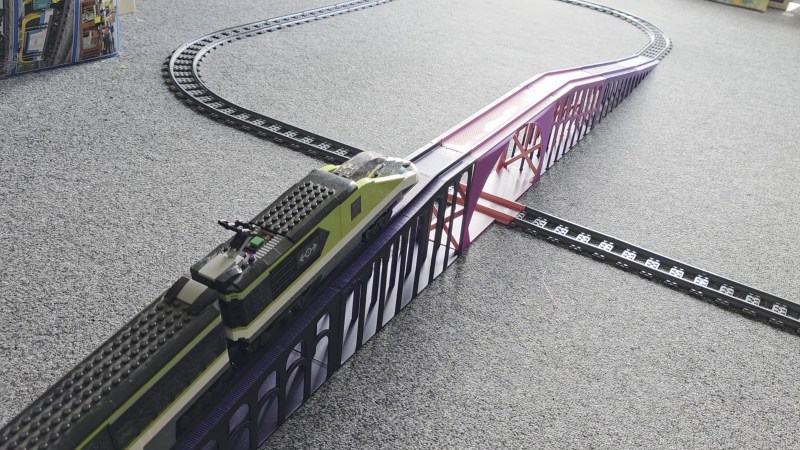
Lego train sets have been available for decades, now. The Danish manufacturer long ago realized the magic of combining its building block sets with motors and plastic rails to create real working railways for children and adults to enjoy. Over the years, Lego has innovated through several generations of trains, from classic metal-rail systems to the more modern IR and later Bluetooth-controlled versions. The only thing largely missing over all that time, though…? A bridge!
Yes, Lego has largely neglected to build any bridges for its mainstream train lineup. There are aftermarket solutions, and innovative hacks invented by the community, all with their own limitations and drawbacks. This glaring oversight, though, seemed like a perfect opportunity to me. It was time to fire up the 3D printer and churn out a fully-realized Lego rail bridge of my very own.
Bridges Are Hard
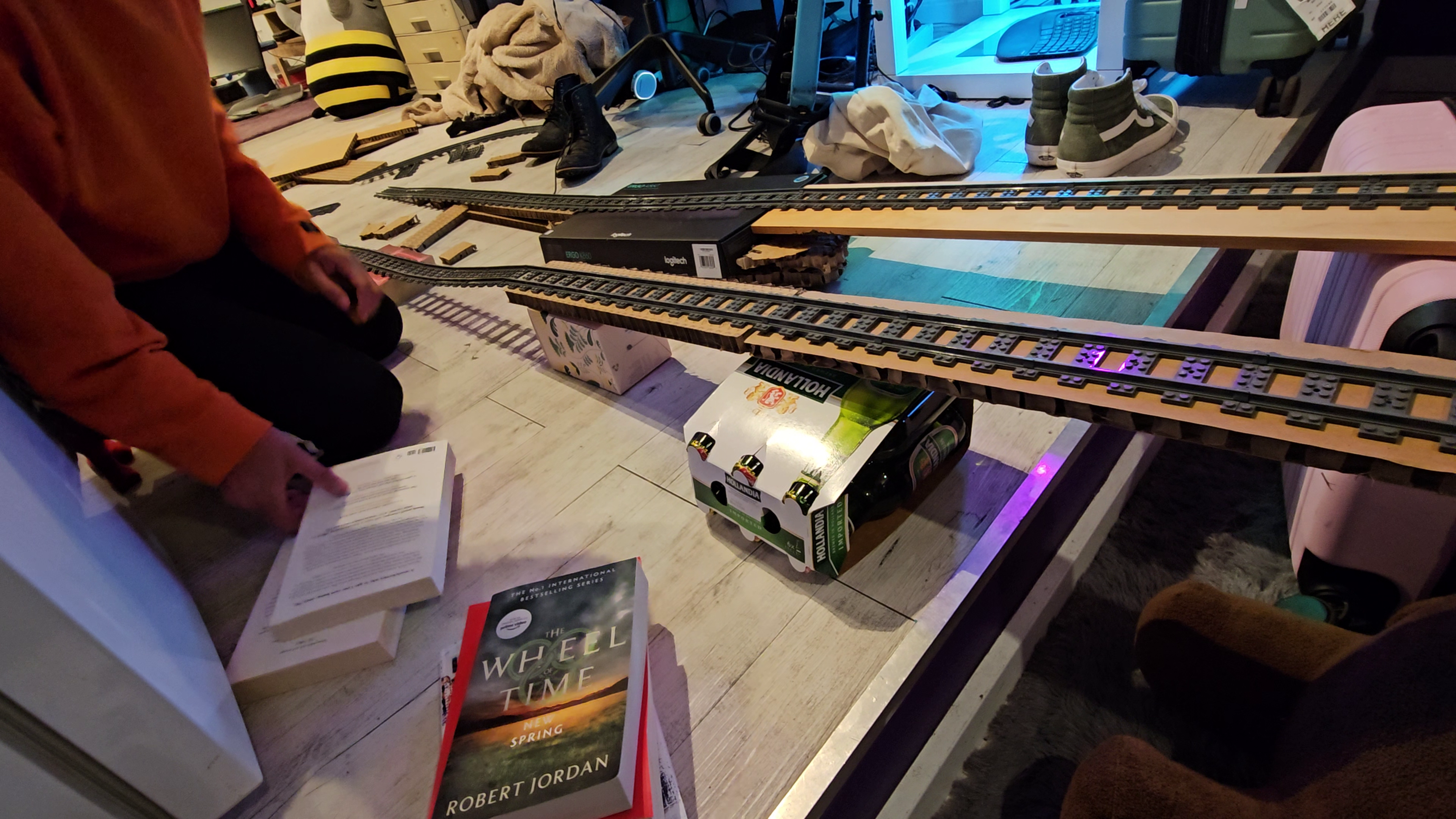
There’s actually a good reason Lego bridges aren’t a big thing in the company’s own product lineup, beyond a few obscure historical parts. This is probably because they aren’t very practical. Lego locomotives are not particularly strong haulers, nor do they have excellent grip on the rails, and this makes them very poor at climbing even mild grades. Any official Lego bridge would have to be very long with a shallow slope just to allow a train to climb high enough to clear a locomotive on a track below. This would end up being an expensive set that would probably prove unpopular with the casual Lego train builder, even if the diehard enthusiasts loved it.
There are third-party options available out there. However, most rely on standard Lego track pieces and merely combine them with supports that hold them up at height. This can work in some cases, but it can be very difficult to do cool things like passing a Lego train under a bridge, for example. It can be hard to gain enough height, and the short length of Lego track pieces makes it hard to squeeze a locomotive between supports.
However, none of these problems are insurmountable if you’re dedicated to the task. The trick is in being able to make entire pieces of Lego track with custom geometry to suit your exact needs. I’ve always tried to add bridges to my Lego railways, and I’ve found that trying to do so with the standard track pieces is often difficult. At just 150 mm long, they require a lot of supports, particularly at the joints, and it can be difficult to build any sort of structure that is stable enough to hold together without a train derailing across it. After many prior experiments, I figured that 3D printing bespoke bridge pieces would probably be the way to go to build a stable Lego train bridge that actually works.
Research And Development
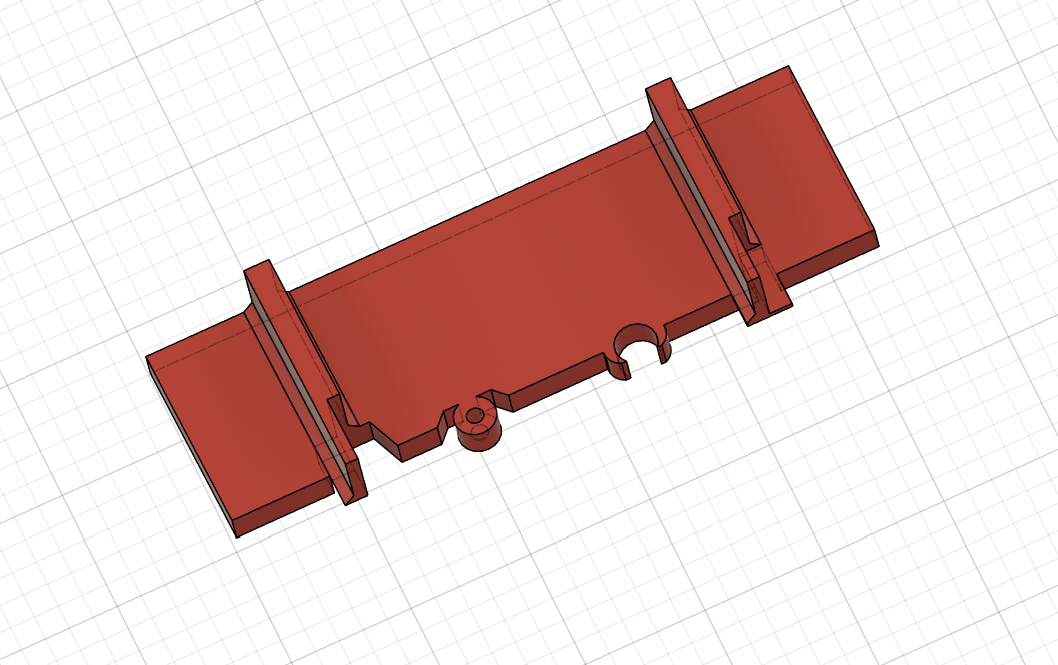
I started my work by recreating the track geometry so that my 3D printed parts would work with official Lego track. I was able to recreate the rails and the inter-track coupler design, based on a drawing available at the L-Gauge website. From there, I began my bridge design, starting with picking the most critical number—the grade of the bridge. Having done some research on Lego trains online, combined with my own prior tests, I figured a 10 degree grade would be low enough for a Lego train to climb without too much trouble. I also wanted to make the individual bridge pieces as long as possible to reduce the number of joints involved. I landed on a figure of approximately 290 mm, as this was the largest track length I could fit by printing diagonally on my printer.
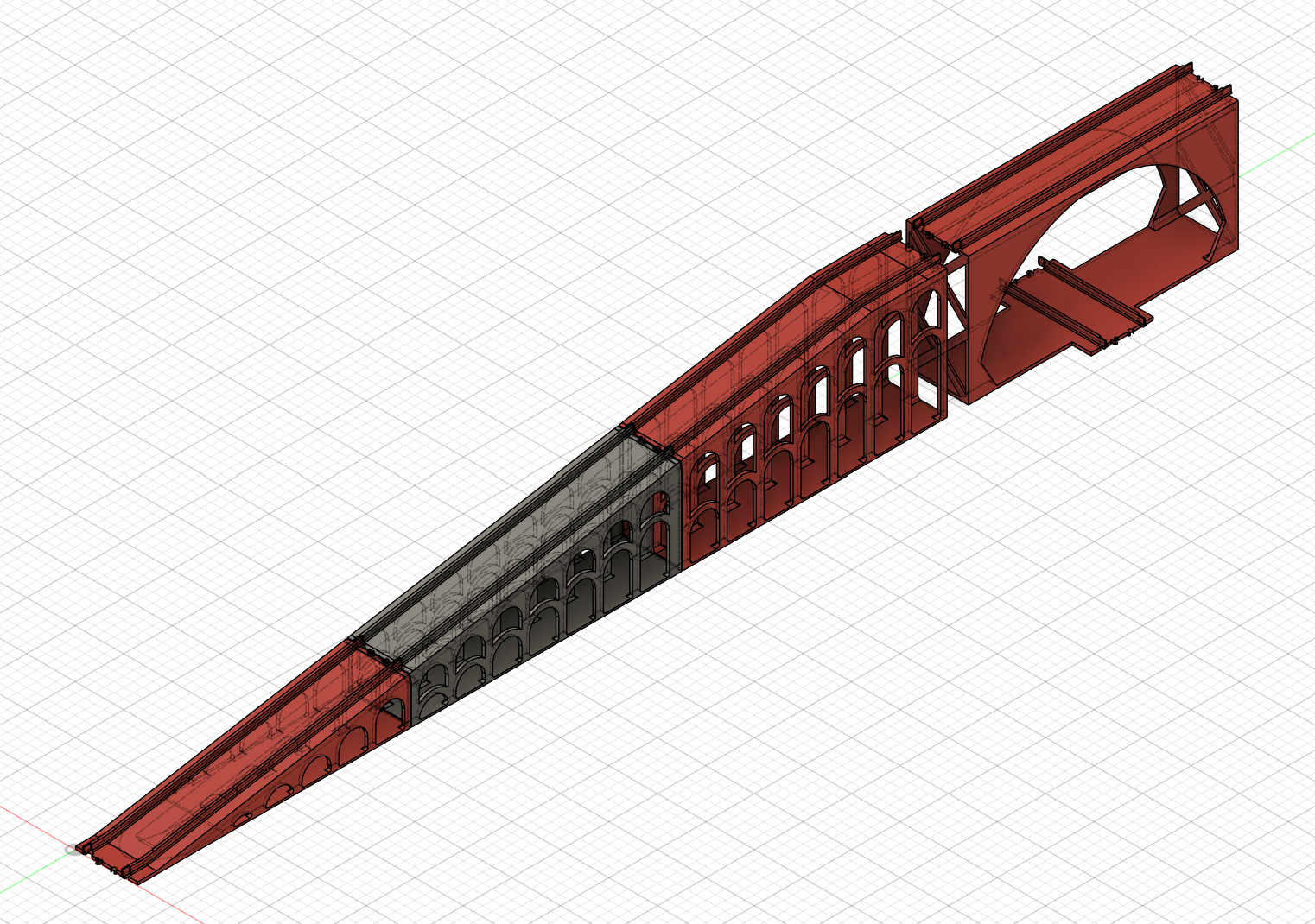
I quickly worked up a design that involved seven separate pieces to create a whole bridge. Three individual ramp pieces on each side, plus a central flat bridge piece that has a piece of track passing at a perpendicular angle underneath. In total, the whole bridge measures almost two meters long, mostly because Lego locomotives only like a gentle climb and it’s quite a hike to get high enough to clear a train passing below.
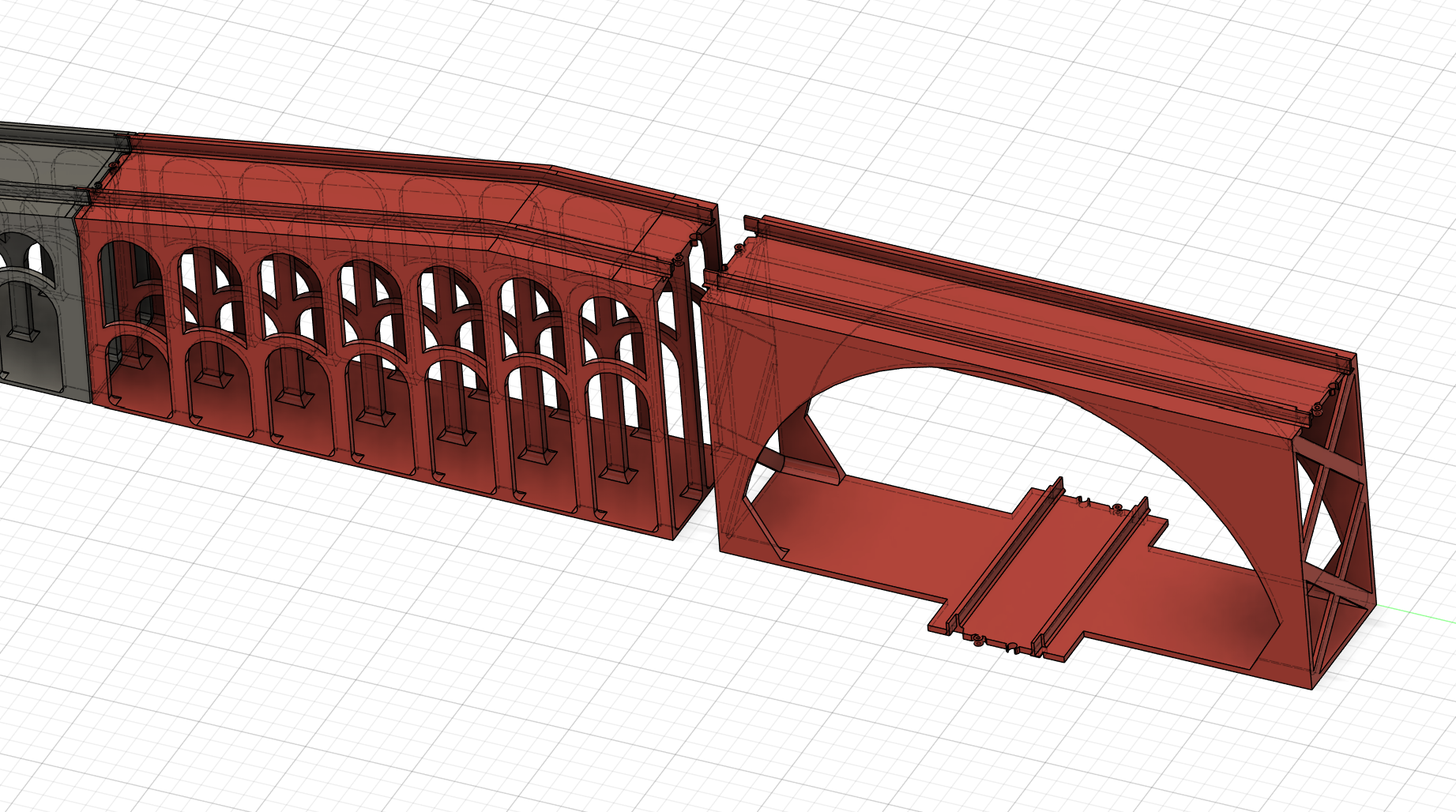
From the get go, I wanted to print without supports—both for speed and to save plastic. This took some experimentation, but I mostly achieved success by using arches and subtle curves to keep overhangs in check and create a structure that would print cleanly.
With that said, one might argue that the excessive amount of arches and pillars used in my design might have wasted more plastic than just using standard supports generated by the slicer. Regardless, I think the choice to go with arches gave the bridge a nice aesthetic befitting a good railway. I printed the bridge pieces in PLA at a layer height of 0.20 mm, using two-colored filament just because I could, and it was cheap at the store. While some of the diagonal stretches of the rails featured obvious layer lines, this didn’t seem to have any negative effect on performance. It did, however, give the trains a zippy sound when they climbed and descended the bridge.
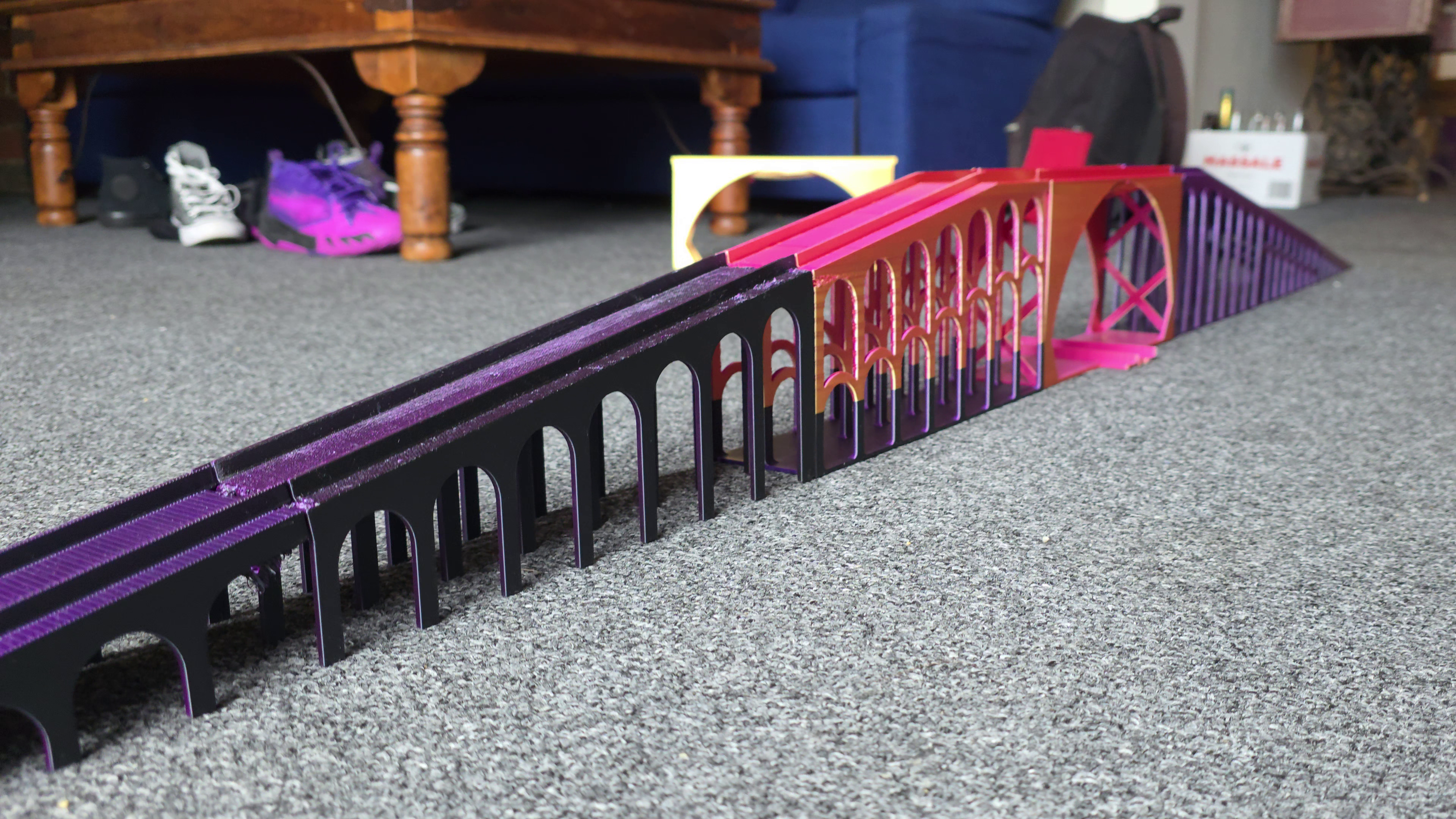
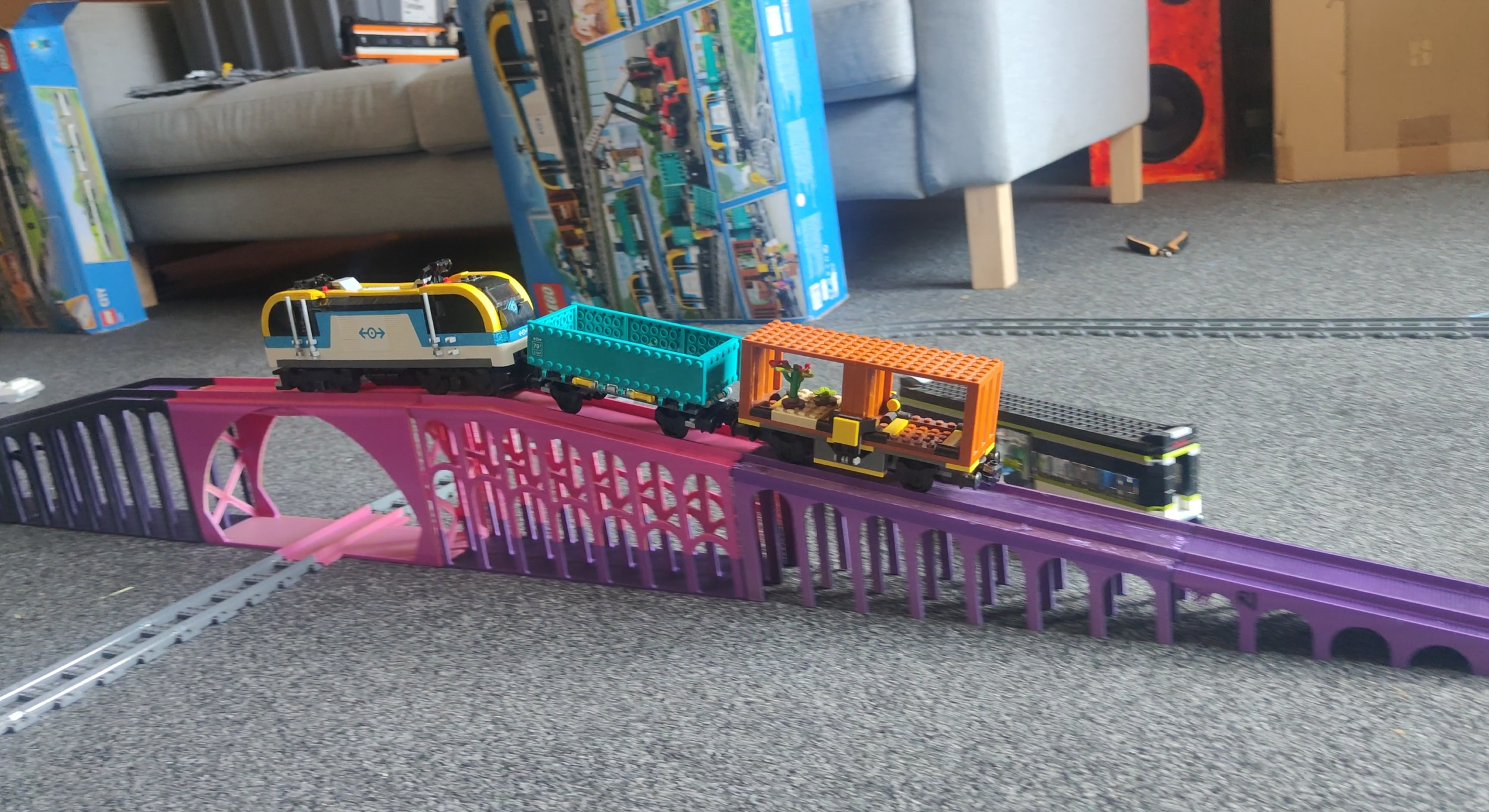
I set about testing the bridge design by inviting some friends over and building a railway in my living room. We set up a simple S-shaped loop that would allow a single train to test both the bridge itself and the passthrough track underneath. Early testing revealed some fun unexpected problems. Right off the bat, we found that one Lego locomotive had a low-slung piece that would smash into the track coupler as it came down off the bridge back on to the flat rails at ground level. Removing that piece barely compromised the look of the locomotive but enabled it to pass the bridge more easily.
We also soon found issues with carriages. Even at a subtle 10-degree grade, most Lego locomotives struggled to pull more than a single carriage up the slope. Further compounding the problem was that the momentum from the extra carriages on the downhill tended to overspeed the train and derail it at an immediately-following turn. Some carriages and locomotives were also simply incompatible with the bridge due to my design decisions. I had not paid much attention to the transitions on and off the sloped ramps. This meant that some longer carriages with wider-spread bogies would find themselves derailing as one set of wheels left the track while passing over the bridge. There were also some minor issues with the bridge pieces themselves and how they couple together. The Lego track coupling design is pretty good at snapping pieces together when they’re injection molded. It doesn’t work as well with softer 3D-printed PLA, nor is it good at locking together big heavy pieces of bridge that weigh many hundreds of grams each.
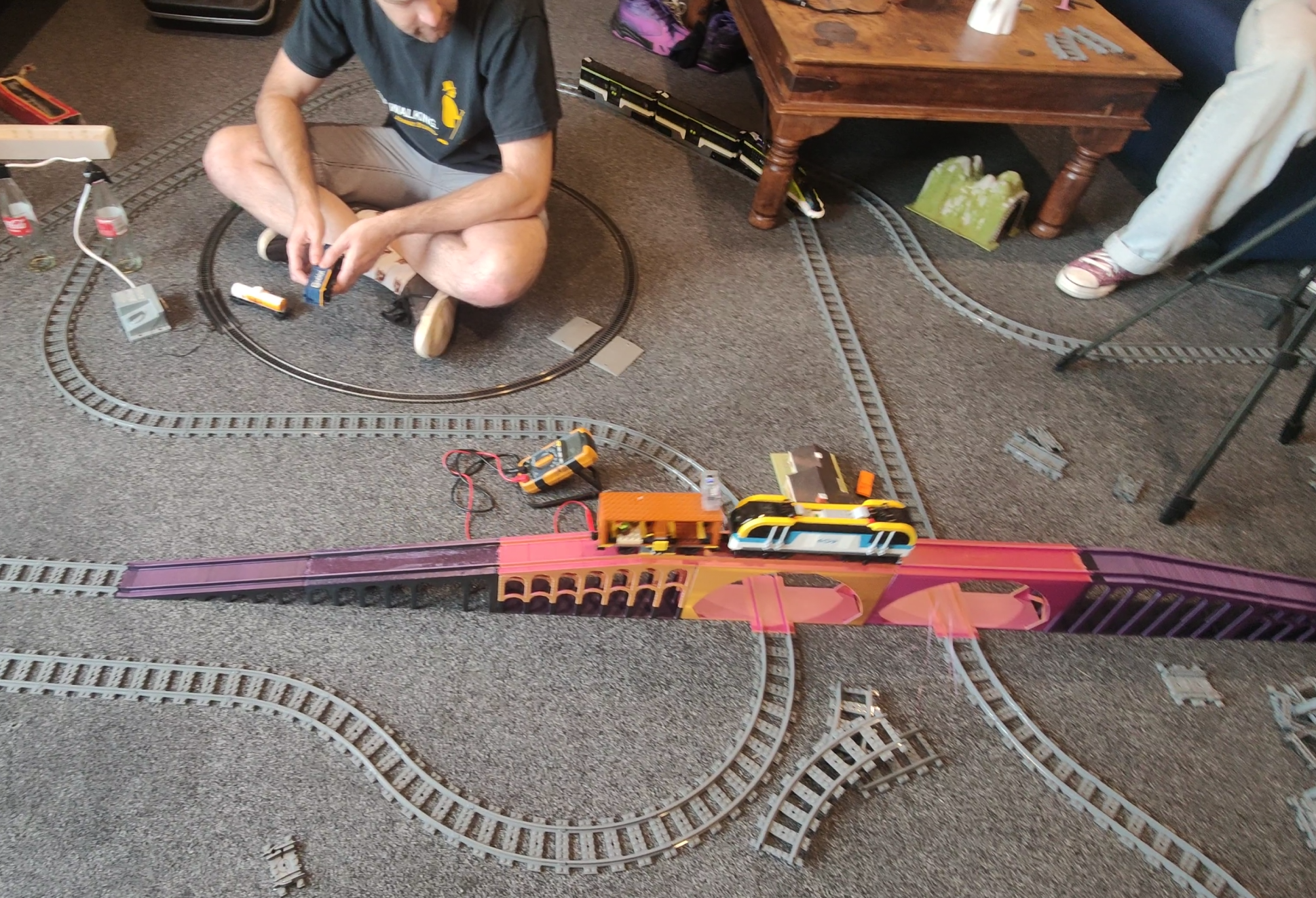
Nevertheless, the bridge design did mostly work if you were careful and only ran the right trains. With a layout built to suit the vagaries of over-bridge travel, with lots of straights for run-up and run-off, it was possible to climb and descend without too much trouble. The underpass track was also perfectly serviceable and presented precisely no problems during hours of play.
This bridge design could be easily improved. I’d probably rework the design with a lower grade—maybe 7 degrees, maybe 5—and really smooth out the transitions on and off the slope to allow as many different Lego trains to use the bridge as possible. Beyond that, it would simply be a matter of improving printability and reducing plastic use to really make this project shine. For those eager to try printing what I built, the files are available, but just be wary that your mileage, and your train’s mileage, may vary.
The fun thing about 3D printers is that they are perfect for jobs like this. If you need to make a plastic part with specific geometry, it’s now almost trivial to do. That makes recreating or innovating on things like toys or home appliances really easy, and also very fun. I had a blast designing this bridge and putting it together, and even more fun playing trains with my friends. I’d highly recommend taking a shot yourself if you feel like tinkering with Lego railways at home!












Oh but why stop there? It’s obviously time to 3d print your own “rack rail” system, i.e. add a cog to the center of the train’s powered axel and then put teeth in the middle of the inclined track.
“This allows the trains to operate on steep gradients of 100% (45 degrees) or more, well above the 10% (5.7 degrees) maximum for friction-based rail”
https://en.wikipedia.org/wiki/Rack_railway
And I bet you $1 that we could over-volt these lego locomotives with a strategically placed resistor.
Official Lego rack rail bridges have existed for a long time
https://www.lego.com/en-us/product/train-bridge-and-tracks-expansion-set-10426
Sadly though not compatible with the main Lego train products, as this is Duplo.
Looks like it could use some c1 continuity.
When I wanted to build a bridge for my lego trains I built a bridge…. out of lego… for my trains.
I think this might have been approached from the wrong angle.
Yeah, I don’t really get it either. The shortness of the track pieces isn’t a problem with enough or the right lego pieces.
The only place where a custom track might be nice is at the transition points, where a smooth vertical curvature would be cool.
“Why do anything?”
Well, you wouldn’t have anything to read, for one…
No, this is the right approach for this job. That’s why this is posted on hackaday. Otherwise it would be on a lego website.
I have to somewhat disagree – I have no great problem with not real Lego parts in your ‘Lego’ to fill some need, but if as Trekintosh says you want to ‘build a bridge… out of lego’ this bridge is rather anathema to the Lego style, it is just a giant bit with no functional play ability – no studs, pins, or any flexibility in use of the ‘parts’ in a different way at all. Building a bridge for Lego railway entirely in Lego rails of the old pushalong/4.5/12v style has been done, but the parts are very limited.
The right approach would be to use something like technic beams, those old Lego rail style bridges or the Lego monorail tracks as inspiration for your 3d printed parts – so you can assemble a bridge of whatever height, length, curvature you desire. Likely having a special ‘track part’ with the vertical grade transition or a long section of living hinge rail clip to allow for smoother vertical curves over a short distance that using flat fixed length Lego strait rails would not. Then you really do have even though not all the parts are ‘real’ Lego a Lego bridge building experience.
But nothing wrong with a project like this if you want your Lego Train to have a bridge, it only fails at being a ‘build out of Lego’ style bridge.
When I was a kid I had an older generation of Lego trains. They were powered by a transformer and the power went through an additional set of conducting rails that was mounted in the center of the track. The main rails were made out of plastic and had a serrated edge, that was gripped by rubber rings that were mounted on the motor wheels. This combination was quite powerful and provided plenty grip, so there were no issues building bridges – although Lego didn’t provide official ones IIRC.
I don’t understand why they abandoned this system in favor of the battery powered versions that came later, and that were inferior in my opinion.
Knowing nothing about toy trains, I’d be 98% sure they switched to battery because it is simpler and cheaper to manufacture. They need only a few cm of low-voltage wires per kit.
The next generation with the blue tracks still had the rubber rings, it was just battery powered but mechanically the same. And the battery track provided some additional weight which helps with traction.
A neat detail was that the serrated edge was put only on the outer (if I remember correctly) curve pieces, so the inner wheels could slip a bit if necessary as the locomotives didn’t have a differential.
yep, the longer curved tracks had the serrated edges, the inner shorter ones were “smooth” (although to be precise I think they had two triangle edges running along the top). I spent enough requested xmas and birthday presents and saved pocket money to have enough to make a track in a multi-level clover leaf shaped spiral up and down that I really liked, was very pleased with myself working that out.
That system certainly did handle “bridges”.
Good times….
No kits but plenty offfcial designs.
Eg: 7777
Same generation here.
I guess that trains fell out of favour. So they went with cheaper options.
I liked the later metal rail solutions, but nothing beats 7862 and 7866.
I had the 12 volt Lego trains as well, starting with set 7740. I got an immense amount of play out of it. I did build a bridge, but only between two cardboard boxes, so there was no gradient up to either side. As for 7862, it occurred to me that you could build a hump shunting layout with that, but I lacked the money and parts – and the 7862 set – to do it!
Why having an angle of (180-10=) 170 degrees when you can have a smooth arc of circle thus making a softer transition from horizontal to inclined then back to horizontal (on top of the bridge)?
Wow had to spell out 180-10? And provide no other math … you must be a masterclass train systems enginner!
I did radius the transition but not nearly enough.
Rubber band around the drive wheels?
The Lego community can be sticklers for this kind of thing, but if Lewin had fun doing it this way, I won’t condemn the fun.
im not beyond printing custom bits of lego. of course if you got a printer, why use lego?
Or you just take wood (different types, too lazy too look up their English terms), cut them into lengths, curves, pillars and what not.
Then glue them together or magnets or metric screws + hammer-/claw-nuts (again, not even trying to look up the appropriate English term) or whatever and you have a modular recyclable bridge system (less energy, less fumes, etc)
Plastic can be easily recycled. Wood can only be burned once it’s worn or damaged.
Have you ever heard of composting?
And some plastics can be easily recycled – many need replacement “condiments” don’t they? (like softeners or something?)
much harder to do in a small townhouse but a perfectly valid way to make a bridge!
Were bridge supports needed to print this I wonder?
This seems like a great use of 3d printing. Thank you for posting the article about your design.
Thank you! Glad you enjoyed it. :)
Nah. Back to your cell, inmate.
Lego has had official rack rail sets for ages, dunno why go to this much length
Example
https://www.lego.com/en-us/product/train-bridge-and-tracks-expansion-set-10426
Those are for Duplo trains. Not compatible with mainstream Lego train products.
Not how I would phrase that – Duplo is also a mainstream Lego product, and largely Lego compatible, so it seems rather harsh.
I’d suggest something like “Duplo trains are targeted at a younger audience and the track is not directly compatible with Lego gauge ‘minifig’ scale railways’.
If part of the grade limitation has to do with traction, then maybe using TPU for the rails on the incline secitons would help. (I have no experience with Lego trains, so I could be totally wrong here).
That’s a really smart idea. Would be neat to try a multimaterial print, coating the rails with grippier filament…
Tbh the Lego train wasn’t very Legoish in the first place. Too bulky. It felt more like duplo.
While you definitely made this work, something to note is that a 10° angle, at least historically, wasn’t possible for most trains. Really, you’d at most see a 10% grade, as mentioned in an earlier comment, which is barely over 5°. Once you added cargo, you’d be stuck more at 2%-4% or 1°-2.3° of actually slope, which might have made a lot of your issues easier to handle, albeit at the cost of much longer slopes for each bridge.
Really depends on the era – the early 9V with metal rails are fairly prone to wheel spin, but the older 4.5 and 12v rail wheels for the motors have rubber band tyres and/or some toothy patterns that grip to the rails, so they can haul quite well (which is important as that era of wheel bearing is much more draggy), and the newer stuff with their regular power functions motors driving the steam engines also have rather impressive hauling power – usually a fairly large locomotive directly providing a good amount of mass and rubber bands on the driving wheels too.
I think the reason to abandon the 12v or 9v rails has to be quite simply price – the entirely plastic injection moulded track is still complex and expensive enough to make part, having to add the conductive rails however you do it just adds so much extra cost that the already niche crowd that buy Lego railway are at risk of being priced out from it as children.
Also the battery powered locomotives can be very performant, and actually better than the electrified 9v rail in traction by miles – the problem child that is related to that 9v motor is how the trains are driven. The motors that are just one bogie with 4 wheel drive are generally not well fixed to the locomotive body – the mass is often not going to stay on the one driven bogie, and they are so short with small wheels its easy for the small rubber drive bands to not be making good contact across the points and curve transition too. But the Battery locomotives, which have existed even back in the era you describe can actually have plenty of traction, and the modern steam locomotives are a good example too – wide spread large driven wheels actually fixed to the locomotive body so there is some significant mass on the driving wheels for friction.