

Cryptography is a funny thing. Supposedly, if you do the right kind of maths to a message, you can send it off to somebody else, and as long as they’re the only one that knows a secret little thing, nobody else will be able to read it. We have all sorts of apps for this, too, that are specifically built for privately messaging other people.
Only… sometimes just having such an app is enough to get you in trouble. Even just the garbled message itself could be proof against you, even if your adversary can’t read it. Enter The Guardian. The UK-based media outlet has deployed a rather creative and secure way of accepting private tips and information, one which seeks to provide heavy cover for those writing in with the hottest scoops.
Hiding In Plain Sight
There are plenty of encrypted messaging apps out there, of greater or lesser value. Ultimately, though, they all have a similar flaw. If you have one of these ultra-secure apps on your phone, or malicious authorities capture you sending lots of messages to such a server, it can be somewhat obvious that you’re doing something worth hiding. You might not be—you might just have a penchant for keeping your fantasy football submissions under wraps. Regardless, using heavily-encrypted messaging systems can put a bit of a beacon on you, at a time when you might be hoping to stay as unobtrusive as possible.
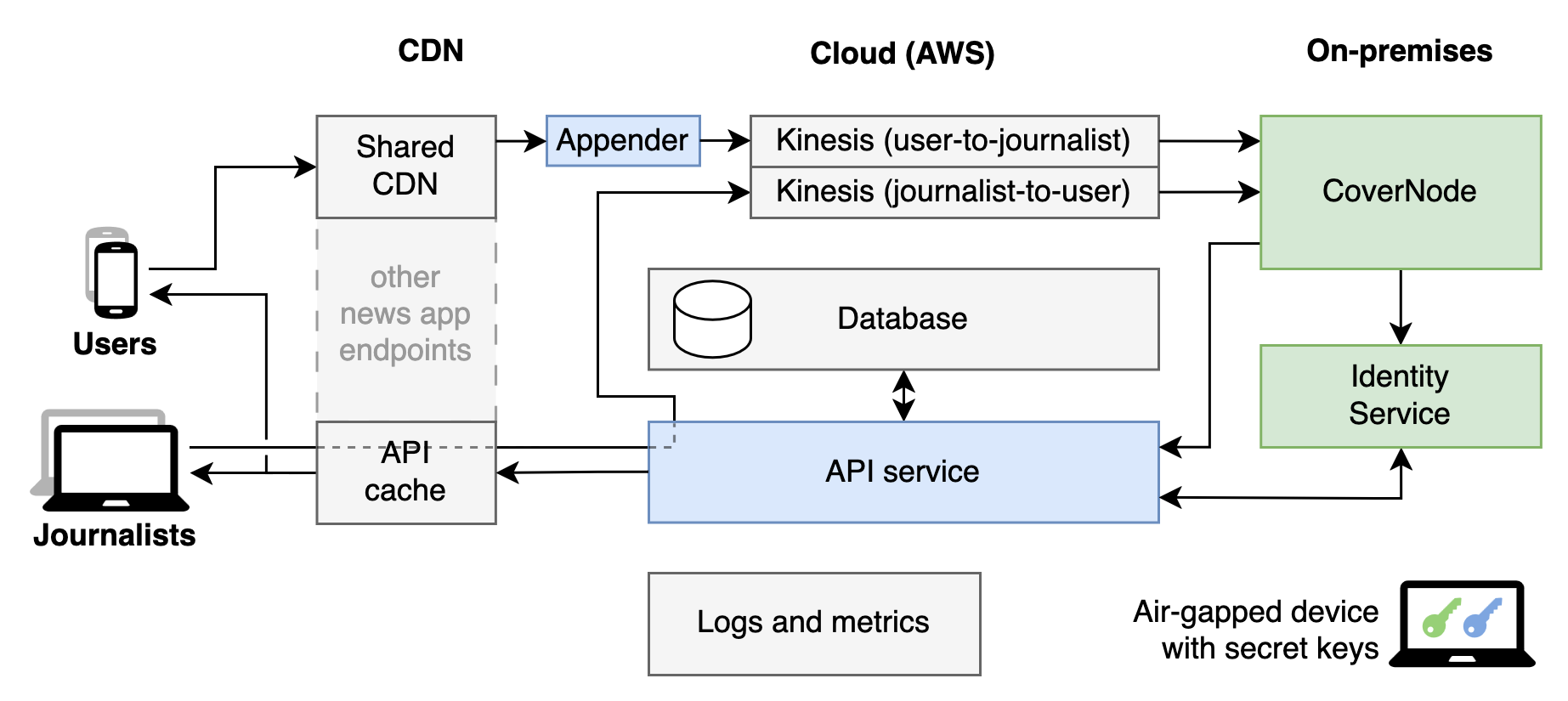
It’s this precise problem that The Guardian and developers at the University of Cambridge hoped to solve with the CoverDrop messaging system. It’s designed specifically for users of news apps to be able to make confidential submissions to journalists without leaving a telltale trail of evidence that could reveal their actions. It’s intended to be suitable for implementation by a wide range of news agencies if so desired, as laid out in the project white paper.
The CoverDrop system uses multiple techniques to not just encrypt messages, but hide whether or not any messaging is happening in the first place. The key is that CoverDrop is integrated into every copy of the Guardian’s news app out there, and each app sends small amounts of encrypted information to the system at regular intervals. Most of the time, this is just meaningless text with no information content whatsoever.
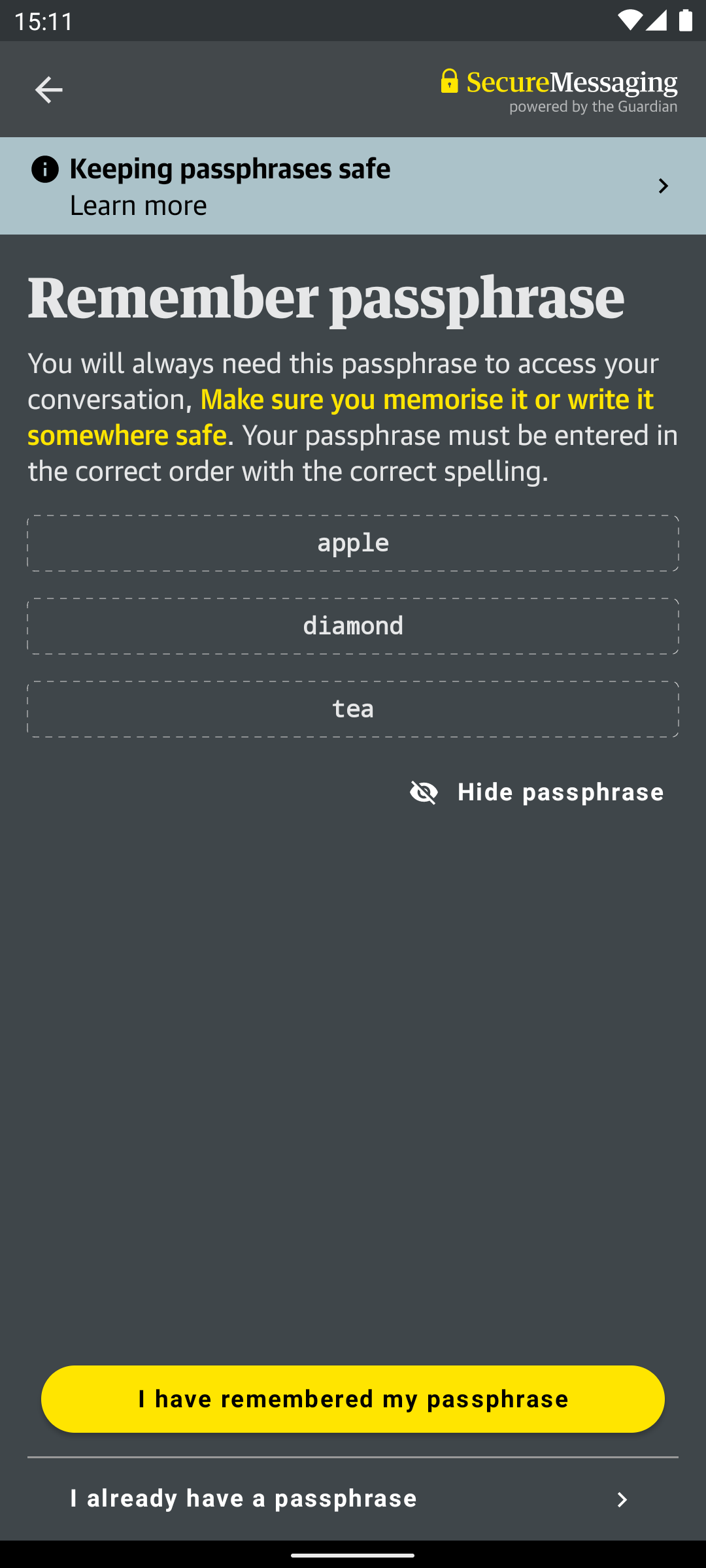
That is, unless somebody has a message to send to a journalist. In that case, the message and the source’s public key is encrypted with the journalist’s public key, packaged up, and sent in such a way that it appears fundamentally no different to any other garbage message that is being sent to the CoverDrop servers. Both real and cover messages are encrypted the same way and have the same length, and are sent at the same times, so anyone monitoring network traffic won’t be able to tell the difference.
At the receiving end, CoverDrop’s secure servers remove an initial layer of encryption to filter out real messages from the cover messages. These are then provided to journalists via a dead drop delivery system, which pads the still-encrypted real messages with some cover messages to ensure the drops are always the same size. In the event a dead drop contains a message for a given journalist, they can decrypt it since it was encrypted with their public key in the first place. Since the messages also include the source’s public key, replies can be sent in the reverse fashion in a similarly secure way.
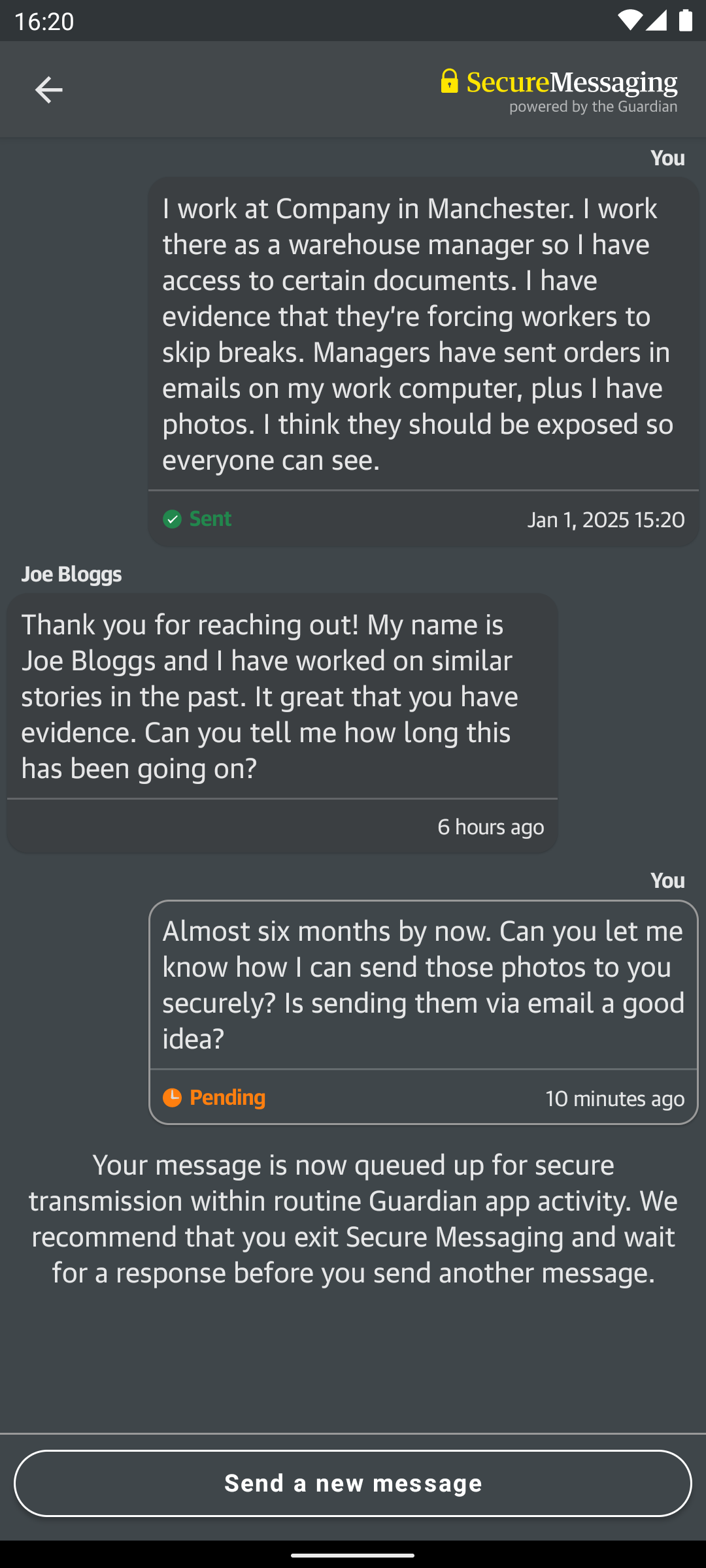
As for on-device security, the system is designed to be as unrevealing as possible as to whether it has been used for secure messaging or not. Message storage vaults used by the app are encrypted, maintained at a regular size, and are routinely modified at regular periods whether covert messages are being sent or not. Unless the decryption passphrase is known, there is no obvious evidence that the app has been used to send any messages at all.
For those eager to implement the system, or merely audit its functionality, the CoverDrop codebase is available on Github. Providing a secure and deniable method of submitting sensitive tips is desirable to many newsrooms, which could lead to wider adoption or similar systems popping up elsewhere. Of course, no system is absolutely secure, but having a messaging system that focuses on more than just simple encryption will be a boon to those looking to communicate with less fear of surveillance or retribution.












Does this count as steganography? It certainly an interesting technique, to introduce a new medium that’s easy to hide in. On the other hand, isn’t encrypted messaging already a good percentage of network traffic, now that HTTPS is commonplace? The app should already be making all of it’s requests to the Guardian through encryption. I’d be curious to understand where that isn’t sufficient.
Is https secure?
In China, only tls 1.3 is forbiden…
B/C of government mandated MITM though (probably).
https relies on 100% valid certificates, which, through deliberate design, can be generated and issued by ANY certificate authority globally for any DNS domain.
However since 2017, it is mandatory for every certificate authority to check DNS records of the domain name for a list “Certification Authority Authorization” before issuing a valid certificate. If they are not on the list they should not issue a valid certificate. But if you are a state actor and have enough control to fake DNS entries, these safeguards can be bypassed by orwellian regimes.
It always boils down to who you are trying to prevent from read your messages.
Easy “fix” if you’re an oppressive regime: just make having news apps evidence of guilt. Problem == solved.
Bingo.
I was thinking the same, it’s a clever idea but unfortunatley not much better than regular encryption apps if you have to have the app of a banned media outlet. Might be some use in the US where there’s still a pretence that the government believes in free speech.
I assure you that has gone out the window, now that we have a circus peanut as president.
It’s interesting that you feel free to make such a comment.
I think there’s quite a difference between whether the government, or the representatives thereof, believe in Free Speech and whether free speech is actively being curtailed. In the US, it’s really under the courts purview, in cases including Murthy v. Missouri (2024) National Rifle Association v. Vullo (2024) Molina v. Book (Ongoing) Students for Justice in Palestine at the University of Florida v. Raymond Rodrigues (Ongoing). Certainly Obama was not a free speech champion either, none of the Presidents have been for a while, although lately Republicans and even conservative media seem determined to misrepresent when and what freedoms are being violated, and how; that’s become more partisan. So, no, it’s not just the current administration, but saying so here isn’t really indicative of anything.
When I hear people comparing SOME_PERSON to SOME_OBJECT the cynic in me wants to ask “what do you have against SOME_OBJECT?”
“what do you have against SOME_OBJECT?”
nothing, but I think it pretty insulting for SOME_OBJECT
It’s been a long time since I ate one of those orange puffed squishy candies that I originally thought were imitation orange sections. They were always associated with the cheapest of any candy. If you know what that particular candy represents, it’s the best polite metaphor I’ve heard yet. People in China and Russia have to use such meta words to conceal meanings when referring to their own great leader.
I try yo avoid injecting politics into technical forums like this, but Don the Con has become a problem for the entire world. Best insult for that clown that I’ve heard yet. I’m stealing that; thanks.
This is why you hack the computer in another cubicle, and have that news app only visible via this tech–“negative light:”
https://techxplore.com/news/2026-03-negative-technology-plain-sight.html
This way you not only have plausible deniability, but you get to cosplay THEY LIVE, but for reals…in that only you see the feed with proper optics as your dull-witted cubicle mate lusts after the red Swingline.
“I always knew he was bad, commissar!”
Or in the UK, they will just require all apps with encryption to require ID and age verification.
And that verification must be provided by approved suppliers, that probably all have ties to Blair in some way…
Reminds me of the shortwave radio number stations. Send a lot of random info so you can hide small bits of important info.
Even better yet, don’t send anything but do force the interceptors to waste time and resources to verify that
Don’t send anything, but force the interceptors to waste time beating people up while insisting something was sent.
“Message storage vaults used by the app are encrypted, maintained at a regular size, and are routinely modified at regular periods whether covert messages are being sent or not.” That strikes me as a possible problem.
I know what a “dead drop” is in meatspace, is the author talking about a dropbox?
The cynic in me thinks that this is a great way for the news apps to spy on all their users. The random nonsense sent back periodically might not stay so random
…what? The system described here is for sending messages that must be hidden. App monitoring doesn’t even fall into that category.
The only defense to an app spying on you is an OS that denies permissions by default. The apps already can (and do) phone home about anything you do within the app. I work at a not-very-large company and every tap you make in our app is logged to our server. No need for any of the stuff above.
Tyrannical Government: “So it is just random data eh, OK then we will block those packets and it will have no impact on users.” …
No, “random data” that doesn’t include necessary functionality isn’t “random enough”.
You need to provide the overt functionality, the covert functionality, and the garbage disguise over the same channel in ways that make them indistinguishable, or else it doesn’t work.
A sufficiently tyrannical government will not care: “any functionality that risks enabling things that we seek to coercively restrict is itself coercively restricted.”
It won’t aid anything in the face of an existing tyrannical government, but it does make it harder for a less-tyrannical government to quietly slide deeper into tyranny. The tyranny ratchet can still tighten, but it is at least overt rather than tacit.
Good old Autodin’s EFTO comes to mind…
Recommended reading to multilayered cryptography: Memoirs Found in a Bathtub, Stanislaw Lem, 1961
Most of Lem’s work is surprisingly deep, once you realize how tacit things must be, in a suppressive environment.
This innovation looks encouraging, especially if matched with a discrete dual-boot device that is easily rebooted and automatically comes up to a historyless system, as if recently factory reset….but with an alternate encrypted system that can be activated at boot with the right boot-up interaction.