
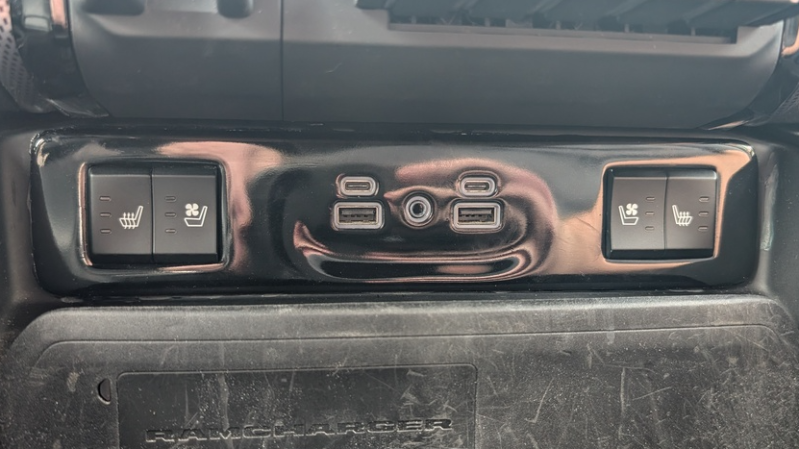
We’ve all owned something where one tiny detail drives us nuts: a blinding power LED, buttons in the wrong order, or a beep that could wake the dead. This beautifully documented project fixes exactly that kind of annoyance, only this time it’s the climate-controlled seats in a 2020 Ram 1500.
[projectsinmotion] wasn’t satisfied with adjusting seat heating and ventilation only through the truck’s touchscreen. Instead, they added real physical buttons that feel just like factory equipment. The challenge? Modern vehicles control seats through the Body Control Module (BCM) over a mix of CAN and LIN buses. To pull this off, they used an ESP32-S3 board with both CAN and LIN transceivers that sits in the middle and translates button presses into the exact messages the BCM expects.
The ESP32 also listens to the CAN bus so the new physical buttons always match whatever setting was last chosen on the touchscreen, no mismatched states, no surprises. On the mechanical side, there are 3D-printed button bezels that snap into blank switch plates that come out looking completely stock, plus a tidy enclosure for the ESP32 board itself. Wiring is fully reversible: custom adapters plug straight into the factory harness. Every pinout, every connector, and every wire color is documented with WireVis diagrams we’ve covered before, making this an easily repeatable seat-hack should you have a similar vehicle. Big thanks to [Tim] for the tip! Be sure to check out some of our other car hacks turning a mass produced item into one of a kind.












Elegant. I would have just hot wired them. Maybe with a PWM controller if I was feeling generous.
I’m still annoyed that my car wanted to turn on the frickin’ air conditioner every time I want air coming from the windshield vents instead of the central vents (ok, they call them “defroster” vents). Even if it’s 10 degrees out, the compressor comes on, blowing cold air unless I turn up the heat. It’s uncomfortable and a waste of fuel, adding at least 10% to consumption.
I know, I know, they do it because the average moron driving a car who wants “defrost” would not think to turn on the A/C to dehumidify the air, so the manufacturer locks A/C on any time you select that vent as an outlet. They had to add a switch to do that, and reduce the usability of the environmental controls, just to avoid average idiot customer complaints.
So I put put a great big toggle switch on the dash, and wired it in series with the A/C compressor electric clutch. Unlabeled, natch.
Curious what kind of fuel mileage you get?
The last few cars I’ve had I found it difficult to spot the difference in consumption between AC on or off
On a 7000 km trip in August: 6.0 L/100km with AC off, 6.5-7.0 L/100 km with it on, depending on ambient temp.
That 0.5-1.0 L/hr consumption represents a mechanical power into the compressor of 1-2 kW, assuming a total fuel-to-compressor efficiency of 20%. So about as much power as my 18 kBTU/hr (1.5 ton, 5 kWt) house unit.
It’s crazy it takes as much power to cool a car cabin as it does to cool a house fifty times the volume.
Well my car gets to over 140 degrees f. The house does not, mainly because the smaller windows are shaded by the roof, and it has an attic. On the upside, I can kill possible bedbug infections in vintage clothing just by leaving in the car for a couple of days.
Most modern cars have variable displacement compressors. Old school compressors are bang bang on/off. This makes a big difference in efficiency.
Some even have completely electric compressors too. Even gas cars. Allows more flexible placement in the engine bay and is a bit more efficient.
You do realize that the A/C is supposed to come on with defrost right? It’s used to lower humidity in the supplied air to help prevent continued moisture buildup while defrosting/defogging.
He mentions that in his comment. Presumably there are times when de-humidification is not necessary, or he simply wants forced-air heating (not defrost specifically) that is not blowing directly on him.
For example if he was talking about 10F outside, then running the AC is pointless because it can’t safely get the dew point below 32F without icing the coils.
I have just the opposite complaint with my car (Kia EV6) – The car’s heat pump supports a dehumidification mode where it runs refrigerant through the cabin AC evaporator in heating mode. This mode sometimes turns on when recirc is selected, but not always – it’ll just shut off, let the humidity climb, and instead of re-engaging the evap coil to dehumidify, it just decides to let in fresh external air which costs FAR more energy to heat up than dehumidifying recirc.
Serious lack of reading and comprehension skills displayed here.
Says the guy who thinks A/C on a 2015 car takes up 10% fuel usage. Gonna need some proof of that.
If your heater can’t overpower the A/C in dehumidify mode, then you have bigger issues than fuel milage anyways.
Correction to the above. I mean 10% in the winter, when the A/C is most efficient as it can easily dump heat. In the summer up to 10% on an old style bang-bang compressor could be accurate. Most cars past 2010 will also have variable displacement compressors for higher efficiency, very cheap vehicles or manufacturers know for poor quality.
I’m bad at typing…
…very cheap vehicles or manufacturers know for poor quality will still have bang- bang controls for compressors*
If it’s well below freezing outside, there’s not much humidity to start with.
Typically max defrost runs in recirc mode so its internal humidity, not external.
Many cars have the ability to turn this off. It’s usually through some arcane button pressing sequence.
Have you checked to see if your car can switch it off? Usually this kind of stuff is on user forums
Haha. Nope. A 2015, and as close to bare metal as I could get it. Manual transmission, none of this turn off the engine at stoplights, and a real handbrake.
The A/C is all hardwired, with actual cables and physical switches and knobs you can turn.
There is an arcane sequence to turn off the godforsaken honk-the-horn remote lock noise, involving open the door and inserting the key some number of times. But nothing on the enviro controls.
I’m not looking forward to getting a new car.
1: Nothing is “hardwired” it’s all through can/lin bus. Those knobs are just encoders or multi-position switches feeding a microcontroller
2: Your issues are due to your lack of systems understanding and choosing a manual climate system. Modern vehicles will automatically blend to maintain temp whether A/C is on for dehumidifying or off. By forgoing a modern climate control system and taking matters into your own hands you have essentially created the issues you complain about.
3: Unless you want to tool around with drifting with a hand brake, the electronic brakes are both more reliable and safer
This was my first thought, but maybe he just has a 2015 Tata model we didn’t consider?
I almost forgot how fun it was. But I also no longer live in a climate with proper winter season.
And that’s the proper answer to heated seats sold as a subscription-paid option.
The proper answer is to shun the vendor entirely.
Drive a classic.
They don’t depreciate.
Any money you put into it is making it more valuable.
The modern $ell fone on wheels will be a pile of broken worthless junk rotting in a landfill within 10-20 years, while a ’68 Camero will only keep increasing in value.
Man after my own heart… I have spent a lot of time gouging out 50,000,000 lumen BLUE power indicators with eyeglass screwdrivers and also gouging to bits the piezo beeper in every microwave. Why does it need to beep constantly, what purpose does it serve? I can tell it’s done because it stopped buzzing and glowing.
At first I thought this might be a workaround for those subscription heated seats. Why is that a thing
I understand the sentiment. But if you want to dim them in a reversible way, I have had success “drawing” over the top of the LED or its light pipe with a black “sharpie” or similar marker.
If you want to be clever, you could cover a piece of clear tape with sharpie, then build up as many layers of tinted tape as you need. If you want to be really clever, there are probably different colours of sharpie that provide the right kind of attenuation for each LED. I haven’t tried this yet.
I wonder if the amber color of kapton tape and its heat resistance might make it a good option for this application.
I have some LED landscape lights that were too bright and too blue. I dimmed them by placing some expanded metal pieces (good riddance to a 10ft satellite dish) over the lens.
I still didn’t like the color of the light. Painting the expanded metal with red primer took care of that. Seemed like a harebrained idea right up to the point where it worked.
I have a coffee maker with a timer and unfortunate blinding blue LEDs in my bedroom (basically it’s my alarm clock). I took off the front panel (sticky plastic with bubble buttons) and put a section of a translucent crisp packet in there. Now I have to concentrate to read what it says during the day, but at least I don’t need sunglasses at night.
The dumbest thing I’ve seen was a humidifier with a blue power indicator bright enough to compete with regular room lighting and turn everything blue. Even with the LED covered by tin foil on the front side, the light spread through the plastic body of the appliance, making the entire thing glow enough to read a book in a dark room.
To add injury to insult, it kept pulsing the light and changing the color periodically, so even when dimmed down by the tin foil, it was still actively distracting. The whole appliance had to be wrapped in dark masking tape, otherwise you couldn’t sleep in the same room.
I have a bedside humidifier with an orange power indicator that put out a ridiculous amount of light. Now nearly completely obscured with aluminum tape, it still functions sufficiently in normal room lighting thanks to the translucence of the white plastic shell.
Didn’t they do the least bit of consumer testing? Did they really think people wanted something like this?
Defective by design.
Links don’t work – they go back to this article.
i know how it looks but this article is the latest chronologically with those “tags”, scroll it down and see
This WireVis tool seems to be getting more and more useful, thanks!
This is the way
IMHO, that’s clever, but very, very complicated way of accomplishing the same results. Funny how things’ complexity is a runaway train of someone else thoughts.
Makes me think car makers (ESPECIALLY the only remaining two US car makers) should go back to basics – sell bunch of parts to whomever buys them, shipped in crates, to be assembled by anyone. Ford used to do that, but not only, it was common practice at the time that car makers sells the frame, the engine, sometimes wheels, etc, and ships it in crates, to be fitted with the custom body made locally. This was way, way before so-called “dealerships” were invented, and way, way before they became de-facto mafias of the car selling in the US, back when we still had real free market unimpeded by monopolies of all kinds.
You’ve complained about the runaway train of some else’s thought, but you’ve left part of what you’re saying in your head. You need to say what “that” is and what the results are the same as.
My first thought was this being used to bypass the “subscription” to be able to use the hardware that is already present in some of these modern day vehicles, aka the reincarnation of the “golden screwdriver”. Maybe those shinannigans worked well back in the days of big iron and the kind of contracts companies and the likes if IBM or Remington-Rabd had with each other, but not so much with a private vehicle. Go ahead and sue.