
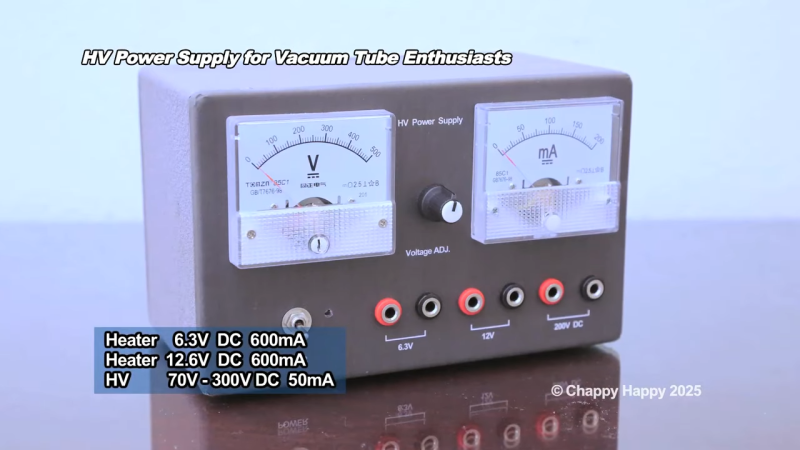
If you work on simple digital projects, just about any bench supply will offer the voltage and current you’re looking for. However, if you’re working with valves, you’ll often find yourself needing much higher voltages that can be tricky to source. [Chappy Happy] has shared a design for a simple HV power supply that should prove useful to vacuum tube enthusiasts.
The build is fairly basic in nature, lacing together some commonly available parts to generate the necessary voltages for working with common vacuum tubes from a 12 volt DC input. Inside the supply is a UC3843A DC boost converter, set up to output high voltage up to around 300 volts DC, with a ripple filter added for good measure. The output can be adjusted with a knob, with a voltmeter on the front panel. There’s also a 12-volt output, and a LM2596 step down converter to produce 6.3 volts for the filament supply. The whole project is built in an old Heathkit project box, and he demonstrates the supply with a simple single-tube amplifier.
If you find yourself regularly whipping up tube circuits, you might like to have something like this on your workbench. Or, you might even consider cooking up your own tubes from scratch if you’re more adventurous like that. Video after the break.
[Thanks to Stephen Walters for the tip!]












Isn’t the entire point of tube devices to have clean, high quality sound? If you connect it to a DC-DC converter then it’s about as useful as a tanning salons in Compton.
This would be for use on a workbench during development or repair work, not for listening.
Not even then, depending on what you’re working on – switch-mode power supplies can generate a lot of RF noise, which could make aligning an AM/shortwave radio problematic.
Aside from this being a bench supply rather than a deployment supply, no.
For audio, I have used 40 to 100KHz dc-dc supplies up to several KV. Frequencies well out of audible are no issue, and decent filtering will correct down to 60 or 50Hz, where much audiophile gear is powered, with unregulated, single pole RC filtered supplies.
Then again, I don’t buy into the tube mystique. They have use cases (guitar amps are my primary one, though I still run a Mac from the 1950’s for my house sound. Recapped maybe 15 years ago)
nothing clean and high quality about tube, aprt from few high power applications it is about nostagia and “pleasant” distortion
This is a bad idea from the start….
Better get use to the BUZZZZZZZ….
Because that project super-regen radio in The Boys First Book of Electronics will sound like Crap…
Sorry but, it’s true.
In the back of the last several editions of the RCA Tube manual is a wonderful regulated high voltage supply for vacuum tubes.
https://www.scribd.com/document/828242682/RCA-Receiving-Tube-Manual-1975-RC-30
By the way…
Te front of that book has the best explanation of how tubes work….
The Front and the back afr well worth the read….
The middle is all the good stuff.
Yes you can put DC on the filament, but Why?
It was only done to reduce hum in first stages of test gear…. (the only place I have seen this practice. ) Usually a center tapped filament transformer and a hum balancing pot in the filament circuit.
I have read somewhere, that DC powered tube filaments tend to wear out unevenly, since the negative side emits more electrons. The DC supply polarity should then be periodically changed.
100%
I couldn’t find the article on the problems with DC on the filament (or heater if you will)
In ether case the lifespan of the heather / filament is shortened for the reason you sighted.
Tubes have their good points , and their flaws, still nothing has a higher input impedance than a metal grid suspended in a vacuum.
No FET on the planet can compete.
True when using a filament type tube.
With a cathode type tube this isnt an issue.
Sorry if this is a dumb question, im just a beginner in the world of electronics…but could this power supply be useful for delivering the high voltage needed in hardcote anodizing (Type 3) as opposed to the less durable and mostly cosmetic (Type 2)? I have been consistently successful with (Type 2) and really want to be able to hardcote my parts but many hours of research into building a viable high voltage power supply have been unsucessful …does anybody have any ideas? It would be greatly appreciated
Those uninsulated banana plugs are scary.
Nowhere does the article give details about the UC3843A and the LM2596 circuit boards. Do you have to make these or can you buy them from Aliexpress?