
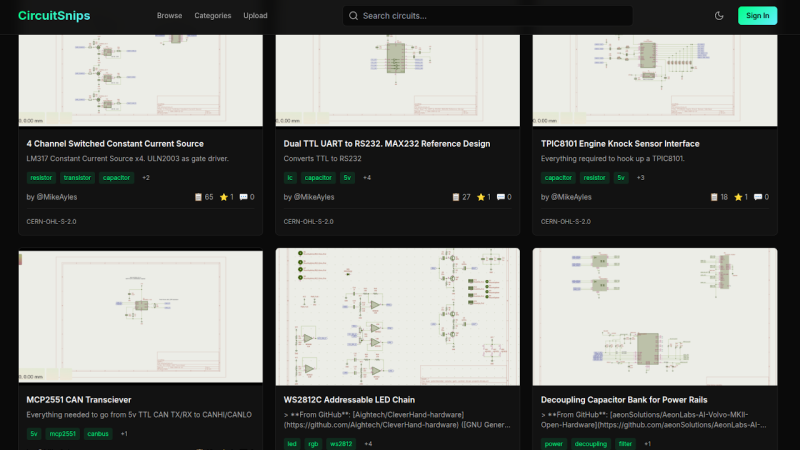
In the desktop 3D printing world, we’re fortunate to have multiple online repositories of models that anyone can load up on their machine. Looking to create a similar experience but for electronic projects, [Mike Ayles] created CircuitSnips — a searchable database of ready-to-use KiCad schematics available under open source licenses.
Looking for reference designs for LiPo chargers? CircuitSnips has you covered. Want to upload your own design so others can utilize it? Even better. Currently, there are over four thousand circuits on CircuitSnips, although not all have been put there purposely. To get the project off the ground, [Mike] scraped GitHub for open source KiCad projects. While this doesn’t run afoul of the licensing, there’s a mechanism in place for anyone who wants to have their project removed from the repository.
To scrape the depths of GitHub, [Mike] had to simplify the text expression for the KiCad projects using a tool he’s since released. For anyone so inclined, he’s even put the entire site on GitHub for anyone who wants to try their hand at running it locally.
CircuitSnaps fills a very specific space to post your circuit diagrams, but if you’re looking for somewhere to host your complete designs, we can’t fail to mention Hackaday’s own repository for hardware projects and hacks!












Just in the process of migrating the thumbnail store to cloudflare R2, so the thumbs should be correct at some point today, the user attribution and licensing should be sorted now.
W
Not for me- the circuit designs are not vetted nor professional. Fuse, protection diodes – oops missing.
Reminds me of the Arduino libraries- anyone and their dog can and does make a library, for fame and glory. So the quality can be (usually) low, and they are not always maintained, some get abandoned.
I think you still need design reviews and someone to parent the snips.
Many websites aggregrate circuits collected from old electronics magazines, they’ll change a part or two and make huge claims about what the circuit does. But it’s a lie. And then builders are posting on electronics forums “why my circuit not work?” “why it smoke?”.
So I’m not a fan of the snippets adding noise to electronics design- unless they get vetted. I’m an engineer for a long time and this is common practice at the workplace – design reviews to catch problems.
Tried to peruse the sight but it kinda fizzled out:
https://www.circuitsnips.com/circuit/5v-linear-voltage-regulator-eurorack
“5V Linear Voltage Regulator”, “A standard linear voltage regulator circuit using an L7805 IC to generate a stable +5V supply from a higher input voltage (implied +12V or similar, based on power nets). It includes input/output decoupling capacitors (C1 is present near the regulator, though other necessary bulk caps might be off-screen or assumed).”
Statistics, Components, 151(!) Arduino Nano too. This ain’t a 5V reg. circuit…
You guys broke the website. “Browse Circuits” – “Failed to load circuits: Failed to load circuits”
Being open source allows the projects to be vetted by the community. Ofcourse that works only when the community flourishes and there is a raise of either jealousy or care.
But much like code, it depends on the standards set whether things fit together well. However, code is still fairly universal though. You can forgive or quickly rename a few function names if they do(n’t) use CamelCasing etc. Or simply black-box it and use it is a library.
But with hardware: in my own parts library, each value resistor can be a distinct part, which integrates database information, supplier information, stock information, etc.
I draw with my own symbols and footprints for everything, because of readability, or layout, manufacturability, etc.
This is a level of control I want, so that when I spend money on prototypes, I know exactly what is a proven design and what I’m getting.
I like the idea in spirit. In reality, there’s some dodgy circuits out there. Before I knew anything about electronics I would Google for ready made circuits to do what I needed. The results were mostly awful and some kind of hazardous.
I would like if there was some vetting going on though. Also I’d love to see it broken down into breadboard friendly vs straight to PCB. Maybe I’m just stuck in my ways but if I can’t breadboard something then most the time it will not get solder let alone a pcb order.
I could see this being a somewhat lucrative startup though. I bet all the AI companies would love to have data from a crowd sourced and freely vetted place. I can see it now “why are you hiring EETs, use ChatEET for pennies!!”
“scraped Github for Open Source projects”, “Some bulk-imported circuits may have missing attribution and thumbnails. ” – as everything that dovetails into the machine learning ecosystem (https://platform.openai.com/docs/mcp).
What’s the business model here? The software is on github, but not the database?
I wish these articles here weren’t as cheerful and more concerned with the life cycle of such projects.
In software you often have to use poorly written proprietary libraries. They are often slow and buggy, and you spend a lot of time fighting them and trying to integrate them. They’re also not a good fit for your architecture. Still, you persist. Not because you want to, but because the management doesn’t trust you to write a better one. Or they want “time to market” to be some impossibly short.
Thankfully that culture hasn’t made its way to the hardware realm, there are simply too many variables, approaches and gotcha moments. It is also why “reusable” hardware doesn’t exist, and will likely never do. Good luck searching for a power supply that has the exact input-output voltage, quiescent current, ripple, PSRR, transient response, and a tons of other parameters already present in a repo, ready for you to use. If you’re only using it for reference, a datasheet or eval board would be a better one…
The idea is neat though, I applaud [Mike Ayles] for giving it a go.
While I agree that many aspects of HW are unique, there are also many that are truly cookie cutter. Getting the basic Mega328 AVR up and running or a RP2040 is pretty stock (ignoring details like crystal selecting and loading). Even with those details, quite often the footprints are identical for a reasonable range of values or the manufacturer has made a solid recommendation that you can keep (or tweak).
The CM4 module has specific sockets and physical spacing. having a drop-in component and starting layout would save me quite a bit of time (if the footprints were vetted, and the sizes, etc…)
So I think the idea is neat, there are some expensive issues that require vetting and feedback and it does not work for every situation.
Those pesky details are often what makes or breaks a circuit.
The fact that the circuit library doesn’t have the associated layouts doesn’t help either. If I ever use the thing it will be only to go to the original source so that I can see the layout and understand the designer’s rationale. The collection by itself is pretty useless IMHO.
The idea is actually great, but the result?
Scraping others projects from github? Like i get that the licenses are permissive and you at least try to do attribution – but first it’s not cool and second by doing this you are setting the bar for the content, and as for now the bar is “garbage” – what you want is start with couple (like even 5 would be ok) of nice correct reusable datasheet compliant circuits (even though you need to that by hand) and say “look, this is what we expect to be here, this is the quality we expect”
And looking at some commits in the github repo – was this vibe coded? All of it? Some of the commits are really scary. It doesn’t even looks like inexperienced developers, it just looks like AI.
This is a neat idea. I’m no engineer, but I like to keep little blocks that I can reuse in kicad, especially the routing within a block (not found a good way to do that yet). Hopefully it becomes useful.
Hey all, Mike here (the author).
Fair points across the board. A few responses:
On quality/vetting: You are correct that unvetted circuits are a concern. The bulk-uploaded content is a bootstrapping mechanism to get the site off the ground – most of my own work is either niche automotive stuff or things I can’t share publicly. There’s already a toggle to hide bulk uploads from browse and search if you want curated content only. As the community contributes properly useful snips, the scraped stuff can be downranked. Happy to look at tuning the quality classifier based on feedback.
On the “100+ component 5V regulator”: Bulk uploads are full sheets because automatically extracting subcircuits is a project in itself. To work around this, I modified KiCanvas to allow box-selection so users can grab just the bit they want. Not ideal, but does the job.
On the scraping: I get why this rubs people the wrong way. The licenses are permissive and attribution is tracked, but I understand the optics. For what it’s worth, there’s no business model here – just a solo project solving a problem I have. If anyone wants their work removed, there’s a one-click report that doesn’t need login.
On the site being broken: Hug of death from you lot! Exceeded Vercel’s free tier and had to migrate 1.2GB of thumbnails from Supabase to Cloudflare R2. Should be stable now.
The Thingiverse comparison is deliberate – this is for side projects, not production. If you’re throwing an ESP on a board with an AMS1117 and an MCP2515 for the tenth time, why not have something to pull from? You should always check everything yourself regardless.
Appreciate the feedback, genuinely.
I have an idea that might help you get some higher quality results. It will likely take more of your time and please be careful using AI to do this.
You can get circuits from data sheets and academic papers. A lot of papers have cad in their supplementary information and sometimes they have githubs as well. Why you want to be careful with that is, sometimes data sheets have bad diagrams and sometimes papers shouldn’t have been accepted or are just low quality.
Thanks for doing this. Having redundant copies of available schematics up is always a good thing. They can dissapear off the Internet and N+1 copies makes that less likely.
As for licensing, in the USA at least, you can copyright copy; patents are for design. Consult your lawyer before complaining about how that works or the “optics” of the legal system.
Or patent your special AMS1117 voltage regulator circuit. The human lung got through so you’ve got a chance,
I honestly would encourage the ditching of scraped content asap.
If someone tries one of these potentially incomplete/outdated/untested scraped designs and gets disappointed. that disappointment is going to get projected to both your site and the one who likely didn’t even know their work was being propagated in this manner.
I get wanting to bootstrap one’s endeavour for better odds of success. But you are making a short-term vs long-term gamble here.
Cool stuff. Some complain about duplicates, I don’t.
4 suggestions :
It will be a killer feature if one could chain the parts like lego. This will need every part to have input(s) and outputs. Say I want to build an audio mixer : I described my inputs (multiple (“4.5v” “audio” “analog”) ) and desired output (“digital” “audio”); I searched for circuits that best match the input and outputs with/out a description of what I wanna do (“mix”). I see what I want is probably a “adc”.
The I search for (“digital” “audio”),(“digital” “audio”),”frequency mix” and so on.
When there are multiple implementations of a circuit, it would be cool to have more metas to sort them in terms of : price, number of layers, size, signal quality, heat dissipation…
We need a seal of approval for circuits where “experts” could vote/approved for/against them.
Make it fun and usefull. Every week (month ?) choose a kind of circuit and challenge users to identifiy the best implementation so far and make the “definitive one”.
We’ve all had a few days now to think about your project. While I recognize the potential and lack of proper search on Github itself, the more I think about the prospect of a private entity vacuuming up the works of others to re-package it, and probably laundering it as derivative work by extracting parts of it, along with perhaps community-provided additions, the more I’m disappointed with its existence in its current form.
Some people may be foolish enough to put in time and effort into it, but it seems naive and shortsighted to do this without so much as a guarantee that they’re not helping build an asset that will, after some time, be sold off and end up being a cog in some big corporate machine. Enshittification is the rule now, not the exception.
So unless you pay people for their expertise, it’s only fair to demand that the “database” should e.g. be an organization on github, with the ability for anyone to clone all repos for offline use. Then discussions, change history, PRs and reviews could also map to version control tool equivalents.
The optics is what it is: it’s you wanting to solve one of your problems in the first place, not attempting to build a resource for the community with you among the people benefiting from it. This makes the project extractive in nature and spirit (considering the whole premise is that those that had their works taken also enlist to provide additional value for free on top of that).
Coming to think of it, an offline / on-premises version can be developed towards a KiCad-adjacent product that can be offered to both community and businesses (see https://obsidian.md/license terms, which are one of the few positive examples out there).
It would also be great to offer component and PCB manufacturers ways to sponsor reference design / snippet creation with proper documentation. Aisler has found a way to reward PCB designers for sharing their work, and being able to search circuits tagged with the corresponding sponsorships would be a win-win, continually rewarding the sponsor through visibility and giving the user reasonable confidence that the design has been vetted, perhaps also built and tested.
There are multiple ways to solve the money problem that are not “we run ads” and “[xzy] completes acquisition of”, or a half-page banner begging for donations.
And that’s something that will need to be addressed.
In the past I’ve looked at some circuits on gitlab via RepoRecon, but this is a much better interface, as it lets you view the schematic directly. It’s much quicker to discard the crud, and to find and extract interesting snippets. I also like that it shows the involved licensing for the projects directly on the front page, and that it has direct links to the github projects. To me it looks like this has some potential. It would be nice if it could also scrape projects from other sites, for example from the hackaday projects, etc. It would be especially nice if it had reference designs from chip manufactures, take for example the Nucleo boards from STM (Available from ST’s website, but in (easily to KiCad convertible) altium format.) Olimex has put a bunch of their SBC and FPGA boards on github (and made in KiCad!) but I did not see them in Circuitsnips. RepoRecon also finds some 40k repositories related to KiCad on github. That’s 9x more then Circuitsnips. Maybe add RepoRecon algorithm to Circuitsnips? But this is probably also due to unclear licensing for those projects.
In the past I’ve looked a bit at altium / circuitmaker / online stuff, and that is truly yucky. Lots of beginner projects, which get forked 20 times and then abandoned after a few short experiments. It’s much worse then this collection of github projects.
I’ve also had a look at the projects section on the PCBWay website. Those projects seem to be of much better quality, and that’s logical, as I assume PCBway only hosts them after someone (OP) finds it interesting enough to put some money into actual manufacturing of the PCB.
Some things I do not like:
The buttons have green text with green background, which makes text hard to read.
The website has a max width of some 1300 to 1800pixels. This has has been an annoying practice for nearly every site for the last 20 years, and for text based sites (such as Hackaday) this is “manageable”. But when searching though and re viewing graphical designs such as schematics, I would really like to be able to use my 3840 pixel wide monitor (without scaling).
What about SVG to be easily viewed in a browser?
What about adding an (AI if necessary) translation of https://www.franzis.de/bausaetze/elektronik-und-elektrotechnik/sammelband-zur-professionellen-schaltungstechnik-band-1-7-e-book-pdf to kicad? I enjoyed the paper version so much.
I took one look at the site and I thought, “He’s using LLMs to do this.”
Brilliant work. I love it. We’re just scratching the surface with what these things can do…
Can’t tell if sarcasm…
For those pointing out that this isn’t maintained professionally, the Quickboards library for Altium is.
Is it possible to search by component? Didn’t seem like it, but I didn’t try too hard.
It’d also be nice to be able to search for custom components/footprints.
That they bootstrapped in this manner is a massive concern. Like i get wanting to have enough resources to inflate traffic, but the odds of any of that stuff actually working is rather low and with some cases: dangerously so.
These will get tried out, fail and fingers will be getting pointed to both the site and the one who uploaded the design to github that didn’t even know their work got scraped for. Reflecting poorly…
I would encourage the site creator to get rid of the Bulk uploads asap.