
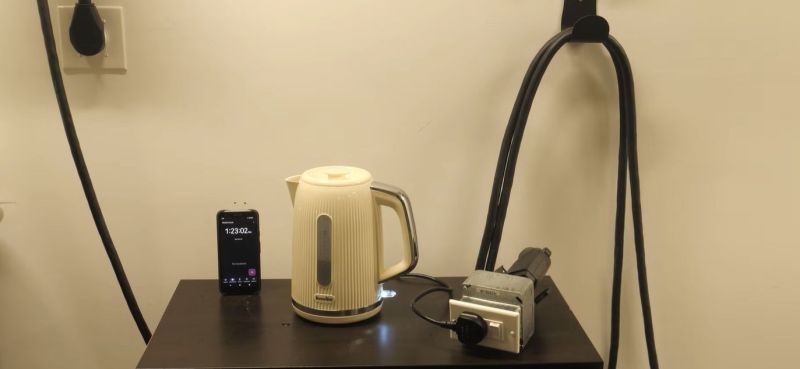
To those of us who live in the civilized lands where ~230 VAC mains is the norm and we can shove a cool 3.5 kW into an electric kettle without so much as a second thought, the mere idea of trying to boil water with 120 VAC and a tepid 1.5 kW brings back traumatic memories of trying to boil water with a 12 VDC kettle while out camping. Naturally, in a fit of nationalistic pride this leads certain North American people like that bloke over at the [Technology Connections] YouTube to insist that this is fine, as he tries to demonstrate how ridiculous 240 VAC kettles are by abusing a North American Level 2 car charger to power a UK-sourced kettle.
Ignoring for a moment that in Europe a ‘Level 1’ charger is already 230 VAC (±10%) and many of us charge EVs at home with three-phase ~440 VAC, this video is an interesting demonstration, both of how to abuse an EV car charger for other applications and how great having hot water for tea that much faster is.
Friendly tea-related transatlantic jabs aside, the socket adapter required to go from the car charger to the UK-style plug is a sight to behold. All which we starts as we learn that Leviton makes a UK-style outlet for US-style junction boxes, due to Gulf States using this combination. This is subsequently wired to the pins of the EV charger connector, after which the tests can commence.
Unsurprisingly, the two US kettles took nearly five minutes to boil the water, while the UK kettle coasted over the finish line at under two minutes, allowing any tea drinker to savor the delightful smells of the brewing process while their US companion still stares forlornly at their American Ingenuity in action.
Beginning to catch the gist of why more power now is better, the two US kettles were then upgraded to a NEMA 6-20 connector, rated for 250 VAC and 20 A, or basically your standard UK ring circuit outlet depending on what fuse you feel bold enough to stick into the appliance’s power plug. This should reduce boiling time to about one minute and potentially not catch on fire in the process.
Both of the kettles barely got a chance to overheat and boiled the water in 55 seconds. Unfortunately only the exposed element kettle survived multiple runs, and both found themselves on an autopsy table as it would seem that these kettles are not designed to heat up so quickly. Clearly a proper fast cup of tea will remain beyond reach of the average North American citizen beyond sketchy hacks or using an old-school kettle.
Meanwhile if you’d like further international power rivalry, don’t forget to look into the world as seen through its power connectors.











Just order pre-heated water from Amazon, easy.
And if you buy it in bulk just put it into the freezer for later.
Bulk? Unless you’ve got a huge mailbox, that is just unnecessary weight and volume and the UPS guy will hate you.
Order the powdered, dehydrated stuff and reconstitute it at home.
🙂
And when it arrives you just add hot water, simple
I, too thought that this was the simple approach, but it turns out that the dehydrated 230V/50Hz water is imported from the EU, and subject to tariffs., which are quite steep (to tea pun intended).
Thankfully, the dehydrated water worked fine with 240/60Hz.
Good point on the just-add-water variant, another great choice.
PS: Paket deliverants do not hate you, they hate their job.
https://www.youtube.com/shorts/T1pbn4y0A5Q
Unfortunately not. There aren’t that many kettles marketed as 3 kW available on the EU market, and I haven’t seen any yet that go higher. And the “3 kW” ones I have measured deliver more like 2.8 or 2.9 in reality.
There are a few premium induction cooking fields available that allow you to combine the power of multiple fields into one, sometimes up to 11 kW. This of course requires proper 3 phase wiring in the kitchen, but this is no issue. The issue seems to be finding cookware that is able to take that much power without the glazing melting…
I had no problem finding a ~3kW kettle on Amazon UK. A friend brough it back to the US for me and I intend to add a 240V receptacle to my kitchen
Breville definitely do one :-P
On the German price comparison site I like to use 45 of the 1378 electric kettles have at least 3 kW.
I’m really not sure where you’re looking, but a very quick Google search for 3KW kettle gave me pages of results from different retailers, different makes, models etc. theyay of course only be 2.9KW but meh, it’s still one heck of a lot faster than 1.5KW.
Oh, and 11KW induction hobs?
I haven’t seen one, but I’d recommend using them with proper metal cookware, not fashion statement stuff that’s designed to look pretty and make you feel good about how empty your wallet is.
I have a 3kW kettle… which I can’t use, because I now live in Switzerland, where sockets max out at 10A rather than 13A. I miss it so much…
Also, can you even get glazed induction hob cookware? Doesn’t the entire technology require them to be made from steel or cast iron?
Does Switzerland use a european Schuko plug? If so I thought those topped out at 16A?
Perhaps, but the rule says 10A maximum.
Your neighbor will rat you out.
Watching you!
The plugs and the socket can do 16A.
The real question is:
What can the wiring in the walls handle.
If the house wiring has a gauge only rated for 10A, then you better not exceed it. That’s how fires start.
Plugs can handle 16A, Wires are 2,5mm² and can handle 20A.
Both Ikea and Le Creuset do enameled cast iron pots and pans, depending on your price range. I use my 4.2 liter all the time on the good (4.8 kW) plate on my induction hob. The other zones work as well, but, y’know, are slower and further from the cutting board.
sorry. i pressed report comment. wrong button on a small screen with big fingers. (are you shure popup maybe?)
you absolutely dont want 3.5kw kettles if you have 3 phase 25A in your house. only 9A left on that paticulair phases main fuse. getting that one replaced here in the netherlands costs you 70 euro each time the line man has to come. im quite happy with my 2.2kw kettle thank you very much.
Why can’t you replace a fuse yourself? And no resettable brakers?
yes. that were also my questions as i saw the fuse box in my house. the main fuses come before the meter, so sealed of and they are of the molten wire in sand type as the installation is rather dated. upgrading them to 3x 35A would cost me an extra 1k each year, so thank you, but no.
25A is rather measly for the reasons you explained above. However I’m also a bit surprised that your main fuse blew, shouldn’t the regular breaker (behind the meter) trip before that happens (at least assuming it is a normal overload situation and not any kind of accident / short)?
When we got our PV system installed the main fuses had to be upgraded. Now we have 50A :) Unlike in your case, that was only a one time fee, and surprisingly cheap (low 3-digit €, don’t even remember exactly how much). I was told that for 60A and above it gets much more expensive but up until that it’s quite ok (Germany, may be different locally).
“only” 9A only matters if you have other large consumers at the same time, and the 25A will handle probably +50% for and hour, for 5 minutes of boiling a kettle of water probably +100%
3kW is very common in the UK unless you go super cheap – in fact a quick check of Tesco’s website reveals their cheapest kettle at £14.99 is a full 3kW.
Many fast boil kettles in Australia are stated to be 2.2kW, but there are about 10 brands who do a stated 3kW and at least one who does a 3.5kW for brewing purposes (at 60 litres it’s maybe a little wasteful for a cuppa).
Our voltage on the East Coast is officially 230V~ in practice 240V~ +/- 10%, and with 5kW of solar panels on the roof, our home sits a little higher at 254V~ during daylight hours.
Heating with E-lec-tricity? Problem solved. No cord necessary. George knows how to do it quick. Don’t think they’d let you get away with that in the EU! https://improbable.com/2018/10/26/a-look-back-at-george-gobles-prize-winning-barbecue-quick-ignition-triumph/
Nor in Tippecanoe county! Some lox and bagels anyone?
A friend from the other side of the pond came here through Canada with a 110 version. I thought it was fast compared to an aluminum kettle on the gas stove. A chrome dome with a curved handle and a spout. It died because of the hard water we have which coated the tube element and bottom so bad it insulates the heat source from the water and the element burns up. I use a pumper drip for coffee so I’m happy without a kettle. All my potable water is reverse osmosis filtered. No lime at all. I wonder at the amount of lime buildup in any of these kettles tested.
Putting 240v on a 120v 1500 watt kettle will make it draw 6kW. No wonder it failed!
That’s stated in the video.
There was a lot of “No I will not show you how to do this.” and “This is why you might end up with a live casing.” involved in these shenanigans. Everything is do-at-your-own-risk.
In Germany there are 3kW electric kettles and they have Liter markings. e.g. https://www.pollin.de/p/braun-wasserkocher-wk-5115-bk-3000-w-694988
I wouldn’t buy anything from pollin… Did I ever buy from pollin ? Maybe my asuro robot, the one I lost at some point ? … definitely not something that draws that much power. Boiling more water than you need is also something you should avoid. 2 large tea cups do not need 3 L of water…
If you really wanted to do this, you would just fit a UK kettle with a chonky US 220V plug and then plug it in to the 220V outlet of your stove, dryer, or car charger. If your charger is plugged in to 220V, you save yourself a whole lot of headaches. Unless you have an oddball socket, you’re looking at $20 and 5 minutes to wire it up.
Just be aware that UK mains plugs give you 0V and 230V, and US plugs give you -120V and +120V. This makes a difference because sometimes (rarely) UK devices don’t switch the 0V line. When connected to a US 240V socket, you might end up with bits of the device live while turned off, when they really shouldn’t be.
Kettle is a class 1 device so its case is connected to PE, and there’s a RCD in case earthing fails.
Well, you could, I suppose.
I did it with a NEMA 6-15.
12.5 amps in a 15 amp plug is no big deal, because it’s done heating in about a minute. If I was worried about it, I could use a NEMA 6-20, but there is zero reason to go to 30 amps.
My dad did that.
I live in Germany. He always marveled at the electric kettles when he visited. He tried the ones available in the US and found them too puny.
On one trip, he bought a German kettle and a German 220V outlet.
He installed a 230VAC line in the kitchen and put his German 220VAC outlet on it to plug in his German electric kettle. Zap, quick hot water for making instant coffee.
Cut the cord off and put the 14-50 plug on it? Likely cheaper than a J1772 inlet…On a more horrifying note, Amazon sells the 6-50 to 5-15 straight through adapter cord $18.99 delivered.
When I moved into my current house, it had a 240V cooktop in the island. Which was stupid. The island is narrow, so a small child could pull a pot off one side while you were on the other side.
So I deleted the cooktop. But then my girlfriend kept tripping the kitchen breaker. “I know! I have a 240V 30A circuit right below the island!” So I slapped a couple of breakers in a panel in the island (conveniently behind a door that didn’t actually open before I removed the staples, because there are drawers on the other side of the island), moved a couple of outlets to their own breakers, and…
Added a NEMA 6-15 outlet, and ordered a 3KW kettle from England.
Sheer bliss.
Despite what one of the other commenters has said, it was easy to buy a kettle that actually takes 3KW. The kettle was cheap, but shipping was abysmal, so I bought a couple of backup kettles, too.
This counts for nothing unless you warm the pot first.
Pedantic point: to get phase-to-phase (2 hots) voltage from the phase-to-neutral voltage of a 3-phase circuit, multiply by 1.732, or sqrt(3). So if your phase-to-neutral is 230V, phase-to-phase will be 398.4V, i.e. nominal 400V.
It’s sqrt(2) for actual RMS voltage. Triple square root is only used in multimeters.
no, Ralph is correct
Actually, it depends on whether it’s AC or PWM DC.
You might think it’s pedantic but I think it’s one of the better points here. I wonder what the final effect is on the speed of boiling water. We need a European guy and an American guy with the same model kettle, one plugging it in normally and the other splicing the cable to plug it into their dryer outlet, and a pair of stopwatches.
Here in the US my 120V electric kettle brings a liter of water to a vigorous boil in exactly 3 minutes. Timed it on first use, timed it today three years later. Same. What’s all the fuss? Why are you wasting my valuable internet with this nonsense?
Noted with interest: absolutely NO mention of litres, quarts, or pints in the article. What’s all the fuss? Why are you wasting my valuable internet with this nonsense?
Do you live in Colorado?
Poor bastards.
Don’t they have gas stoves in England?
A 3 KW electric kettle heats much faster than a kettle of water on most gas stoves,, doesn’t reduce indoor air quality, and has an auto-shutoff so it won’t burn your house down if you forget it.
But sure, you do whatever floats your boat.
A 3kW burner is equivalent to a medium range gas burner in that both produce about 10k BTU. A high power gas burner can put out about 18k BTU, or about 5.25kW. Safety aspect sure, heating aspect, no.
How much of the heat from the gas burner actually makes it into the kettle vs the air around it?
and maybe if you are lucky 50% of the energy in the gas ends up in the kettle, the rest just heats the kitchen
Generally, an electric kettle will heat up quicker than one on a (kitchen) gas stove, because they use the heat more efficiently.
(I have seen some fancy camping kettles with fins on the outside to collect more heat from a gas stove, I’m not sure how much better they are, eg https://firemaple.co.uk/products/high-efficiency-tea-kettle-coffee-pot)
Heheh I like how the “indoor air quality” thing wasn’t a talking point until they blew up the nord stream line; almost the week that happened it became a Tourette’s tic which is automatically brought up whenever gas appliances are mentioned.
No unnecessary single use tools. (read: Only single use tool in kitchen is coffee grinder.)
A stove isn’t just for heating water.
Spare a thought for us in Japan, we are at 100V….. regular outlets are rated to 15 Amps, and many flats and smaller houses only have a 30 – 40 amp mains supply, so it’s just embarrassingly anaemic.
I had 200V 50A run to my house (effectively 2x 100V with a combined total of 100A), but even with 2.0mm cable rather than the more common 1.6mm cable run from the switchboard to the outlets in the house, you haven’t known hardship until your test equipment occasionally reboots when you use your laser printer due to voltage drop…
I have a decent American toaster (because you cannot get a good Japanese pop-up toaster) and I have to run it twice for a properly cooked slice of toast.
We can have 200V split-phase for certain things, but generally nothing smaller than an expensive microwave.
But hey, we do have earthquake circuit breakers, which is cool…
I wondered if this is why Japanese prefer water heaters that maintain a constant temperature of a reservoir: no waiting for the ōcha.
American here, I just use a microwave. Maybe not as fast but ~1.5 minutes is fast enough.
Hmm…are european microwaves also 2.5+ kw as well?
My German (inverter) microwave tops out at about 1 kW, and that seems to be about the top end for regular consumer microwaves available here.
Which is why using the 3 kW kettle is so much easier and faster, not to mention you can easily boil over 1.5 litre, have it cut off at the set temperature (starting at 50 degrees C or so), etc. Only a savage would make all their tea with boiling water.
Ours is 1.25kw
As a proud UK liviing person with 100A house supply (although car chargers intelligently cap this at 60A by reducing charge rate so the whole house doesn’t exceed this), I decided that I needed powaaaahh on the go.
So made a 3kW setup with a 3000W Renogy inverter and 300Ah LiFePO4 battery. It charges at 1kW with the built in charger, so why not just get one of those, charge off your 110V outlet and then enjoy unadulterated 3kWness?
Definitely runs the microwave and the big kettle, not sure the wife is going to approve me sticking the microwave from the kitchen in the car for weekends away….
Nice! That’s pretty resourceful.. I’ll probably just plug it into my dryer outlet. Or, more realistically, do nothing since I’m a drip coffee kinda guy.
a video about boiling water… what wonderful times we live in.
Regarding wonderful times, I’m looking forward to another “perfect xmas lights” episode from the same Technology connections channel. I wonder what he comes up with this year as the hunt for the perfect xmas light is a never ending one. A few years ago he showed some nice examples called “bubble lights”. Spoiler… it boils too but isn’t water.
https://www.youtube.com/watch?v=5un4DdKQZvs
I’m pretty sure the never ending hunt ended.
https://www.youtube.com/watch?v=qSFNufruSKw
There are comments on this video saying he should still do something for 2025 but I wouldn’t bet on it.
I’ll say one thing; the real advantage of 230VAC, it kills faster.
Besides we have 240VAC here in The States.
The UK has 240v, Europe is 220v. They fudged the tolerances so both could say 230v and keep their existing voltages.
And that was true eons ago.nowadays, we actually get 230V out of the outlet ;)
A little while ago there was an issue in our local substation (in the UK), and our mains voltage got up to 247V!
Impressively, absolutely everything in our office survived, although partially that was because our Eaton UPS’s were protecting all the servers. They did alert about the high voltage, but kept on working.
So funny to see an article about this. After I lived in the UK for a while (2005-2006), we brought a 3kW kettle back with us, along with a “13A” socket (BS1363). I wired it into the kitchen and it did great work until we moved on from that house. Should really do the same thing in the “new” (7 years) house but haven’t gotten around to it.
Oh, and as a few others have mentioned, just be aware that you’ll have ~120v to ground on what should be the “0v” side of the kettle. Never caused us any trouble, but you need to be aware.
Well, if you don’t want to snake a new cable from your load center (“breaker box”) to another location in your house, it’s trivially easy to add a 240V outlet near the box if you have two spare, adjacent breaker slots in the box (so that you can use a safe, code-compliant tandem breaker). Or if you can create adjacent free slots by moving existing breakers around. Or if you take a risks-be-damned approach by connecting a 240V outlet to any two existing breakers that are on different “phases” (just kidding—don’t do it. It would leave the outlet hot at 120V if only one of those two breakers popped/were turned off. That’s why tandem breakers are required, since they simultaneously disconnect both phases).
Besides, think of the extra exercise you’d get going to your basement or garage to boil a pot of water.
Also, if your 240V appliance doesn’t require a neutral line (and a 240V water kettle almost certainly would not), you could rewire an existing 120V outlet anywhere in the house for 240V by replacing it with a 240V three-terminal one (e.g., NEMA 6-20R) and moving the corresponding black and white wires in the load center to a new tandem breaker. This assumes, of course, that said 120V outlet is the ONLY ONE on that circuit, because otherwise the results would be dire if someone plugged a 120V-only device into one of the nonmodified outlets in that circuit. Multiple outlets on single breakers are the curse of lazy/cheap builders—in my opinion, every outlet should be “home run” (rather than daisy chained) so that you don’t have to guess where you can safely plug in multiple high-current loads (“Don’t run the microwave while I’m vacuuming!!”).
When I remodeled my house, I ran 12-3 (as opposed to 12-2, which has just black, white, and bare wires) cable to every single new outlet (and some existing ones), and connected each to a separate breaker in my load center. Normally (for 120V) the red wire in the 12-3 cable is unused, but I now have the option to easily change any of the new/rewired outlets to 240V (with neutral) if needed—I have a lot of 240V appliances & tools.
Also—and this is the part that’s really useful—if you have 12-3 cable installed and just want twice the normal maximum of 20A current at one 120V outlet location, you could cut the tab between the hot screws on a duplex outlet and connect the black & red wires to the separated hots (the white neutral wire still needs to go to both sockets, so 𝑑𝑜 𝑛𝑜𝑡 cut its tab in the outlet). This gives you 120V 20A available at 𝑒𝑎𝑐ℎ of the two sockets in that duplex outlet. Yes, believe it or not this is safe & legal even though there’s only one 20A 12-gauge neutral wire supplying both sockets, because the phase difference between the black and red hot wires means that the white neutral never sees more than 20A even if both 120V sockets have 20A loads connected. This is especially useful in kitchens (or workshops) where you might want to plug, say, a toaster and a microwave into the same socket without popping a breaker, and it’s much easier & neater than installing two separate outlets in the same location.
Where do you live? Split outlets like you describe have been required by the NEC in kitchens for decades now.
It’s entirely trivial to get 240 Vac in an American kitchen. Using a Level 2 charger to do it is just a youtube stunt for clicks.
“Split outlets like you describe have been required by the NEC in kitchens for decades now.” Not true. In fact, while still legal, they are deprecated for new construction. Source: my electrical permit application (in Virginia).
Ahh. Good. It’s about time. That makes GFCIs and AFCIs a whole lot easier.
I have a quooker nowadays. Instant hot water. Whats not to like.
Interesting comments! Have to admit, I’m surprised how fast water boils in a kettle when I visit Europe. So here are some other numbers to compare:
In Ontario, Canada, all-in with various deregulatory nickels, dimes, subscription and taxes, we pay about $0.18/kWh ($0.13 US or E0.11) for a house consuming 1,000 kWh per month.
Most homes have 120/240V @ 200A (48kW available to them)
Large homes can have 400A service (96kW)
in the video u mention author clearly said that americans houses also uses the same voltage but just split phases. So.. maybe just use it?