
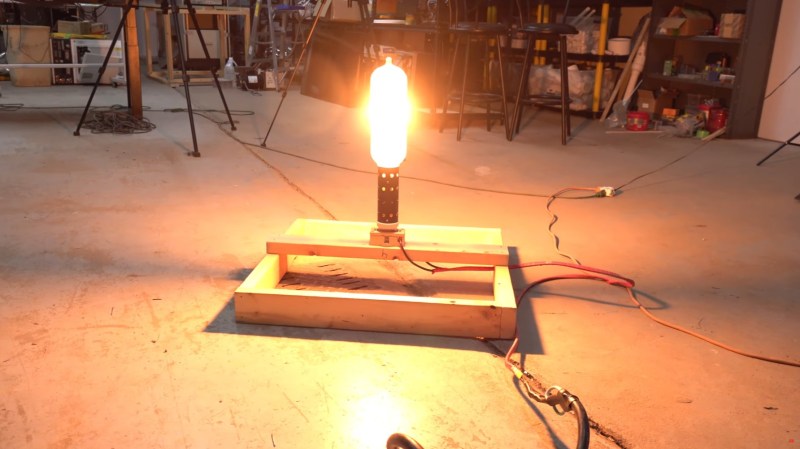
Over on YouTube [Drake] from the [styropyro] channel investigates what happens when you take an enormous tungsten incandescent light bulb and pump 30,000 watts through it.
The answer: it burns bright enough to light up the forest at night, and hot enough to cook food and melt metal. And why on Earth would anybody do such a thing? Well [Drake] said it was because he wanted to outdo [Photonicinduction] who had already put 20,000 watts through a light bulb. Nothing like a little friendly competition to drive… progress?
[Drake] says he has purchased the most powerful incandescent light bulb ever made for commercial production. Rated for 24,000 watts (and operated at 30,000 watts) the enormous filament is made from tungsten. The starting current drawn by a light bulb is higher than the operating current, because the resistance of the filament increases with temperature, so it’s prudent to warm the device slowly. To this end [Drake] builds some custom wiring and dials to power the thing. Once that’s done, it’s off to the forest to play!
If you’re interested in over-the-top lighting shenanigans, you might enjoy reading about The World’s Longest Range LED Flashlight.












Looking forward to the next iteration of an article about a video about putting 40 kW through a light bulb!
I knew immediately who did this just by reading the title
You gotta admire the man’s dedication to never ever engage in anything that does not involve lethal voltages and retina melting optical devices
Truly the construction crane climber of the hacker world
Off to the forest? Hmm… https://imgs.xkcd.com/comics/flashlights.png
Borrowing from Monty Python:
Styropyro is a loony, but he’s a happy loony.
(Lucky bastard…)
I must be getting old because stupid youtube stunts bore me – perhaps because there’s 10000 youtubers all desperately trying to out-stupid each other for the clicks.
It´s exactly that. Motivation is GREED.
Well… GREED is is not the right word here. There are plenty of people with a YouTube channel that would like to change that YouTube channel into their day job and doing something for a living doesn’t always mean GREED. Many simply don’t succeed, a few do and become successful but that they have success (a large viewer base, which doesn’t automatically mean a large income), doesn’t mean they are greedy.
How nice is it to be your own boss, to do something silly that you like and bring joy to so many viewers.
Sure there are plenty of channels with people doing stupid things, there are also plenty of stupid comments with all sorts of people saying the same stupid things. It’s up to ourselves how we spend our time and keep in mind that we do not need to watch all those 10000 other channels if we do not want to, nobody is forcing us.
Regarding the video here, I watched it, enjoyed it, couldn’t say it was high-end-entertainment but it was interesting, it satisfied my curiosity regarding some practicals problem with such a light source of such power. Although I knew from the start I would not be able to utilize this new info personally, don’t need to, don’t want too, good to see somebody else did it for us.
Everyone would like to turn their hobbies into their day job.
The reason their hobbies aren’t already their job is because the thing they’re doing, at the level they’re doing it, does not produce enough value to replace the effort. It’s not good enough, or in-demand enough to warrant getting paid more than it costs. Turning such things into ad-funded youtube content to make profit regardless is the greed of demanding more than you deserve.
It works only because the cost of the ads and Google as the middle man is distributed across the whole market, and the individual viewers feel like it’s “free”.
For instance, the average business spends around 10-15% of their revenue in marketing. In principle, you could be paying 10-15% less for everything if they didn’t shove adverts in your face to try and convince you to buy their stuff. Every youtube content creator who subsists or stretches their income on marketing money is basically adding to that 10% share of extra cost that you’re paying for all things
The tragedy is that most of this cost is unnecessary and counter-productive, since advertising mostly doesn’t work. Only the companies that pay the most get the visibility to benefit from marketing – which also makes them the worse option for you to buy since they’re wasting money on marketing rather than product quality.
The more someone advertises, the more certain you can be that the stuff they’re peddling is overpriced crap.
Or the alternative, the Patreon beggar: “Your contributions enable content like this.” Buy me coffee, donate on paypal… etc. etc.
Yes and no, since Patreon is essentially online panhandling. There’s no connection or contract between what you pay and what content gets produced. The collective members may barely pay the rent, or they may pay enough for a private jet – you’re not actually selling anything and there’s no negotiation over quantity, value, or price.
The trap with Patreon is that the members are not aware of what the other members are paying, so they have no means to determine whether their contribution is actually in proportion or even necessary to keep the content coming. For instance, if the value of the content remains the same, the price should remain the same, then logically as the number of patrons increase they should each pay less – and that’s not what happens. Each individual patron does not see what the thing they’re “buying” actually costs, so they cannot make informed decisions about whether they should pay – the fundamental principle of the free market is broken.
In other words, it’s just another game of bullshitting people to pay you more than you deserve.
Any way you look at it, today’s content creation game is about cheating people for money by obfuscating information: keeping the people who pay ignorant of what they’re really paying and what for. In consequence, very few content creators get their “fair compensation” so to speak – they either don’t get enough because they haven’t yet learned how to game the system, or they have and get more than their fair share.
Not to mention the accomplicity of using someone else’s clickbait to avoid creating your own.
Forest getting bright at night? Either that Ocarina kid is playing with Song of Sun or styropyro has a new light bulb to play with.
You don’t pump 30,000 watts through anything. It has to draw that much current at a certain voltage.
I upvote that!
273 amp on North America and Japanese 110v system, 136 amps for most of the world. My nice space heater tops out at 10A and my desktop computer (with ton of hard drives) is about 7 amps when running Prime95 and Furmark 3D at the same time.
US voltage is generally 120 or 240V now, not 110. This specifically was using the split phase, so it is 240V
Please don’t just post anything tech-related that popped up in your youtube thumbnails section. We’ve seen it too and we’ve decided to ignore it because it reeks of clickbait.
+42
What was the question?
Life.
Now that’s what I call content
Please don’t speak for other people. We have seen the video and it was cool.
We have, so why do we have to see it again here?
Did you know that other people also exist?
So it does what it normally does but brighter. Wow I could have saved ya some time and wattage on that one lol.
Most smaller light bulbs rarely survives being pushed 50% over spec. Plus light bulbs generally had much thinner filament. The one in that 20kw bulb is very thick.
Great to see [Photonicinduction] still getting shoutouts after all these years
I really wish Photonicinduction would make a a new video.
I don’t watch his videos because he voice annoys the heck out of me. Same with that guy from The Action Lab.
Another day, another no hack at all at Hackaday.
Fortunately, it looks like John Faggot V stopped posting new “hacks” after this. Hopefully for good this time.
I dont know if you know about rapid thermal annealing in semiconductor technology. It’s a small enclosure with quarter glassware with 40 halogen lamps rated 1000w each its used to rapidly heat silicon water….it’s like your 40000w light bulb not for lighting but for heating….also look up thermal evaporation where we evaporate gold, aluminium or chrome pellet using tungsten and molybdenum boats we pass 120 amps of current at low voltage to vaporize pellet it shines like a bright lamp in a vacuum belljar.