
Helium is inert, which makes it useful in a lot of different industries. But helium’s colorless and odorless non-reactivity also means traditional gas sensing methods don’t work. Specialized detectors exist, but are expensive and fussy. Thankfully, researcher [Li Fan] and colleagues found a physics-based method of detecting helium that seems as elegant as it is simple.
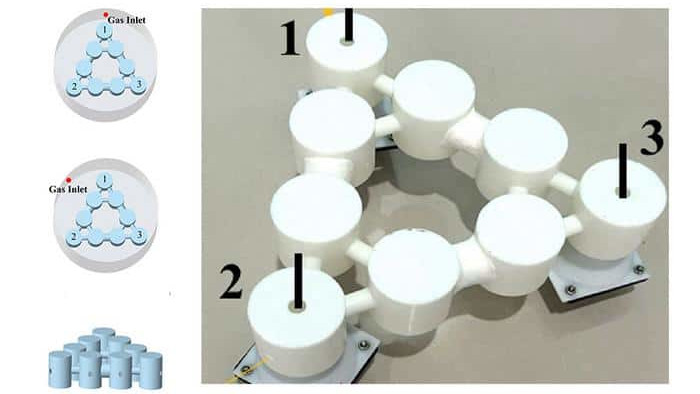
The new sensor relies on a topological kagome structure, and doesn’t depend on any chemical reaction or process whatsoever. The cylinders in the structure are interconnected; air can flow in and speakers at the three corners inject sound.
Sound waves propagate through the air within the structure at a fixed rate, and as helium enters the sensor it changes how fast the sound waves travel. This measurable shift in vibration frequency indicates the concentration of helium. It’s stable, calibration-free, doesn’t care much about temperature, and resets quickly. Even better, the three corners act as separate sensors, making it directional. It’s even quite rugged. Just as a basket weaved in a kagome pattern is stable and resistant to damage or imperfections in the individual strips that make up the pattern, so too is this sensor only marginally affected by physical defects.
The sensor design has been tested and shown to work with helium, but could possibly be applied to other gases. More detail is available at ResearchGate, with some information about the math behind it all in a supplemental paper.












This is so cool. It’s essentially the voice raising helium balloon flipped over to make a measuring device. HaD’s sins for the current part of this week are forgiven.
This reminds me of the Firedamp Whistle. Admittedly, this design doesn’t require an external uncontaminated air source but in the early 20th Century, Fritz Haber designed an arrangement of two whistles with one fed by air from the mine and the other fed with surface air. Instead of a clean tone, a difference in gas densities would cause the production of an oscillating beat.
I imagine listening to a continuous tone (present when everything is safe) wasn’t the most pleasant way to monitor safety.
This is a cool way to detect gases, and I like the 3D nature. Acoustics are used to messure (binary) composition, flow rates, and fluid levels in industrial sensors. I haven’t followed the field closely enough to know if 3d acoustic structures are commonly used, but this is clever.
I don’t have access to the article, but what I am curious about is the detection limits and response time. A helium sensor is useful, a hydrogen sensor is extremely useful. But leak concentrations are typically extremely low. I wonder what the detection limit is, such as percent, parts per thousand, parts per million, etc. Approaches like this one are typically either quite slow to respond, or relatively insensitive. I don’t have a ballpark sense of what the performance might be.
Hydrogen detection isn’t difficult, the entire point of the article is the difficulty of detecting helium because it’s non-reactive. Hydrogen reacts.
Although using a broom for hydrogen fire detection does amuse me, it’s so low tech.
The difficulty is reliably detecting hydrogen before it catches a broom on fire.
It’s an old idea but a easonable good one. Helium is a pretty special gas. In most cases where people are looking for it it’s in or around medium to high vacuum systems so the interference with other chemical species isn’t very high. Alternatives to this are portal mass spectrometers as far as I am aware. If the measurement truly mattered nothing beats a mass spec. Having used one of those things it was invaluable but I would have been very happy to have an alternative. Trouble shooting vacuum systems is a real pain!
Back in the bad old days of diffusion pumps, we had a huge vacuum tank for far-UV spectroscopy. It took days to pump down, and leaks were, yes, a real pain.
The quickest way to find a leak was to wander around the tank with a helium party balloon, holding the balloon up to suspect flanges and joints. Helium atoms wandering through the balloon and meandering through the leak would zip across the chamber at the speed of sound and give instant feedback on the helium detector. It was pretty neat. Fixing the leak and pumping down again was not.
After the leaks, it turns out water vapor adsorbed onto the chamber walls was the biggest contaminant. The chamber was too big to bake out, so the solution was a plain old tungsten light bulb in the tank: The infrared photons quickly knocked the adsorbed water molecules loose and dramatically shortened that long tail in the pumpdown.
I only had passing exposure to high vac systems and mercury diffusion pumps and stuff but it seems both really awesome and super fiddly and pain in the butt all at the same time.
Good call on the tungsten bulb. Baking out high vac systems is awful. Especially when the instruments cost more than my life. I won’t share what systems I’ve been around as it would dox me. That was a lifetime ago. There’s a good deal of contraindicated materials that most people don’t realize. The tiniest bit of off gassing can wreck everything. Some of them seem more like paranoia but I’d hate to prove them right.
No medium vacuum systems. Still not fun but at least you can do quick pump downs and see whether you have virtual or real leaks. Cool to see someone else who has done this stuff!
Not to take away from this discovery, but I was hoping it was going to be a practical application of the “Helium Gate” problem where exposure to helium was ‘destroying’ iPhones. IIRC, it was a small enough molecule to seep through the sealent in the MEMS oscillators and causing them to misperform.
A small array of them with some kind of comparison circuit on their outputs would give a similar function to this–but not as quickly.
None of that should take away from this clever design.
I used a helium leak detector as a technician, called a He mass spectrometer on the Titan II missile when they were in the sight activation phase to find leaks missed during the mfg phase for Martin Marietta. This was in 1962 when I was in college and I took some time off from school, to work in Tucson and Arkansaw. Why is this still not a good procedure? The rocket propellants were Hydrazine and Nitrogen tetroxide There were 18 missiles in tucson, 18 in Little Rock and 18 in Wichita. This was in the cold war.