
Probably the biggest story in the world of old cars over the past couple of weeks has been the surfacing of a GM EV1 electric car for sale from an auto salvage yard. This was the famous electric car produced in small numbers by the automaker in the 1990s, then only made available for lease before being recalled. The vast majority were controversially crushed with a few units being donated to museums and universities in a non-functional state.
Finding an old car isn’t really a Hackaday story in itself, but now it’s landed in [The Questionable Garage]. It’s being subjected to a teardown as a prelude to its restoration, offering a unique opportunity to look at the state of the art in 1990s electric automotive technology.
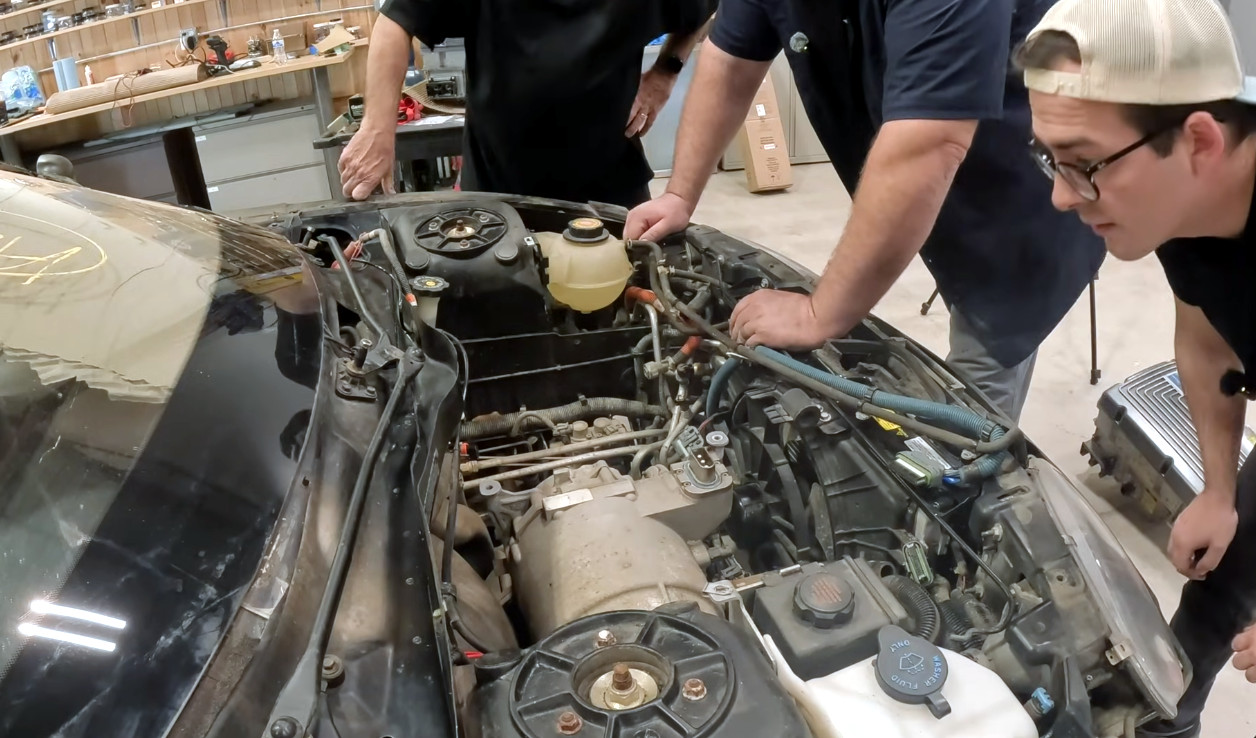 The special thing about this car is that by a murky chain of events it ended up as an abandoned vehicle. GM’s legal net covers the rest of the surviving cars, but buying this car as an abandoned vehicle gives the owner legal title over it and frees him from their restrictions. The video is long, but well worth a watch as we see pieces of automotive tech never before shown in public. As we understand it the intention is to bring it to life using parts from GM’s contemporary S10 electric pickup truck — itself a rare vehicle — so we learn quite a bit about those machines too.
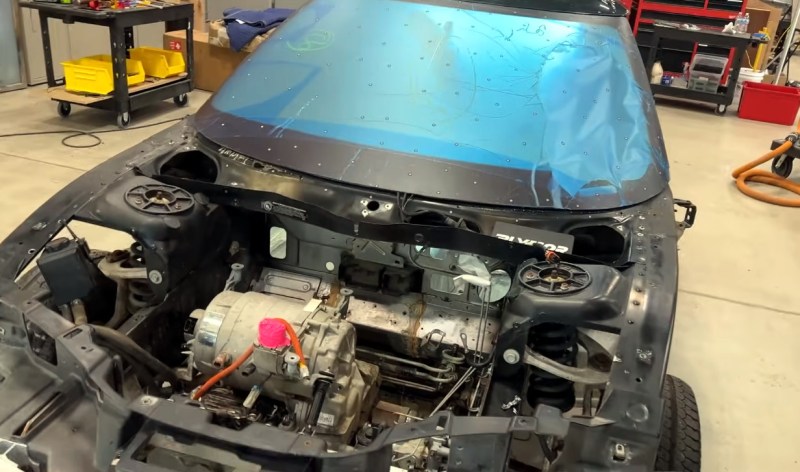
Along the way they find an EV1 charger hiding among a stock of pickup chargers, take us through the vehicle electronics, and find some galvanic corrosion in the car’s structure due to water ingress. The windscreen has a huge hole, which they cover with a plastic wrap in order to 3D scan so they can create a replacement.
This car will undoubtedly become a star of the automotive show circuit due to its unique status, so there will be plenty of chances to look at it from the outside in future. Seeing it this close up in parts though is as unique an opportunity as the car itself. We’ve certainly seen far more crusty conventional cars restored to the road, but without the challenge of zero parts availability and no donor cars. Keep an eye out as they bring it closer to the road.












2 hours long? no chapter breaks?
You can get a refund of the viewing fee if you like.
I think I want a refund for the time I spent reading another stub of an article that says “here watch this YouTube video.”
There are other websites on the internet designed to waste your time, maybe go check those out.
Isn’t the point to not waste time?
Clearly my Dude is new to the internet. lol The current iteration of the internet is specifically designed to waste time. I would have done a time study on it, but I wasted the most critical resource to perform such a study.
The average business spends 10% of their revenue on marketing. That is paid from everything I buy, so I’m actually paying something for every second of advertising and marketing, and ad-funded material regardless of whether I watch it or not.
So if I’m not watching stuff that’s paid out of my money, shouldn’t I be getting my money back?
Let’s calculate: I consume around 10 hours of ad-funded content a week, and for that pleasure I pay around 10% of the price of all the stuff I buy. Let’s say that portion is roughly $200. Therefore, if I don’t view this two hours of video this month and only make 8 hours in total, I should be getting a refund for $40.
So where’s my forty bucks?
Or 200 bucks a month for 40 hours of content to be accurate – same point. If I don’t watch this video, or 2 hours of some other clickbait content instead, someone owes me 10 bucks.
Many people don’t realize how much “content” actually costs, because it’s hidden in the system.
Wrong model. Watching ads is the penalty you pay for buying a product whose supplier presents those ads. You have to pay to avoid watching the ads. (Youtube, for example) If people shun advertised products, suppliers who don’t advertise will be more able to succeed. Alas, that has the disadvantage that ad-supported “free” media content would tend to disappear.
Taking a more realistic view, advertising works. For some types of businesses, advertising drives so much more business that efficiencies of scale apply, and the lower unit cost in volume production overwhelms the cost of advertising.
For myself, I boycott products whose ads annoy me. Consequently, I haven’t bought Charmin for more than 50 years. I block advertisers that irritate me (d**bleclick). Advertisers should be less intrusive: banner ads and sidebars are OK, long mid-video interruptions are not.
Marketing drives business towards some businesses – particularly those that pay the most for marketing – but this adds the cost of marketing to their products.
From the business point of view, the increased revenue offsets the reduced efficiency, while from the consumer point of view the increased marketing cost is simply a loss. You pay more for worse products and have to watch adverts for the point.
Not at all. If I’m paying more than a hundred bucks a month for marketing costs, literally in the price of my daily bread, regardless of my choice, then I feel that I’m at least morally entitled to an amount of quality content that matches my interests.
Otherwise this system would be functionally equivalent to tax farming where private businesses are granted the right to collect a tax and keep the revenue. I would be paying Google and friends simply out of the joy of paying them, which begs the question, why should such practices be considered legal in the first place?
That applies Youtube channels, or HaD, or anyone who takes part in my money through counting my viewership as their claim to get paid. If the content I am given in compensation for the money taken from me does not meet my criteria for quality, to the point that I don’t feel like watching it, then I’m simply demanding my money back. After all, the money I’m paying is worth several streaming service subscriptions, movie rentals, books, games, theater plays… I could be consuming those instead if I had the money in hand.
Depending on what kind of stuff you buy, the marketing budget is far higher than that.
If we look at the software world, the most expensive and most complex software we make is a video game.
A totally realistic breakdown of production costs might look something like…
$500k for art.
$1.5M for software development.
$500k for long term support.
$2.5M for management and executive bonuses.
$2M for marketing.
Marketing and executive bonuses are usually 2/3 to 4/5 of the cost.
I’d recommend asking your favorite AI tool to provide a summary….😆
I got to test drive one of these in 1996/1997. It was fast off the line. Would have been a great car for driving around town. Compared to the other ’90s EV options, like the Sparrow, this was a real car with some performance behind it. Also came with a CD player as a standard (selling point at the time).
Your experience combined with the shot in the video showing how the battery pack was packaged, I wonder how much of the EV1’s DNA influenced the Volt.
The Volt is also very quick off the line and accelerates pretty well up to about 45mph as well as it’s battery pack having a very similar T shape as what it looks like is in the EV1’s chassis. So perhaps GM’s issues with EVs were not entirely a loss of knowledge but rather a disdain of EV tech by decision makers in the company.
Maybe they lost 9 of them. 221-9 = 212… Or the first few frames were used for templates, examples, and testing.
I was a part of the original Impact (pre-EV1 name) car team starting in 1991. Even got to drive a two-motor version around the test track at the GM Tech Center in Warren, Michigan, USA. We also had a version that used NiMH batteries that I drove around the metro Detroit area. I was new to the auto industry at that time, and it was very cool seeing a whole new car get designed with so much technology in it.
A funny side note – In my first week on the team, our leadership was giving a year-end “We’re going to do great things” speech and I was trying to help a coworker get a large format plotter working. This one had some sort of suction system to keep the paper taut. Best I remember, I moved the serial cable to it (I think it had a break in one of the hardware handshake lines) and it came to life. Loud fans running, paper rolling and the pen carriage flying around – right in the middle of the speech. Got some very dirty looks and I don’t think I’ve ever been that red-faced in my life since!
I find that flaming red faces are often the biproduct of getting shit done.
Well shit. I misspelled “byproduct”. We really need an edit button…