
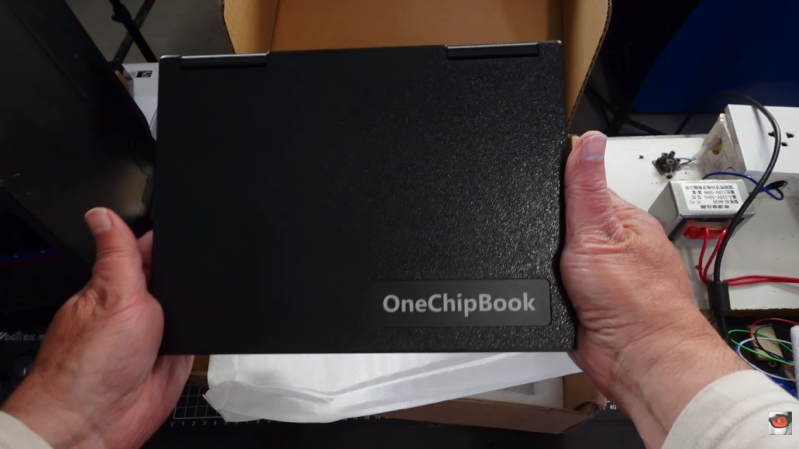
In the 1980s there were an incredible number of personal computers of all shapes, sizes, and operating system types, and there was very little interoperability. Unlike today’s Windows-Mac duopoly, this era was much more of a free-for-all but that didn’t mean companies like Microsoft weren’t trying to clean up all of this mess. In 1983 they introduced the MSX standard for computers, hoping to coalesce users around a single design. Eventually it became very successful in Japan and saw some use in a few other places but is now relegated to the dustbin of history, but a new FPGA kit unofficially supports this standard.
The kit is called the OneChip Book and, unlike most FPGA kits, includes essentially everything needed to get it up and running including screen, keyboard, and I/O all in a pre-built laptop case. At its core it’s just that: and FPGA kit. But its original intent was to recreate this old 80s computer standard with modern hardware. The only problem is they never asked for permission, and their plans were quickly quashed. The development kit is still available, though, and [electricadventures] goes through the steps to get this computer set up to emulate this unofficially-supported retro spec. He’s also able to get original MSX cartridges running on it when everything is said and done.
Although MSX is relatively unknown in North America and Western Europe, it remains a fairly popular platform for retro computing enthusiasts in much of the rest of the world. We’ve seen a few similar projects related to this computer standard like this MSX-inspired cyberdeck design, but also others that bring new hardware to this old platform.











Relatively unknown in Europe? In Spain it was probably the 3rd best selling 8-bit platform, following ZX Spectrum and Amstrad CPC, but way ahead of C64.
Same in the Netherlands. Americans always think if they don’t know it, it must’ve been unpopular :D.
But to be fair, what comes to mind if thinking about “western Europe” first?
I would think of France, Italy and the country I’m from. Maybe Spain as the last one on the list, too.
That’s also what you’ll see in the language options of 80s/90s computer games from Europe.
They had about 3 to 5 language options, at best.
Here’s a random example of an Infogrames game (Infogrames was a popular publisher long ago.):
https://www.mobygames.com/game/11900/the-smurfs/screenshots/
Okay, the UK is part of that, too, to a stretch, but it always been a bit special, isolated.
Like Switzerland, which is part of Europe. But not really part of Europe, same time.
Then you have little countries such as Belgium or Austria. Or Luxembourg.
Indeed, they’re legit parts of European community.
But do they come to mind first? I mean, for real? 🤔
I don’t mean to sound arrogant or something,
but what catches someone’s eye first if looking on an map of Europe? Spain? Sweden? Norway? UK?
What would foreign people from China, India or Japan look at first? 🤷♂️
quite popular in Brazil, to the point the local phone company used (wuith a proper 1200/75 modem and a minitel cartridge) it for the local version of the french minitel system…
Huge in The Netherlands (admittedly a small country) because of Philips who made a whole line of MSX1 and MSX2 computers. Pretty popular in Spain, too. Outside there and Japan, also relatively popular in Brazil. And there were several Arabic versions made, I think they got some traction.
I had a Goldstar (now LG!) FC-200 which looked great with its colourful keys, real keys as opposed to the ZX Spectrum my school friend had, and less mushy than the Commodore 64 my neighbour kid had. Konami games were a high water mark.
Hi there! Greetings! Over here in former West Germany,
the Sony HitBit gained some popularity but then sort of went under with the other niche home computers (Apple II, TRS-80, Sharp MZ, Colour Genie, Dragon etc).
MSX2 was cool and very capable, but it was too late to make a change over here.
A few later MSX computers over here had the MSX2 VDP, but not the MSX2 firmware or built-in floppy drives.
In addition, some known MSX home computers didn’t stand out as being MSX computers.
So users didn’t really understand what they stood for.
To them it was some random Z80 or CP/M computer, perhaps.
I guess France was similiar – instead of MSX it had these Thomson computers (TO 7, MO 8 etc).
Though in direct comparison, France had better awareness of the MSX than us.
Here’s an article in English that described our situation:
https://www.heise.de/en/background/MSX-When-Sony-Philips-Samsung-and-Microsoft-cooperated-to-build-computers-10257462.html
All in all it’s a bit strange that MSX didn’t catch on over here,
considering how Microsoft obedient this country historically is.
I guess the dominance of Commodore and Atari was too big over here.
Even Sinclair and Amstrad (Schneider) weren’t as overly popular in direct comparison.
If you ask someone over here about home computers,
you’ll likely hear about C64, Amiga 500, ZX Spectrum/ZX81 or Schneider CPC.
Only a few computer veterans will talk about Apple II (clones), VC-20, Colour Genie EG2000 or Sharp MZ-80K/B/700/800.
Even the NES (or SMS) wasn’t such a thing over here until early 90s, apparently.
The C64 generation wasn’t into video game consoles yet.
Except for ancient 1970s consoles, such as Atari 2600 or the Interton VC-4000.
“I had a Goldstar (now LG!) ” the company was the merger of the Lucky chemical company and Goldstar radios to be Lucky Goldstar. Much like that way the 3M company merged with M&M Mars to become, get this, Ultradyne Systems.
They were certainly known about in the UK for sure, but never gained much traction as the likes of the Spectrum, C64 and Acorn machines already had huge momentum. Plus they were plagued with compatibility problems – ironic given that was the whole point.
I have a CGL Sord M5 in a cupboard somewhere, no idea if it still actually works though.
For those who have no idea what an MSX is (I knew it was a industry standard of sorts but for some reason thought it used a 68000), MSX is a Z80 system, but with standardized graphics hardware, sound hardware, standardized ROM, and a fairly standard set of peripherals, etc. so you could program for the MSX (.. in contrast to the Z80 CP/M systems where, other than having the Z80, each could have totally different hardware, and your software would usually make calls through CP/M to so much as write a character of text to the display or use the serial port.) 16 color display, a rather fancy 32 sprite system (1 color per sprite but they could overlay each other), 3 channel audio, 1 to 2 joystick ports, etc. Oh, and apparently the graphics chip actually had dedicated VRAM which is very unusual for the time.
MSX2 came out 4 or 5 years later, so it specified more system RAM, more VRAM, a newer video chip that could do 256 colors, and some other little improvements while maintaining backward compatibility with MSX.
Thank you very much for the summary! 😃👍
The little what I basically know about MSX2 is that it was good for Japanese adventure games and visual novels, such as Snatcher.
From a graphics quality point of view the MSX2 ports somehow were between PC-88 and PC-98.
Then I remember there was a strange hybrid of an MSX home computer and an IBM PC, the SpectraVideo 838.
It had MSX2 VDP (Yamaha V9938) and MSX sound chip (AY-3-8910) and the usual 8088 PC hardware with PC Speaker (8253) and CGA (Yamaha V6355).
GW-BASIC and a few special DOS games supported the MSX2 hardware.
To play MSX1 games, an a optional module with Z80 processor and MSX firmware could be plugged in.
https://www.msx.org/wiki/Spectravideo_SVI-838
Btw: The Yamaha V6355D Video Chip also had an 160×200 pixel 16c graphics mode.
There’s a thread at Vogons right now about the Olivetti Prodest PC1, which has that chip.
If there’s ever an Sierra AGI driver written for it (as it happened with Plantronics Colorplus),
vintage computers could run these Sierra games in 16c for the first time.
https://www.seasip.info/VintagePC/v6355d.html
https://www.vogons.org/viewtopic.php?t=109593
PS: Didn’t that ’80s Canadian Nabu PC gain some attention a few years ago?
I vaguely remember that it had Z80 processor, the outdated TMS9918A (TI-99/4A video chip) and that some MSX games were ported to the Nabu PC.
I assume the comment about not having permission inth article involves not having the legal rights to distribute the rom.
Just to clarify, it’s about the specific fitmware, right?
The MSX BIOS as such has been re-implemented as open source.
https://cbios.sourceforge.net/
The original MSX was graphically a bit underpowered, the graphics chip (TMS9918) was less powerful than the 8-bit alternatives of Atari, C64 and ZX Spectrum. The MSX2 was better in that respect, but it came a bit too late to compete.
As an original ZX Spectrum 48K (issue 3) owner, I can tell you that MSX1 graphics were envied because they did not have the limitations the spectrum did. Many spectrum games used just black and white, or other combination of just dark and white color to avoid those issues, which were non-existing on MSX1. And MSX2 was a whole new level.
Sweden here. I was also coding and gaming on an msx 128 before anything else. But I was the only one, everyone else was running commodore or Amiga.