
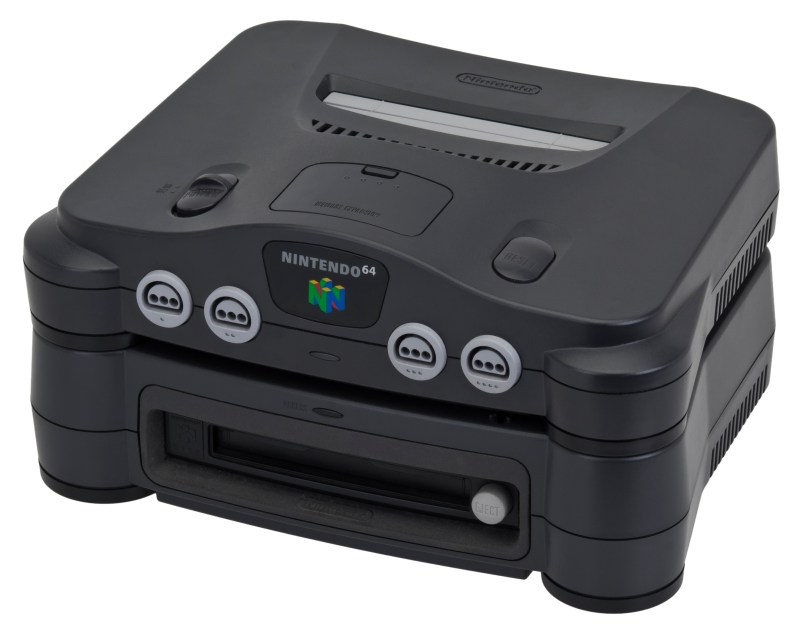
What if you took a Nintendo 64 cartridge-based game and allowed it to also use a large capacity magnetic disc format alongside it? This was the premise of the Nintendo 64DD peripheral, and the topic of a recent video by [Skawo] in which an archaeological code dig is performed to see what traces of the abandoned product may remain.
The 64DD slots into the bottom of the console where the peripheral connector is located, following which the console can read and write the magnetic discs of the 64DD. At 64 MB it matched the cartridge in storage capacity, while also being writable unlike cartridges or CDs. It followed on previous formats like the Famicom Disk System.
For 1998’s Game of the Year title The Legend of Zelda: Ocarina of Time such a 64DD-based expansion was worked on for a while before being cancelled along with the 64DD. With this Zelda game now decompiled, its source code has shown to be still full of 64DD-related code that [Skawo] takes us through in the video.

As is typical for CD- and magnetic storage formats like these 64DD discs, their access times and transfer speeds are atrociously slow next to a cartridge’s mask ROM, which clearly left the developers scrambling to find some way to use the 64DD as an actual enhancement. Considering that the 64DD never was released outside of Japan and had a very short life, it would seem apparent that, barring PlayStation-level compromises, disc formats just weren’t a good match for the console.
The interface with the 64DD in the game’s code gives some idea of what the developers had in mind, which mostly consisted out of swapping on-cartridge resources like dungeon maps with different ones. Ultimately this content did make its way into a commercial release, in the form of the Master Quest option on the game’s re-release on the GameCube.
Although this doesn’t enable features once envisioned, such as tracking the player’s entire route and storing permanent map changes during gameplay, it at least gives us a glimpse of what the expansion game on the 64DD could have looked like.
Top image: N64 with stacked 64DD, credit: Evan-Amos












It is unfortunate for Nintendo they chose ROM cartridges for N64 games. Just imagine thr N64 with a CD drive instead, more space for textures and music.
It’s a trade off. You get high storage in exchange for high access time but the way to offset this issue is to add more RAM. Nintendo historically did well with cheap hardware which used carts. Optical readers were still expensive and had reliability issues. They placed their bet on Flash memory by sticking with reliable carts and lost. Had advancements in Flash memory production come a few years earlier then you might be talking about how optical storage was yet another stupid detour in data storage.
Hindsight is 20/20.
Potentially they also went with cartridges for piracy reasons. Writable CDs where only a year after the PS1 released. But producing writable cartridges was a much more complex deal in 199X
There was actually quite a bit of competition among manufacturers of a “writable cartridge”.
I had the DoctorV64, https://en.wikipedia.org/wiki/Doctor_V64
Data on optical disks can’t be modified or cracked? How many aimbots have you seen in PS2 shooters compared to PC games? It’s pathetic that people diss technology just because they invested in something else and feel threatened (by their own stupidity).
R U OK? Maybe at the time it might have been pathetic to “dis alternative technologies”, but as for just posing “what if” questions about 30yo tech? Um, maybe you should be worried about how passionately defending 1996 tech might not be any less pathetic at this point? It’s long over, bud.
Lolololol
Quite a few Nintendo 64 cartridges used mask ROMs as well, just strange ones. Flash also isn’t a guarantee of reliability, as there are a number of obscure handheld consoles from the early to mid 2000’s that are already turning up with floating bits.
The more amusing aspect of the cartridge vs. CD-ROM debate with the Nintendo 64 is that SGI’s own internal documentation makes it abundantly clear that the chipset was primarily designed with an optical drive from the jump. When initially shopping it around to interested console manufacturers, the designs specified a decent about of buffer RAM sitting on the BSD (Bulk Storage Device) bus and an optical drive. This also happens to be why the Nintendo 64 can only really operate out of RDRAM, with data being DMA’d from the BSD bus on an as-needed basis. While this is broadly how cartridge-based systems since the Nintendo DS have operated, this was a pretty new thing for the time, as it switched up how things were from the NES all the way up through the Virtual Boy.
Side fun fact: Nintendo didn’t commission SGI, the approach was from the other direction.
Take a peek into the Lynxes developer manual then, you would be surprised. The console was first planed to utilize tapes(!) and the carts are read in serially, even if their pinout suggests otherwise.
See here:
https://atarilynxvault.com/pages/atari-lynx-cartridge-pinout
My fav game was Banjo Kaaozie so I’m just imagining that but with 10s loading screens and without dynamic music. I appreciate the fast ROM so much.
Based on the adventures of Kaze, giving the N64 more data to transfer around would’ve likely hurt its performance more than helped.
A good example of where cartridge trumped disc was the Harvest Moon games. Back to Nature reused many of its assets from Harvest Moon 64. Back to Nature also featured many loading screens whereas HM64 was mostly seamless.
Actually they avoided optical disks due to the fallout from the Sony deal and the nightmare that was the CDI.
Now imagining the N64 getting swamped with FMV games because “interactive TV is the wave of the future”. Actually, by the SNES not getting a CD-ROM drive, they might have avoided that particular grief because had things gone as planned, it would’ve been released at “interactive TV” peak hype.
I was at the E3 trade show in 1996, where the N64 hardware was being demoed using Mario64 and a debug build of Pilot Wings. While taking my turn to play Pilots Wings, I asked the Nintendo rep why they opted to stay with cartridges when everyone else had moved on to higher capacity and cheaper to manufacture CDs. He said Nintendo was concerned about piracy.
I am sure that was only part of the reason, but it was the reason he gave.