
Although most of us simultaneously accept the premise that magnets are quite literally everywhere and that few people know how they work, a major problem with magnets today is that they tend to rely on so-called rare-earth elements.
Although firmly in the top 5 of misnomers, these abundant elements are hard to mine and isolate, which means that finding alternatives to their use is much desired. Fortunately the field of high entropy alloys (HEAs) offers hope here, with [Beeson] and colleagues recently demonstrating a rare-earth-free material that could be used for magnets.
Although many materials can be magnetic, to make a good magnet you need the material in question to be both magnetically anisotropic and posses a clear easy axis. This basically means a material that has strong preferential magnetic directions, with the easy axis being the orientation which is the most energetically favorable.
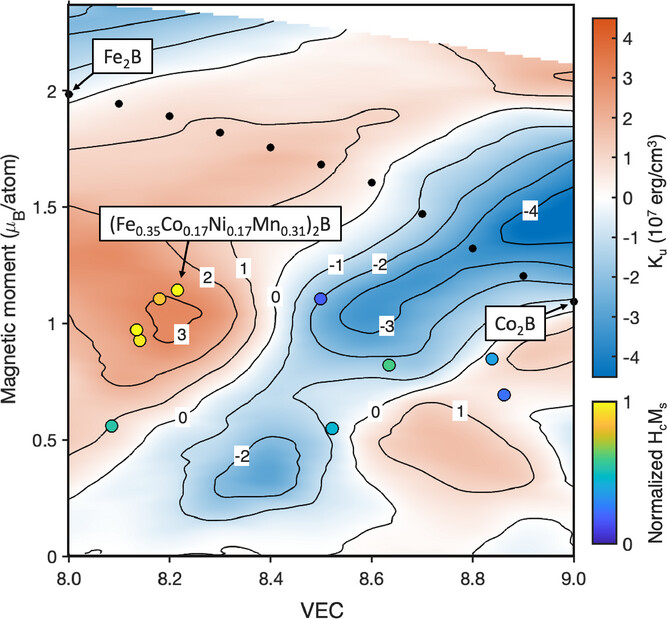
Through experimental validation with magnetic coercion it was determined that of the tested boride films, the (FeCoNiMn)2B variant with a specific deposition order showed the strongest anisotropy. What is interesting in this study is how much the way that the elements are added and in which way determines the final properties of the boride, which is one of the reasons why HEAs are such a hot topic of research currently.
Of course, this is just an early proof-of-concept, but it shows the promise of HEAs when it comes to replacing other types of anisotropic materials, in particular where – as noted in the paper – normally rare-earths are added to gain the properties that these researchers achieved without these elements being required.












Yep, replace rare earths (we have a lot but china does it too cheap, so we had to pause our mines) with cobalt, the most “children abused in congo/kg” element. Good idea.
Excellent point. Sidenote, the SI unit for “children abused in Congo/Kg” is the Leopold.
“we had to pause our mines” is merely saying that our government has been unwilling to subsidize mining to ensure ethical mining practices and prevent undue dependence on a hostile nation.
If it makes investors megabucks ethics go out the window and never return.
In this sense any for-profit entity that’s deeply entrenched is mostly indistinguishable from maaafffia. Whether governments back “ethic mining” or not is irrelevant, megabuck is a megabuck, and it has to be made.
Oh nuts, you’re right. Immediately stop doing basic scientific research because if it did work, somehow, and became practical at a larger scale, then there would be moral issues to contend with! I mean, there’s no possible way other elements could substitute for the Cobalt atom in there, nor would any other sources of Cobalt could ever become available, nor could there ever be any political / social improvement in the Congo over time.
Of course our CURRENT tech doesn’t use much Cobalt at all, right?. In fact it’s baffling why there’s any child abuse in Congo at all given that we use rare earth magnets now.
So yeah. No more science please.
But THE major problem with magnets is that they are black magic that’s powered by the souls of the damned and everyone seems to think that’s OK, not realizing that by using them that they are in turn damning themselves.
I will however concede that mining/refinement issue is a close second and it’s good to see that researchers attempting to address that issue.
You are overcomplicating and confusing this. It is the mining business that is powered by the souls of the damned.
Pointing out that cobalt is readily obtainable from defunct Lithium batteries.
Specifically, older ones (LiCoO2) so likely that recycling will become a viable source.
Yes but when does it become viable? The child worker in congo will always be paid a pittance, hence making new cells will always be likely cheaper than recycling
It’s already viable as cobalt is presently being recovered from old batteries. The good news is that companies in western nations are phasing cobalt out of battery tech but it’s not entirely there. The bad news is that Chinese battery companies doesn’t give a damn using about virtual slavery, so they will keep using it while it benefits them.
The Congolese child miner actually earns more than some tradesmen here in Germany (excluding pension and health insurance). I was shocked to find out. The rents in that mining village are also easily western Europe level considering how bad the quality of housing is over there.
Maybe it was true at some point in time, but child miner in Congo earns from $1 up to $2 per day. I think you’ll need to go back a century or two in time to have a tradesmen earning only that amount. They risks their life in artisanal mines every single day for less than what you spend in chewing gums or a coffee.
I wonder if this’ll go anywhere or if it’ll gather dust like the artificial tetrataenite ( https://patents.google.com/patent/US11462358B2/en ).
I fear it’ll be Copper-Clad-Iron – the magnet version.
You scrubs that aren’t millionaires let alone billionaires get DDR3 RAM and non-TI versions of low-end geforce cards with 8GB or less RAM, and copper clad iron cables and now REF-magnets
Also, tin contacts instead of gold or silver of course.
I though boron -was- a rare-earth element. The Solar System as a whole is kind of lean of it.