
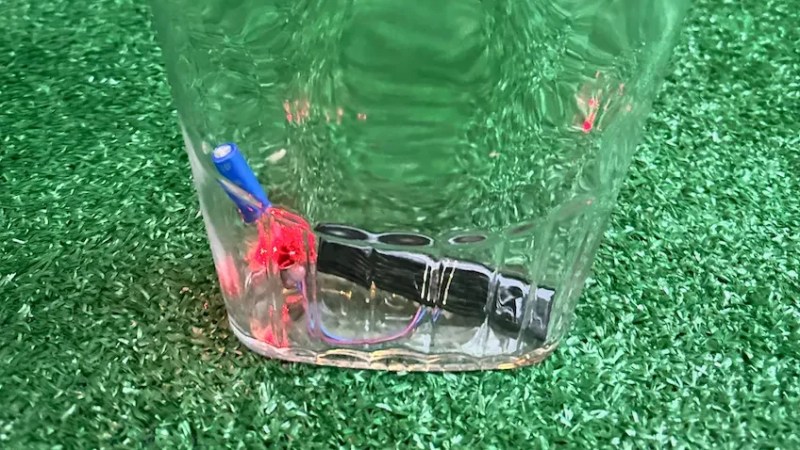
Most solar lights are cheap garbage that exist just to put more microplastics into the environment as they degrade in short order. [Jeremy Cook] built his own solar light, however, and this one might just last a little longer.
Most solar lights rely on the cheapest nickel-cadmium or nickel-metal hydride cells that are available on the market. They don’t tend to have a lot of capacity and they wear out incredibly fast. [Jeremy] went a different route for his build, though, instead relying on a rather tasty supercapacitor to store energy. Unlike a rechargeable battery, that may only last a few thousand cycles, these supercaps are expected to perform over 500,000 charge/discharge cycles without failure. With such longevity, [Jeremy] suggests his build could last a full 1369.8 years, assuming it charged and discharged once a day. Whether the plastic transistor, LEDs, or diode could hold up over such a long period is another question entirely.
Electronically, the build is relatively simple. The solar panel collects light energy and turns it into electricity, charging the supercaps through a diode. The supercaps are only able to discharge through a transistor, which only turns on when the voltage output by the solar panel drops at night time, and the voltage on the base becomes lower than that on the emitter. When current flows through the transistor, it then lights the LED in turn and the device glows in the darkness. As a nice touch, the whole circuit is installed in a glass jug of syrup originally sourced from Costco. Files are on Github for those eager to explore further.
Given the light-in-a-bottle construction, [Jeremy] also playfully imagined that a lamp like this could theoretically be used as a safety device. If lost at sea, you could charge it using the sun and try and use it to signal for help. However, upon casually exploring the concept, he notes that a small solar-powered light will only raise the chance of a far-off ocean rescue from “extremely unlikely” to “still very unlikely.”
You can do all kinds of neat things with free energy from the sun, from mowing your lawn to processing waste products. Video after the break.












Neat.
I started looking for more expensive LiFePo4 solar lights here (Australia), but it doesn’t really solve the problem: Even with the LiFePo4 cells, the lights still die quickly because, despite the IP67 rating, rain/water still penetrates and erodes the circuitry.
Very difficult to find one that lasts more than a year.
I have discovered that dipping your circuit boards in wood varnish, then letting it dry, then dipping it again and repeating for about 4-5 cycles makes a thick waterproof conformal coating on the circuit board.
Works well for outdoor use
Add a 555 to make it flash.
Anyone still make the LM3809?
I think that was the LM3909, not 3809. It’s been out of production for years, quite sadly.
As said it’s been out of production for decades with no replacement.
Probably the simplest clone would be a solar IC as used in garden lights (QX5252 etc) with a blinking LED. The blinking LEDs have a 50% duty cycle so that’ll shorten your run time dramatically.
Search this site, someone cloned the LM3909 a while back.
No part numbers, voltages etc. what a waste of my time looking at the project
A real hacker would look and see, no parts numbers, voltages etc. and go “challenge accepted”
I don’t need no stinking specs
Oh, c’mon…R3 is clearly given as “200R” .
Yeah, maybe if we taunt the author enough they’ll add values in the post. The narrative seems to indicated they kind of forgot them so it may mean breaking the precious bottle…
The transistor, per the circuit diagram in the first link, is 2N3906. Supercaps are 2.7V, which would have been good to include, thx.
What a useless post. Video says could last 1000+ years. Sorry chump, that super cap will dry out way before then.
Well I thought it was a fun project. The source material isn’t meant to be too serious.
This bring up an interesting question; if you put them in an airtight bottle will they last much longer? What if you fill the bottle with a specific gas? What if you fill it with some kind of potting compound? What if you fill it with some kind of oil?
Are supercaps really cycle-limited? Don’t they eventually die just sitting on a shelf?
Capacitors don’t really have cycle limits as the charge / discharge cycle doesn’t cause damage, unlike a battery. Switching power supplies cycle capacitors a few hundred thousand times per second, over a trillion cycles per day and they seem to do just fine.
In theory it’ll outlive you. In practice exceeding the voltage rating, dust, vibration, moisture and of course the #1 enemy heat will reduce the life span.
Siting on a shelf shouldn’t bother them too much if stored correctly.
The manufacturer specs tend to be CYA.
Not so much cycle limited, but time limited. The electrolyte will slowly dry out, just as in electrolytic capacitors, although at a slower rate.
Thanks for the great writeup Lewin!
I have a Davis Vantage Pro 2+ wireless weather station. The Integrated Sensor Suite (outdoor transmitter) has a solar panel that charges a 10F super capacitor to run the station overnight or longer. After that a lithium battery cuts in during long periods of low light like a heavy overcast winter. According to Davis at least 10 to 15 minutes of sun charges the super capacitor with enough power to run the station 8-12 hours. The solar panel runs the station during the day, the super capacitor runs the station overnight and the lithium battery serves as a backup.The station doesn’t require a battery change (CR123A) for several years unlike some stations that use regular or rechargeable batteries. The supercap in my station is over 8 years old and probably charged and discharged nearly 3000 times.
Thanks for the info and the keywords! I would love ANY weather station to last 8 years! Forget the battery, all the other parts of mine started to die after ~2 years. Solar panel, temp sensor, rainfall bucket thingy…
Down here under the ozone hole, surrounded by cockatoos and spiders is a tough place for outdoor electronics.
I will look into this hardware from Davis. Thanks again.
BEAM robotics is a nice source of inspiration for collecting and storing power.