
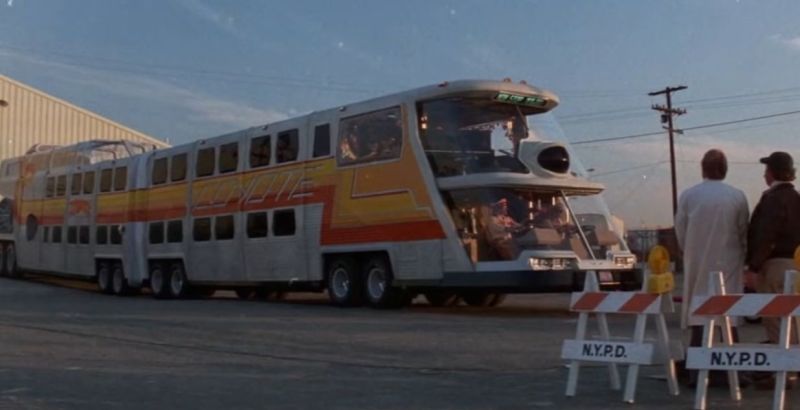
Regardless of what your opinion is on cult-classic movies that got mixed-to-negative box office reviews when they were released, you have to admire the ones that went all out on practical effects and full-size constructions rather than CGI and scale models. Case in point the 1976 satirical comedy film The Big Bus that featured an absolutely massive articulated double-decker bus. With 32 wheels and multiple levels you’d think that a scale model would be used since most interior shots were done in the studio, but instead they built a real bus.
In this video by [Timeworn lengends] the genesis and details of the vehicle are covered. At the core of this road-worthy bus are two cabover International trucks, which were temporarily attached with a quick-release mechanism and required a second driver for the rear section who followed radio instructions for steering. In 1976 dollars, the entire bus prop cost between $250,000 and $500,000 USD to construct — making it one of the most expensive props ever made, especially considering the relatively low budget.
A fiberglass shell gave the bus its characteristic design, with the over the top ‘nuclear reactor’ propulsion befitting the comedy satire. Although the bowling alley and swimming pool were not really inside the bus, there was a functional bar installed along with the functional cockpit at the front.
Despite the movie flopping at the box office and critics being very mixed on its merits, it’s hard to deny that this bus prop is very unique and probably has a big part in why the movie has become a cult classic. As for the closest real-life equivalent, there is the articulated, double-decker Neoplan Jumbocruiser, which had its own troubled history.












I’ve never even heard of this movie. That bus looks pretty awesome. And, thanks for using contemporaneous dollars for the cost!
The movie is real, but this video is unfortunately from an AI generated youtube click farm, so the info and the details may be whatever.
Thanks for the info! I’ll keep that in mind. I’m glad I learned this movie exists, though!
Omg the constant, out of……….place pauses were so friggin……..painful! If a real human had just read that script, minus the mispronounced words, it would have been a perfectly acceptable video.
Nope, the bus is real.
The bus is real, but whatever is said about the bus or the production in the video is LLM hallucinations that may or may not have anything to do with reality.
That’s the problem with these click farms. They churn out junk with minimum effort: these are not people who are interested in the subjects they’re presenting or fact checking anything. It’s bots scripting, narrating, and directing the entire video using generative AI and LLMs, and film clips almost surely stolen from other youtube videos of the same subject because these guys never do original research.
For example, the clips in the film were quite likely stolen from this channel:
https://www.youtube.com/watch?v=XLWp11GP94k
One of the hallucinatory claims in the video:
The back and front portions of the bus are steered separately and are driven to the filming location as two separate vehicles. When connected together, the rear driver becomes blind and has to steer by instructions over the radio. This wasn’t radio control – it was people telling the driver how much and when to turn, which probably took some practice and trial and error to make it smooth on camera.
However, later in the video it’s claimed that they drove the whole bus across the country on public streets for a promotion: that’s unlikely to happen if the rear driver can’t see. They would have had to keep them on the radio the entire time, giving detailed instructions just to keep it on the road, without outside observers.
Something doesn’t add up here.
Oh it was a hoot. That and supertrain was a product of their time.
total cheese mill…. it really kicked the bucket…
I watched the movie as a teenager in the 1970’s at our local cinema. The movie was barmy and forgettable but the bus was not, it was the star throughout.
Loved seeing this in 1976 or 1977 in India
I remember the movie. It was like airplane but based on a bus. I remember them pumping hundreds of gallons of sodas into a rear compartment to balance the bus because it was hanging off a cliff. Interestingly enough I didn’t know the bus was real I would love to see it
My mothers first movie (she is not in the credits) Set designers didn’t have that in their union contract. A man who sanded the fiberglass on the bus, became a director of Lavern and Shirley. His mother lived in one of the most amazing apartments in Los Angeles.
Yeah they went hard in the 70s. The iconic 12-wheeled Landmaster vehicle from the 1977 film Damnation Alley cost around $300,000 to $350,000 to build in 1976, a significant sum for the time, with some sources placing it closer to $500,000. $1.7-2.9m in today bucks.
Damnation alley cost $8 million to make and only brought in $4m in overall revenue. $1,250,956 of that came in its first 9 days from 64 theaters.
The Big Bus was originally budgeted around $2 million but ultimately costing approximately $6 million to produce, It earned a total domestic gross revenue of $3,540,307.
So going big really didnt pay off in either case.
As much as I like the LandMaster, the producers of Damnation Alley could have spent a few of those dollars making the “killer cockroaches” a bit more realistic.
The original budget for the 1977 sci-fi film Damnation Alley was around $17 million, The studio pulled most of their funding for an unmemorable space opera few people have heard of or remember, Star Wars.
If I remember, the issues were they couldn’t kill those giant roaches and it is difficult to control a few thousands and have them move the right way in the empty mall so they used garbage bag to fake a mass of roaches moving around.
I wouldn’t have noticed this when they aired on TV in the 80s. But with BD version, it is clearly obvious it’s garbage bag and not roaches.
THE STUFF OF MY CHILDHOOD NIGHTMARES.
Ahh, the good old days. 😂
But they still used fabric of some sort on the body… i remember seeing it flap in several scenes.
Disappointment of a movie for a big Zelazny fan.
Between $250,,, and 500,000… that’s a lot. Consumer cars from that era were under $10,000 new. A basic car would be bought new for about $5,000
I need to find this film, I like comedy and never heard of this. Plus my pre-K self would have been excited over that huge bus!!
I remember watching it on TV many, many years ago. It’s a spoof of the Arthur Hailey-type disaster movies that were so common in the early 70s. Airplane did it much, much better, of course, but this one wasn’t bad. As I recall the “plot” was that the Bus went hurtling out of control due to a technical failure and the rest of the movie was the attempts to slow it down and bring it to a safe stop.
The only line I remember from the whole thing was when, traveling at ludicrous speeds because of the nuclear propulsion, they break the “wind barrier” at some speed or other, and the NASA-like control room proudly announces “we’ve broken wind at 100 miles per hour!”.
It’s that sort of movie.
I think it was called “the Bus that Couldn’t Slow Down”
“Raise The Flags of All Nations” is not only ceremonial.
It’s also the critical final item on the Break Failure Emergency Checklist.
“The aerodynamics work! He’s breaking wind at 90!”
I remember watching this film a Saturday evening when I was a kid. It was quite fun. But I always presumed that a lot of the sequences were miniatures (specifically the one at the end, where the two halves of the bus disconnect and go each one on their own).
In 1976, CGI wasn’t realistically capable of doing that bus. It would probably cost more and take longer than than it did to build the bus.
In 1977, Star Wars used wire frame animations. It certainly had a much bigger budget than “The Big Bus”.
True.
It’s generally acknowledged that the first movie to use CGI as part of the actual movie (instead of as “onscreen” computer graphics IN the movie) was 1984’s “The Last Starfighter”
I don’t know exactly what you mean by “part of the actual movie”, but Wikipedia claims that Logan’s Run (1976) used computer graphics in the same sense. The force field in the carousel scene was made with CGI.
https://www.youtube.com/watch?v=WUFUegBO13Y
The reason why some people don’t qualify it as CGI was that the Scanimate system was an analog computer, not a digital one. The Scanimate system takes a video signal and distorts it with oscillators and filters and feedback, then displays it back to be recorded on film, which can then be superimposed on the movie. It’s closer in principle to practical in-camera effects done with optics than modern computer graphics, but it is technically Computer Generated Imagery.
Also, Tron came out in 1982.
And Japan defeated ruZZian warshits in Battle of Tshushima… so what?
Torn had whole CGI scenes.
The first feature film to use CGI was 1973’s Westworld, featuring 2D computer-generated imagery to show the robot’s vision,
Yeah, but the question was, was it on the screen to show a computer display or part of the world as an effect, prop, or an actor? At least that’s how I understood it.
it was onscreen to show a scene from the perspective of the robot.
Which was technically just showing a computer monitor, not embedding CGI in the scenery.
I have a memory of the “breaking wind” line, but I never knew where it was from. Always thought of it as a Mel Brooks line. There’s some impressive star power in the cast. Clearly somebody thought this was going to make some numbers.
“There’s some impressive star power in the cast. Clearly somebody thought this was going to make some numbers.”
Hollywood sometimes structures films to appear to lose money on paper due to complex “Hollywood accounting,” where inflated overhead, distribution fees, and separate corporate entities hide profits to avoid paying talent their share (net profits) and potentially shelter income, while also minimizing perceived risk for major studios. Studios use these practices to keep massive blockbusters technically unprofitable on paper, even when they gross hundreds of millions, while also sometimes producing small films to satisfy star contracts for bigger movies, knowing they’ll underperform
What you’re describing are weasels, just like the record industry.
That’s gross slander. Weasels are lovely animals.
Weaseling out of things is what separates us from the animals. Well, except for the weasel.
A channel named “Timeworn lengends” (sic) that pushes out a video a week and started 2 months ago is unfortunately an AI generated click farm.
Although the topic is interesting, I wouldn’t trust any of the details or visuals.
Like the nonsense being pushed out as “documentaries” by the MSM is any better, with historical revisionist narratives and DEI placement of people(s) who simply would not have been there.
It’s moronic to think that telling a fake story is somehow making things better.
But they do it anyway…
The videos these click farms produce are not even that. The contents of these channels are a simulacrum – something that looks like real content, so it isn’t instantly picked up as bot spam. Most of the commenters are bots too, to make it seem like there’s real traffic to the channel to boost its rating and make it appear in people’s feeds.
They are doing this to everything. You can find for example, made up lectures by Richard Feynman or Alan Watts talking banalities in their own voices. Stuff that they never said, wrote, or would have agreed to, that sounds just plausible enough that you have to listen to a quarter of the video to notice that it’s slop.
They don’t appear to be trying to convince you of anything, or push any point of view. It’s not even nonsense, just vacuous babble. It’s non-content.
The Swedish left-wing public service created a series, I think titled something like “the history of Sweden” a year or two ago. It documented early settlements in Sweden and so on, except the cast looked nothing like the native Samis, nor anything you might recognise as a Nordic or even European person shall we say.
Let’s just say there was a lot of ‘confusion’ (to put it nicely) when it was broadcast.
Imagine if a series “the history of Australia” was created where the cast were all ‘European’ and you get the idea.
The Big Bus…
https://archive.org/details/the-big-bus-1976
for those interested in seeing it.
God bless archive dot org
Deploy the flags of all nations… still with me after all these decades.
Why do they call you “shoulders”?
I saw this movie on broadcast television in the late ’70s. I enjoyed it more than the Star Wars Holiday Special, which I realize is a pretty low bar.
Now, if you had the foresight to record that star wars special, you’d be to only one with a copy to share with the world some 50 years later.
What?
https://youtu.be/UL-hL6_XR30?si=MHcPvtAW23j1Hyu9
It’s awful.
The worst Star Wars content until ‘Phantom Menace’.
IMHO the 4th best SW content.
i recently watched damnation alley after watching a video about the landmaster (i clicked on it thinking it was an actual vehicle, and i wasn’t wrong). ’70s movie vehicles dont screw around.
The Ark II (1976) kind of like the Landmaster from the 70’s wedge era.
Not really like the landmaster. The Ark was a 1971 Ford C-Series cabover truck with a fiberglass body. A strange looking RV really.
The Landmaster was a custom articulated chassis with a unique all teraine tristar wheel arrangement which allowed it to traverse significant obstructions and trenches. Rather than fiberglass the Landmaster was crafted out of 1cm steel plating. Despite an overall weight of at least 10 tons, as much as 18 tons by some accounts, It was also amphibious.
Well strange RVs were popular back in the day, like with Shazam.
Done get me wrong. It was cool.
It just wasnt the engineering masterpiece the Landmaster was. Ones a movie prop, the other is bordering on military prototype.
Yet they never showed the tri wheels doing anything but riding on the bottom ones.
https://youtu.be/26n3RsXNyKE?si=rIAySPeHyKHqWv7x&t=68
https://youtu.be/26n3RsXNyKE?si=cYJAy5WPp7_KD7pq&t=392
youtube titles starting with a number: nope..
that is item one on the list of things to avoid.
nothing wrong with the subject though.
“You wouldn’t believe….”
“This 65 year old carpenter…”
“N number of reasons…”
“Incredible workers….”
They’re all click farms. They’re bots re-uploading the same videos over and over, sometimes remixed and mirrored to avoid detection for longer, so other bots can generate the clicks. The contents are whatever slop or junk they happen to have at hand, often stolen from other channels and recently they’ve started running it through generative AI to stop 1:1 content match detection.
Like this video, where they’ve just repeated the same few clips in variation over and over, with generated interstitial clips that have nothing to do with the original film, with an AI narrator voice on top repeating AI generated text that they most likely didn’t bother to fact-check or verify at all.
It’s sad that HaD falls for this sort of stuff.
Ninety, no wind resistance. We did it! We’re breaking wind at 90.
I saw this movie I seem to recall it was similar to airplane, crazy pilot with PTSD, I thought it was funny.
Never saw this movie, though I distinctly remember seeing a trailer for it. I would have been in middle school when this came out, and I remember thinking the bus looked cool. What a blast from the past
Awesome prop!
Horrible video.
I’ve been reading this almost daily for ~20 years. I’ve had projects posted and been the the supercon, and they have been truly wonderful experiences.
Please, please, please, do not let this become another garbage ai slop aggregate. Please. We need at least a few bastions of culture to survive :'(
HaD seems to be indecisive about whether to censor the first comment that points out the video is coming from an AI click farm. Somebody doesn’t want it appearing at the top of the comments right under the video, so it keeps appearing and disappearing.
Could also just be MySQL doing it’s thing.
Wait, I remember an old Movie, where a Bus had some scrubbers like in a Car-Wash coming out on its side, to clean it’s outside, is that the Bus?
Can we please not shill AI-scripted and AI-voiced videos going forward? The quality of the video and others like it from this channel were abysmal and the manner in which the content was presented is frankly insulting to viewers.
” the entire bus prop cost between $250,000 and $500,000 USD to construct”
Still crunching the numbers, the final figure will be announced in due time.
Don’t worry, it’s all accounted for.