
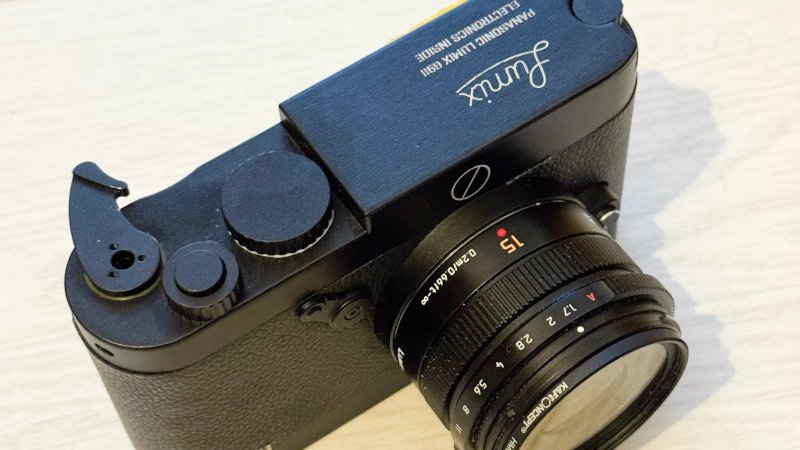
There’s an old adage in photography that the best camera in the world is the one in your hand when the shot presents itself, but there’s no doubt that a better camera makes a difference to the quality of the final image. Among decent quality cameras the Leica rangefinder models have near cult-like status, but the problem is for would-be Leica owners that they carry eye-watering prices. [Cristian Băluță] approached this problem in s special way, by crafting a Leica-style body for a Panasonic Lumix camera. Given the technology relationship between the Japanese and German companies, we can see the appeal.
While the aesthetics of a Leica are an important consideration, the ergonomics such as the position of the lens on the body dictated the design choices. He was fortunate that the internal design of the Lumix gave plenty of scope for re-arrangement of parts, given that cameras are often extremely packed internally. Some rather bold surgery to the Lumix mainboard and a set of redesigned flex PCBs result in all the parts fitting in the CNC machined case, and the resulting camera certainly looks the part.
The write-up is in part a journey through discovering the process of getting parts manufactured, but it contains a lot of impressive work. Does the performance of the final result match up to its looks? We’ll leave you to be the judge of that. Meanwhile, take a look at another Leica clone.












Easier just by a lx100
But that doesn’t scratch the itch of “I wanted a camera that doesn’t exist”.
I have a lx100 II and absolutely love it
Fell in love with lumix with the gx-85. The quality would always impress people with pro cameras
The article leaves out, most important aspect of any camera, the resolution.
This is simply not true. Sensor size and optics are far more important for perceived image quality than resolution. There are high-end digital cameras from over a decade ago that still take better photos than any smartphone on the market even though they have half or in some cases a quarter the resolution.
Correct sensor size and optics are more important in a camera than resolution.
i believe it’s a rehoused g9ii for those who are interested
All three together are wanted.
Resolution is rarely (never) the limiting factor.
High megapixel phones are great at resolving the blur, but edge case crappy glass.
Sensor size and resolution, more or less, together imply sensor speed.
Bigger elements (better/faster/more sensitive), given same underlying technology.
Tradeoffs:
Sensor size is limited by optics.
Trade resolution for speed.
Like you trade depth of field for light (speed).
Image is everything 🕶️
Where’s the beef 🕶️
So this is a one-off, custom special body to take Leica lenses, that will never been in production or available to the public?
Not exactly. While the body of the camera has changed, it was and still is a micro four thirds camera and those are micro four thirds lenses that will fit any other micro four thirds cameras.
I find I achieve much the same with a Panasonic GX9 and either Panasonic-Leica lenses or an L39 or M mount adapter.
So much effort, that in my view (it’s a view) could have been used for so many better projects.
Still, a lot was learned I bet.