

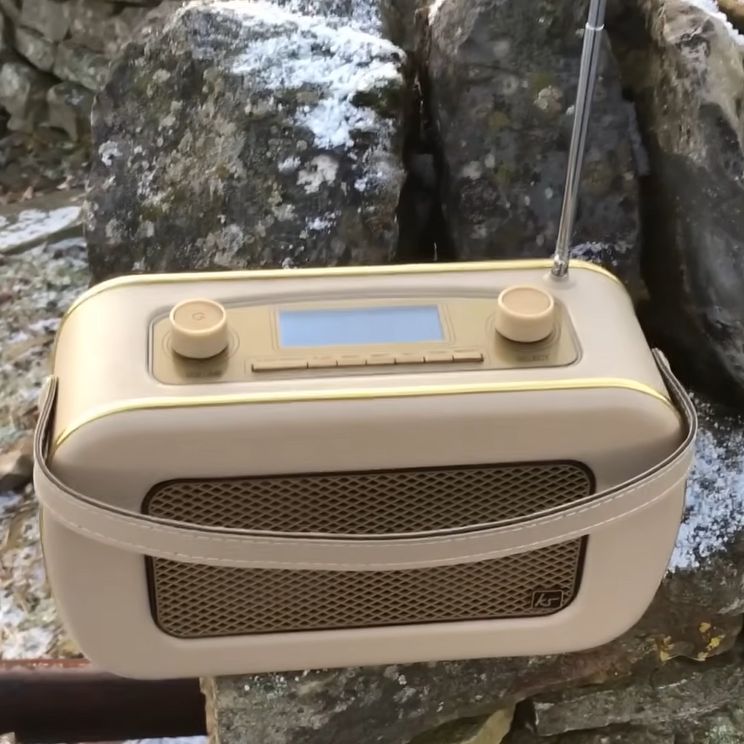
The exciting part about repairing consumer electronics is that you are never quite sure what you are going to find. In a recent video by [Mick] of Buy it Fix it on YouTube the subject is a KS Jive radio that throws a few curve balls along the way. After initially seeing the unit not power on with either batteries or external power, opening it up revealed a few loose wires that gave the false hope that it would be an easy fix.
As is typical, the cause of the unit failing appears to have been a power surge that burned out a trace and obliterated the 3.3V LDO and ST TDA7266P amplifier. While the trace was easily fixed, and AMS1117 LDOs are cheap and plentiful, the amplifier chip turned out to be the real challenge on account of being an EOL chip.
The typical response here is to waddle over to purveyors of scrap hardware, like AliExpress sellers. Here [Mick] bought a ‘new’ TDA7266P, but upon receiving his order, he got suspicious after comparing it with the busted original. As can be seen in the top image, the markings, logo and even typeface are wildly different. Thus [Mick] did what any reasonable person does and x-rayed both chips to compare their internals.
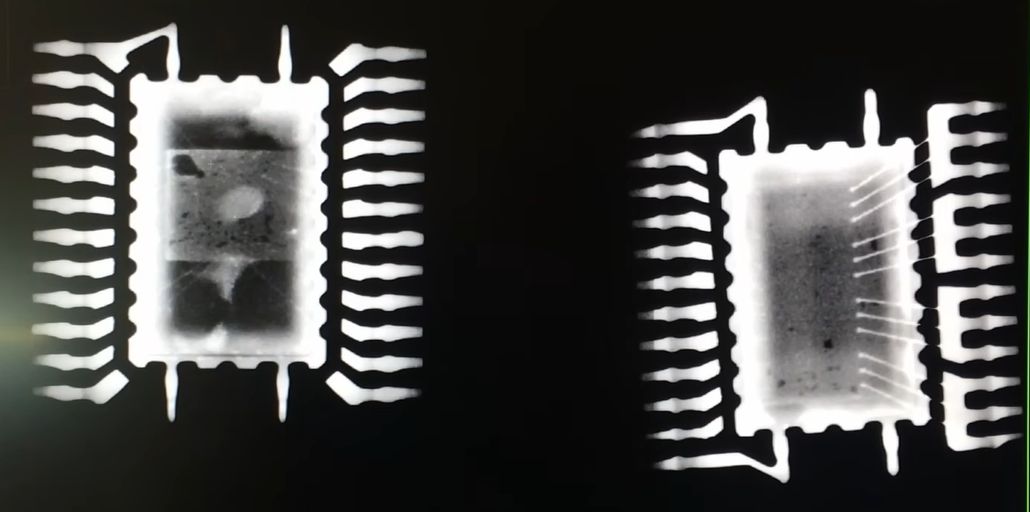
On the left you can see the dead original amplifier, with what looks like a big mark on the die where the power event destroyed part of it. What’s also apparent from this and the other x-ray shots is that neither the die size, bond wires, nor the physical package’s pins match up. The unusual connections of the fake IC led [Mick] to conclude that it was likely an ST VNQ5E050AK-E quad-channel high-side driver, or at least something very similar to it.
After taking a CNC milling machine to the real and fake chips for additional comparison and a crude decapping, he was still left in a bind, as finding a replacement IC turned out to be basically impossible. Almost, that is, as Mouser turned out to still have the TDA7266P13TR, tape-reel version in stock, with a few left.
This is apparently the same IC, but the cut-reel variety. Interestingly, when tossing this replacement in the x-ray machine, it showed to have a bigger die than the dead ST amplifier IC, which could be due to having been produced with a different process node or so. Regardless, with the original part the radio sprung right back to life, but it shows once again how many chips are being remarked by AliExpress sellers to be something that they are definitely not. Caveat emptor, once more.












“Buy cheap, buy twice” — my Mum!
Certainly used to be true.
Unfortunately these days it’s also often “buy expensive, buy twice” as the expensive options are just the cheap rubbish with a higher markup :(
Indeed, and for added annoyance those buy cheap can often be really darn good as well which just adds to the challenge as you can never know what you are getting. Even Brand names are not a good marker of quality as they once were as so many of these old names are now trading the crappiest junk they can at huge markup till folks realise… Though I think the worst part is these days almost everything is hidden in blobs of plastic so you can’t tell without fancy tools or destructive testing what is actually supplied at all.
For instance I just picked up a small collection of very cheap ratcheting socket/screwdriver handles expecting them to be pretty poor. But being good for those awkward small spaces I can never get my giant mit and the regular tool in still worth the gamble at that price.
Turns out at least on initial inspection they are really really great, very very smooth ratchet that seems to hold well with the only thing I can nitpick on being the finishing quality of the machine work as a rule isn’t as good as I’d have done if I made the tool for myself. But given I couldn’t even buy the raw stock to make just one of the larger parts for the price I bought the whole darn lot…
100%. that’s why i shop at temu for a certain class of goods now, because there’s no illusion. just accept my fate and lean into it.
I second that. Some things we bought off temu were essentially the same things on Amazon except cheaper.
It depends.. Sure, a high price tag alone doesn’t guarantee anything anymore.
Why selling low quality stuff for low price, after all,
if you can scam people and sell low quality stuff for a high price just as well?
Isn’t that at heart the whole concept of good ol’ western way of making business, to exploit for profits? ;)
But I think that specialist shops tend to still offer quality things rather than super markets and $1 shops (1€ shops) tend to.
If you’re visting a real hi-fi shop, bicycle shop or lighting shop chances are higher the expensive products hold up to their claims.
Simply because these specialist shops know their special fields better than a general purpose shop, like a super market/discounter.
Admittedly, I didn’t sit through the video, but I see no mention above as to whether the “fake” chip was tested for functionality. I know that chips are produced in multiple location and that being visually different, is not always an indicator that some thing won’t work as intended. I’ve purchase a great deal of what might have been fake chips and found they all worked well (except the unintentional FT232 fakes due to driver issues). They noticed that the real replacement looked different also, and I wonder if something was changed internally to keep it from blowing up?
The pins were probed with the multimeter to see whether they made sense compared to the datasheet. Having many pins directly shorted was very suspicious, as were supposedly ‘NC’ pins that were definitely connected and shorted to others.
That’s when he tossed it in the x-ray machine and found out that the way the pins are wired up (as can be seen in the x-ray) confirms that it’s absolutely not the amplifier chip that he thought he had purchased.
So he didn’t even try the AliExpress version?
Probably would have worked, not all it’s have the same font or style during it’s lifetime, as the article noted the mouser part had also another die.
He probed the pins of the IC, found many of them to be shorted with each other in a way that made no sense, which the x-ray confirmed to be due to a pin and bond wire layout that means that it is absolutely not the advertised amplifier IC.
So no, it would not have worked, and may have damaged the circuit as the worst case scenario.
When you are shopping for an EOL chip, and another company decides there is a market for it, they can redesign the chip completely, including mounting, chip layout. Change the process node. Beef up the power connections. So most xray machines wont tell the story of functional mapping. Maybe an ohmmmeter can tell more, but hard to compare with a burnt chip.
There should be legal action taken by chip makers against fake and counterfeit chips using the manufacturers logo which is IP. You know Nintendo would be suing for something like this!
Or that one time I bought a 4-pack of Pittsburgh or whatever adjustable wrenches at Harbor Freight because one of them was a Craftsman…
You can even get bad/fake chips directly from a major chip manufacturer. I bought 500 network PHY chips directly from a well known manufacturer (whom I will not name), and only about 10% of them actually work properly. The rest either fail after a few hours, or don’t work at all. Since I work in a mission critical industry where stuff just HAS to work, I can’t use any of these chips as I can’t trust them.
I contacted the manufacturer and explained my plight. I was told that I was not using the chip properly and I would not be getting any redress. The application engineer was looking for a schematic sample of the use of the chip, which I was not allowed to provide because the engineer would not sign an NDA. In the end, I re-designed the circuit and used a new PHY from another manufacturer. It wasn’t horribly expensive to do that, just a nuisance. I was surprised that a well known manufacturer would have a problem like this, but I guess it happens everywhere. I managed to find the original PHY from Mouser and bought them to finish the stock I had on hand. The new boards have the new PHY, and I haven’t had one problem with any of them, at all.
But rest assured, I don’t buy anything from that particular manufacturer any more.