Trying To Fix A Suspiciously Cheap Enterprise-Grade Network Switch

When you see a listing for an Ethernet switch whose specification list is in effect ‘yes’, with a four-digit price tag when new, and with the seller asking for less than 10% of said $3,000 asking price in an ‘untested’ condition, the only rational thing to do is of course to mash that ‘buy’ button. This is what [This Does Not Compute] did, and created a video about to show what a great investment decision this was.

Naturally this Juniper EX4100-F-12P switch came without power supply brick for its 48VDC input. Figuring out its pin-out and probing said input showed that the voltage rails had been shorted, giving a first clue as to why this switch had been on sale for so very cheap. Bravely hoping that it would be a straightforward fix, the unit was disassembled.

With a 280 Watt power brick, it’s little wonder that the top of the unit is a one massive aluminium heatsink, including a large heatpipe. Also visible on the lid near the power input was a very-bad-news black skid mark.

From that first discovery the news just got worse and worse, with clear signs of water ingression, rust and corrosion, along with the aftermath of a powered circuit meeting such bad corrosion. After some clean-up it’s clear that some components had violently exploded, ripping apart layers of the PCB and likely parts of traces in those inner sections too.

With no schematics available and no other good repair options via Juniper or anywhere else, it seems that unfortunately this gamble turned out to be merely a pile of e-waste and a few bucks worth of scrap metal. Caveat emptor, once more.

Continue reading “Trying To Fix A Suspiciously Cheap Enterprise-Grade Network Switch” →

Comparing A Clone Raspberry Pi Pico 2 With An Original One

Although [Thomas] really likes the Raspberry Pi Pico 2 and the RP2350 MCU, he absolutely, totally, really doesn’t like the micro-USB connector on it. Hence he jumped on the opportunity to source a Pico 2 clone board with the same MCU but with a USB-C connector from AliExpress. After receiving the new board, he set about comparing the two to see whether the clone board was worth it after all. In the accompanying video you can get even more details on why you should avoid this particular clone board.

In the video the respective components of both boards are analyzed and compared to see how they stack up. The worst issues with the clone Pico 2 board are an improper USB trace impedance at 130 Ω with also a cut ground plane below it that won’t do signal integrity any favors.

There is also an issue with the buck converter routing for the RP2350 with an unconnected pin (VREG_FB) despite the recommended layout in the RP2350 datasheet. Power supply issues continue with the used LN3440 DC-DC converter which can source 800 mA instead of the 1A of the Pico 2 version and performed rather poorly during load tests, with one board dying at 800 mA load.

Continue reading “Comparing A Clone Raspberry Pi Pico 2 With An Original One” →

Looking At A Real Fake Raspberry Pi RP2040 Board

Since the RP2040 microcontroller is available as a stand-alone component, it’s easy enough for third parties to churn out their own variations — or outright clones of — the Raspberry Pi Pico. Thus we end up with for example AliExpress sellers offering their own versions that can be significantly cheaper than the genuine article. The ones that [electronupdate] obtained for a test and decapping session cost just $2.25 a pop.

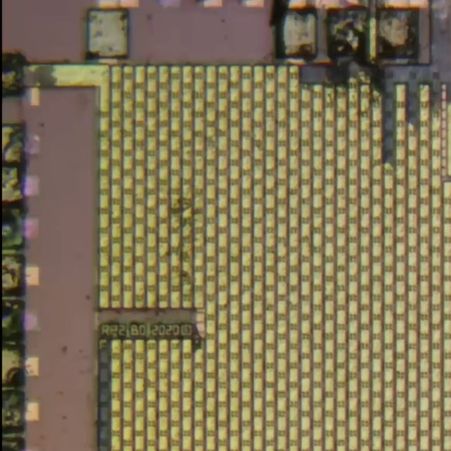
RP2 B0 stepping imprinted on the die shot.

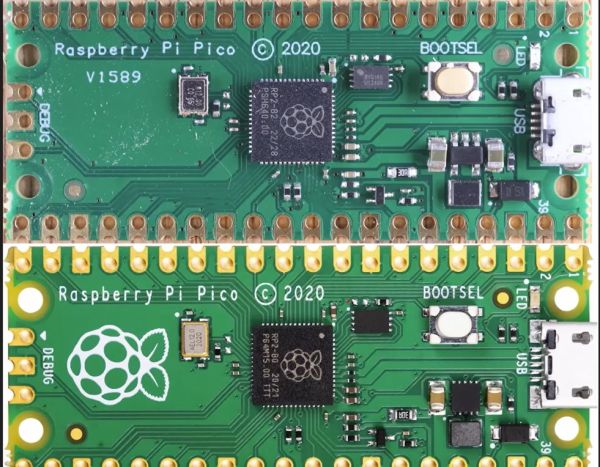
As can be seen in the top image, the board from AliExpress misses the Raspberry Pi logo on the silkscreen for obvious reasons, but otherwise appears to feature an identical component layout. The QSPI Flash IC is marked on the die as BY250156FS, identifying it as a Boya part.

Niggles about flash ROM quality aside, what’s perhaps most interesting about this teardown is what eagle-eyed commentators spotted on the die shot of the RP2040. Although on the MCU the laser markings identify the RP2040 as a B2 stepping, the die clearly identifies it as an ‘RP2 B0’ part, meaning B0 stepping. This can be problematic when you try to use the USB functionality due to hardware USB bugs in the B0 and B1 steppings.

As they say, caveat emptor.

Continue reading “Looking At A Real Fake Raspberry Pi RP2040 Board” →

Fixing A KS Jive DAB Radio With A Dash Of Fake ICs

The radio unit after a successful repair. (Credit: Buy it Fix it, YouTube)

The exciting part about repairing consumer electronics is that you are never quite sure what you are going to find. In a recent video by [Mick] of Buy it Fix it on YouTube the subject is a KS Jive radio that throws a few curve balls along the way. After initially seeing the unit not power on with either batteries or external power, opening it up revealed a few loose wires that gave the false hope that it would be an easy fix.

As is typical, the cause of the unit failing appears to have been a power surge that burned out a trace and obliterated the 3.3V LDO and ST TDA7266P amplifier. While the trace was easily fixed, and AMS1117 LDOs are cheap and plentiful, the amplifier chip turned out to be the real challenge on account of being an EOL chip.

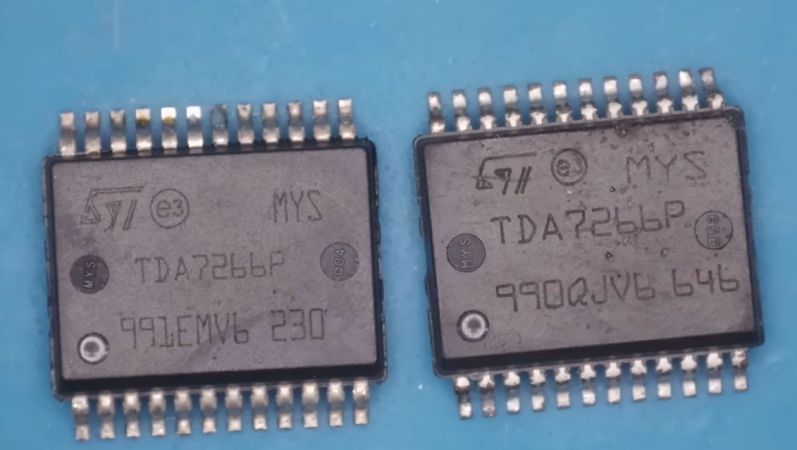
The typical response here is to waddle over to purveyors of scrap hardware, like AliExpress sellers. Here [Mick] bought a ‘new’ TDA7266P, but upon receiving his order, he got suspicious after comparing it with the busted original. As can be seen in the top image, the markings, logo and even typeface are wildly different. Thus [Mick] did what any reasonable person does and x-rayed both chips to compare their internals.

Continue reading “Fixing A KS Jive DAB Radio With A Dash Of Fake ICs” →

Be Wary Of Flash-less ESP32-C3 Super Mini Boards

Everyone loves tiny microcontroller boards, and the ESP32-C3 Super Mini boards are no exception. Unfortunately if you just casually stroll over to your nearest online purveyor of such goods to purchase a bunch of them, you’re likely to be disappointed. The reason for this is, as explained in a video by [Hacker University] that these boards are equipped with any of the variants of the ESP32-C3. The worst offender here is probably the version with the ESP32-C3 without further markings, as this one has no built-in Flash for program storage.

Beyond that basic MCU version we can see the other versions clearly listed in the Espressif ESP32-C3 datasheet. Of these, the FN4 is already listed as EOL, the FH4AZ as NRND, leaving only the FH4 and FH4X with the latter as ‘recommended’ as the newest chip revision. Here the F stands for  built-in Flash with the next character for its temperature rating, e.g. H for ‘High’. Next is the amount of Flash in MB, so always 4 MB for all but the Flash-less variant.

Identifying this information from some online listing is anything but easy unless the seller is especially forthcoming. The chip markings show this information on the third row, as can be seen in the top image, but relying solely on a listing’s photos is rather sketchy. If you do end up with a Flash-less variant, you can still wire up an external Flash chip yourself, but obviously this is probably not the intended use case.

As always, caveat emptor.

Continue reading “Be Wary Of Flash-less ESP32-C3 Super Mini Boards” →

Flash Memory: Caveat Emptor

We all love new tech. Some of us love getting the bleeding edge, barely-on-the-market devices and some enjoy getting tech thirty years after the fact to revel in nostalgia. The similarity is that we assume we know what we’re buying and only the latter category expects used parts. But, what if the prior category is getting used parts in a new case? The University of Alabama in Huntsville has a tool for protecting us from unscrupulous manufacturers installing old flash memory.

Flash memory usually lasts longer than the devices where it is installed, so there is a market for used chips which are still “good enough” to pass for new. Of course, this is highly unethical. You would not expect to find a used transmission in your brand new car so why should your brand new tablet contain someone’s discarded memory?

The principles of flash memory are well explained by comparing them to an ordinary transistor, of which we are happy to educate you. Wear-and-tear on flash memory starts right away and the erase time gets longer and longer. By measuring how long it takes to erase, it is possible to accurately determine the age of chip in question.

Pushing the limits of flash memory’s life-span can tell a lot about how to avoid operation disruption or you can build a flash drive from parts you know are used.